
Economics
Rev. Williams Wants to Build a Movement for Reparations

By Polly Seaberry
Rev. Henry C. Williams is pointing the way to reparations as a partial economic solution for African Americans. He wants to reach churchgoers, students, families and media outlets to generate interest in a people’s movement and campaign to persuade Congress and the White House to redeem the promises it made to the freed slaves and their descendants.

“Now is the time for African Americans to receive money, gold and land to rebuild our communities and broken families,” said Williams.
In his presentations to churches, he teaches about the pledge contained in the Emancipation Proclamation, which promised 40 acres and a mule for every slave, and the Freedmen’s Bank, which Congress formed to receive their deposits and to make loans.
Williams often begins with the biblical text from Jeremiah 5:1 “Run ye to and fro through the streets of Jerusalem, and seek in the broad places thereof, if ye can find a man, if there be any that executeth judgment, that seeketh the truth; and I will pardon it.”
Rev. Williams says he is called a “Trailblazer for Justice” by other ministers because he wants Black people to take a stand for the money, land and gold owed to them by the government.
“We need restitution for the 400 years of slavery, abuse and broken promises,” Williams says.
“When Blacks search their ancestry and the Freedmen’s Bank records, they will find that our people deposited more than $57 million dollars after slavery from 1865 to 1868 and their deposits were then lent by Congress to white individuals who never paid it back,” said Williams.
“And those deposits are worth hundreds of billions of dollars after more than 150 years of accumulated compounded interest.”
Williams wants President Obama to fulfill President Lincoln’s proclamation.
William stated that some Native Americans received 3.9 Billion Dollars for 1 year of Reparation for the U.S. Soldiers killed them, took their land and destroyed a significant portion of their culture.
He also uses the biblical story of Zacchaeus, the wealthy tax collector, who told Jesus that he would repay the poor four times if he had cheated them, as a teaching tool to help make the case for the justification of a demand for Reparations.
When he preaches about his own family he talks about his Father Pleasant Williams, his Grandparents. His grandmother worked as a Nanny for The Confederate Army.
“Just as the Japanese Americans received reparations for their forced resettlement during WWII and the Alaskans were paid for the installation of the pipeline, African Americans must also be compensated,” said Williams. To contact Williams call (510) 507-3424 or email bishophenrycwilliams@gmail.com


Activism
Oakland Post: Week of April 1 – 7, 2026
The printed Weekly Edition of the Oakland Post: Week of April 1 – 7, 2026
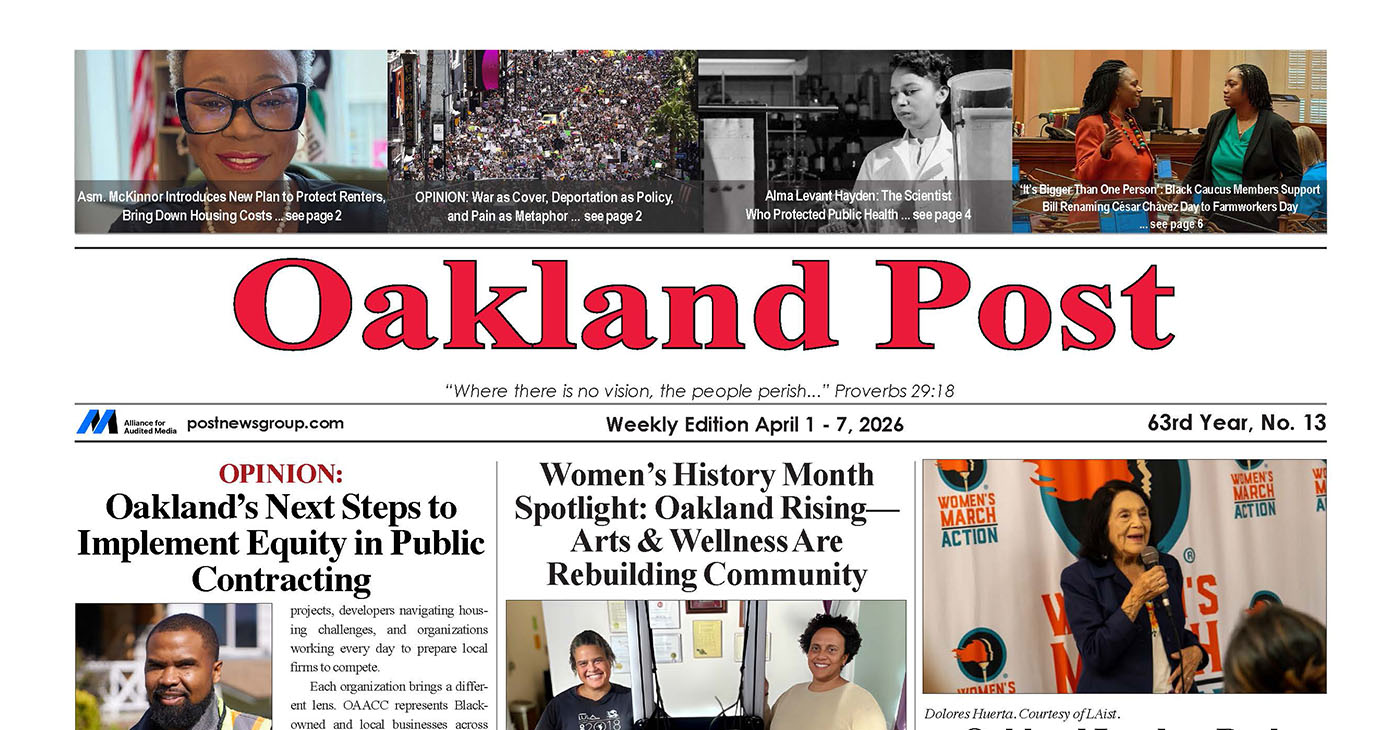
To enlarge your view of this issue, use the slider, magnifying glass icon or full page icon in the lower right corner of the browser window.
Activism
Oakland Post: Week of March 18 – 24, 2026
The printed Weekly Edition of the Oakland Post: Week of March 18 – 24, 2026
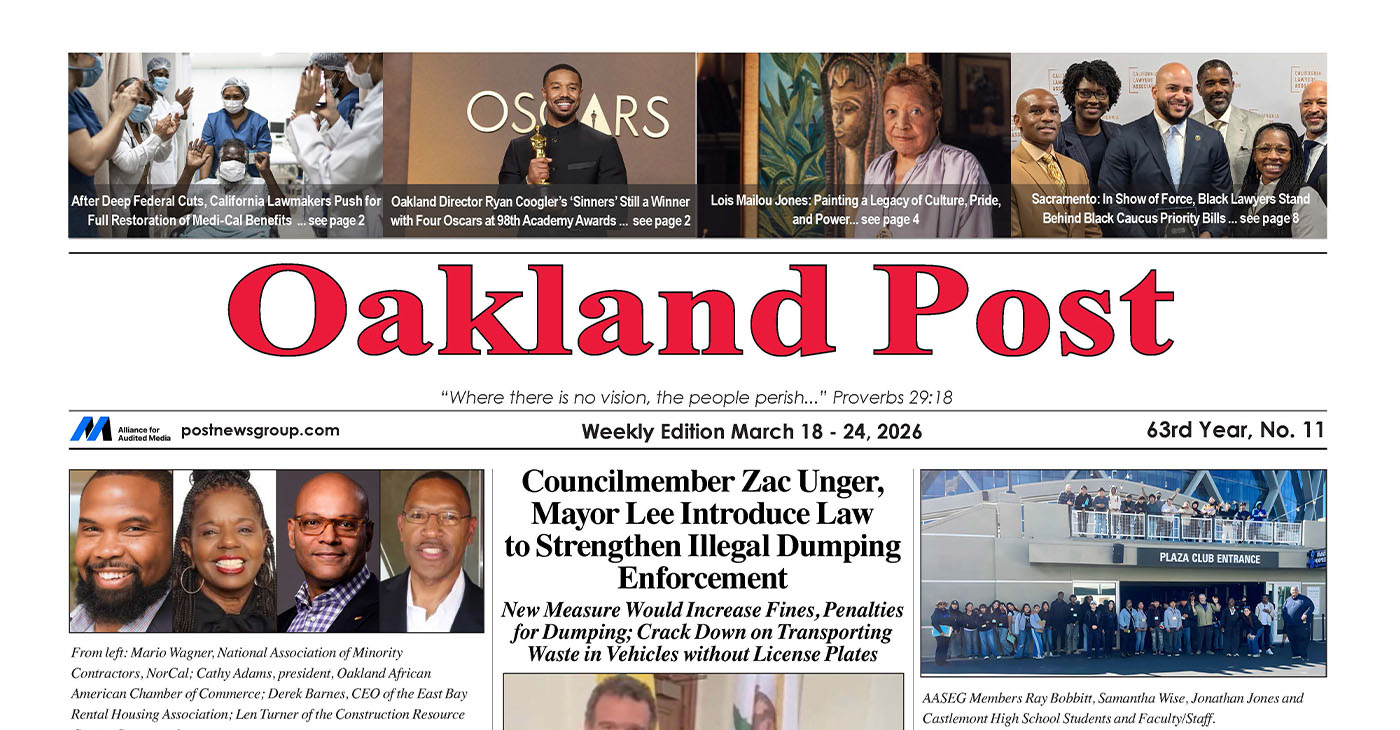
To enlarge your view of this issue, use the slider, magnifying glass icon or full page icon in the lower right corner of the browser window.
Activism
Oakland Post: Week of March 11 -17, 2026
The printed Weekly Edition of the Oakland Post: Week of March 11 – 17, 2026
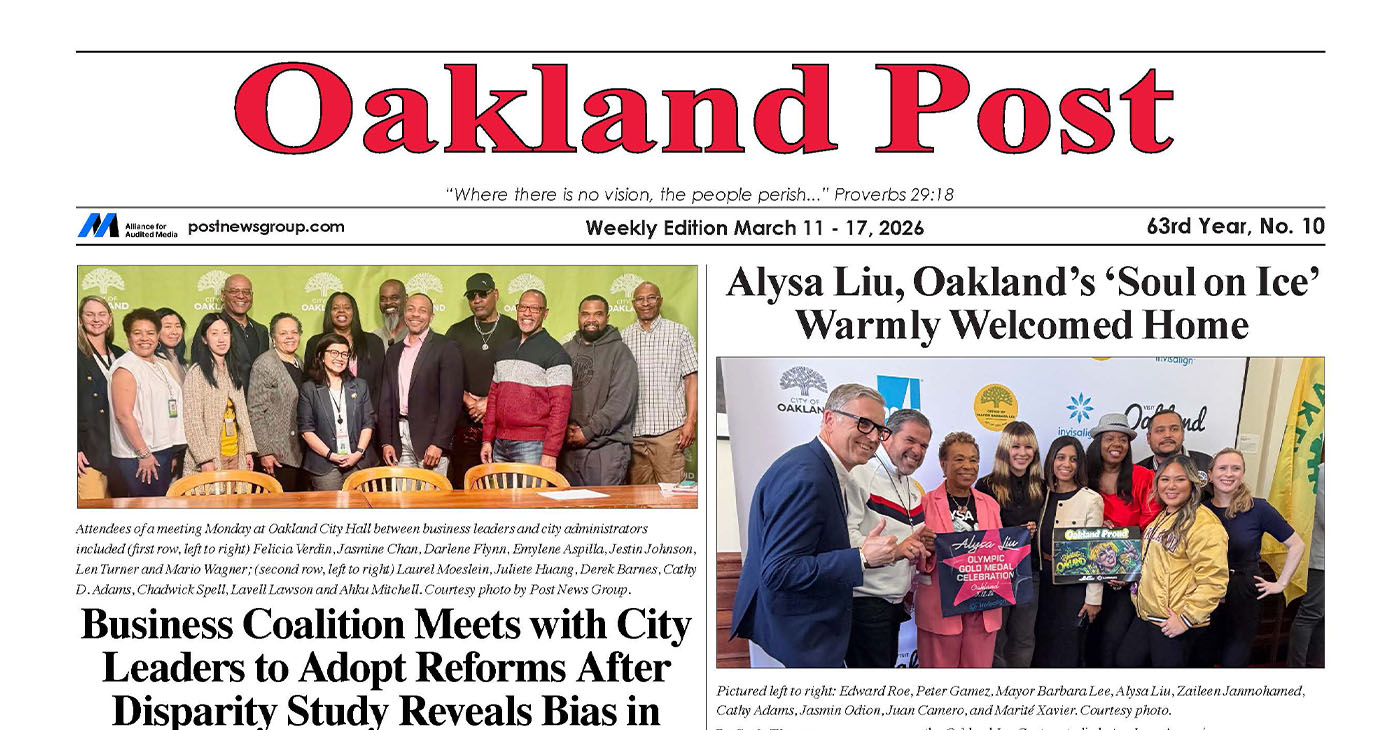
To enlarge your view of this issue, use the slider, magnifying glass icon or full page icon in the lower right corner of the browser window.

WORK FROM HOME
Home-based business with potential monthly income of $10K+ per month. A proven training system and website provided to maximize business effectiveness. Perfect job to earn side and primary income. Contact Lynne for more details: Lynne4npusa@gmail.com 800-334-0540


Oakland Post: Week of April 1 – 7, 2026

Black Artists in America, Installation Three Wraps at the Dixon Gallery and Gardens

Grief, Advocacy, and Education: A Counselor Reflects on Black Maternal Health

Future of Florida’s Black History Museum in Limbo

New Research Shows the Many Benefits of Early Learning

South Hampton K-8 Students Among Top 10 Finalists for Samsung’s ‘Solve for Tomorrow’ Competition

Cuba: No Negotiation with US on the President or Political System

Brooklyn Academy of Music Names Jamaican-Born Tamara McCaw as President

Trinidad & Tobego – U.S. Launches WhatsApp Channel for American Citizens in the Country

Oakland Post: Week of March 18 – 24, 2026

AI Innovation vs. Ethics and Environmental Impact

AI, Web3, and Digital Reparations

What If You Owned Your AI Agent?

Season 7, Episode 3 – January Reporter’s Roundtable 📱

Season 7, Episode 3 – January Reporter’s Roundtable

Reflecting on Black History Milestones in Birmingham AL

Oakland Post: Week of February 25 – March 3, 2026

PRESS ROOM: NBA Hall of Fame Nominee Terry Cummings Joins 100 Black Men of DeKalb County to Launch Victory & Values Initiative

Trump’s MAGA Allies are Creating Executive Order Plan to Steal the 2026 Midterms

Oakland Post: Week of March 4 – 10, 2026

Chase Oakland Community Center Hosts Alley-Oop Accelerator Building Community and Opportunity for Bay Area Entrepreneurs

U.S. manufacturing rebounds – how foundry services are adapting to rising demand

Poll Shows Support for Policies That Help Families Afford Child Care

OP-ED: One Hundred Years of Black Workers Telling the Truth

Advancements in solar technology that are changing the way we power the world

Oakland Post: Week of March 11 -17, 2026

Woman’s Search for Family’s Roots Leads to Ancestor John T. Ward – A Successful Entrepreneur and Conductor on the Underground Railroad

COMMENTARY: Women of Color Shape Our Past and Future

PRESS ROOM: Civil Rights TV Launches in Selma as the World’s First 24/7 Civil Rights Television Network
Oakland Post: Week of March 18 – 24, 2026

Hyundai Ioniq 5 Parking, Safety, and 360 View #shorts

2025 Ioniq 5 New Wiper & Powerful Performance! #shorts

Electric SUV Range: Is 259 Miles Enough? #shorts

EV Charging: How Fast Can You Charge an Electric Vehicle? #shorts

Biometric Cooling… Messaging Seats…Come on! 2025 Infiniti QX80 Autograph 4WD

Charged Up: Witness the Magic of a Fully Electric Car! #shorts

Range Rover Sport PHEV Included…: See What’s Inside This Luxury SUV! #shorts

Invisible Hood View: Perfect Parking with X-Ray Vision! #shorts

AI Is Reshaping Black Healthcare: Promise, Peril, and the Push for Improved Results in California

ESSAY: Technology and Medicine, a Primary Care Point of View

Sanctuary Cities

The RESISTANCE – FREEDOM NOW

STATE OF THE PEOPLE: Freddie

ECONOMIC BOYCOTT DAY!!!!!

I told You So
-
 Activism3 weeks ago
Oakland Post: Week of March 11 -17, 2026
-
 #NNPA BlackPress4 weeks ago
Woman’s Search for Family’s Roots Leads to Ancestor John T. Ward – A Successful Entrepreneur and Conductor on the Underground Railroad
-
 #NNPA BlackPress4 weeks ago
COMMENTARY: Women of Color Shape Our Past and Future
-
 Activism2 weeks ago
Oakland Post: Week of March 18 – 24, 2026
-

 Advice3 weeks ago
Financial Wellness and Mental Health: Managing Money Stress in College
-

 #NNPA BlackPress4 weeks ago
Advocates Raise Alarm Over ICE Operation, MOU and Detention Risks in Baltimore County
-

 #NNPA BlackPress4 weeks ago
Pete Buttigieg to Join Mayor Randall Woodfin for Community Town Hall in Birmingham
-
 #NNPA BlackPress2 weeks ago
Brooklyn Academy of Music Names Jamaican-Born Tamara McCaw as President
