
#NNPA BlackPress
Reparations for Descendants of the Slave Trade Emerges as Democrats’ Campaign Platform
NNPA NEWSWIRE — “In this context, new organizations such as ADOS (American Descendants of Slavery) also emerged and certainly contributed to the visibility of the debate on reparations,” Dr. Araujo said. “Unlike previous movements, ADOS gained more visibility through the presence of its founders on social media that helped disseminating the #ADOS hashtag,” said Dr. Ana Lucia Araujo, who authored the groundbreaking 2017 book, “Reparations for Slavery and the Slave Trade: A Transnational and Comparative History.”

Part 13 of The National Newspaper Publishers Association (NNPA) global news feature series on the history, contemporary realities and implications of the Transatlantic Slave Trade.
(Read the entire series: Part 1, Part 2, Part 3, Part 4, Part 5, Part 6, Part 7, Part 8, Part 9, Part 10, Part 11, Part 12
By Stacy M. Brown, NNPA Newswire Correspondent
@StacyBrownMedia
Reparations have fast become a major platform for Democrats seeking the 2020 presidential nomination.
Former Texas Rep. Beto O’Rourke joined that movement at the recent National Action Network convention when he said he’d support legislation for a slavery reparations commission if he were to win the White House next year.
Senators Kamala Harris (D-Calif.), Elizabeth Warren (D-Mass.), Bernie Sanders (D-Vt.), Cory Booker (D-NJ) and former Housing and Urban Development Secretary Julian Castro have also raised the topic of reparations in this early phase of their presidential campaigns.
“Not only do I support it, but I have legislation that actually does it,” Booker said earlier this month during a Town Hall. “In fact, I’ve got the only legislation, I think, in the entire Congress that Columbia University says would virtually eliminate the racial wealth gap in our country,” Booker said of his so-called “Baby Bonds” proposal.

 Slavery and the Atlantic slave trade are among the most heinous crimes against humanity committed in the modern era, yet no one-time slave society in the Americas has paid reparations to former slaves or their descendants, notes historian, author and history professor Dr. Ana Lucia Araujo, who authored the groundbreaking 2017 book, “Reparations for Slavery and the Slave Trade: A Transnational and Comparative History.”
At 288 pages, Araujo’s book counts as arguably the most in-depth and carefully researched material on the subject of reparations.
Reviewers have given it more acclaim.
James Walvin, Professor of History Emeritus at the University of York in the United Kingdom, noted the trans-Atlantic debate about reparations for slavery has long needed a serious historical explanation.
In Dr. Araujo’s book, “We have the answer,” Walvin said, adding that the book is a “sweeping study, grounded in meticulous research, [which] explains how and why reparations have become so pressing a modern-day issue.”
“It is essential reading for everyone concerned – whatever their viewpoint,” Walvin added.
A history professor at Howard University, Dr. Araujo looks at slavery reparations movements that reaches across time and space and she considers enslavement, emancipation, and the continued refusal of every single slave-owning society in the Atlantic world-the USA, Britain, France, Brazil, Portugal, and Spain, especially to address the centuries of theft that made them wealthy and built the modern global political economy.
“The [presidential] candidates did not start addressing the issue suddenly. But there is now a momentum,” Dr. Araujo said.
“We know that the history of demands of reparations is an old one. When in March 2014 CARICOM released its 10-point plan demanding reparations to European nations, it had an immediate impact on the United States public sphere,” she said.
Two months later, Ta-Nehisi Coates published his essay “The Case for Reparations,” and other newspapers also covered the debate.
“Since then the debate has been evolving more intensely,” Dr. Araujo said.
“Also, in those years and up to now we see a true avalanche of news related to the slave past in Europe, Africa, and the Americas, especially in the United States,” she said.
Dr. Araujo continued:
“Remember that Bernie Sanders was asked about his support to reparations in 2016, to which he answered the issue was too divisive.
“Very probably he understood reparations as payments to African Americans. [Hillary] Clinton did not even consider the issue.”
With only two frontrunners [in the 2016 presidential election] that would succeed the first black president of the United States, the issue of reparations could not become a central element in the debate, Dr. Araujo explained.
Now, with several candidates running for the Democratic Party presidential primaries bringing this discussion back can certainly attract black voters, she said.
“[Another Democratic presidential candidate] Marianne Williamson was the first to bring the issue of reparations, that emerges within a religious framework such as atonement and amendments,” Dr. Araujo said.
“She proposes a $100 billion dollar plan to be paid over 10 years to African Americans. Later on, Elizabeth Warren and Kamala Harris also declared they supported reparations but were rather vague regarding what that would mean,” she said.
Sebastian Hunt, author of “Black Diets Matter,” said he still found it odd that candidates are speaking up now.
While slavery devastated African Americans, the War on Drugs would later decimate blacks and the old Homestead Act disproportionately benefitted white Americans, Hunt said.
“If you can dole out free land disproportionately to whites and move the goalposts all of the time with the types of insidious policies discussed in ‘The New Jim Crow’ then, yes, reparations are due,” he said.
For the 2020 presidential candidates, it not an expensive proposition for them to make statements about reparations because very often what those running mean by the term reparations is broad and vague, Dr. Araujo said.
However, in a campaign loaded with candidates, those who embrace the issue of reparations perhaps have more chances of attracting African American voters, she said.
“In this context, new organizations such as ADOS (American Descendants of Slavery) also emerged and certainly contributed to the visibility of the debate on reparations,” Dr. Araujo said. “Unlike previous movements, ADOS gained more visibility through the presence of its founders on social media that helped disseminating the #ADOS hashtag,” she said.
However, Dr. Araujo said what shouldn’t be forgotten is that present-day movements draw from the long history paved by the associations of ex-slaves demanding pensions at the end of the 19th century.
They also draw from others like Queen Audley Moore – whose activism among others promoted a Pan-African consciousness –, James Forman’s Black Manifesto, and the Republic of New Africa and NCOBRA – National Coalition of Blacks for Reparations in America, she said.
“All of these movements, some of which gathered thousands of members, were largely repressed,” Dr. Araujo said.
“Then if history teaches one something about the movements of reparations is that like abolition of slavery, reparations will never be a gift given by one individual to African Americans or individuals who identify as descendants of slaves,” she said.




#NNPA BlackPress
Lock In Car Price: Avoid Dealer Payment Traps!
Watch the long-form video https://youtu.be/YANxGwD2CjI Don’t get swayed by monthly payments! Always settle the out-of-the-door price first, including all fees. Only then discuss monthly payments, terms, and potential add-ons. #AutoNetwork #CarBuyingTips #CarSales #DealershipSecrets #Negotiation
The post Lock In Car Price: Avoid Dealer Payment Traps! appeared first on BlackPressUSA.
Watch the long-form video
Don’t get swayed by monthly payments! Always settle the out-of-the-door price first, including all fees. Only then discuss monthly payments, terms, and potential add-ons. #AutoNetwork #CarBuyingTips #CarSales #DealershipSecrets #Negotiation
The post Lock In Car Price: Avoid Dealer Payment Traps! appeared first on BlackPressUSA.
#NNPA BlackPress
Sell Your Car: Get Offers BEFORE Visiting Dealerships!
Watch the video https://youtu.be/zJF32l2Fz8I. Before you step onto a lot, get a written offer for your trade-in from CarMax, Carvana, or even a competing dealer. Make them beat it, or they lose your business. Get that number on paper, not just in your head. #AutoNetwork #TradeInTips #CarBuying #Negotiation #SmartShopping
The post Sell Your Car: Get Offers BEFORE Visiting Dealerships! appeared first on BlackPressUSA.
Watch the video
Before you step onto a lot, get a written offer for your trade-in from CarMax, Carvana, or even a competing dealer. Make them beat it, or they lose your business. Get that number on paper, not just in your head. #AutoNetwork #TradeInTips #CarBuying #Negotiation #SmartShopping
The post Sell Your Car: Get Offers BEFORE Visiting Dealerships! appeared first on BlackPressUSA.
#NNPA BlackPress
The Conversation With Al McFarlane 6/23/26
The conversation continues.
The post The Conversation With Al McFarlane 6/23/26 appeared first on BlackPressUSA.
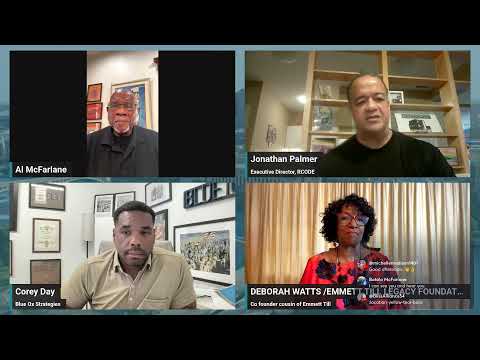
The conversation continues.
The post The Conversation With Al McFarlane 6/23/26 appeared first on BlackPressUSA.

WORK FROM HOME
Home-based business with potential monthly income of $10K+ per month. A proven training system and website provided to maximize business effectiveness. Perfect job to earn side and primary income. Contact Lynne for more details: Lynne4npusa@gmail.com 800-334-0540



Oakland Museum Presents Landmark Retrospective Celebrating Beloved Bay Area Artist Mildred Howard

Ferry Fares to Increase July 1 as Ridership Hits Record Highs

Stop the Hate Symposium Brings Oakland Together Through Dialogue, Partnership, and Community Healing

Six Months in, Probate Reform Coalition Marks Progress in Protecting Elders From Financial Abuse

A Long Time Coming: School District Kicks Off Massive $97 Million Renovation of West Oakland’s McClymonds High School

IN MEMORIAM: Oakland Dance Legend Reginald Ray-Savage, 67

UC Berkeley Named Top Public University in the U.S. and No. 7 in the World by ‘U.S. News’

NCBW-OBAC Champions Black Women Entrepreneurs at Business en Blaque Expo

Lock In Car Price: Avoid Dealer Payment Traps!

Sell Your Car: Get Offers BEFORE Visiting Dealerships!

The Conversation With Al McFarlane 6/23/26

Media Monday 6/22/26

LIVE! ASK ALMA! — TUES. 6.23.26 7PM EST

Car Buying Secrets: 4 Hidden Checks Before You Sign!

Book Review: Books for College-Bound Students

Against All Odds: Mary Jackson’s Journey to NASA Engineer

Q&A with Steven Bradford: Why He Wants Your Vote for California Insurance Commissioner

Oakland Mayor Pushes Charter Overhaul to Clarify Roles in City Government, Increase Accountability and Improve Service Delivery

The Marin City Flea Market Is Back

The Ladies of Delta Sigma Theta Hold Day of Advocacy at the Capitol in Sacramento

OPINION: The Fire of Oakland’s Justin Jones

California Launches Free Diaper Program for Newborns Statewide

Mayor Barbara Lee Declares ‘Delroy Lindo Day,’ Presents Acclaimed Actor with Key to the City

How Is AI Affecting California? The State Wants You to Share Your Story

EBMUD Enshrines the Legacy of its First Black Board Member William ‘Bill’ Patterson

Rep. Kamlager-Dove Introduces Bill to Protect Women in Custody After Reports Detailing Miscarriages and Neglect

Oakland Post: Week of May 13 – 19, 2026

More and More, Black Californians Are Worried About Rising Costs of Housing, Energy, Food and Gas

Coming to Orinda: A Lecture on Finding the Strength to Heal and Move Past Fear With Divine Love
The Conversation With Al McFarlane 6/23/26
Media Monday 6/22/26
LIVE! ASK ALMA! — TUES. 6.23.26 7PM EST
Car Buying Secrets: 4 Hidden Checks Before You Sign!

Is This 550 HP Charger Worth YOUR Money? AutoNetwork Review

Celebrating Juneteenth – Frederick Douglass on education and resistance

LIVE! — ASK ALMA! — TUES. 6.19.26 7PM EST

Hyundai Ioniq 5 Parking, Safety, and 360 View #shorts

2025 Ioniq 5 New Wiper & Powerful Performance! #shorts

Electric SUV Range: Is 259 Miles Enough? #shorts

EV Charging: How Fast Can You Charge an Electric Vehicle? #shorts

Biometric Cooling… Messaging Seats…Come on! 2025 Infiniti QX80 Autograph 4WD

Charged Up: Witness the Magic of a Fully Electric Car! #shorts

Range Rover Sport PHEV Included…: See What’s Inside This Luxury SUV! #shorts

Invisible Hood View: Perfect Parking with X-Ray Vision! #shorts
-
 Art3 weeks ago
After 10-Year Wait, Fillmore Heritage Center Reopens in San Francisco
-
 Activism3 weeks ago
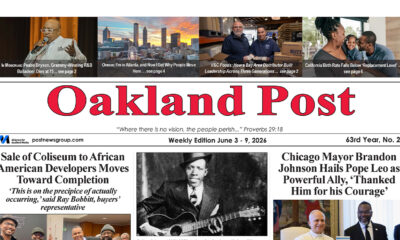
Oakland Post: Week of June 3 – 9, 2026
-
 #NNPA BlackPress3 weeks ago
5 Cleveland Police Officers Injured, Gunfire Erupts During East Side Pursuit
-

 #NNPA BlackPress3 weeks ago
2026 World Cup is Here and Atlanta is Ready For It
-
 Arts and Culture3 weeks ago
COMMENTARY: Black Music is the Sound of Black Freedom: Let Us Reclaim Both This Juneteenth
-
 #NNPA BlackPress3 weeks ago
COMMENTARY: Using Art, Healing, And Community to Transform Mental Health Dialogue
-

 #NNPA BlackPress3 weeks ago
Venus Williams Calls a Sabalenka Exit a Tragedy
-
 Art3 weeks ago
Oakland Director Boots Dazzles Once Again in ‘I Love Boosters’

2 Comments