
Politics
Q&A: Issues, Possible Legal Outcomes in Gay Marriage Cases


In this June 26, 2013, file photo, Sean Lewrence, of Philadelphia, holds up a flag during a rally for gay marriage, on Independence Mall in Philadelphia. A federal appeals court on Thursday, Nov. 6. 2014, upheld anti-gay marriage laws in four states, breaking ranks with other courts that have considered the issue and setting up the prospect of Supreme Court review. (AP Photo/Matt Slocum, File)
Mark Sherman, ASSOCIATED PRESS
WASHINGTON (AP) — Just two years ago, the Supreme Court struck down part of the federal anti-gay marriage law that denied a range of government benefits to legally married same-sex couples.
The decision in United States v. Windsor did not address the validity of state marriage bans, but courts across the country, with few exceptions, said its logic compelled them to invalidate state laws that prohibited gay and lesbian couples from marrying.
The number of states allowing same-sex marriage has grown rapidly. As recently as October, just over one-third of the states permitted same-sex marriage. Now, same-sex couples can marry in 36 states and the District of Columbia. A look at what is now before the Supreme Court, and the status of same-sex marriage around the country:
___
WHAT’S LEFT FOR THE SUPREME COURT TO DO AMID ALL THIS CHANGE?
The justices on Tuesday are hearing extended arguments, scheduled to run 2½ hours, in highly anticipated cases about the right of same-sex couples to marry. The cases before the court come from Kentucky, Michigan, Ohio and Tennessee, all of which had their marriage bans upheld by the federal appeals court in Cincinnati in November. That appeals court is the only one that has ruled in favor of the states since the 2013 Windsor decision.
___
WHAT’S AT STAKE?
Two related issues would expand the marriage rights of same-sex couples. The bigger one: Do same-sex couples have a constitutional right to marry or can states continue to define marriage as the union of a man and a woman? The second: Even if states won’t allow some couples to marry, must they recognize valid same-sex marriages from elsewhere?
___
WHAT ARE THE MAIN ARGUMENTS ON EACH SIDE?
The arguments of marriage-rights supporters boil down to a claim that states lack any valid reason to deny the right to marry, which the court has earlier described as fundamental to the pursuit of happiness. They say state laws that allow only some people to marry violate the Constitution’s guarantee of equal protection under the law and make second-class citizens of same-sex couples and their families. Same-sex couples say that preventing them from marrying is akin to a past ban on interracial marriage, which the Supreme Court struck down in 1967.
The states respond that they have always set the rules for marriage and that voters in many states have backed, sometimes overwhelmingly, changes to their constitutions to limit marriage to a man and a woman. They say a lively national debate is underway and there is no reason for courts to impose a solution that should be left to the political process. The states also argue that they have a good reason to keep defining marriage as they do. Because only heterosexual couples can produce children, it is in the states’ interest to make marriage laws that encourage those couples to enter a union that supports raising children.
___
IS THE OBAMA ADMINISTRATION PLAYING A ROLE?
The administration is backing the right of same-sex couples to marry, although its argument differs in one respect. The plaintiffs say that the state laws should fall, no matter what standard the court applies. The administration calls for more rigorous scrutiny than courts ordinarily apply to most laws, saying it is appropriate when governments discriminate against a group of people. That already is the case for claims that laws discriminate on the basis of race, sex and other factors. But the administration is silent about what the outcome should be if the court does not give gays the special protection it has afforded women and minorities.
The Justice Department’s decision to stop defending the federal anti-marriage law in 2011 was an important moment for gay rights, and President Barack Obama declared his support for same-sex marriage in 2012.
___
WHAT HAPPENS IF THE COURT STRIKES DOWN THE STATE BANS?
A ruling that same-sex couples have a right to marry would invalidate the remaining anti-gay marriage laws in the country. If the court limits its ruling to requiring states to recognize same-sex unions, couples in states without same-sex marriage presumably could get married elsewhere and then demand recognition at home.
___
WHAT HAPPENS IF THE COURT RULES FOR THE STATES ON BOTH QUESTIONS?
The bans in 14 states would survive. Beyond that, confusion probably would reign. Some states that had their marriage laws struck down by federal courts might seek to reinstate prohibitions on gay and lesbian unions. Questions also could be raised about the validity of some same-sex weddings. Many of these problems would be of the Supreme Court’s own making.
___
WHY IS THAT?
From October to January, the justices first rejected appeals from states seeking to preserve their marriage bans, then allowed court rulings to take effect even as other states appealed those decisions. The result is that the court essentially allowed the number of states with same-sex marriage to double.
___
WHERE IS SAME-SEX MARRIAGE LEGAL?
Same-sex couples can marry in 36 states, the District of Columbia and parts of Missouri. More than 500 marriage licenses were issued to same-sex couples in Alabama this year after a federal court struck down the state’s ban. But probate judges have not issued any more licenses to gay and lesbian couples since the Alabama Supreme Court ordered a halt to same-sex unions in early March.
Gay and lesbian couples may not marry in Alabama, Arkansas, Georgia, Kentucky, Louisiana, Michigan, Mississippi, most of Missouri, Nebraska, North Dakota, Ohio, South Dakota, Tennessee and Texas.
___
HOW MANY MARRIED SAME-SEX COUPLES ARE THERE IN THE U.S.?
Gary Gates, an expert at UCLA’s Williams Institute on the demography of gays and lesbians in the U.S., estimated that there were 350,000 married same-sex couples as of February. Gates relied on Gallup Inc. survey data and Census Bureau information to arrive at his estimate. That’s just 0.3 percent of the nation’s 242 million adults, Gates said. Almost as many same-sex couples are unmarried, Gates said.
___
WHAT ARE THE NEXT ISSUES FACING GAY RIGHTS?
One fight in the news this year is over efforts to carve out religious exemptions for people and institutions that object to same-sex marriage. It is clear that churches do not have to marry same-sex couples if doing so violates their religious tenets, but what about county clerks? Can photographers refuse to shoot same-sex weddings? Can bakers decline to bake a cake for two men? Civil rights groups say they will continue pressing for other protections from discrimination against LGBT people in employment and housing, among other areas. Even if same-sex couples win the right to marry everywhere, people still can be fired because of their sexual orientation in more than half the states.
___
Online:
Supreme Court: http://www.supremecourt.gov
Follow Mark Sherman on Twitter at: http://www.twitter.com/shermancourt.
Copyright 2015 The Associated Press. All rights reserved. This material may not be published, broadcast, rewritten or redistributed.
###




Business
OP-ED: Proposition 44 Would Put a Price on Trust
The danger in Proposition 44 is not only its 90 percent figure. It is that the meaning of “qualifying” spending will be worked out later. A clinic preparing a budget today may not know whether a navigator, health educator, transportation program, outreach worker, technology upgrade, or other patient-support service will be counted the way it expects. Yet the financial consequence of getting it wrong could be immediate.




Business
OP-ED: Proposition 40: It’s Time to Play Chess, Not Checkers
Proposition 40 would impose a one-time 5 percent tax on the wealth of Californians with more than $1 billion in assets. Most of that money would go toward health care, with the remainder supporting food assistance and education-related programs.

Activism
Oakland Post: Week of September 30 – October 6, 2026
The printed Weekly Edition of the Oakland Post: Week of September 30 – October 6, 2026
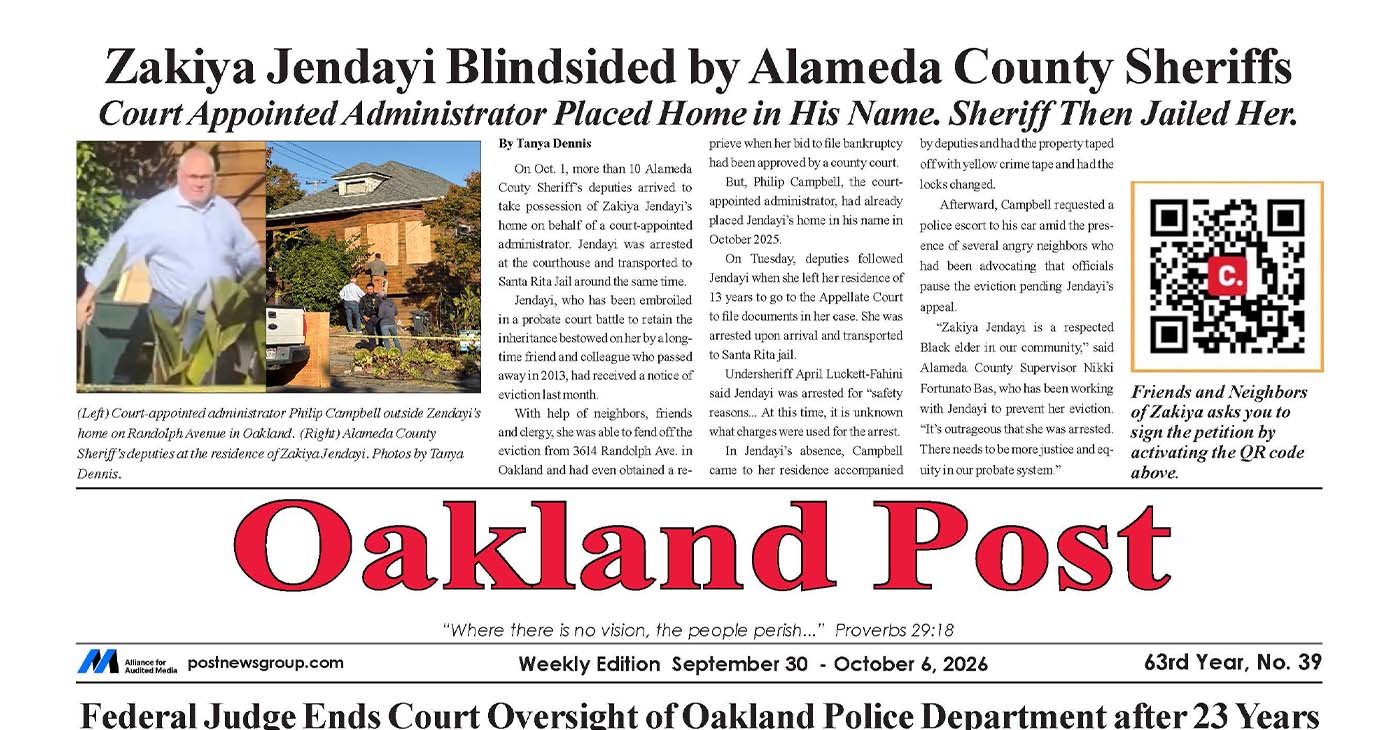
To enlarge your view of this issue, use the slider, magnifying glass icon or full page icon in the lower right corner of the browser window.



OP-ED: Proposition 44 Would Put a Price on Trust

OP-ED: Proposition 40: It’s Time to Play Chess, Not Checkers

Listening as a Lifeline: A Doula’s Witness to Black Maternal Health

New Protections for Ticket Buyers: Gov. Newsom Signs Assemblymember Isaac Bryan’s Bill

‘We Don’t Talk Trash — We Pick Up Trash!’

Zakiya Jendayi Arrested, Locked Out of Home by Sheriff’s Deputies

Oakland Post: Week of September 30 – October 6, 2026

Asm. Corey Jackson Announces Launch of 24-Hour Childcare in His District

IN MEMORIAM: The Rev. Leon “Sonny” Clark, Longtime Orange County Pastor and Community Leader, Dies at 72

Poll: Becerra Widens His Lead Over Hilton; Californians Split on Wealth Tax

From Historic Memories to New Possibilities: Oakland Celebrates Coliseum 60

County Office of Education Says OUSD Finances Are Getting Healthier, Materially Stronger

LIVE FREE Sunday Dinner Brings Faith, Fellowship and Civic Conversation to Oakland

Remembering Chauncey Bailey as Student Journalists Face Threats to Truth-Telling

BLACspace Cooperative Invites Bay Area to Experience Oakland’s Black Cultural Ecosystem Through a BLAC Map Tour + Party

Standoff for Justice: Our Homes Are Worth Fighting For

Oakland Post: Week of August 26 – September 1, 2026

Frontier Airlines’ Return to Oakland Airport Brings Flights, Jobs and Opportunity

Gubernatorial Candidate Steve Hilton Blasts California New Tire Rules; Newsom Hits Back

Chef Sharon Lee Blends Culinary Excellence, Education and Empowerment

Jackie Wright Champions Bay Area Stories, Filmmakers and Cultural Institutions

Misnamed ‘Parent’ PAC Seeks to Influence Oakland School Board Elections

Oakland Coliseum Project Opens Door for Small Businesses to Build Bigger

Big City Mayors Ask for “Yes” Vote on Housing Bond Measure; Conservatives Say “No”

Gov. Newsom’s Latest Appointees Include Sacramento Advocate for Formerly Incarcerated Students; State’s New Tech Chief

Longtime BWOPA Member Brendalyn Goodall Appointed to California Workforce Development Board

Gov. Newsom Signs Law Shielding Immigration Aid Workers From Doxing Threats

Secretary of State Shirley N. Weber Urges Californians to Vote Early as Voter ID Battle Intensifies

Oakland Post: Week of September 2 – 8, 2026

IN MEMORIAM: Dolly Parton Dead at 80 — How She Built a Legacy of Love and Earned Her Place in Black Culture

The Conversation With Al McFarlane 6/23/26

Media Monday 6/22/26

LIVE! ASK ALMA! — TUES. 6.23.26 7PM EST

Car Buying Secrets: 4 Hidden Checks Before You Sign!

Is This 550 HP Charger Worth YOUR Money? AutoNetwork Review

Celebrating Juneteenth – Frederick Douglass on education and resistance

LIVE! — ASK ALMA! — TUES. 6.19.26 7PM EST

Hyundai Ioniq 5 Parking, Safety, and 360 View #shorts

2025 Ioniq 5 New Wiper & Powerful Performance! #shorts

Electric SUV Range: Is 259 Miles Enough? #shorts

EV Charging: How Fast Can You Charge an Electric Vehicle? #shorts

Biometric Cooling… Messaging Seats…Come on! 2025 Infiniti QX80 Autograph 4WD

Charged Up: Witness the Magic of a Fully Electric Car! #shorts

Range Rover Sport PHEV Included…: See What’s Inside This Luxury SUV! #shorts

Invisible Hood View: Perfect Parking with X-Ray Vision! #shorts
-
 Community3 weeks ago
Misnamed ‘Parent’ PAC Seeks to Influence Oakland School Board Elections
-
 Activism4 weeks ago
Oakland Post: Week of September 2 – 8, 2026
-

 Activism3 weeks ago
Oakland Post: Week of September 9 – 15, 2026
-

 Community3 weeks ago
Richmond Tiny House Village Farm & Garden Set to Open Gates on Sept. 26
-

 Black History3 weeks ago
Latest Massacre in Haiti Reveals Cruelty U.S. Deportations
-

 Black History3 weeks ago
OPINION: Nolan Wells’ Death One of Several Signifying Racial Terror Lives on in U.S. South
-

 Business2 weeks ago
Mayor Lee Announces $1 Million Kaiser Permanente Grant for Pilot Program to Address Homelessness, Clean Up Public Spaces throughout Oakland
-

 Community3 weeks ago
Democratic Clubs Interview Candidates for Oakland School Board
