
Activism
Protesters Demanding Hearing on Gaza Ceasefire Resolution Shut Down Oakland School Board Meeting
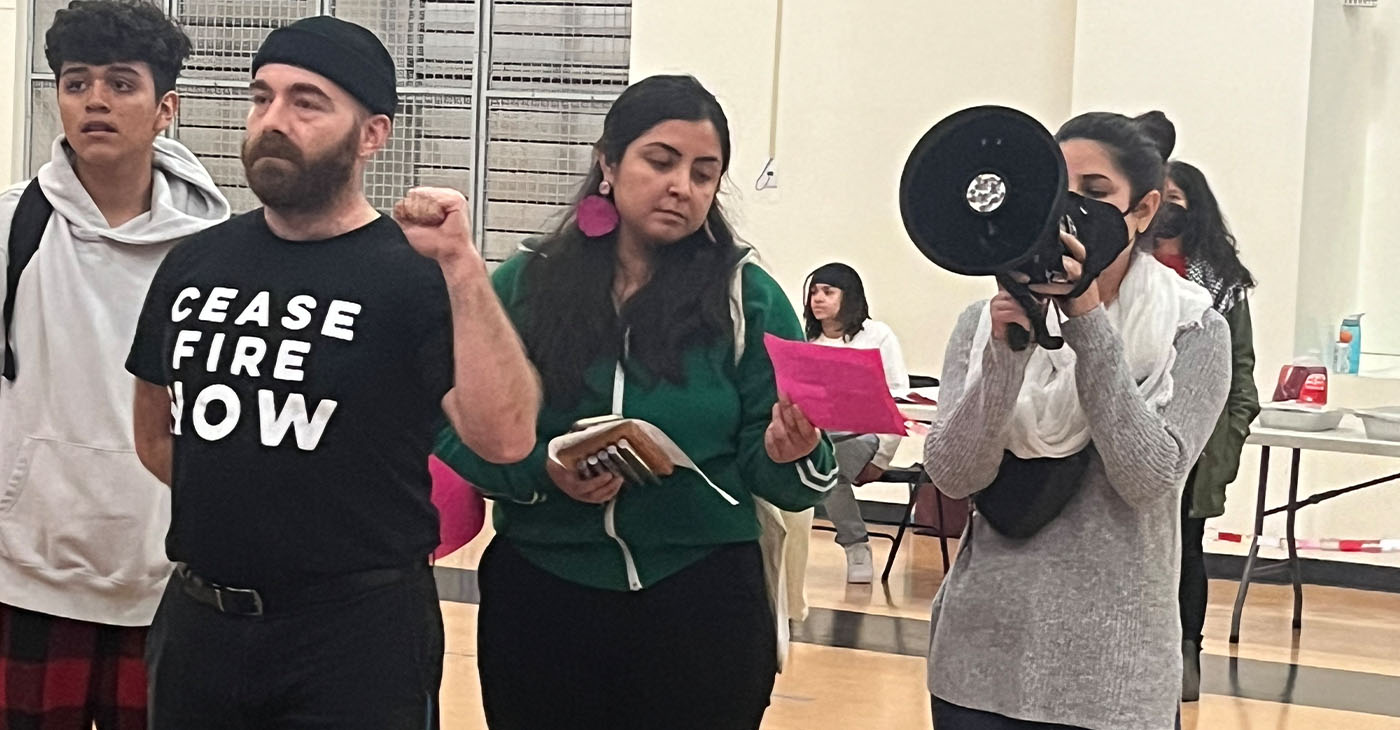
Ceasefire demonstrators beat a drum and called out the names and ages of children who have died in the Israeli army attack on Gaza. Protesters said they were angry and frustrated that school board President Sam Davis, backed by former board President Mike Hutchinson and Jorge Lerma, blocked the discussion even though four of the seven members of the board have called for the Gaza resolution to be placed on a board agenda, as permitted by Oakland Unified School District bylaws.

By Ken Epstein
Parents, teachers, and community members shut down the Oakland Board of Education meeting Wednesday evening to protest attempts by several members of the school board to keep a discussion of a Gaza Ceasefire resolution off the board agenda for the past five months.
Hours into the meeting, protest leaders came to the front of the room, below the stage, leading the audience in chants: “We feel unsafe. We feel unseen. We feel unheard!”
Ceasefire demonstrators beat a drum and called out the names and ages of children who have died in the Israeli army attack on Gaza.
Protesters said they were angry and frustrated that school board President Sam Davis, backed by former board President Mike Hutchinson and Jorge Lerma, blocked the discussion even though four of the seven members of the board have called for the Gaza resolution to be placed on a board agenda, as permitted by Oakland Unified School District bylaws.
Board members Jennifer Brouhard, Valarie Bachelor, VanCedric Williams, and Clifford Thompson, sent an email to Board President Sam Davis supporting placing the resolution on the agenda for a full discussion but were ignored.
The proposed resolution, originally submitted by Brouhard and Bachelor would read:
“The Oakland Unified School District supports U.S. Congress Resolution H.R.786 and joins others in calling on our Congressmembers to demand: an immediate ceasefire; the unrestricted entry of humanitarian assistance into Gaza; the restoration of food, water, electricity, and medical supplies to Gaza; and the respect for international law.”
The resolution continued: “OUSD encourages all staff to read and learn about the region to help students understand the complexities of the Palestinian-Israeli conflict, the historical context, and the impact on all communities and, in the process, to create an environment in our schools and classrooms that encourages open, respectful, and well-informed discussions on Palestine and Israel, enabling students and staff to build empathy and compassion, and engage in constructive dialogue, where no student or staff member feels singled out for their identity, ethnicity or religious affiliation.”
Board President Davis and Vice President Hutchinson have issued a statement in which they said they spoke for the board, even though they only spoke for themselves. They supported peace in the Middle East and backed Congresswoman Barbara Lee’s call for a ceasefire in Gaza, but at the same time shut down public discussion.
“The board does not intend to take further legislative action at its meetings this year,” their statement said.
Mona Lisa Treviño, a parent activist who works with OUSD Families and Community for Palestine, said the meeting was shut down because the district and several board members ignored democratic norms, refusing to allow a public discussion of the ceasefire resolution to be discussed at a board meeting.
“We went through all the proper steps to get on the agenda,” she said. “We had four board members who agreed. Still the board president refused to [have it] agendized. To discuss it with the board, we scheduled multiple meetings (with the board leadership), but they cancelled at the last minute.
“Arab students and families are experiencing harassment and bullying in this district from district staff and other students,” continued Treviño. “Arab staff have been targeted by the district. Some students have been called into the office, where the felt like they were being targeted because of their heritage.”
Lara Kiswani, a member of the local Arab Resource and Organizing Center (AROC), speaking to the board, said she understood that some board leaders were trying to decide whether a discussion of a ceasefire was a legitimate local issue. “It’s not your decision as local policy makers to decide if this is a local issue, your constituents can tell you when it’s a local issue.”
“Your Black students, your Palestinian students, your Muslim students, your Jewish students and allies and teachers, staff, and parents across the district have been begging you to honor and respect them and their lives and their needs, including the lives of children being massacred in Gaza. You have been dismissing that and disrespecting the very simple demand to put it on the agenda and have a discussion. How do you think you can continue to ignore a community?”
Teacher Gabriel Kahn, who also works with OUSD Families and Community for Palestine, told the Oakland Post he was impressed that so many people came to the board meeting to support the peace resolution on Valentine’s Day, despite the rain.
“This shows that this movement is based on love and there is massive community support in Oakland for a ceasefire resolution,” he said.
“All we’re asking at this point is for people to hear, discuss and [hold a public] vote on this resolution. It’s incredibly disrespectful for the resolution to be ignored for five months in a row.
“The silence (of the board) is a different kind of violence,” he said.






Activism
Oakland Post: Week of April 1 – 7, 2026
The printed Weekly Edition of the Oakland Post: Week of April 1 – 7, 2026


To enlarge your view of this issue, use the slider, magnifying glass icon or full page icon in the lower right corner of the browser window.

Activism
Oakland Post: Week of March 18 – 24, 2026
The printed Weekly Edition of the Oakland Post: Week of March 18 – 24, 2026

To enlarge your view of this issue, use the slider, magnifying glass icon or full page icon in the lower right corner of the browser window.
Activism
Oakland Post: Week of March 11 -17, 2026
The printed Weekly Edition of the Oakland Post: Week of March 11 – 17, 2026
To enlarge your view of this issue, use the slider, magnifying glass icon or full page icon in the lower right corner of the browser window.

WORK FROM HOME
Home-based business with potential monthly income of $10K+ per month. A proven training system and website provided to maximize business effectiveness. Perfect job to earn side and primary income. Contact Lynne for more details: Lynne4npusa@gmail.com 800-334-0540


Oakland Post: Week of April 1 – 7, 2026

Black Artists in America, Installation Three Wraps at the Dixon Gallery and Gardens

Grief, Advocacy, and Education: A Counselor Reflects on Black Maternal Health

Future of Florida’s Black History Museum in Limbo

New Research Shows the Many Benefits of Early Learning

South Hampton K-8 Students Among Top 10 Finalists for Samsung’s ‘Solve for Tomorrow’ Competition

Cuba: No Negotiation with US on the President or Political System

Brooklyn Academy of Music Names Jamaican-Born Tamara McCaw as President

Trinidad & Tobego – U.S. Launches WhatsApp Channel for American Citizens in the Country

Oakland Post: Week of March 18 – 24, 2026

AI Innovation vs. Ethics and Environmental Impact

AI, Web3, and Digital Reparations

What If You Owned Your AI Agent?

Season 7, Episode 3 – January Reporter’s Roundtable 📱

Season 7, Episode 3 – January Reporter’s Roundtable

Reflecting on Black History Milestones in Birmingham AL

Oakland Post: Week of February 25 – March 3, 2026

PRESS ROOM: NBA Hall of Fame Nominee Terry Cummings Joins 100 Black Men of DeKalb County to Launch Victory & Values Initiative

Oakland Post: Week of March 4 – 10, 2026

Trump’s MAGA Allies are Creating Executive Order Plan to Steal the 2026 Midterms

U.S. manufacturing rebounds – how foundry services are adapting to rising demand

Poll Shows Support for Policies That Help Families Afford Child Care

OP-ED: One Hundred Years of Black Workers Telling the Truth

Oakland Post: Week of March 11 -17, 2026

Advancements in solar technology that are changing the way we power the world
Oakland Post: Week of March 18 – 24, 2026

Woman’s Search for Family’s Roots Leads to Ancestor John T. Ward – A Successful Entrepreneur and Conductor on the Underground Railroad

COMMENTARY: Women of Color Shape Our Past and Future

PRESS ROOM: Civil Rights TV Launches in Selma as the World’s First 24/7 Civil Rights Television Network

Financial Wellness and Mental Health: Managing Money Stress in College

Hyundai Ioniq 5 Parking, Safety, and 360 View #shorts

2025 Ioniq 5 New Wiper & Powerful Performance! #shorts

Electric SUV Range: Is 259 Miles Enough? #shorts

EV Charging: How Fast Can You Charge an Electric Vehicle? #shorts

Biometric Cooling… Messaging Seats…Come on! 2025 Infiniti QX80 Autograph 4WD

Charged Up: Witness the Magic of a Fully Electric Car! #shorts

Range Rover Sport PHEV Included…: See What’s Inside This Luxury SUV! #shorts

Invisible Hood View: Perfect Parking with X-Ray Vision! #shorts

AI Is Reshaping Black Healthcare: Promise, Peril, and the Push for Improved Results in California

ESSAY: Technology and Medicine, a Primary Care Point of View

Sanctuary Cities

The RESISTANCE – FREEDOM NOW

STATE OF THE PEOPLE: Freddie

ECONOMIC BOYCOTT DAY!!!!!

I told You So

-
 Activism3 weeks ago
Oakland Post: Week of March 11 -17, 2026
-
 Activism2 weeks ago
Oakland Post: Week of March 18 – 24, 2026
-
 #NNPA BlackPress4 weeks ago
Woman’s Search for Family’s Roots Leads to Ancestor John T. Ward – A Successful Entrepreneur and Conductor on the Underground Railroad
-
 #NNPA BlackPress4 weeks ago
COMMENTARY: Women of Color Shape Our Past and Future
-
 Advice3 weeks ago
Financial Wellness and Mental Health: Managing Money Stress in College
-

 #NNPA BlackPress4 weeks ago
Advocates Raise Alarm Over ICE Operation, MOU and Detention Risks in Baltimore County
-

 #NNPA BlackPress4 weeks ago
Pete Buttigieg to Join Mayor Randall Woodfin for Community Town Hall in Birmingham
-
 #NNPA BlackPress2 weeks ago
Brooklyn Academy of Music Names Jamaican-Born Tamara McCaw as President
