
News
Proposed City Council Rule Change Falls Short in Face of Community Opposition

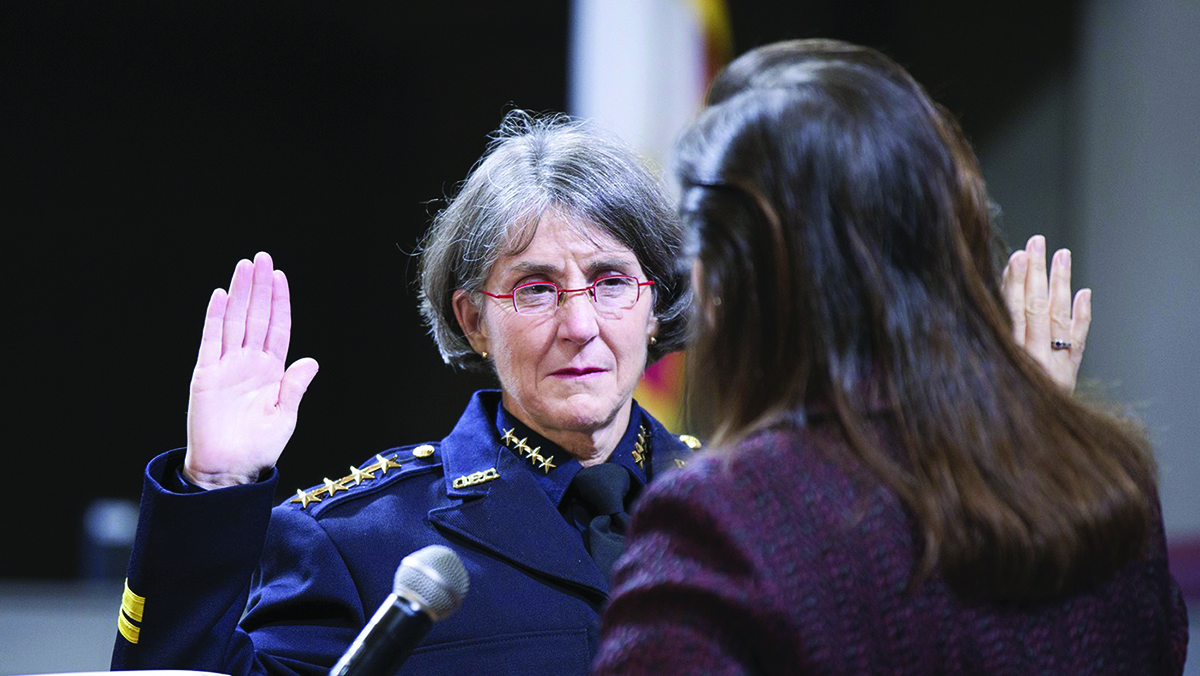
Speakers concerned about Chief Kirkpatrick’s interference in council decisions; Her
actions also cost her former employer, City of Spokane, $1.7 million jury award
Conflicts about abuse of power and political intrigue that are typically a feature of debates at the national level arose at the Oakland City Council meeting this week. Dozens of people from the community showed up to oppose a resolution to give the council president unchecked authority to appoint and remove committee chairs and members.
Speaker after speaker blasted the resolution as an anti-democratic move designed to intimidate oppositional, progressive voices on the council. A number of speakers said the change was especially meant to silence Public Safety Committee Chair Desley Brooks, who has been outspoken in condemnation of the Oakland Police Department’s cooperation with ICE immigration raids in violation of the sanctuary city policy passed by the council.
In the course of the debate, Council President Larry Reid admitted he had been called by Police Chief Anne Kirkpatrick about this issue but refused to discuss the content of their conversation.
Until now, the council’s Rules and Procedures has granted the president the authority to appoint committee members and chairs for two-year terms and has required that the appointments go to a council vote for confirmation.
The rule change, proposed by Councilmembers Lynette Gibson McElhaney and Annie Campbell Washington and Council President Larry Reid, would have allowed the president to shuffle committee chairs and members at any time and would remove the requirement for a council confirmation vote.
Not a single speaker who addressed the council supported the motion. In the face of community opposition, the proposal failed, winning only four votes, one vote short of what it needed to pass. It was supported by the proposal’s original three sponsors and Councilmember Abel Guillén.
Ultimately, a modified motion was passed, proposed by Councilmember Dan Kalb.
Falling short of what the McElhaney proposal was trying to achieve, the new rule—which goes into effect immediately—gives the council president power to appoint and remove committee members at will, but requires that his decisions go to the council for ratification.
Under the new rule, changes in committee membership cannot go into effect without public debate and a council decision.
Voting for the rule change were McElhaney, Campbell Washington, Reid, Guillén and Kalb. Opposed were Brooks and Noel Gallo. Councilmember-at-Large Rebecca Kaplan abstained.
Concerns have been circulating about whether Police Chief Anne Kirkpatrick had contacted Council President Reid about removing Brooks from her position as chair of Public Safety, and when questioned at the meeting by a community member, Reid said he had received a call from the chief.
Jonah Strauss of the Oakland Warehouse Coalition asked President Reid, “Did you have a recent call with Anne Kirkpatrick, chief of police? Do you feel it is appropriate for OPD to have a say in committee assignments?”
Reid responded, “Yeah, the police chief called me, but that’s my conversation with her, and I don’t have to share it with you. That’s my answer to your question.”
Rashidah Grinage of the Coalition for Police Accountability criticized the chief for interfering in city government and councilmembers for doing her bidding.
The police chief is afraid of an elected councilmember “to the point where she crosses all kinds of ethical and governmental
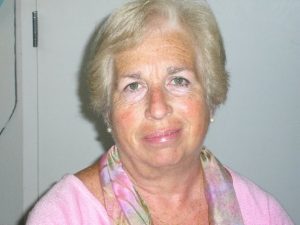
Rashidah Grinage
processes to make an effort to remove this person who has oversight,” said Grinage.
The chief is “so intimidated by being questioned and asked to account for her own actions that she retaliates against this person who is doing her job [and] who is representing the interests and the values and the laws of the community,” she said.
“This is a very frightening situation if this council is going to knuckle to pressure from a police chief,” she said. “Think about the signal that will send to this community.”
“You seem to think we don’t know what’s behind [the rule change], and in your efforts to be obscure, you are very clear and transparent,” Grinage said.
The East Bay Times reported Wednesday that the police chief said she had called Reid “to express concerns” about the December verdict in Elaine Brown’s lawsuit against the city and Brooks.
The police chief was herself the subject of a lawsuit while she served in Spokane, costing the city nearly $2 million.
Councilmember McElhaney said the rule change was only to make the council rules more efficient and modern, in line with how other cities assign committee members.
“Since 2014, I have sought to bring forth these changes…to provide for a continuity of service in case there is an interruption in our chair leadership [for health or other reasons],” said McElhaney.
“I have sought to bring modernization to [the rules],” she said.
Campbell Washington said, “This a very common rule in legislative bodies. I believe it will allow us to manage our business in a way that is necessary and respond to issues that we need to respond to.”
Kaplan questioned the motivation and consequences of the rule change.
“I don’t see any reference [in the proposal] to when a committee chair is incapacitated,” she said.
“But it appears this would allow committee assignments to be changed daily, hourly, for any reason, for no reason, and in fact there be no protections at all [against] it being used to punish somebody for not voting for something or for other reasons that would really be disruptive to the integrity of the body.”
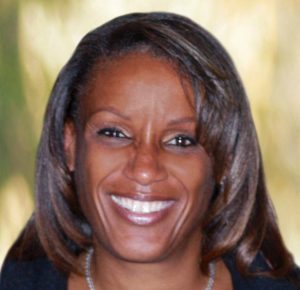
Desley Brooks
Councilmember Brooks called the proposal part of a “concerted effort” on the part of councilmembers, the administration and the media “to try and seize this moment, to try to get the public to make a rush to judgment about me.”
“[This] really isn’t just about me,” she said. “I am just the vehicle. This has been an attempt to silence the voice of the community.”
A number of speakers syosupported Brooks’ work as a defender of the interests of the community.
Anthony Palik said he has been living in Oakland for less than a week and came to the council meeting after reading newspapers.
“[Desley Brooks] is obviously someone who can speak truth to power, and she’s a courageous woman for doing so,” he said.
“To hear what Ms. Brooks had to say convinced me that there’s a problem here. And that problem is the consolidation of power…an attempt of the majority to silence the minority.”
Turha Ak of the Community Ready Corps talked about how Brooks helped protect people during the protests in 2009 when Oscar Grant was killed by BART police.
He explained that as he was “trying to get people out to safety,” Ms. Brooks stepped through the tear gas, made [the police] back down and allowed me to get the people out.”
“You are not going to tell me that this isn’t about getting rid of her,” he said. “We’re (not) going to play that game,” he said. “You do developers’ business. You do corporations’ business. You do your business. You don’t do the people’s business.”
Cat Brooks, a journalist, actor and leader of the Anti Police-Terror Project, said, “This is not about personal relations. It’s about when the people say this is how we want to move, and we got hundreds of people inside this room saying this is how Oakland wants you to move, Desley listens when we say that.
“We have to be clear that getting Desley off of this council is getting progressive voices out of the room.”
In November 2011, a jury found that then-Spokane, WA Police Chief Anne Kirkpatrick (left) had illegally fired a police officer and then retaliated against him even after the officer was cleared of any wrongdoing. The jury ultimately awarded the officer $1.7 million.













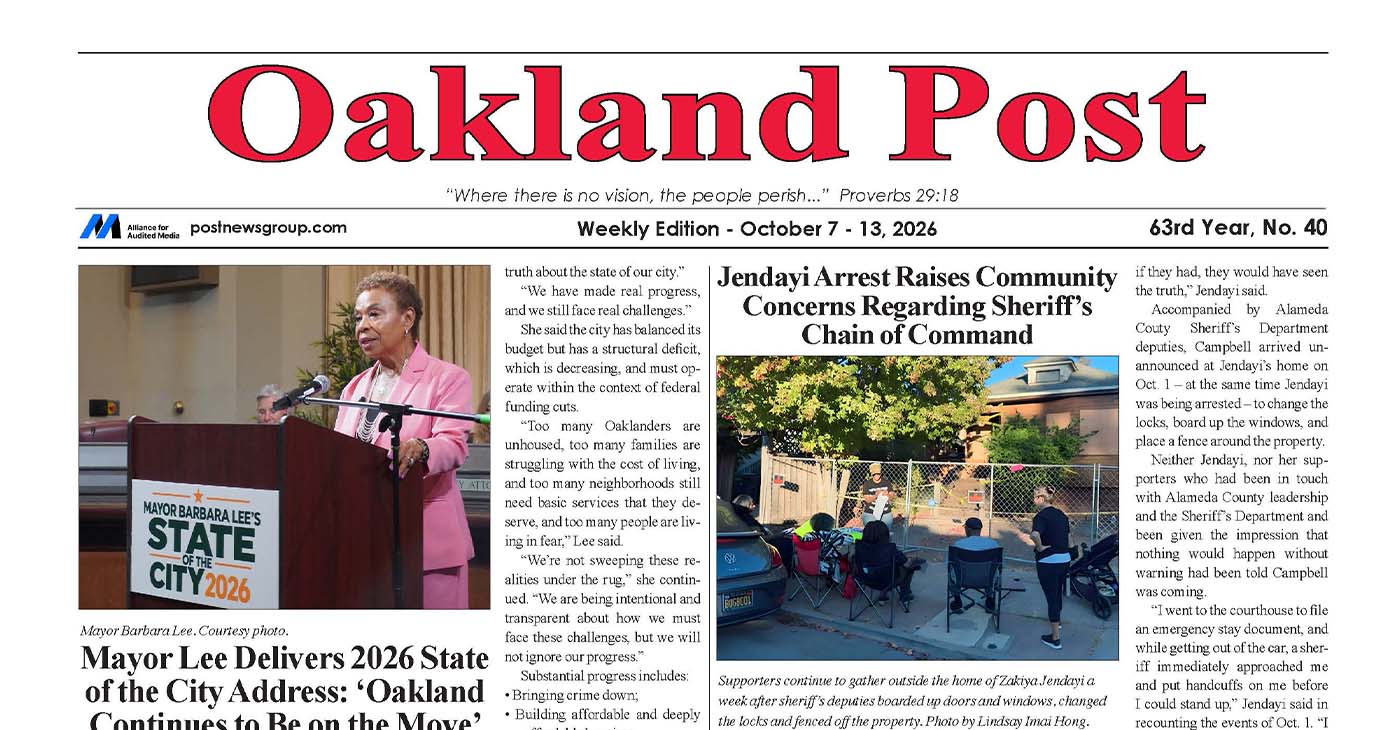
To enlarge your view of this issue, use the slider, magnifying glass icon or full page icon in the lower right corner of the browser window.

Black History
Ghana’s Ministry of Foreign Affairs Publishes Global Circle’s Vatican Reparations Call in Special Edition Alongside Heads of State
GLOBAL CIRCLE FOR REPARATIONS AND HEALING — Ghana’s Ministry of Foreign Affairs has published the Global Circle for Reparations and Healing’s submission, “From Accra to the Vatican,” in a special edition of The Ghanaian Envoy. This marks the first time a sovereign state has incorporated the Reparations Presentment to the Holy See into its official record. The 175-page edition, titled “Creating A New World,” also documents Ghana’s campaign that led to UN Resolution A/RES/80/250, which recognized the trafficking and enslavement of Africans as the gravest crime against humanity.


“From Accra to the Vatican” appears in The Ghanaian Envoy Special Edition on UN Resolution A/RES/80/250 — the first time a sovereign state has carried the Reparations Presentment to the Holy See into its official record
ACCRA, Ghana / CHICAGO, Illinois — October 7, 2026 — The Global Circle for Reparations and Healing today announced that its submission to Ghana’s Ministry of Foreign Affairs, “From Accra to the Vatican: A Call for a Global Plan of Action on Catholic Church Redress”, has been published in the Special Edition of The Ghanaian Envoy, the official newsletter of the Ministry of Foreign Affairs of the Republic of Ghana. The 175-page edition, titled “Creating A New World,” documents the Ghana-led campaign that culminated on March 25, 2026, in United Nations General Assembly Resolution A/RES/80/250, which declared the trafficking of enslaved Africans and the racialized chattel enslavement of Africans the gravest crime against humanity.
The Global Circle’s submission, authored by Co-Convener Kamm Howard, appears in Part V of the edition, “What Repair Must Now Mean,” at page 161. It shares the volume with statements by President John Dramani Mahama of Ghana, President Joseph Nyuma Boakai Sr. of Liberia, President Netumbo Nandi-Ndaitwah of Namibia, President Bassirou Diomaye Diakhar Faye of Senegal, President Carlos Manuel Vila Nova of São Tomé and Príncipe, President Emmanuel Macron of France, Prime Minister Mia Amor Mottley of Barbados, United Nations Secretary-General António Guterres, Foreign Minister Samuel Okudzeto Ablakwa, African Union Commissioner Amma Twum-Amoah, CARICOM Reparations Commission Chair Sir Hilary Beckles, Nobel Laureate Wole Soyinka, Dr. Julius Garvey, and Congressional Black Caucus Executive Director Vincent Evans, among others.
The submission traces the Global Circle’s delivery of the Reparations Presentment to the Holy See in Vatican City on July 18, 2022, the document’s subsequent use by the former Vice President of Costa Rica and the Vice President of Colombia in their engagements with Pope Francis, and the partial response contained in Pope Leo XIV’s May 2026 encyclical Magnifica Humanitas. It argues that while three of the Presentment’s seven demands have entered the Church’s official language in diluted form, four remain wholly unmet: rescission of the papal bulls that authorized African enslavement, the Church’s call upon other offending Western nations to make redress, the establishment of a joint Vatican–African Diaspora–African Papal Commission on Reparations and Healing, and a substantial financial commitment to repair. The submission asks Ghana to adopt the Presentment as the reference instrument for a Vatican track within the Accra Next Steps Commitments and to convene a first meeting of Global African reparationists toward a collective response.
“For four years the Presentment has been a civil society document carried by civil society hands,” said Kamm Howard, Co-Convener of the Global Circle and Commissioner of the National African American Reparations Commission. “Ghana has now placed it in the official record of a sovereign state, in a volume that opens with a President’s address to the General Assembly and closes by asking what repair must mean. That is not a courtesy. It is a signal to every government, every reparations commission, and every African Catholic that the claim against the Holy See belongs on the state agenda, and that the state which broke the deadlock at the United Nations is prepared to see it there.”
The significance of the publication extends beyond the Vatican file. The Presentment was created as a legal claims instrument by Howard in 2014 and first delivered to corporations and institutions in the United States, where it secured significant concessions. Its appearance in a foreign ministry’s official publication, translated and distributed in English, French, Portuguese, Spanish, and Italian, establishes the reparations presentment as a recognized instrument of international reparatory diplomacy, one that other states and descendant communities can adopt without drafting a new framework of their own. The Global Circle has described this catalytic potential as the “N’namba Effect,” after the Evanston, Illinois, reparations initiative – led by N’nanba Robin Rue Simmons – that gave municipalities across the United States the model, permission, and courage to act.
“The Vatican told us in 2022 that it moves in fifteen-year increments,” Howard added. “Ghana has just demonstrated at the United Nations that a determined state can compress that timeline to a single vote. We are asking Ghana to do for the Church what it did for the General Assembly, and we are asking Global Africa to organize behind that ask with one document, one voice, and one set of demands.”
The Global Circle has written to President Mahama and Foreign Minister Ablakwa to express its gratitude and to propose that its Vatican and Interreligious Actors Working Group lead the first meeting on a collective Vatican response under the auspices of the Government of Ghana. The Global Circle has also formally advised the Congressional Black Caucus of the publication in connection with its pending request that the Caucus recognize the Presentment as the foundational document for reparations engagement with the Roman Catholic Church and join the Government of Ghana in this global call to action.
###
About the Global Circle for Reparations and Healing
The Global Circle for Reparations and Healing was convened in 2022 to help build united global reparations front across Africa and its worldwide diaspora. In July 2022 the Global Circle delivered the Reparations Presentment to the Holy See in Vatican City. It co-organized Accra Summit I in August 2022 with the Government of Ghana and the Africa Transitional Justice Legacy Fund, and led the organization of Accra Summit II: Centering Healing Across Global Africa in March 2025 in partnership with the African Union. The Reparations Presentment to the Holy See is available in English, French, Italian, Portuguese, and Spanish at gcrh.org.
Media Contact
Global Circle for Reparations and Healing
Kamm Howard, Co-Convenor
Kammh369@gmail.com 773 520 0369
gcrh.org

Activism
Oakland Post: Week of September 30 – October 6, 2026
The printed Weekly Edition of the Oakland Post: Week of September 30 – October 6, 2026

To enlarge your view of this issue, use the slider, magnifying glass icon or full page icon in the lower right corner of the browser window.


WCCUSD Joins Statewide Organic School Food Purchasing Cooperative

Democrats, Community Groups Back Measure EE to Change How Oakland Is Governed

Four Tips to Help You Plan a Holiday “Staycation”

Veterans Housing Project Proposed for South Richmond
PRESS ROOM: Transformative Justice Coalition 2026 Voting Rights Champion Awards Reception ‘Yesterday Is Today: The Battle For Voting Rights

Mayor Lee Delivers 2026 State of the City Address: ‘Oakland Continues to Be on the Move’

Oakland Awarded More than $14 Million in State Funding

Jendayi Arrest Raises Community Concerns Regarding Sheriff’s Chain of Command

Marin County Supes Expand Small Business Options with Home Kitchen Pilot Program

Allen Temple Baptist Church Hosts Free Prostate Cancer Screenings on Oct. 17

AC Transit Labor Unions Back Director Joel Young

Locals Can Get Locally Grown Produce Delivered Through Urban Tilth

‘ICE-Free Marin’ Supporters Press Supervisors as County Drafts Enforcement Restrictions

Oakland Post: Week of October 7 – 13, 2026

Ghana’s Ministry of Foreign Affairs Publishes Global Circle’s Vatican Reparations Call in Special Edition Alongside Heads of State

Misnamed ‘Parent’ PAC Seeks to Influence Oakland School Board Elections

Oakland Post: Week of September 2 – 8, 2026

Oakland Post: Week of September 9 – 15, 2026

Richmond Tiny House Village Farm & Garden Set to Open Gates on Sept. 26

Latest Massacre in Haiti Reveals Cruelty U.S. Deportations

OPINION: Nolan Wells’ Death One of Several Signifying Racial Terror Lives on in U.S. South

Poll: Becerra Widens His Lead Over Hilton; Californians Split on Wealth Tax

County Office of Education Says OUSD Finances Are Getting Healthier, Materially Stronger

Mayor Lee Announces $1 Million Kaiser Permanente Grant for Pilot Program to Address Homelessness, Clean Up Public Spaces throughout Oakland

Democratic Clubs Interview Candidates for Oakland School Board

Oakland People’s Arms Embargo Coalition Demands End to Military Shipments Thru Oakland

Oakland Post: Week of September 16 – 22, 2026

BLACspace Cooperative Invites Bay Area to Experience Oakland’s Black Cultural Ecosystem Through a BLAC Map Tour + Party

Two Looming Threats Every Alameda County Elder Should Know About

Zakiya Jendayi Arrested, Locked Out of Home by Sheriff’s Deputies

The Conversation With Al McFarlane 6/23/26

Media Monday 6/22/26

LIVE! ASK ALMA! — TUES. 6.23.26 7PM EST

Car Buying Secrets: 4 Hidden Checks Before You Sign!

Is This 550 HP Charger Worth YOUR Money? AutoNetwork Review

Celebrating Juneteenth – Frederick Douglass on education and resistance

LIVE! — ASK ALMA! — TUES. 6.19.26 7PM EST

Hyundai Ioniq 5 Parking, Safety, and 360 View #shorts

2025 Ioniq 5 New Wiper & Powerful Performance! #shorts

Electric SUV Range: Is 259 Miles Enough? #shorts

EV Charging: How Fast Can You Charge an Electric Vehicle? #shorts

Biometric Cooling… Messaging Seats…Come on! 2025 Infiniti QX80 Autograph 4WD

Charged Up: Witness the Magic of a Fully Electric Car! #shorts

Range Rover Sport PHEV Included…: See What’s Inside This Luxury SUV! #shorts

Invisible Hood View: Perfect Parking with X-Ray Vision! #shorts
-
 Economy3 weeks ago
Poll: Becerra Widens His Lead Over Hilton; Californians Split on Wealth Tax
-
 Business3 weeks ago
County Office of Education Says OUSD Finances Are Getting Healthier, Materially Stronger
-
 Business3 weeks ago
Mayor Lee Announces $1 Million Kaiser Permanente Grant for Pilot Program to Address Homelessness, Clean Up Public Spaces throughout Oakland
-
 Uncategorized3 weeks ago
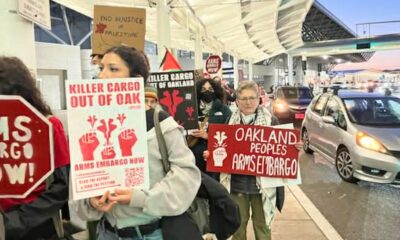
Oakland People’s Arms Embargo Coalition Demands End to Military Shipments Thru Oakland
-
 Activism3 weeks ago
Oakland Post: Week of September 16 – 22, 2026
-
 Art3 weeks ago
BLACspace Cooperative Invites Bay Area to Experience Oakland’s Black Cultural Ecosystem Through a BLAC Map Tour + Party
-
 Community3 weeks ago
Two Looming Threats Every Alameda County Elder Should Know About
-
 Lead Story2 weeks ago
Zakiya Jendayi Arrested, Locked Out of Home by Sheriff’s Deputies
