
Activism
Project to Help Non-Profits Gain Access to Almost $200B in State and Federal Funds
The Center at the Sierra Health Foundation, a Sacramento-based organization that promotes health and racial equity, and the James Irvine Foundation, a private San Francisco-based philanthropic nonprofit that advocates for Californians who earn low wages, are the first two foundations investing in the fund called the Community Economic Mobilization Initiative (CEMI).


By Tanu Henry, California Black Media
Non-profit organizations across California will be able to apply for funding from a pool of cash created with an initial investment of $15 million from two foundations.
The money will help local Community Based Organizations (CBOs) gain access to almost $200 billion in federal and state funding coming down the pike for economic development projects.
The Center at the Sierra Health Foundation, a Sacramento-based organization that promotes health and racial equity, and the James Irvine Foundation, a private San Francisco-based philanthropic nonprofit that advocates for Californians who earn low wages, are the first two foundations investing in the fund called the Community Economic Mobilization Initiative (CEMI).
“CEMI will strengthen nonprofits working in marginalized communities and help them secure and influence the use of public funds designated to reduce economic and environmental inequities,” said Chet P. Hewitt, president and CEO of Sierra Health Foundation and The Center.
This year, California is expected to receive close to $200 billion in federal and state funding. The money will be sourced from the American Rescue Plan ($43 billion) and Infrastructure Investment and Jobs Act ($56 billion), as well as the state’s Community Economic Resilience Fund ($565 million) and its budget surplus ($46 billion).

“This is a much-needed investment for community-driven organizations, particularly those that support the most vulnerable Californians. Historically, they have not been invested in the same manner as larger organizations. Many of them were affected throughout the pandemic and need this fiscal and operational support,” said Kellie Todd Griffin, convenor of the California Black Women’s Collective, an organization of more than 1500 Black women leaders in various professions from different regions of the state. “My hope is that there will be intentionality to be inclusive of the organizations that can have the greatest impact in our communities.”
CEMI is expected to begin funding the CBOs in the summer of 2022 with $14 million from the James Irvine Foundation and $1 million from the Center at Sierra Health.
“We have a golden opportunity to make sure these investments reach community-based organizations that best know the infrastructure their communities need for economic growth that is inclusive and resilient,” said Don Howard, president and CEO of The James Irvine Foundation.
Howard says the funding from CEMI aligns with the James Irvine Foundation’s mission of supporting low-income workers because it helps grassroots organizations and community advocates participate in the planning and decision-making that goes into the distribution of public funds.
“We need an economy built on inclusion, equity, and dignity for all work and workers — and that starts by making room for diverse leaders to have a say in how these once-in-a-generation investments shape their communities’ futures,” Howard continued.
The CEMI funding will provide technical assistance and training to the CBOs that qualify to build their capacity and infrastructure and build models for what community-driven economic development looks like, according to the Center at Sierra Health Foundation.
The funders of CEMI say they believe the organizations they support will grow into a strong network that can drive more “equitable economic development policy, regulation and accountability at state and local levels.”
The California Endowment (TCE), a private foundation with headquarters in Los Angeles, has also committed to investing in CEMI.
TCE is a 56-year-old foundation that supports programs that improve the health care of Californians living in underserved communities.
“The availability of state and federal funding provides California with an important opportunity to address critical health and economic challenges for the most vulnerable Californians,” said Dr. Bob Ross, president and CEO of TCE.
“This potential can only be realized by investing in community-led change,” Ross added.
Gov. Gavin Newsom praised the foundations for taking a leadership role in making a difference in the lives of Californians who need help the most.
“This initiative will help grow the capacity of committed organizations to continue their important work in communities across the state. This will be especially important as we focus on COVID-19 recovery and creating a healthier, safer, more equitable future for all,” Newsom said.
Hewitt says the project will result in “transformative change” in California.
“The past few years have laid bare the impact of long-term disinvestment in poor communities. We must do all we can to position community institutions to grow power and create opportunity for the places and populations they serve,” he said.













Activism
Oakland Post: Week of March 18 – 24, 2026
The printed Weekly Edition of the Oakland Post: Week of March 18 – 24, 2026


To enlarge your view of this issue, use the slider, magnifying glass icon or full page icon in the lower right corner of the browser window.

Activism
Oakland Post: Week of March 11 -17, 2026
The printed Weekly Edition of the Oakland Post: Week of March 11 – 17, 2026
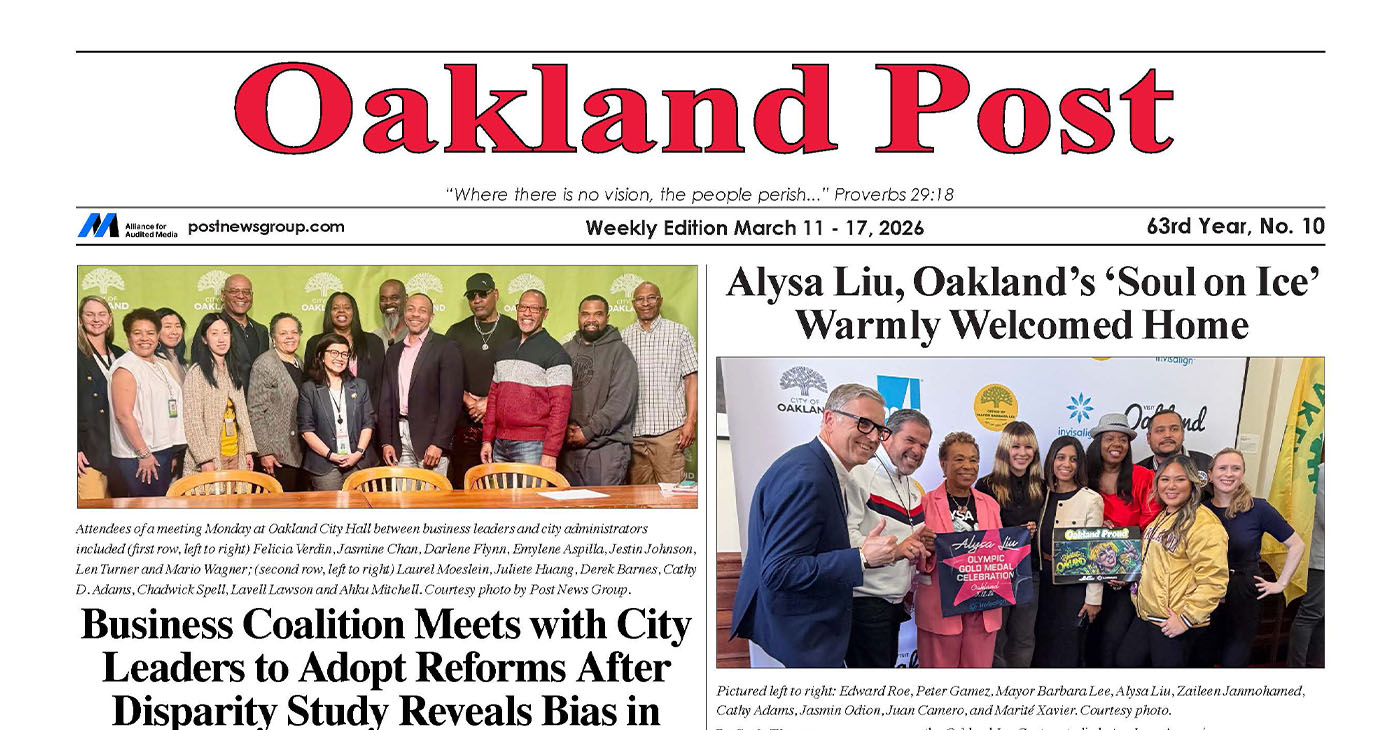
To enlarge your view of this issue, use the slider, magnifying glass icon or full page icon in the lower right corner of the browser window.
Activism
Oakland Post: Week of March 4 – 10, 2026
The printed Weekly Edition of the Oakland Post: Week of March 4 – 10, 2026

To enlarge your view of this issue, use the slider, magnifying glass icon or full page icon in the lower right corner of the browser window.


WORK FROM HOME
Home-based business with potential monthly income of $10K+ per month. A proven training system and website provided to maximize business effectiveness. Perfect job to earn side and primary income. Contact Lynne for more details: Lynne4npusa@gmail.com 800-334-0540


Black Artists in America, Installation Three Wraps at the Dixon Gallery and Gardens

Grief, Advocacy, and Education: A Counselor Reflects on Black Maternal Health

Future of Florida’s Black History Museum in Limbo

New Research Shows the Many Benefits of Early Learning

South Hampton K-8 Students Among Top 10 Finalists for Samsung’s ‘Solve for Tomorrow’ Competition

Cuba: No Negotiation with US on the President or Political System

Brooklyn Academy of Music Names Jamaican-Born Tamara McCaw as President

Trinidad & Tobego – U.S. Launches WhatsApp Channel for American Citizens in the Country

Oakland Post: Week of March 18 – 24, 2026

AI Innovation vs. Ethics and Environmental Impact

AI, Web3, and Digital Reparations

What If You Owned Your AI Agent?

Season 7, Episode 3 – January Reporter’s Roundtable 📱

Season 7, Episode 3 – January Reporter’s Roundtable

AI, Media, and Power | Part 2, Real-World Impacts and Tradeoffs

Discrimination in City Contracts

Oakland Post: Week of February 11 – 17, 2026

Reflecting on Black History Milestones in Birmingham AL

Rising Optimism Among Small And Middle Market Business Leaders Suggests Growth for California

CITY OF SAN LEANDRO STATE OF CALIFORNIA PUBLIC WORKS DEPARTMENT ENGINEERING DIVISION NOTICE TO BIDDERS FOR ANNUAL STREET OVERLAY/REHABILITATION 2019-21 – PHASE III

Oakland Post: Week of February 18 – 24, 2026

PRESS ROOM: NBA Hall of Fame Nominee Terry Cummings Joins 100 Black Men of DeKalb County to Launch Victory & Values Initiative

Oakland Post: Week of February 25 – March 3, 2026

U.S. manufacturing rebounds – how foundry services are adapting to rising demand

Trump’s MAGA Allies are Creating Executive Order Plan to Steal the 2026 Midterms

OP-ED: One Hundred Years of Black Workers Telling the Truth

Advancements in solar technology that are changing the way we power the world

Chase Oakland Community Center Hosts Alley-Oop Accelerator Building Community and Opportunity for Bay Area Entrepreneurs

PRESS ROOM: Civil Rights TV Launches in Selma as the World’s First 24/7 Civil Rights Television Network

Poll Shows Support for Policies That Help Families Afford Child Care

Hyundai Ioniq 5 Parking, Safety, and 360 View #shorts

2025 Ioniq 5 New Wiper & Powerful Performance! #shorts

Electric SUV Range: Is 259 Miles Enough? #shorts

EV Charging: How Fast Can You Charge an Electric Vehicle? #shorts

Biometric Cooling… Messaging Seats…Come on! 2025 Infiniti QX80 Autograph 4WD

Charged Up: Witness the Magic of a Fully Electric Car! #shorts

Range Rover Sport PHEV Included…: See What’s Inside This Luxury SUV! #shorts

Invisible Hood View: Perfect Parking with X-Ray Vision! #shorts

AI Is Reshaping Black Healthcare: Promise, Peril, and the Push for Improved Results in California

ESSAY: Technology and Medicine, a Primary Care Point of View

Sanctuary Cities

The RESISTANCE – FREEDOM NOW

STATE OF THE PEOPLE: Freddie

ECONOMIC BOYCOTT DAY!!!!!

I told You So
-
 #NNPA BlackPress4 weeks ago
Reflecting on Black History Milestones in Birmingham AL
-
 #NNPA BlackPress4 weeks ago
PRESS ROOM: NBA Hall of Fame Nominee Terry Cummings Joins 100 Black Men of DeKalb County to Launch Victory & Values Initiative
-
 Activism4 weeks ago
Oakland Post: Week of February 25 – March 3, 2026
-
 #NNPA BlackPress4 weeks ago
Trump’s MAGA Allies are Creating Executive Order Plan to Steal the 2026 Midterms
-
 #NNPA BlackPress4 weeks ago
OP-ED: One Hundred Years of Black Workers Telling the Truth
-
 #NNPA BlackPress4 weeks ago
Poll Shows Support for Policies That Help Families Afford Child Care
-

 Activism3 weeks ago
Oakland Post: Week of March 4 – 10, 2026
-

 #NNPA BlackPress3 weeks ago
Woman’s Search for Family’s Roots Leads to Ancestor John T. Ward – A Successful Entrepreneur and Conductor on the Underground Railroad
