
Bay Area
Peralta Colleges Chancellor Steps Down, Citing Conflicts with Board of Trustees


Peralta Colleges Chancellor Regina Stanback Stroud, who has only held the position for nine months, will step down next month amid claims that the Peralta Community College District Board of Trustees undermined her leadership and exhibited racial discrimination against African American staff.
In a scathing resignation letter, Stanback Stroud listed a series of 11 accusations against the Board of Trustees, including, “Hostile conduct towards others and each other,” “violations of confidentiality at closed board meetings,” and “fostering a culture of contempt by modeling disrespect and contempt for executive administration…”
“They are not true,” Trustee Board President Julina Bonilla told the San Francisco Chronicle. She declined to make specific responses as some of Stanback Stroud’s accusations, by law, would require investigations.
Stanback Stroud claimed in her letter that the Board interfered with “fair and effective hiring practices,” as she attempted to fill vacant leadership positions at the district level, and added that the Board colluded with unions “against the interest of the district.”
Peralta Faculty Union President Jennifer Shanoski contradicted Stanback Stroud’s charge of collusion in a statement to the Chronicle. “From a labor perspective, we’ve never had a worse relationship than with this chancellor,” Shanoski said.
According to the Chronicle, the unions had filed a complaint against her over a communications matter and the failure to reveal plans on what employees can expect this fall in light of the COVID-19 pandemic.
Allegations of racist and ‘hostile’ behavior
In a July 19 letter to the California Community Colleges Chancellor’s office in Sacramento from the president of the Peralta Association of African American Affairs (PAAAA) alleged that the board’s actions toward Stanback Stroud were not only abusive but racially motivated.
“We have observed an increase in racism toward the Chancellor by some Board members,” said the letter written by PAAAA President Lawrence VanHook, a Laney College professor, referring to concerns expressed in April.
Stanback Stroud claimed that the Board’s “hostility and contempt toward administration, particularly a pattern practice against African American executive staff” undermined the Chancellor’s authority as outlined in the Accrediting Commission for Community and Junior Colleges.
Thus far, no evidence has been provided to support the allegations.
On Friday, Bonilla and board vice president Cindi Napoli-Abella Reiss issued a joint statement, signed by Stanback Stroud.
“We want to assure everyone in the Peralta Community that our organization is strong,” the letter states. “While this situation is not ideal, there is no doubt that we will continue to serve students and our community with dedication and compassion.”
A district in distress
When Stanback Stroud was hired in a unanimous vote from the Board of Trustees in Fall 2019, it was no secret that she faced a district in distress. The former president of Skyline College said she had come out of retirement to work for the Peralta District because she had felt “called” to serve her home community.
White responds with a brief speech, expressing gratitude while symbolically passing on her duties to the new chancellor Regina Stanback Stroud. pic.twitter.com/S0bIhGtrYC
— The Citizen (@peraltacitizen) October 9, 2019
In a now-foreboding statement during the September 2019 Chancellor’s forum, Stanback Stroud said that she hoped to address the internal culture of the colleges and that she was “not willing to be abused,” — emphasizing that she would not tolerate any bullying of any kind, especially towards leadership.
Just a few months earlier, amid widespread concern for the district’s fiscal health, the Board had requested an evaluation from the Fiscal Crisis Management Team (FCMAT). The subsequent report cited an “excessively high” fiscal health risk and referenced a culture of favoritism and miscommunication — among other alarming issues. The California Community College Board of Governors warned that the district could face fiscal insolvency or an emergency takeover from the state if the financial issues were not resolved.
The FCMAT report came as no surprise to some faculty and staff who had long been critical of the district’s administrative culture and budget priorities while declining enrollment and high turnover at the executive level of Peralta College leadership had further impacted public trust and credit rating over the years.
In early 2019, Chancellor Jowell Laguerre prematurely stepped down amid widespread criticism and accusations of fund mismanagement. His contract was due to end in 2020 but the board voted unanimously to accept his “early retirement.”
Just a few months later, vice-chancellor of general services Sadiq Ikharo was placed on permanent leave following Laney College’s failure to meet fire safety standards — ultimately resulting in over half a million dollars spent in temporary safety expenses.
The district announced July 29 that Vice-Chancellor Carla Walter will serve as acting chancellor while the board undertakes the search for Stanback Stroud’s replacement. The board aims to appoint an interim chancellor by Oct. 1.
Written by Saskia Hatvany with contribution by Wanda Ravernell.
. @PeraltaColleges chancellor abruptly resigns, effective August 15. Closed session board meeting today —> agenda items include: evaluation of the chancellor, public employee discipline/dismissal/release. Public comment @ 11 am. https://t.co/XbfPTsgAyN
— The Citizen (@peraltacitizen) July 18, 2020






Activism
Oakland Post: Week of September 16 – 22, 2026
The printed Weekly Edition of the Oakland Post: Week of September 16 – 22, 2026


To enlarge your view of this issue, use the slider, magnifying glass icon or full page icon in the lower right corner of the browser window.

Activism
Oakland Post: Week of September 9 – 15, 2026
The printed Weekly Edition of the Oakland Post: Week of September 9 – 15, 2026

To enlarge your view of this issue, use the slider, magnifying glass icon or full page icon in the lower right corner of the browser window.
Activism
Oakland Post: Week of September 2 – 8, 2026
The printed Weekly Edition of the Oakland Post: Week of September 2 – 8, 2026
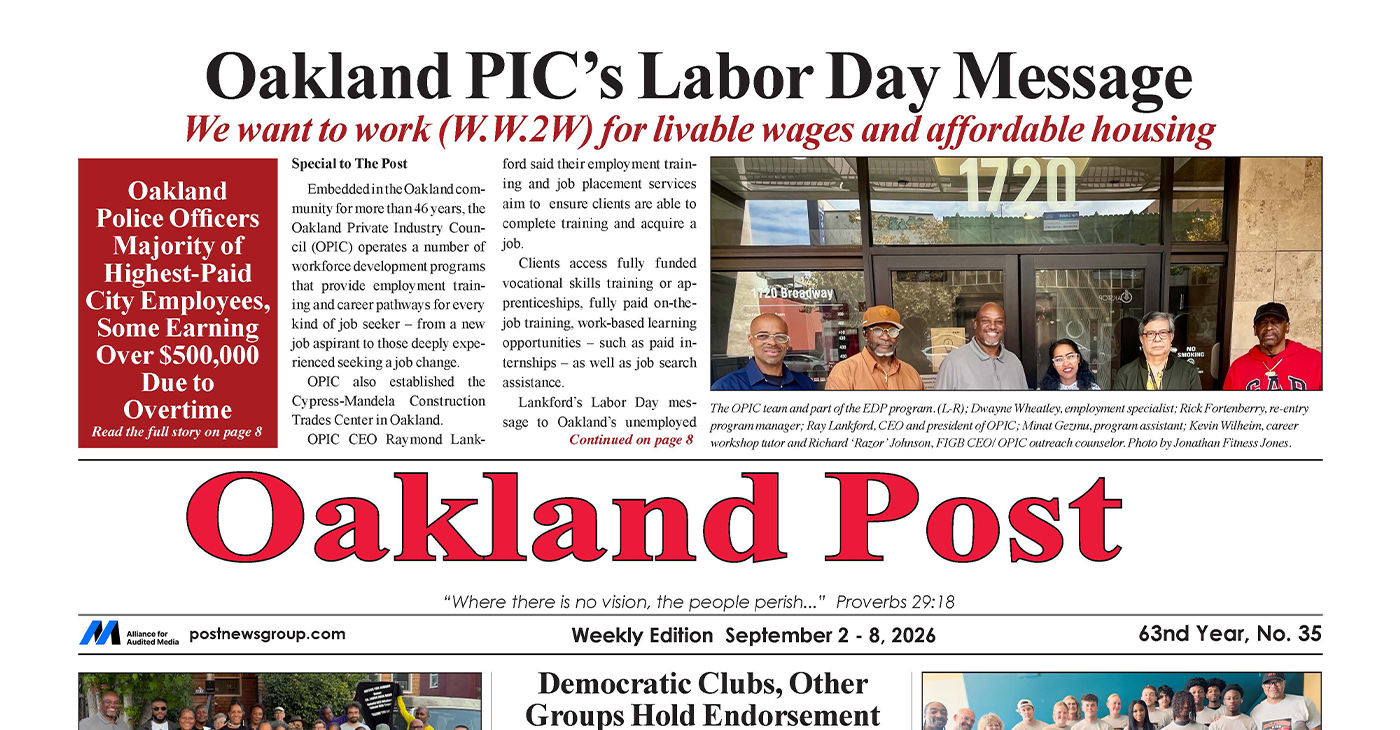
To enlarge your view of this issue, use the slider, magnifying glass icon or full page icon in the lower right corner of the browser window.



Doulas Are Helping Black California Moms Navigate Pregnancy–Even as High Mortality Rates Persist

Newsom Signs Addictive Social Media Law to Protect Kids

On Your November Ballot: Prop 38 Would Allocate $8.4 Billion to Immunology and Immunotherapy Funding

Ask California: Golden State Releases New AI Chatbot

Asm. Isaac Bryan’s Bill Banning California Police From ICE Side Jobs Reaches Newsom’s Desk

Assemblymember LaShae Sharp-Collins’s Bill Would Pause Law Enforcement’s Use of Shock Gloves Pending Study

BOOK REVIEW: ‘Laws of Solomon’ Reveals Tender Heart of Former Child Soldier

OPINION: The New American Fear – From 9-11 to AI

Passing for White, Fighting for Black America: The Courage of Walter White

Oakland People’s Arms Embargo Coalition Demands End to Military Shipments Thru Oakland

Barbara Lee Mourns Gloria Steinem, Remembers a Friendship Rooted in Equality

Event Preview: ‘Fashion v. Fascism’ – A Runway Revolution Is Coming to the Bay Area

Two Looming Threats Every Alameda County Elder Should Know About

Oakland Mayor Reads to Children at Bookout Block Party at Marcus Books Store

Tradition Comes to the Streets in 11th Annual Black-Eyed Pea Festival at the Freedom Farmers Market

Less Affluent School Districts, Including Sacramento City, Face Threat of State Takeover

ESSAY: California Can Close Its Colorectal Cancer Gap

California Hispanic Chambers of Commerce Unveils: ‘Powering the Future’ Theme for 47th Annual Statewide Convention

Four Candidates, Including Incumbent Barbara Lee, Qualify for Oakland Mayor’s Race

Oakland Post: Week of August 12 – 18, 2026

From Blueprint to Breakthrough: Tackling Affordable Housing in Oakland

Oakland Observes Black August with Block Parties, Film Showings, Workshops

COMMENTARY: Why Local School Tax Measure G1 Will Not Be on the November Ballot

Standoff for Justice: Our Homes Are Worth Fighting For

Returning to Its Roots, the Oakland Black-Eyed Pea Festival Partners with the Freedom Farmers Market Sept. 12

NPRC Scores First Advocacy Victory: David Shaw Finally Gets His Wish to ‘Go Home’

Oakland Post: Week of August 26 – September 1, 2026

Frontier Airlines’ Return to Oakland Airport Brings Flights, Jobs and Opportunity

Gubernatorial Candidate Steve Hilton Blasts California New Tire Rules; Newsom Hits Back

Chef Sharon Lee Blends Culinary Excellence, Education and Empowerment

The Conversation With Al McFarlane 6/23/26

Media Monday 6/22/26

LIVE! ASK ALMA! — TUES. 6.23.26 7PM EST

Car Buying Secrets: 4 Hidden Checks Before You Sign!

Is This 550 HP Charger Worth YOUR Money? AutoNetwork Review

Celebrating Juneteenth – Frederick Douglass on education and resistance

LIVE! — ASK ALMA! — TUES. 6.19.26 7PM EST

Hyundai Ioniq 5 Parking, Safety, and 360 View #shorts

2025 Ioniq 5 New Wiper & Powerful Performance! #shorts

Electric SUV Range: Is 259 Miles Enough? #shorts

EV Charging: How Fast Can You Charge an Electric Vehicle? #shorts

Biometric Cooling… Messaging Seats…Come on! 2025 Infiniti QX80 Autograph 4WD

Charged Up: Witness the Magic of a Fully Electric Car! #shorts

Range Rover Sport PHEV Included…: See What’s Inside This Luxury SUV! #shorts

Invisible Hood View: Perfect Parking with X-Ray Vision! #shorts
-
 Commentary4 weeks ago
Standoff for Justice: Our Homes Are Worth Fighting For
-
 Activism4 weeks ago
Oakland Post: Week of August 26 – September 1, 2026
-
 Business4 weeks ago
Frontier Airlines’ Return to Oakland Airport Brings Flights, Jobs and Opportunity
-
 Business4 weeks ago
Gubernatorial Candidate Steve Hilton Blasts California New Tire Rules; Newsom Hits Back
-
 Business4 weeks ago
Chef Sharon Lee Blends Culinary Excellence, Education and Empowerment
-

 Education4 weeks ago
Gov. Newsom’s Latest Appointees Include Sacramento Advocate for Formerly Incarcerated Students; State’s New Tech Chief
-

 Community4 weeks ago
Big City Mayors Ask for “Yes” Vote on Housing Bond Measure; Conservatives Say “No”
-

 Business4 weeks ago
Oakland Coliseum Project Opens Door for Small Businesses to Build Bigger
