
Entertainment
Oscar Spotlight Draws Attention to Industry Diversity Issue


In this March 2, 2014 file photo, Lupita Nyong’o accepts the award for best actress in a supporting role for “12 Years a Slave” during the Oscars in Los Angeles. (John Shearer/Invision/AP, File)
JAKE COYLE, AP Film Writer
NEW YORK (AP) — It was a year ago that Lupita Nyong’o, shortly before winning the Academy Award for best supporting actress in “12 Years a Slave,” gave a speech about what she called “dark beauty.”
Nyong’o, who so dazzled Hollywood and the Oscar-viewing public through awards season, spoke tenderly of receiving a letter from a girl who had been about to lighten her skin before Nyong’o’s success, she said, “saved me.” The letter struck Nyong’o because she recognized herself in that girl: “I remember a time when I too felt unbeautiful. I put on the TV and only saw pale skin.”
The Mexican-born, Kenyan-raised actress was a central part last year to an Academy Awards flush with faces uncommon to the Oscar podium.
What a difference a year makes.
This year’s Oscars repeat a stubborn pattern that has plagued the Academy Awards throughout its history: Whenever change seems to come, a frustrating hangover follows. “Every 10 years, we have the same conversation,” Spike Lee, a regular witness to the sporadic progress, has said.
Seldom have such fits and starts been starker than this Oscars, coming a year after a richly diverse Oscar crop. In Sunday’s Academy Awards, all 20 acting nominees are white, a result that prompted some to declare that they would boycott this year’s ceremony.
The lack of nominations for “Selma” director Ava DuVernay and star David Oyelowo were a particular flashpoint, viewed by many as unjust oversights not only because they merited honoring, but because their absences furthered an ignoble Oscar history.
“I was surprised but then I wasn’t,” said Darnell Hunt, a UCLA professor and director of the Ralph J. Bunche Center for African American Studies, who co-authored a 2014 diversity report on the film and TV industries. “What we saw in terms of the nominations this year was business as usual. What we got was more or less an accurate reflection of the way the industry is structured and the way the academy is populated.”
An Associated Press survey of the academy’s voting history since the first Academy Awards in 1929 shows gradual progress but not nearly at a rate to match the ever-increasing diversity of the American public. In those 87 years, 15 black actors have won Oscars, four Latinos and three Asians, a record that doesn’t even speak to other categories like best director, where only one woman (Kathryn Bigelow) has won.
The number of non-whites to be nominated for best actor or best actress has nearly doubled in just the last two decades, but the 9.4 percent of non-white acting nominees over the academy’s history is about four times less than the percentage of the non-white population.
Not all of this can be laid at the film academy’s feet, but some of it can. The 6,000-plus membership of the Academy of Motion Pictures Arts and Sciences was found to be 94 percent white and 77 percent male in a 2012 Los Angeles Times investigation.
Since becoming president of the academy, Cheryl Boone Isaacs has worked to diversify the organization’s ranks, though change comes slowly considering membership is for life.
But the academy is a reflection of the film industry; it can only reward the films that get made. What this year’s all-white acting nominees did was lay bare the enormous, hulking iceberg of the movie business’ diversity problems.
The UCLA diversity report released last year after eight years of research put found underrepresentation of minorities and women throughout film and TV, from board rooms to talent agencies.
“White males have dominated things for so long that it’s been hard to image an alternative that would produce or be open to producing the types of projects that are likely to enlist more people of color or women. So it becomes a self-fulfilling prophecy, this vicious cycle that produces the same type of stuff over and over again,” says Hunt.
What’s particularly galling for many of those working to change Hollywood is that minorities are among its most passionate customers.
“They acknowledge the demographic. They understand our participation rate. They continue to market these projects to the community, but never with the community’s identity or building a base of A-lister talent,” says Felix Sanchez, president of the National Hispanic Foundation for the Arts.
Hunt hopes that by studying diversity objectively, the data will reveal “the bottlenecks” that are stifling advancement. That includes findings that show more diverse projects make more money at the box office and earn better TV ratings. He knows the one thing Hollywood will respond to: the bottom line.
But frustration is mounting. Another year’s worth of research, to be released later this month by UCLA, shows no significant change, says Hunt.
Stacy L. Smith, founder and director of USC Annenberg’s Media, Diversity and Social Change Initiative, calls the lack of progress in the industry “egregious.”
“Hollywood does not think diversity is commercial,” Smith said. “The numbers speak loudly and clearly about who is valued and who isn’t.”
With studies finding so little progress, Smith proposes the industry adopt a modified version of the NFL’s Rooney Rule, which stipulates that teams must interview minorities for vacant coaching jobs.
Not everyone agrees. “Enforced ‘diversity’ will undermine the very mission of (the academy),” wrote Lionel Chetwynd, an Oscar-nominated writer and an academy member. “As new filmmakers and craftspeople achieve new levels of excellence, the face of the academy will change as it should, to the meter of its time, the pace of its art.”
Why does all this matter? It isn’t just an issue of equal opportunity, though it is that. It’s because when people aren’t reflected in culture, when they don’t see themselves on screens, behind cameras or on the Oscar stage, they feel invisible and voiceless. Hollywood would do well to remember that young girl who wrote to Nyong’o, and hope to inspire a flood of such letters.
___
AP researcher Jennifer Farrar contributed to this report.
___
Follow AP Film Writer Jake Coyle on Twitter at: http://twitter.com/jakecoyleAP
Copyright 2015 The Associated Press. All rights reserved. This material may not be published, broadcast, rewritten or redistributed.









Activism
Oakland Post: Week of March 18 – 24, 2026
The printed Weekly Edition of the Oakland Post: Week of March 18 – 24, 2026
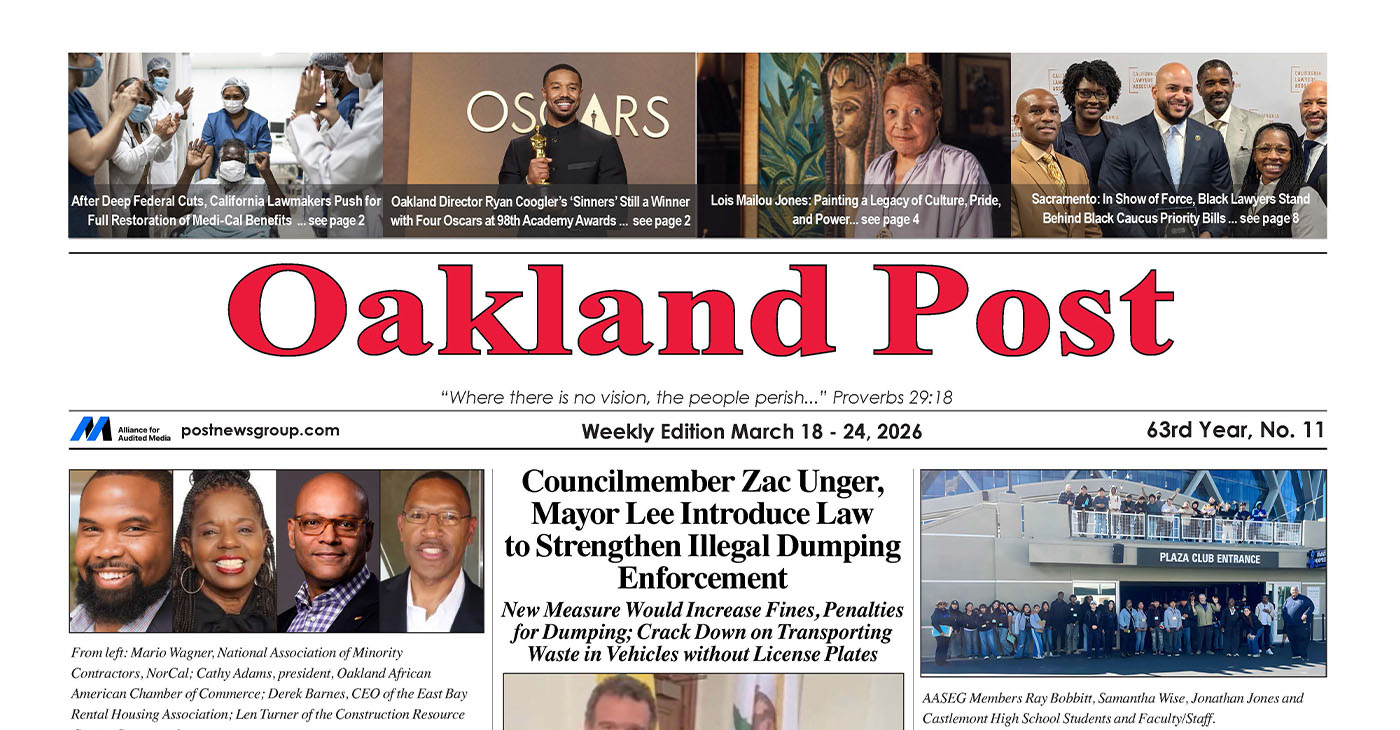
To enlarge your view of this issue, use the slider, magnifying glass icon or full page icon in the lower right corner of the browser window.
Activism
Oakland Post: Week of March 11 -17, 2026
The printed Weekly Edition of the Oakland Post: Week of March 11 – 17, 2026
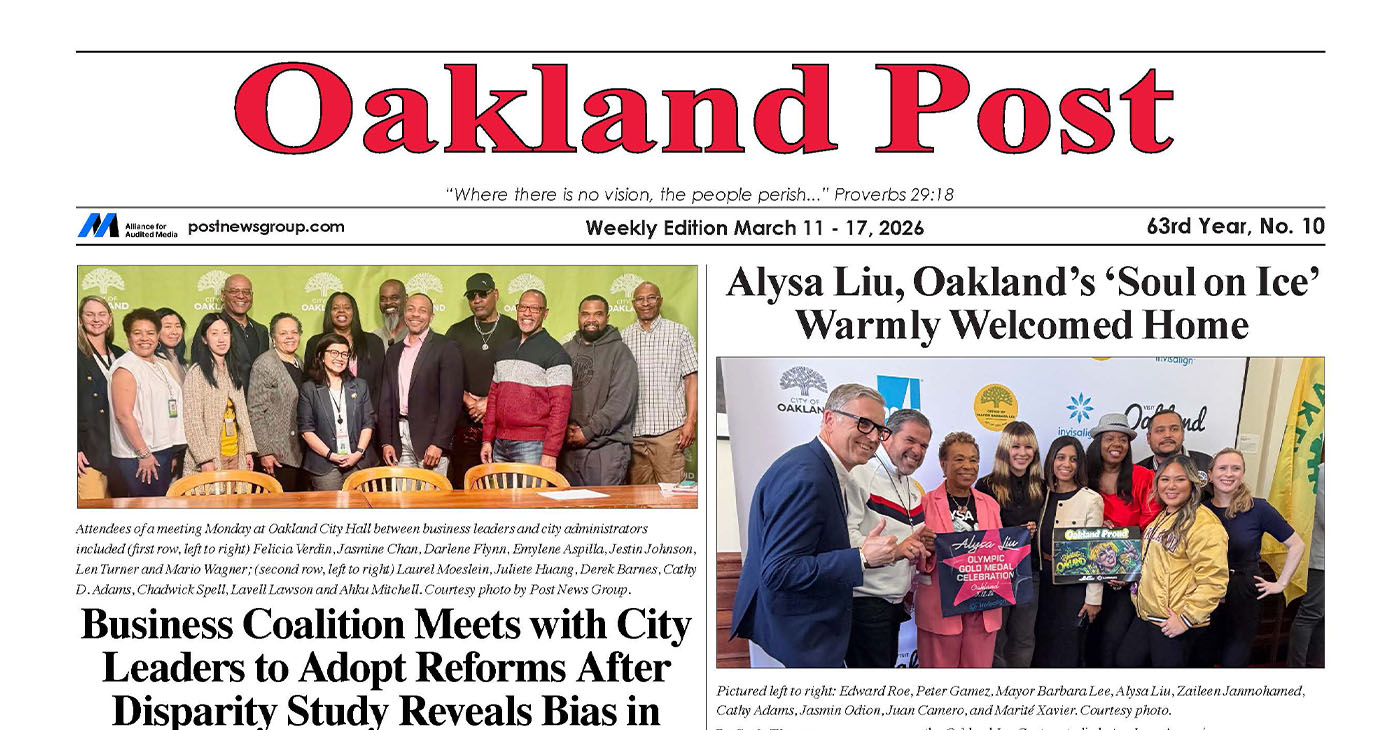
To enlarge your view of this issue, use the slider, magnifying glass icon or full page icon in the lower right corner of the browser window.
Activism
Oakland Post: Week of March 4 – 10, 2026
The printed Weekly Edition of the Oakland Post: Week of March 4 – 10, 2026

To enlarge your view of this issue, use the slider, magnifying glass icon or full page icon in the lower right corner of the browser window.

WORK FROM HOME
Home-based business with potential monthly income of $10K+ per month. A proven training system and website provided to maximize business effectiveness. Perfect job to earn side and primary income. Contact Lynne for more details: Lynne4npusa@gmail.com 800-334-0540


Black Artists in America, Installation Three Wraps at the Dixon Gallery and Gardens

Grief, Advocacy, and Education: A Counselor Reflects on Black Maternal Health

Future of Florida’s Black History Museum in Limbo

New Research Shows the Many Benefits of Early Learning

South Hampton K-8 Students Among Top 10 Finalists for Samsung’s ‘Solve for Tomorrow’ Competition

Cuba: No Negotiation with US on the President or Political System

Brooklyn Academy of Music Names Jamaican-Born Tamara McCaw as President

Trinidad & Tobego – U.S. Launches WhatsApp Channel for American Citizens in the Country

Oakland Post: Week of March 18 – 24, 2026

AI Innovation vs. Ethics and Environmental Impact

AI, Web3, and Digital Reparations

What If You Owned Your AI Agent?

Season 7, Episode 3 – January Reporter’s Roundtable 📱

Season 7, Episode 3 – January Reporter’s Roundtable

AI, Media, and Power | Part 2, Real-World Impacts and Tradeoffs

Oakland Post: Week of February 11 – 17, 2026

Reflecting on Black History Milestones in Birmingham AL

Rising Optimism Among Small And Middle Market Business Leaders Suggests Growth for California

CITY OF SAN LEANDRO STATE OF CALIFORNIA PUBLIC WORKS DEPARTMENT ENGINEERING DIVISION NOTICE TO BIDDERS FOR ANNUAL STREET OVERLAY/REHABILITATION 2019-21 – PHASE III

Oakland Post: Week of February 18 – 24, 2026

PRESS ROOM: NBA Hall of Fame Nominee Terry Cummings Joins 100 Black Men of DeKalb County to Launch Victory & Values Initiative

Oakland Post: Week of February 25 – March 3, 2026

Trump’s MAGA Allies are Creating Executive Order Plan to Steal the 2026 Midterms

U.S. manufacturing rebounds – how foundry services are adapting to rising demand

OP-ED: One Hundred Years of Black Workers Telling the Truth

Advancements in solar technology that are changing the way we power the world

Chase Oakland Community Center Hosts Alley-Oop Accelerator Building Community and Opportunity for Bay Area Entrepreneurs

Poll Shows Support for Policies That Help Families Afford Child Care

PRESS ROOM: Civil Rights TV Launches in Selma as the World’s First 24/7 Civil Rights Television Network

Oakland Post: Week of March 4 – 10, 2026

Hyundai Ioniq 5 Parking, Safety, and 360 View #shorts

2025 Ioniq 5 New Wiper & Powerful Performance! #shorts

Electric SUV Range: Is 259 Miles Enough? #shorts

EV Charging: How Fast Can You Charge an Electric Vehicle? #shorts

Biometric Cooling… Messaging Seats…Come on! 2025 Infiniti QX80 Autograph 4WD

Charged Up: Witness the Magic of a Fully Electric Car! #shorts

Range Rover Sport PHEV Included…: See What’s Inside This Luxury SUV! #shorts

Invisible Hood View: Perfect Parking with X-Ray Vision! #shorts

AI Is Reshaping Black Healthcare: Promise, Peril, and the Push for Improved Results in California

ESSAY: Technology and Medicine, a Primary Care Point of View

Sanctuary Cities

The RESISTANCE – FREEDOM NOW

STATE OF THE PEOPLE: Freddie

ECONOMIC BOYCOTT DAY!!!!!

I told You So
-
 Activism4 weeks ago
Oakland Post: Week of February 25 – March 3, 2026
-
 #NNPA BlackPress4 weeks ago
Poll Shows Support for Policies That Help Families Afford Child Care
-
 Activism3 weeks ago
Oakland Post: Week of March 4 – 10, 2026
-

 #NNPA BlackPress3 weeks ago
Woman’s Search for Family’s Roots Leads to Ancestor John T. Ward – A Successful Entrepreneur and Conductor on the Underground Railroad
-

 #NNPA BlackPress3 weeks ago
OP-ED: NNPA Launches 2026 “Leadership Matters” Video Series
-

 #NNPA BlackPress3 weeks ago
Advocates Raise Alarm Over ICE Operation, MOU and Detention Risks in Baltimore County
-

 #NNPA BlackPress3 weeks ago
COMMENTARY: Women of Color Shape Our Past and Future
-

 #NNPA BlackPress3 weeks ago
Pete Buttigieg to Join Mayor Randall Woodfin for Community Town Hall in Birmingham
