
Activism
OPINION: Supreme Court Case Highlights Clash Between Parental Rights and Progressive Indoctrination
At the center of this controversy are some parents from Montgomery County in Maryland, who assert a fundamental principle: the right to shield their children from exposure to sexual content that is inappropriate for their age, while also steering their moral and ethical upbringing in alignment with their faith. The local school board decided to introduce a curriculum that includes LGBTQ+ themes — often embracing controversial discussions of human sexuality and gender identity.


By Craig J. DeLuz, Special to California Black Media Partners
In America’s schools, the tension between parental rights and learning curricula has created a contentious battlefield.
In this debate, it is essential to recognize that parents are, first and foremost, their children’s primary educators. When they send their children to school — public or private — they do not surrender their rights or responsibilities. Yet, the education establishment has been increasingly encroaching on this vital paradigm.
A case recently argued before the Supreme Court regarding Maryland parents’ rights to opt out of lessons that infringe upon their religious beliefs epitomizes this growing conflict. This case, Mahmoud v. Taylor, is not simply about retreating from progressive educational mandates. It is fundamentally a defense of First Amendment rights, a defense of parents’ rights to be parents.
At the center of this controversy are some parents from Montgomery County in Maryland, who assert a fundamental principle: the right to shield their children from exposure to sexual content that is inappropriate for their age, while also steering their moral and ethical upbringing in alignment with their faith. The local school board decided to introduce a curriculum that includes LGBTQ+ themes, often embracing controversial discussions of human sexuality and gender identity. The parents argue that the subject matter is age-inappropriate, and the school board does not give parents the option to withdraw their children when those lessons are taught.

This case raises profound questions about the role of public education in a democratic society. In their fervent quest for inclusivity, some educators seem to have overlooked an essential truth: that the promotion of inclusivity should never infringe upon parental rights and the deeply held convictions that guide families of different faith backgrounds.
This matter goes well beyond mere exposure. It veers into indoctrination when children are repeatedly confronted with concepts that clash with their family values.
“I don’t think anybody can read that and say: well, this is just telling children that there are occasions when men marry other men,” noted Justice Samuel Alito. “It has a clear moral message, and it may be a good message. It’s just a message that a lot of religious people disagree with.”
Justice Amy Coney Barrett raised a crucial point, noting that it is one thing to merely expose students to diverse ideas; it is quite another to present certain viewpoints as indisputable truths. By framing an ideology with the certainty of “this is the right view of the world,” educators risk indoctrination rather than enlightenment. This distinction is not merely academic; it speaks to the very essence of cultivating a truly informed citizenry.
Even Justice Elena Kagan expressed concern regarding the exposure of young children to certain materials in Montgomery County.
“I, too, was struck by these young kids’ picture books and, on matters concerning sexuality, I suspect there are a lot of non-religious parents who weren’t all that thrilled about this,” she said.
Justice John Roberts aptly questioned the practicality of expecting young children to compartmentalize their beliefs in the classroom.
“It is unreasonable to expect five-year-olds, still forming their worldviews, to reconcile lessons that conflict fundamentally with the teachings they receive at home,” he said.
As was noted in my previous commentary, “The Hidden Truth In The Battle Over Books In American Schools”, what lies at the heart of these debates is a moral disconnect between the values held by the majority of Americans and those promoted by the educational establishment. While the majority rightly argue that material containing controversial content of a sexual nature should have no place in our children’s classrooms, the education establishment continues to tout the necessity of exposing children to such content under the guise of inclusivity. This disregards the legitimate values held by the wider community.
Highlighted in this case that is before the Supreme Court is a crucial truth: parents must resolutely maintain their right to direct their children’s education, according to their values. This struggle is not simply a skirmish; it reflects a broader movement aimed at reshaping education by privileging a state-sanctioned narrative while marginalizing dissenting voices.
It is imperative that we assert, without hesitation, that parents are — and must remain — the primary educators of their children.
When parents enroll a child in a school, it should in no way be interpreted as a relinquishment of parental authority or the moral guidance essential to their upbringing. We must stand firm in defending parental rights against the encroaching ideologies of the education establishment.
About the Author
Craig J. DeLuz has almost 30 years of experience in public policy and advocacy. He has served as a member of The Robla School District Board of Trustees for over 20 years. He also currently hosts a daily news and commentary show called “The RUNDOWN.” You can follow him on X at @CraigDeLuz.






Activism
Oakland Post: Week of September 16 – 22, 2026
The printed Weekly Edition of the Oakland Post: Week of September 16 – 22, 2026

To enlarge your view of this issue, use the slider, magnifying glass icon or full page icon in the lower right corner of the browser window.
Activism
Oakland Post: Week of September 9 – 15, 2026
The printed Weekly Edition of the Oakland Post: Week of September 9 – 15, 2026

To enlarge your view of this issue, use the slider, magnifying glass icon or full page icon in the lower right corner of the browser window.
Activism
Oakland Post: Week of September 2 – 8, 2026
The printed Weekly Edition of the Oakland Post: Week of September 2 – 8, 2026
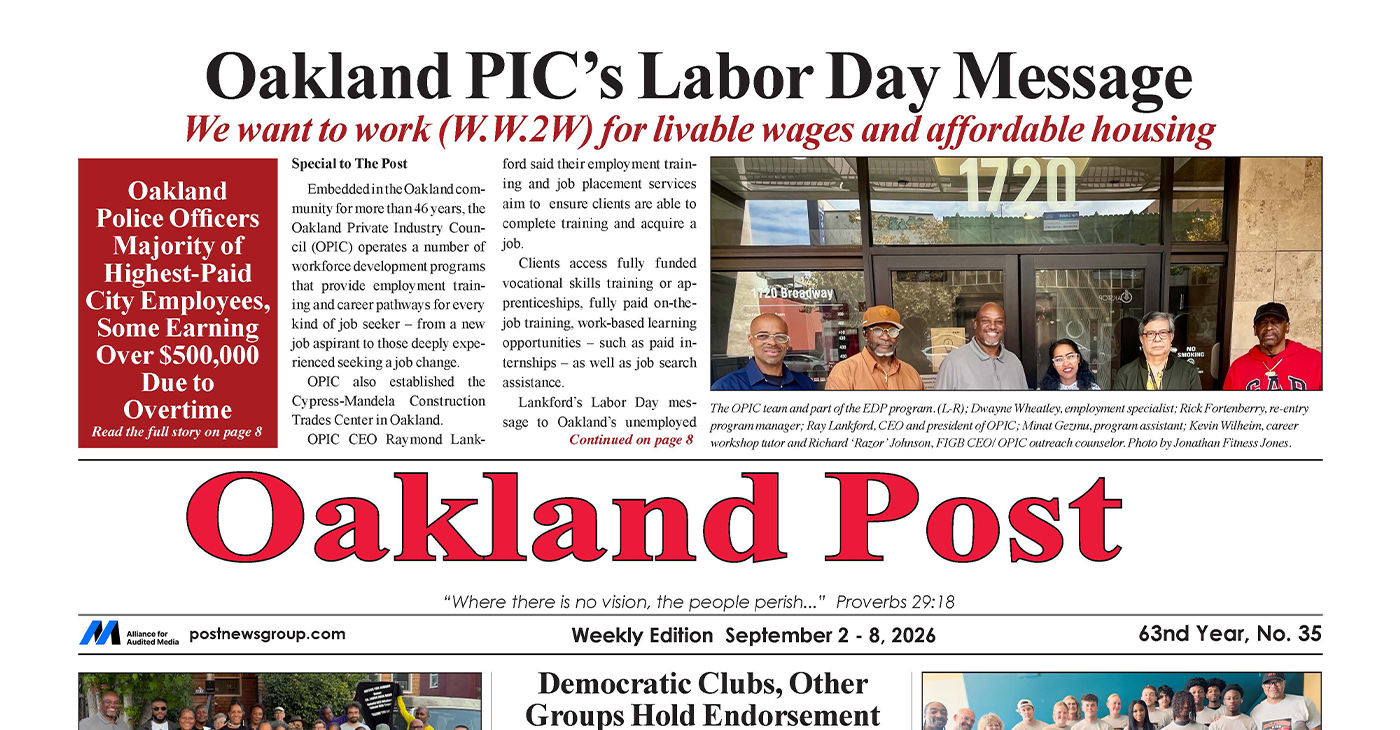
To enlarge your view of this issue, use the slider, magnifying glass icon or full page icon in the lower right corner of the browser window.



Doulas Are Helping Black California Moms Navigate Pregnancy–Even as High Mortality Rates Persist

Newsom Signs Addictive Social Media Law to Protect Kids

On Your November Ballot: Prop 38 Would Allocate $8.4 Billion to Immunology and Immunotherapy Funding

Ask California: Golden State Releases New AI Chatbot

Asm. Isaac Bryan’s Bill Banning California Police From ICE Side Jobs Reaches Newsom’s Desk

Assemblymember LaShae Sharp-Collins’s Bill Would Pause Law Enforcement’s Use of Shock Gloves Pending Study

BOOK REVIEW: ‘Laws of Solomon’ Reveals Tender Heart of Former Child Soldier

OPINION: The New American Fear – From 9-11 to AI

Passing for White, Fighting for Black America: The Courage of Walter White

Oakland People’s Arms Embargo Coalition Demands End to Military Shipments Thru Oakland

Barbara Lee Mourns Gloria Steinem, Remembers a Friendship Rooted in Equality

Event Preview: ‘Fashion v. Fascism’ – A Runway Revolution Is Coming to the Bay Area

Two Looming Threats Every Alameda County Elder Should Know About

Oakland Mayor Reads to Children at Bookout Block Party at Marcus Books Store

Tradition Comes to the Streets in 11th Annual Black-Eyed Pea Festival at the Freedom Farmers Market

Less Affluent School Districts, Including Sacramento City, Face Threat of State Takeover

ESSAY: California Can Close Its Colorectal Cancer Gap

California Hispanic Chambers of Commerce Unveils: ‘Powering the Future’ Theme for 47th Annual Statewide Convention

Four Candidates, Including Incumbent Barbara Lee, Qualify for Oakland Mayor’s Race

Oakland Post: Week of August 12 – 18, 2026

From Blueprint to Breakthrough: Tackling Affordable Housing in Oakland

Oakland Observes Black August with Block Parties, Film Showings, Workshops

COMMENTARY: Why Local School Tax Measure G1 Will Not Be on the November Ballot

Standoff for Justice: Our Homes Are Worth Fighting For

Returning to Its Roots, the Oakland Black-Eyed Pea Festival Partners with the Freedom Farmers Market Sept. 12

NPRC Scores First Advocacy Victory: David Shaw Finally Gets His Wish to ‘Go Home’

Oakland Post: Week of August 26 – September 1, 2026

Frontier Airlines’ Return to Oakland Airport Brings Flights, Jobs and Opportunity

Gubernatorial Candidate Steve Hilton Blasts California New Tire Rules; Newsom Hits Back

Chef Sharon Lee Blends Culinary Excellence, Education and Empowerment

The Conversation With Al McFarlane 6/23/26

Media Monday 6/22/26

LIVE! ASK ALMA! — TUES. 6.23.26 7PM EST

Car Buying Secrets: 4 Hidden Checks Before You Sign!

Is This 550 HP Charger Worth YOUR Money? AutoNetwork Review

Celebrating Juneteenth – Frederick Douglass on education and resistance

LIVE! — ASK ALMA! — TUES. 6.19.26 7PM EST

Hyundai Ioniq 5 Parking, Safety, and 360 View #shorts

2025 Ioniq 5 New Wiper & Powerful Performance! #shorts

Electric SUV Range: Is 259 Miles Enough? #shorts

EV Charging: How Fast Can You Charge an Electric Vehicle? #shorts

Biometric Cooling… Messaging Seats…Come on! 2025 Infiniti QX80 Autograph 4WD

Charged Up: Witness the Magic of a Fully Electric Car! #shorts

Range Rover Sport PHEV Included…: See What’s Inside This Luxury SUV! #shorts

Invisible Hood View: Perfect Parking with X-Ray Vision! #shorts
-
 Commentary4 weeks ago
Standoff for Justice: Our Homes Are Worth Fighting For
-
 Activism4 weeks ago
Oakland Post: Week of August 26 – September 1, 2026
-
 Business4 weeks ago
Frontier Airlines’ Return to Oakland Airport Brings Flights, Jobs and Opportunity
-
 Business4 weeks ago
Gubernatorial Candidate Steve Hilton Blasts California New Tire Rules; Newsom Hits Back
-
 Business4 weeks ago
Chef Sharon Lee Blends Culinary Excellence, Education and Empowerment
-

 Education4 weeks ago
Gov. Newsom’s Latest Appointees Include Sacramento Advocate for Formerly Incarcerated Students; State’s New Tech Chief
-

 Community4 weeks ago
Big City Mayors Ask for “Yes” Vote on Housing Bond Measure; Conservatives Say “No”
-

 Business4 weeks ago
Oakland Coliseum Project Opens Door for Small Businesses to Build Bigger
