
Opinion
Opinion: South Carolina Heads Down a Dead-end Street in Rejecting Medicaid Expansion


South Carolina’s James Louis Petigru was a Civil War-era lawyer, judge, congressman and most notably the attorney general who opposed South Carolina’s use of nullification of federal laws and, after Abraham Lincoln was elected president in 1860, opposed state secession.
He famously quipped, after learning that his state had seceded from the Union, “South Carolina is too small to be a republic and too large to be an insane asylum.”
While not insane, the state was a little nutty when it rejected Medicaid expansion under the Affordable Care Act (ACA). South Carolina has one of the highest percentages of uninsured people in the country.
The leaders of the state are leading the people down a dead-end street. They support tax cuts for the rich and health care cuts for the poor. South Carolina is a red state with blue needs — more health care, less poverty, better schools and fewer jails.
Nikki Haley, the former governor of South Carolina and President Donald Trump’s former ambassador to the United Nations, was born in Bamberg, South Carolina, a small city of approximately 3,600 people.
The Bamberg County Hospital, where Haley was born, closed on April 30, 2012 for lack of money. Not only did people lose health services but Bamberg County Hospital workers lost their jobs.

Many other small rural hospitals and workers faced the same fate in South Carolina when the state rejected the $10 billion over 10 years it would have received if it had expanded Medicaid.
A recent article in the Greenville News reported that when hospital beds fill up in the state, patients are boarded in emergency rooms. It is inhumane and economically foolish and morally wrong to argue against expanding Medicaid when 50,000 jobs and greater health care is involved.
Arguing against keeping rural hospitals open, like Bamberg County, makes no sense. It’s arguing for sickness and unnecessary death.
It’s a national problem, but recently South Carolina’s Greenville News documented the situation locally when 80-year-old Ron Miller of Pickens County collapsed at home two days after surgery and had to be rushed back to the hospital and readmitted. The problem was there were no available beds at that hospital or any of the hospitals in Greenville.
The paper reported, “The phenomenon, called boarding, occurs when hospitals hold patients in the ER until they find a bed for them on a medical floor.” Dr. Ryan Stanton, a spokesman for the American College of Emergency Physicians, an ER physician with Central Emergency Physicians in Lexington, Kentucky, has indicated it’s a growing problem across the nation. It’s a simple problem of supply and demand.
There are more patients than there are beds. A further concern is whether patients forced to stay in the ER for long periods of time have the same equipment made available to them and receive the same level of care that those in hospital beds receive.
Expanding Medicaid could help, but South Carolina is a state that pretends to resent big government and federal dollars, even though 32 percent of its general revenue comes from Washington for education, health care, airports, highways, seaports, the big military presence in the state and more. South Carolina couldn’t exist without federal dollars. It, apparently, just doesn’t want to receive Medicaid funds for its neediest citizens.
There is a better South Carolina on the horizon and Congressman Joe Cunningham (SC-01) is an example. He’s the new Democrat from the Lowcountry and he’s worked to reinstate the ban on offshore drilling, protect Lowcountry jobs from damaging tariffs and fix South Carolina’s ailing infrastructure. On Jan. 3, 2019, he said he was “ready to roll up his sleeves and get to work” and he has. South Carolina needs more Joe Cunninghams.
We all do.

Activism
Oakland Post: Week of September 9 – 15, 2026
The printed Weekly Edition of the Oakland Post: Week of September 9 – 15, 2026


To enlarge your view of this issue, use the slider, magnifying glass icon or full page icon in the lower right corner of the browser window.

Activism
Oakland Post: Week of September 2 – 8, 2026
The printed Weekly Edition of the Oakland Post: Week of September 2 – 8, 2026
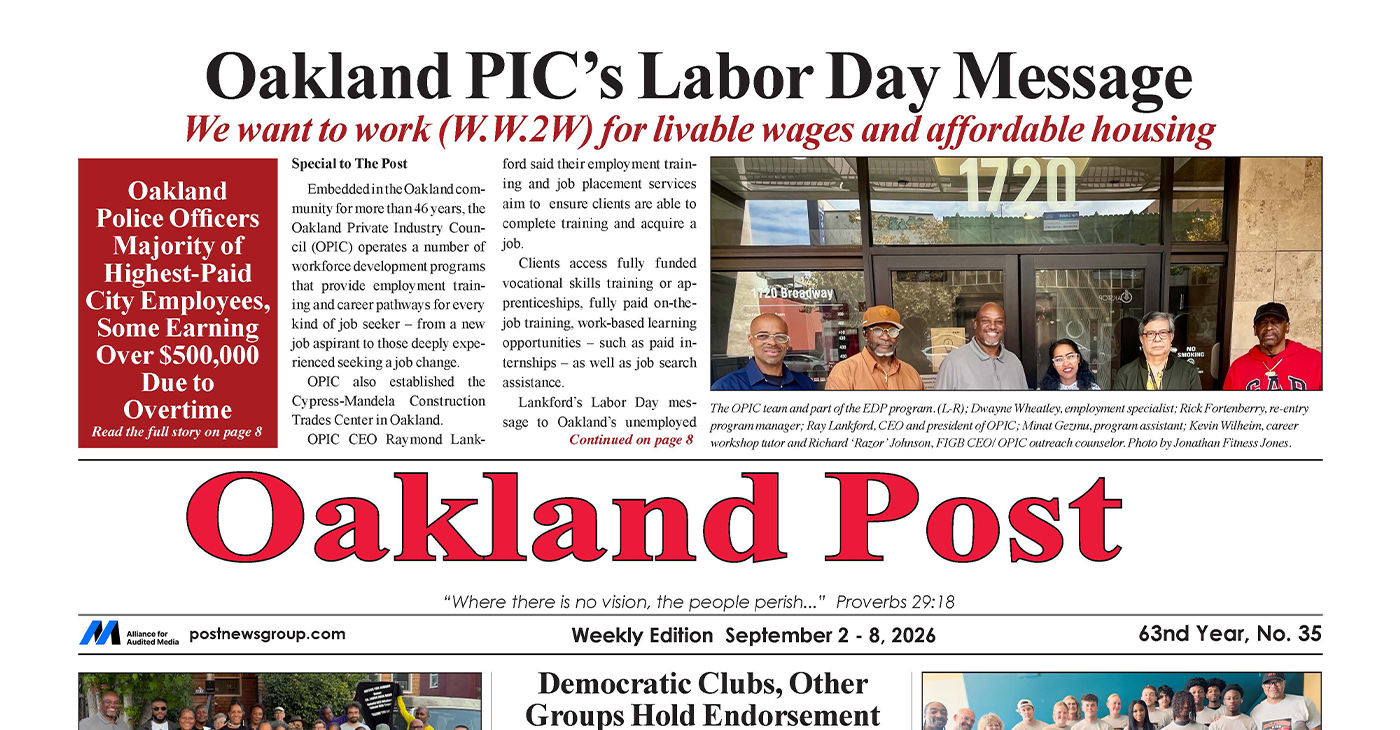
To enlarge your view of this issue, use the slider, magnifying glass icon or full page icon in the lower right corner of the browser window.
Activism
Oakland Post: Week of August 26 – September 1, 2026
The printed Weekly Edition of the Oakland Post: Week of August 26 – September 1, 2026
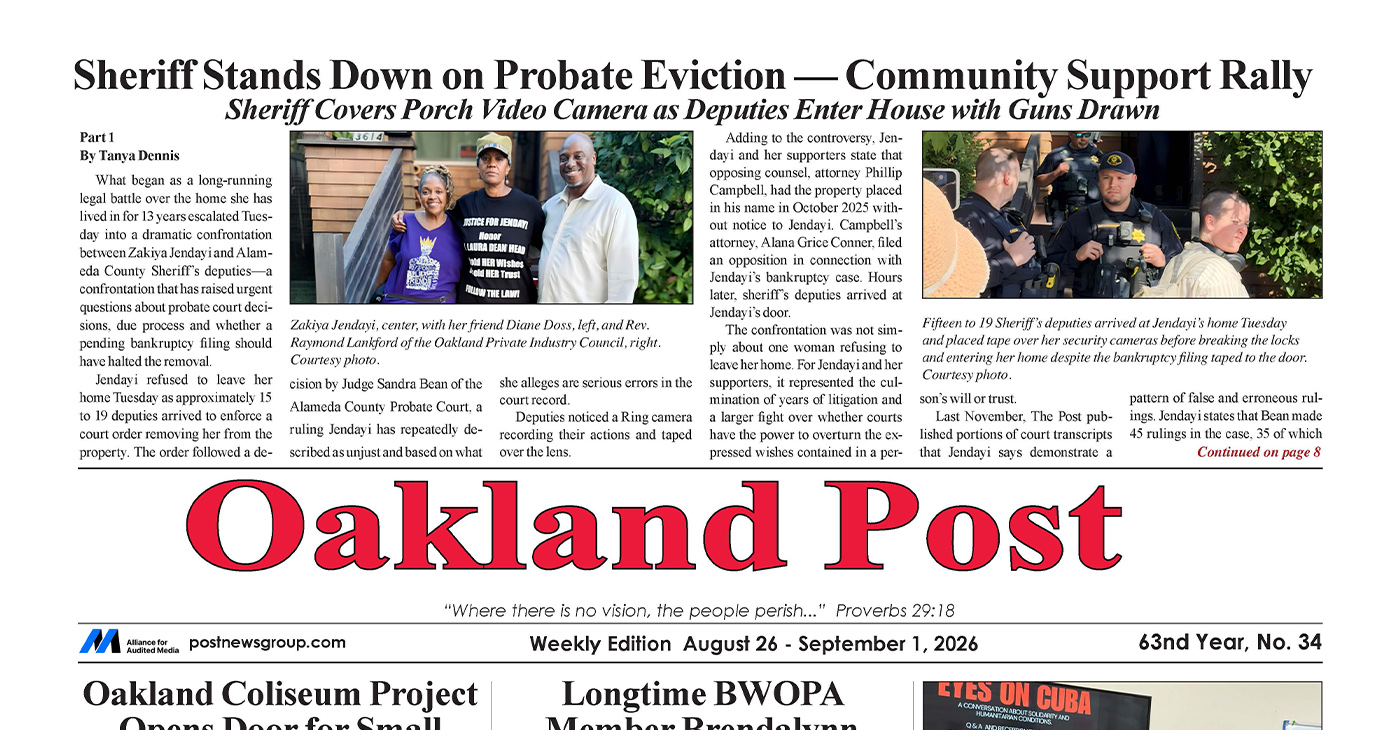
To enlarge your view of this issue, use the slider, magnifying glass icon or full page icon in the lower right corner of the browser window.



Port of Oakland, Army Corps Sign Historic Harbor Design Agreement

Democratic Clubs Interview Candidates for Oakland School Board

Nuna Phillips-McKee Celebrates 100 Years: ‘A Century of Faith, Family and God’s Amazing Grace!’

D.A. Ursula Jones Dickson: Terminix to Pay $3.15 Million Over Illegal Disposal of Pesticides, Customer Records

REPORT: Community Level Policy Is Impacting Homelessness and Drug Abuse in California
OPINION: AI Needs to Know Who Is the Boss
Goldi-Locs and Two (or Three) Bears in the Forest in California Hills

Election Watch 2026: 85% of Eligible Voters in California Are Registered

Don’t Let scammers Crash Your School Year

BOOK REVIEW — Curved Air: A Biography of Sickle Cell Anemia and the Quest to Cure the First Molecular Disease

California’s Legal Cannabis Market Hits $8 Billion as State Touts Progress on Fighting Drugs, Crime

Blacks and Latinos Clash Over LA’s Barrio Run; Mayor Karen Bass Calls for Dialogue Across Racial, Neighborhood Lines

Asm. Smallwood-Cuevas’s Bill Repealing ‘Racist’ CalWORKs ‘Man-in-the-House’ Rule Clears Legislature

Asm. Smallwood-Cuevas’s Bill Repealing ‘Racist’ CalWORKs ‘Man-in-the-House’ Rule Clears Legislature

‘Ready to See These Bills Become Law’: Sen. Weber’s Package of 15 Bills Advance to Gov. Newsom’s Desk

Department of Homeland Security Demands California Secretary of State Shirley N. Weber Scrub Voter Rolls

New Judge Could Decide if Karmelo Anthony Gets a New Trial

“The Power to See Threats Sooner”: Gov. Newsom, Safety Officials Showcase California’s Investments in Hi-Tech Wildfire Prevention

Alpha Kappa Alpha Sorority, Inc. Celebrates New North Atlantic Regional Director

California Sen. Padilla Joins Colleagues to Introduce Bill Imposing Term Limits on Supreme Court Justices

Less Affluent School Districts, Including Sacramento City, Face Threat of State Takeover

Car Wash Workers Cope with Lingering Impacts of ICE Raids

Oakland Post: Week of July 29 – August 4, 2026

How Oakland’s Courtsmith is Scaling its Business and Local Impact

ESSAY: California Can Close Its Colorectal Cancer Gap

Oakland Post: Week of August 5 – 11, 2026

As Part of Your Back-to- School Checklist, Vaccinate

Oakland ‘Port Serves as a Powerful Engine for Good Jobs and Economic Development

Gov. Newsom Signs New Affordable Housing Legislation

Gov. Newsom Announces $109.6 Million in Funding for 278 Supportive Homes in Bakersfield, Contra Costa, Sacramento and Fresno

The Conversation With Al McFarlane 6/23/26

Media Monday 6/22/26

LIVE! ASK ALMA! — TUES. 6.23.26 7PM EST

Car Buying Secrets: 4 Hidden Checks Before You Sign!

Is This 550 HP Charger Worth YOUR Money? AutoNetwork Review

Celebrating Juneteenth – Frederick Douglass on education and resistance

LIVE! — ASK ALMA! — TUES. 6.19.26 7PM EST

Hyundai Ioniq 5 Parking, Safety, and 360 View #shorts

2025 Ioniq 5 New Wiper & Powerful Performance! #shorts

Electric SUV Range: Is 259 Miles Enough? #shorts

EV Charging: How Fast Can You Charge an Electric Vehicle? #shorts

Biometric Cooling… Messaging Seats…Come on! 2025 Infiniti QX80 Autograph 4WD

Charged Up: Witness the Magic of a Fully Electric Car! #shorts

Range Rover Sport PHEV Included…: See What’s Inside This Luxury SUV! #shorts

Invisible Hood View: Perfect Parking with X-Ray Vision! #shorts
-

 Community4 weeks ago
Four Candidates, Including Incumbent Barbara Lee, Qualify for Oakland Mayor’s Race
-

 Activism4 weeks ago
Oakland Post: Week of August 12 – 18, 2026
-

 Black History4 weeks ago
Oakland Observes Black August with Block Parties, Film Showings, Workshops
-

 Commentary4 weeks ago
COMMENTARY: Why Local School Tax Measure G1 Will Not Be on the November Ballot
-

 Commentary2 weeks ago
Standoff for Justice: Our Homes Are Worth Fighting For
-

 Business2 weeks ago
Gubernatorial Candidate Steve Hilton Blasts California New Tire Rules; Newsom Hits Back
-

 Activism2 weeks ago
Oakland Post: Week of August 26 – September 1, 2026
-

 Education2 weeks ago
Gov. Newsom’s Latest Appointees Include Sacramento Advocate for Formerly Incarcerated Students; State’s New Tech Chief
