
Opinion
Opinion: School District Gives Science Teacher Less and Less Time to Teach Students


Recently I sat down to update my resume. See if you can guess my job:
- Promoted and ran online fundraising campaign securing $2,500.00 for equipment from outside parties.
- Designed and implemented behavior logging system using google sheets and sites, allowing users to submit and track site wide behavior data and identify trends in behaviors.
- Presented portfolio of materials to a panel of stakeholders to secure renewal of grant funding.
- Managed tech repair and support program ensuring 40 Chromebooks were kept charged, updated, and functional for daily use.
- Assembled, maintained and repaired equipment and laboratory apparatus for usage 2 times a week.
- Organized and managed chemical storage, including filing inventory and safety documentation.
- Repaired and maintained a 50-year-old heating system.
After seeing this list of responsibilities, your first guess was probably not high school science teacher. You might notice some significant items are missing, like teaching, lesson planning, and grading for 200 students across six classes.
In the five years since I began teaching, my list of job responsibilities has grown to be quite diverse and impressive. However, it has also become less and less recognizable.
A teacher today can easily fill half a page of their resume with roles and responsibilities without even using the words “teach” or “student.” This is not to say that a teacher does not think of their students and effective teaching as their primary focus.

But, as school budgets shrink ever smaller, school support staff are often the first to go. This leaves many tasks that are essential to the functioning of a school to the only people who are left, the teachers.
I did not volunteer or apply to be a fundraising campaign manager, but the alternative option was no lab equipment for my high school physics course.
The time spent creating wish lists, posting on social media, following up with donors were hours that were not spent on creating engaging lessons, providing students with personal feedback, or reaching out to parents.
If we truly value education, we should be demanding that our leaders work for changes that make a teacher’s responsibility teaching their students.
I would clear out all of the bullet points above if tomorrow it meant that I could replace them with:
- Plans and executes engaging and personalized lessons to a diverse student body in a warm and welcoming classroom with 100 percent of students achieving passing grades.
My resume might end up looking a little empty, but I could always double space.

Arts and Culture
COMMENTARY: Black Music is the Sound of Black Freedom: Let Us Reclaim Both This Juneteenth
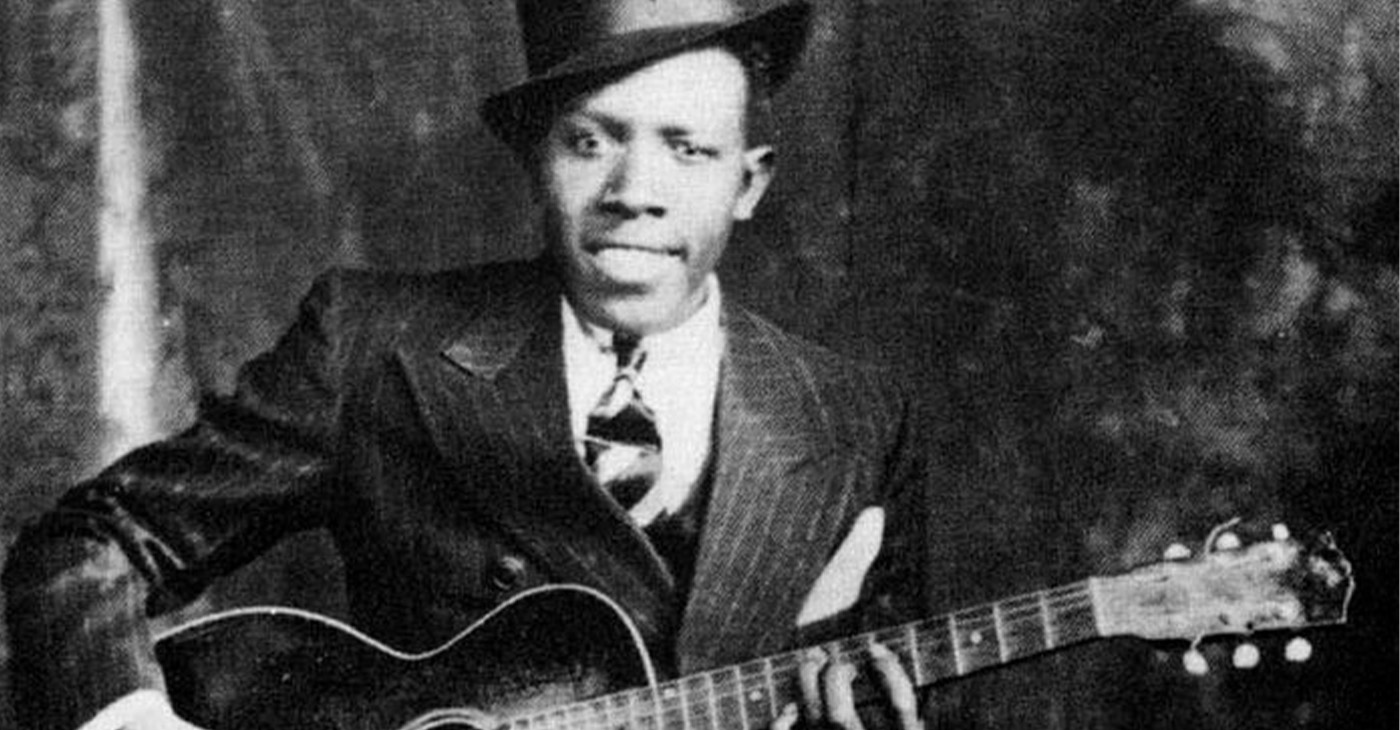
Black Music Month started when Black Music Association members Ed Wright, Kenny Gamble and his wife, journalist and radio host Dyanna Williams were able to persuade President Jimmy Carter to establish the observation on June 7, 1979.

By Wanda Ravernell
Black Music Month and Juneteenth are inextricably linked – Black music is the sound of our freedom.
From the plaintive moans of the enslaved Africans’ ‘sorrow songs,’ to the fields of Civil War battle where Black soldiers picked up abandoned bugles, to the upright piano played in juke joints on Saturday night and churches come Sunday morning, our ancestors’ innovation in the face of want, fear, degradation, and hopelessness has yielded genres of music imitated ’round the world.
Black Music Month started when Black Music Association members Ed Wright, Kenny Gamble and his wife, journalist and radio host Dyanna Williams were able to persuade President Jimmy Carter to establish the observation on June 7, 1979.
In 2000, Congress made it official. In 2009, Pres. Barack Obama changed the name to African American Music Heritage Month and in 2023, Pres. Joe Biden changed it back to Black Music Month, two years after he declared Juneteenth a national holiday, the result of a movement led by Opal Lee.
Our ancestors battle for freedom over these last 400 years and the music that allowed them expression of their humanity deserved to be honored.
But we may be losing sight of the value of their sacrifices.
‘Sing a Song Full of the Faith That the Dark past Has Taught Us…’
Along with the long-known exploitation of Black musicians whose recordings were stolen by record companies, the commercialization of Juneteenth feels like another kind of theft.
I had never heard of Juneteenth until I moved to the Bay Area from my hometown of Philadelphia. I didn’t know it was one of many freedom festivals celebrated by descendants of enslaved people in the United States.
Emancipation Day was Jan. 1 in Pennsylvania, April 16 in Wash., D.C., May 20 in Florida, and Aug. 8 in Kentucky. But Juneteenth, June 19, has the most renown, known in Texas as the ‘colored peoples’ Fourth of July.’
It was marked by parades, beauty pageants, rodeos, backyard barbecues and church picnics.
Yes, church.
The formerly enslaved began the day praying in thanks for their freedom just as they had prayed for Jubilee – the day of freedom – when they had chains on their feet and hands. They ‘testified’ about their past suffering and how they had managed to overcome.
And they sang.
Although, we will not hold it this year, Omnira Institute’s Juneteenth Ritual of Remembrance recalled this part of Juneteenth with prayers in the languages of the African captives. In the middle of the ceremony, a soloist would lead us in singing “Many Thousand Gone” while we took turns reciting portions of the Emancipation Proclamation, the news of freedom that took more than two years to reach Texas – two months after the Civil War ended.
“Many Thousand Gone” was famously recorded by Black luminary Paul Robeson in 1947:
“No more auction block for me,
No more, no more
No more auction black for me
Many thousand gone.”
Other verses refer to the ‘pint of salt’ and the ‘driver’s lash,’ the realities of enslavement that they had survived.
‘Sing a Song Full of the Hope That the Present has Brought Us’
All of the genres of African American music have at their root songs like that, the essence being, as Stevie Wonder, wrote, “the joy inside our pain.” So Black music is not just music. It is our story, our history, our very strength.
During the Civil Rights Movement, which peaked 100 years after slavery ended, the people testified that it was the freedom songs – based on spirituals – that gave them the heart to march, face attack dogs, fire hoses, beatings, and shootouts with vigilantes.
The music reminded them that power was in the people. That music, our music, can do so again. We don’t have to accept the commodification of the products of our culture.
The power of those songs is showing a resurgence across the South as we battle again for the right to self-determination through the ballot box.
Those songs are the voices of our ancestors, voices forged in their blood, their sweat, their tears, joy and, above all, faith. Those songs, those prayers live in our blood and our very breath.
This Juneteenth, let us reclaim those holy voices expressed in Black music for ourselves. It is our birthright. It can neither be bought nor sold. No more. Never again.
Wanda Ravernell is the executive director of Omnira Institute, sponsor for 18 years of the Juneteenth Ritual of Remembrance and Oakland’s 11th Annual Black-Eyed Pea Festival, which will take place on Sept. 12.

Activism
Oakland Post: Week of June 3 – 9, 2026
The printed Weekly Edition of the Oakland Post: Week of June 3 – 9, 2026
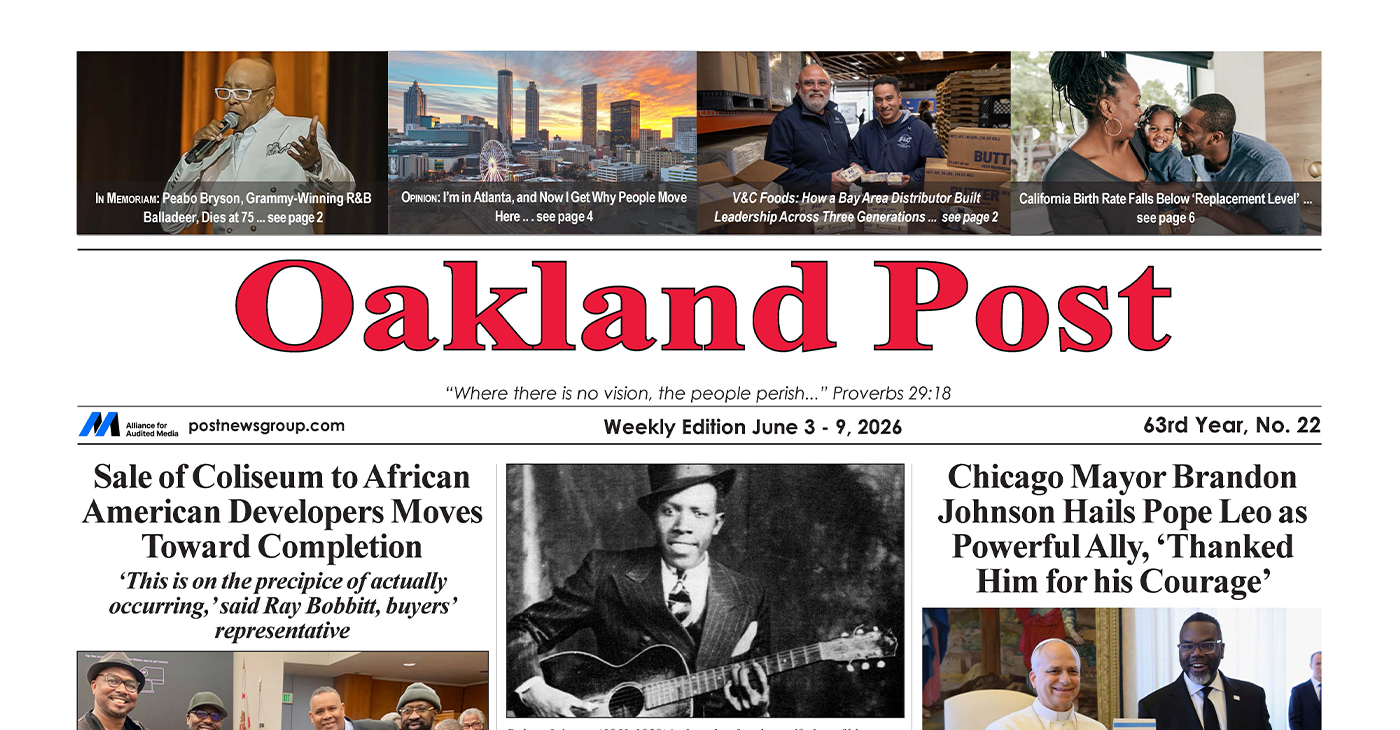
To enlarge your view of this issue, use the slider, magnifying glass icon or full page icon in the lower right corner of the browser window.
Activism
Oakland Post: Week of May 27 – June 2, 2026
The printed Weekly Edition of the Oakland Post: Week of May 27 – June 2, 2026
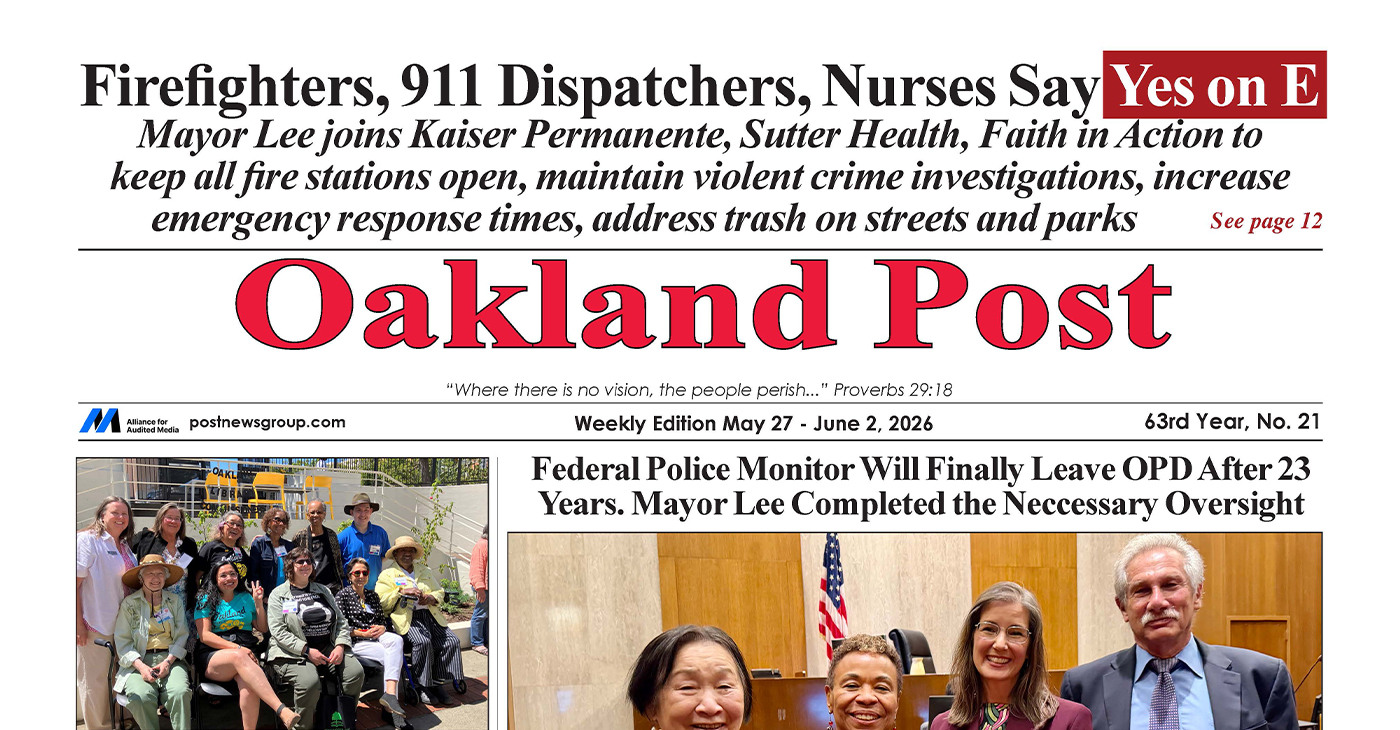
To enlarge your view of this issue, use the slider, magnifying glass icon or full page icon in the lower right corner of the browser window.

WORK FROM HOME
Home-based business with potential monthly income of $10K+ per month. A proven training system and website provided to maximize business effectiveness. Perfect job to earn side and primary income. Contact Lynne for more details: Lynne4npusa@gmail.com 800-334-0540


COMMENTARY: Black Music is the Sound of Black Freedom: Let Us Reclaim Both This Juneteenth

Oakland Post: Week of June 3 – 9, 2026

Study: Waiting Lists for Child Care Assistance Nearly Doubled

Venus Williams Calls a Sabalenka Exit a Tragedy

COMMENTARY: Using Art, Healing, And Community to Transform Mental Health Dialogue

Uptown Music Theatre Summer Camp Returns to Inspire the Next Generation of Performers

5 Cleveland Police Officers Injured, Gunfire Erupts During East Side Pursuit

15-YEAR-OLD COLUMBUS GIRL DIES, Community Mourns as Authorities Urge Water Safety Awareness

Let’s Talk Karmelo Anthony!

2026 World Cup is Here and Atlanta is Ready For It

COMMENTARY: What Andrew Young Reminded Me About Baltimore

COMMENTARY: When Politics Intersects with Professional Sports

K4: Crucial Driving Advice BEFORE You Buy! #shorts
The Conversation with Al McFarlane – MINNESOTANS ORGANIZING FOR CHANGE
Negotiate Car Add-Ons: Don’t Get Ripped Off! #shorts

Book Review: Books for College-Bound Students

Against All Odds: Mary Jackson’s Journey to NASA Engineer

Up to the Job: How San Francisco’s PRC Is Providing Work Opportunities That Turn Into Lasting Stability

Q&A with Steven Bradford: Why He Wants Your Vote for California Insurance Commissioner

OPINION: The Fire of Oakland’s Justin Jones

The Marin City Flea Market Is Back

California Launches Free Diaper Program for Newborns Statewide

EBMUD Enshrines the Legacy of its First Black Board Member William ‘Bill’ Patterson

OP-ED: Small Businesses Need Minnesota to Act on Pass-Through Tax Policy

The Ladies of Delta Sigma Theta Hold Day of Advocacy at the Capitol in Sacramento

Snoop Dogg Celebrates 10 Til’ Midnight at the Compound

Oakland Post: Week of May 6 – 12, 2026

2026 Lucid Air Grand Touring Review — Is This $136K EV Sedan Worth It?

Oakland Mayor Pushes Charter Overhaul to Clarify Roles in City Government, Increase Accountability and Improve Service Delivery

Marin City Public Housing Residents Demand a Voice in County’s Renovation Plans

Hyundai Ioniq 5 Parking, Safety, and 360 View #shorts

2025 Ioniq 5 New Wiper & Powerful Performance! #shorts

Electric SUV Range: Is 259 Miles Enough? #shorts

EV Charging: How Fast Can You Charge an Electric Vehicle? #shorts

Biometric Cooling… Messaging Seats…Come on! 2025 Infiniti QX80 Autograph 4WD

Charged Up: Witness the Magic of a Fully Electric Car! #shorts

Range Rover Sport PHEV Included…: See What’s Inside This Luxury SUV! #shorts

Invisible Hood View: Perfect Parking with X-Ray Vision! #shorts

AI Is Reshaping Black Healthcare: Promise, Peril, and the Push for Improved Results in California

ESSAY: Technology and Medicine, a Primary Care Point of View

Sanctuary Cities

The RESISTANCE – FREEDOM NOW

STATE OF THE PEOPLE: Freddie

ECONOMIC BOYCOTT DAY!!!!!

I told You So
-
 Advice3 weeks ago
Book Review: Books for College-Bound Students
-
 Arts and Culture4 weeks ago
Against All Odds: Mary Jackson’s Journey to NASA Engineer
-
 Bay Area3 weeks ago
Q&A with Steven Bradford: Why He Wants Your Vote for California Insurance Commissioner
-
 Activism3 weeks ago
OPINION: The Fire of Oakland’s Justin Jones
-
 Alameda County4 weeks ago
The Marin City Flea Market Is Back
-
 Activism3 weeks ago
California Launches Free Diaper Program for Newborns Statewide
-
 Activism4 weeks ago
EBMUD Enshrines the Legacy of its First Black Board Member William ‘Bill’ Patterson
-
 Activism3 weeks ago
The Ladies of Delta Sigma Theta Hold Day of Advocacy at the Capitol in Sacramento
