
Activism
OPINION: Oakland Could Take More Innovative Steps to Help Solve Homelessness
We must ensure that we are able to build sufficient housing, especially that which is affordable. Oakland is currently producing under 10% of our state Regional Housing Needs Assessment (RHNA) requirements for very low-income housing; in contrast, we have met our goals for market-rate housing.


By Janani Ramachandran
First, we must conduct a comprehensive audit of where our homelessness dollars are being spent. The recent City Auditor’s report revealed $69 million was spent on homelessness services for 8,600 people over the past three years – yet at least half the participants are believed to have returned to homelessness. We must conduct a deep dive into the third-party entities receiving homelessness contracts and to what extent they use evidence-based models of homelessness reduction.
Second, we must establish a regional board across all neighboring East Bay towns because homelessness certainly crosses borders, and the financial costs of assisting our unhoused while building affordable housing should not exclusively fall on Oakland. We must develop a plan to build on land owned by cities, CalTrans, BART, EBMUD, and other public agencies. A regional strategy must also include better partnership with the Alameda County Board of Supervisors, which is primarily responsible for providing meaningful mental health and addiction services. Oakland must ensure that our residents in need are able to access the County’s supportive services, regardless of language or technological barriers, and not waste funds duplicating efforts.
Third, we must ensure that we prioritize homelessness prevention, whether tenants or homeowners, from losing their homes. The city should re-allocate some of its homelessness dollars to provide emergency vouchers to at-risk individuals, prioritizing households with children and elders.

Finally, we must ensure that we are able to build sufficient housing, especially that which is affordable. Oakland is currently producing under 10% of our state Regional Housing Needs Assessment (RHNA) requirements for very low-income housing; in contrast, we have met our goals for market-rate housing.
There’s little doubt as to why – it’s expensive. Each unit of permanent housing may cost up to $500,000 to build. The elimination of redevelopment agencies under Governor Jerry Brown was a severe blow to Oakland’s ability to build affordable housing, and we must compensate for that by ensuring developers pay their fair share.
This involves drafting an inclusionary zoning ordinance (moving away from the current tiered “in-lieu fee” system) to ensure that developers either include a percentage of affordable units in new buildings, or pay an impact fee, up front and at the start of construction, that directly funds other affordable housing projects.
But the private sector should not shoulder this burden alone – we must be more proactive in applying for competitive state and federal funds. This will require our city to streamline internal processes to help nonprofit or private developers secure local funding (which is generally the first step in applying for state and federal grants) with predictable deadlines.
Underlying all of these priorities, our policymakers must shift their perspective and recognize that those who are housing-insecure or unhoused are not a monolith. There’s no one-size-fits-all solution, but my stated priorities will hopefully begin to move us forward in the right direction.
Janani Ramachandran is a public interest attorney and former Oakland Public Ethics Commissioner running for Oakland City Council District 4. For more informationJananiForOakland.com













Activism
Oakland Post: Week of August 5 – 11, 2026
The printed Weekly Edition of the Oakland Post: Week of August 5 – 11, 2026
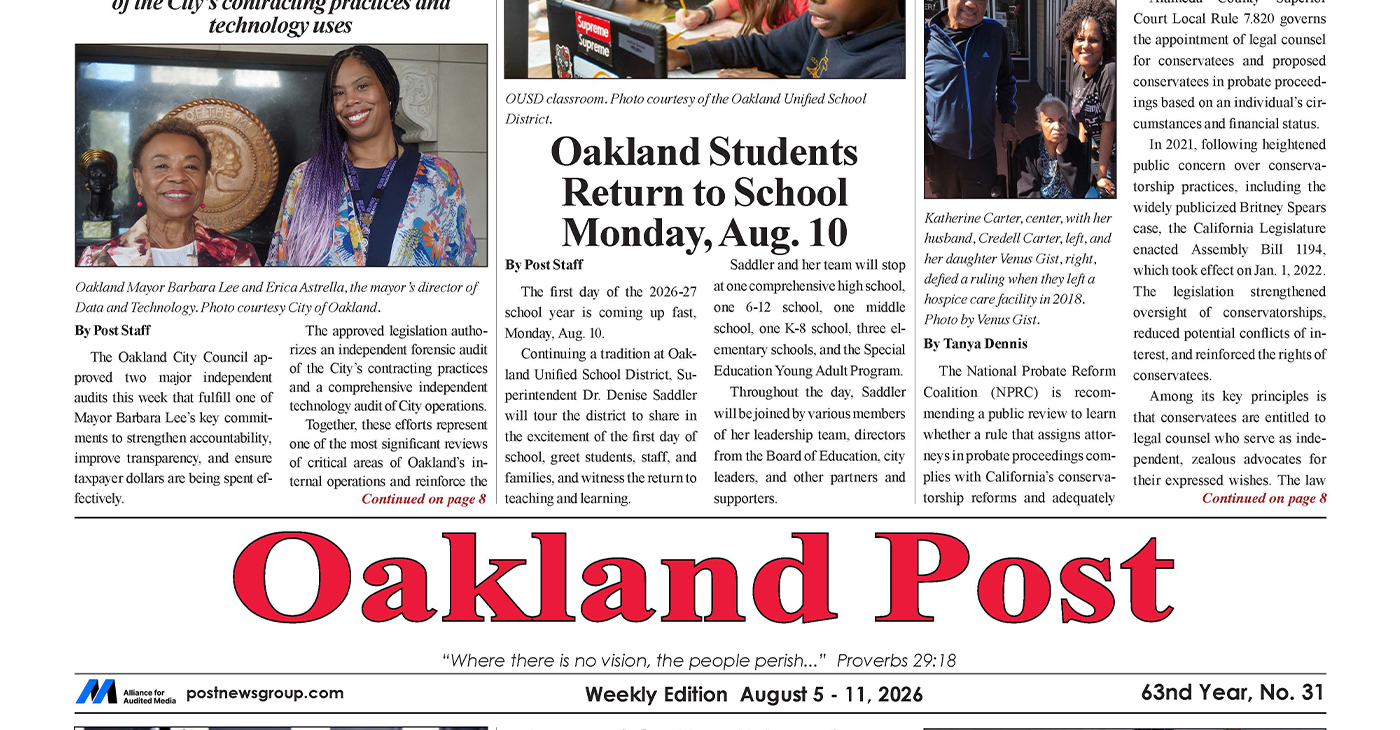
To enlarge your view of this issue, use the slider, magnifying glass icon or full page icon in the lower right corner of the browser window.
Activism
Oakland Post: Week of July 29 – August 4, 2026
The printed Weekly Edition of the Oakland Post: Week of July 29 – August 4, 2026

To enlarge your view of this issue, use the slider, magnifying glass icon or full page icon in the lower right corner of the browser window.
Activism
Oakland Post: Week of July 22 – 28, 2026
The printed Weekly Edition of the Oakland Post: Week of July 22 – 28, 2026

To enlarge your view of this issue, use the slider, magnifying glass icon or full page icon in the lower right corner of the browser window.

WORK FROM HOME
Home-based business with potential monthly income of $10K+ per month. A proven training system and website provided to maximize business effectiveness. Perfect job to earn side and primary income. Contact Lynne for more details: Lynne4npusa@gmail.com 800-334-0540


Car Wash Workers Cope with Lingering Impacts of ICE Raids

Misty Copeland Shapes Ballet’s Tomorrow

As Part of Your Back-to- School Checklist, Vaccinate

As Part of Your Back-to- School Checklist, Vaccinate

Congresswoman Simon Demands Investigation into Trump’s Abuse of Emergency Powers for Coal Export Terminal in West Oakland

OPINION: The Philippines Isn’t Foreign When Your Family Still Lives There

Asm. McKinnor’s Bill Banning Drones Above Outdoor Entertainment Events Awaits Senate Decision

California Sen. Padilla Joins Colleagues to Introduce Bill Imposing Term Limits on Supreme Court Justices

Department of Homeland Security Demands California Secretary of State Shirley N. Weber Scrub Voter Rolls

George Cook: The Inventor Who Made Fishing Smarter

Gov. Newsom Announces $109.6 Million in Funding for 278 Supportive Homes in Bakersfield, Contra Costa, Sacramento and Fresno

Rep. Kamlager Dove Demands Care, Justice for Man Shot by ICE

“The Power to See Threats Sooner”: Gov. Newsom, Safety Officials Showcase California’s Investments in Hi-Tech Wildfire Prevention

100 Black Wings’ Team Oakland Youth Athletes Heading to Taiwan for 2026 International Children’s Games

Oakland ‘Port Serves as a Powerful Engine for Good Jobs and Economic Development
Department of Homeland Security Demands California Secretary of State Shirley N. Weber Scrub Voter Rolls

Oakland Children’s Hospital Workers and Patients Rally for Pediatric Medical Care

New Judge Could Decide if Karmelo Anthony Gets a New Trial
“The Power to See Threats Sooner”: Gov. Newsom, Safety Officials Showcase California’s Investments in Hi-Tech Wildfire Prevention

Alpha Kappa Alpha Sorority, Inc. Celebrates New North Atlantic Regional Director

Surveillance Pricing Fight: State Senate Debates Bill Banning Retailers from Using AI to Set Prices Based on a Buyer’s Profile

Mount Zion MBC, Church of Jesus Christ of Latter-day Saints Partner to Bring 29,000 Meals to Alameda County
California Sen. Padilla Joins Colleagues to Introduce Bill Imposing Term Limits on Supreme Court Justices

Starting This Summer, California Car Buyers Can Get an Instant $3500 Off the Cost of Electric Vehicles

COMMENTARY: You Are Already Paying for the AI Boom

California Bill Would Let Abuse Victims Use Trauma as Legal Defense for Violent Crime

Fed Court to Decide Landmark First Amendment Case

Gov. Gavin Newsom Signs Law Streamlining Affordable Housing Rules

Oakland Celebrates $125 Million Coliseum Sale
Car Wash Workers Cope with Lingering Impacts of ICE Raids

The Conversation With Al McFarlane 6/23/26

Media Monday 6/22/26

LIVE! ASK ALMA! — TUES. 6.23.26 7PM EST

Car Buying Secrets: 4 Hidden Checks Before You Sign!

Is This 550 HP Charger Worth YOUR Money? AutoNetwork Review

Celebrating Juneteenth – Frederick Douglass on education and resistance

LIVE! — ASK ALMA! — TUES. 6.19.26 7PM EST

Hyundai Ioniq 5 Parking, Safety, and 360 View #shorts

2025 Ioniq 5 New Wiper & Powerful Performance! #shorts

Electric SUV Range: Is 259 Miles Enough? #shorts

EV Charging: How Fast Can You Charge an Electric Vehicle? #shorts

Biometric Cooling… Messaging Seats…Come on! 2025 Infiniti QX80 Autograph 4WD

Charged Up: Witness the Magic of a Fully Electric Car! #shorts

Range Rover Sport PHEV Included…: See What’s Inside This Luxury SUV! #shorts

Invisible Hood View: Perfect Parking with X-Ray Vision! #shorts
-
 Featured5 days ago
Department of Homeland Security Demands California Secretary of State Shirley N. Weber Scrub Voter Rolls
-
 Business3 weeks ago
Oakland Children’s Hospital Workers and Patients Rally for Pediatric Medical Care
-
 #NNPA BlackPress2 weeks ago
New Judge Could Decide if Karmelo Anthony Gets a New Trial
-
 Environment5 days ago
“The Power to See Threats Sooner”: Gov. Newsom, Safety Officials Showcase California’s Investments in Hi-Tech Wildfire Prevention
-
 Black History2 weeks ago
Alpha Kappa Alpha Sorority, Inc. Celebrates New North Atlantic Regional Director
-
 Business3 weeks ago
Surveillance Pricing Fight: State Senate Debates Bill Banning Retailers from Using AI to Set Prices Based on a Buyer’s Profile
-
 Business3 weeks ago
Mount Zion MBC, Church of Jesus Christ of Latter-day Saints Partner to Bring 29,000 Meals to Alameda County
-
 Featured5 days ago
California Sen. Padilla Joins Colleagues to Introduce Bill Imposing Term Limits on Supreme Court Justices
