
Activism
Opinion: John Lewis, C.T. Vivian Together Helped Start Voting Rights Movement, Died on Same Day in Atlanta Commentary

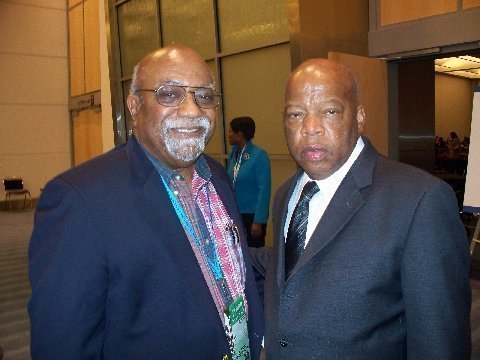
The news of the passing of two veteran Civil Rights leaders and giants John Lewis and C.T.Vivian, on the same day, jolted the nation’s consciousness, especially around the need for Blacks and other minorities to continue to register, vote and fully participate in the census to assure our voices are heard. They were considered “prophetic activist pathfinders” in the biblical tradition of Jeremiah “running to and fro through the streets, looking for a man to execute justice.”
They together added their voices, “made trouble” and were persecuted along with Daisy Bates, Septima Clark, Rev. Dr. Martin Luther King, Jr., Medgar and Myrlie Evers, Andrew Young, Fannie Lou Hamer, Rev. Ralph Abernathy, Ella Baker, Rev. Hosea Williams, Dorothy Height, Rev Joseph Lowery, Rosa Parks, Rev. James Lawson, Diane Nash, Rev. James Bevel and Rev. Jesse Jackson helped to birth the Civil Rights movement of the 60’s, and they both died on the same day to join the pantheon of pioneering prophetic voices.
The news of their passing jolted the nation’s consciousness, especially around the need for Blacks and other minorities to continue to register, vote, and fully participate in the census to assure our voices are heard.

They gave their lives to make sure we are counted so that we can benefit when the roll is called in the upcoming November election — and when the trillions of federal dollars are distributed in 2021.
John Lewis, a minister and an Atlanta congressman from Alabama, shed blood in Selma to earn his civil rights icon status. He continued his indefatigable dedication for voting rights, from his participation in SNCC and VEP (Voter Education Project) until the day he died at 80 in Atlanta. Lewis had collaborated with Vivian while studying theology in Nashville, and the two of them were among the original 1961 Freedom Riders seeking to expose racism and to integrate southern facilities.
C.T. Vivian, a minister and Southern Christian Leadership Conference organizer who pioneered the politics of constructive confrontation behavior in employing voter registration strategies, also shed blood in Selma one month before Lewis, when he confronted Sheriff Clark. Both he and Lewis attracted national media coverage for their courageous challenges. Their sacrifices woke up the nation to the fact that Black votes mattered.
Their struggles and deaths remind us of the courageous volunteerism of the students and activists, who were mostly white, and had worked side-by-side with the Black faith-based community in 1964 and were among those arrested and killed for the right of Blacks to vote. Vivian, 95, like Lewis, was an activator who stirred the pot of activism that motivated organizers like Rev. William Barber and Stacey Abrams. He too died in Atlanta just hours before Lewis.
Lewis and Vivian joined Rev. Joseph Lowery, who also died this year at 98 in Atlanta, the birthplace of Dr. King.
I had the opportunity to march and work with both ministers Lewis and Vivian since the 1965 Selma, Alabama Voting Rights March 1965 as a student, reporter, faith-based organizer and field director for the Southern Elections Fund and the Southern Regional Council, also headquartered in Atlanta.
While my wife Gay Plair Cobb and I lived in Atlanta from 1973 to 1977. Gay was director of the Department of Labor’s Women Bureau in Atlanta before serving in Washington, D.C. with former Secretary of Labor Alexis Herman. We rented the home of Jane Bond and Howard Moore and utilized our residence for many “organizing gatherings and meetings” with many people from the network of civil rights activists.
The Southern Elections Fund (SEF) was headed by the legendary Julian Bond who was also a Student Non-Violent Coordinating Committee (SNCC) founder and member of the Georgia Legislature. Bond served as SEF Chair while Yancey Martin, who was a top advisor to Senator McGovern’s Presidential Campaign, was the Director. My job was to travel throughout the 11 southern states of the old confederacy to help organize voting and election strategies for Blacks. We helped raise funds and provided voter strategies for hundreds of Blacks, including Mississippi congressman Bennie Thompson (see SEF Ebony March 1975, story www.postnewsgroup.com).
I hope faith-based leaders, the Congressional Black Caucus, civil Rights activists and the participants in the Black Lives Matter Movement will dedicate their efforts to monitor the electoral process and demand that the DigiTech companies not become complicit with efforts by those who seek to suppress the Black vote. When I delivered the commencement address at Holy Names University, I challenged the students and the University — since it is in the heart of Oakland with a history of civil rights activism — to commit themselves to the causes of voting, census and ethnic studies in our schools. The passing of Lewis, Vivian and Lowery should resurrect a spirit of activism in all of us.
The Post will continue to provide information on voter suppression tactics. We will monitor social media and any attempts to discourage the Black vote.


Activism
Oakland Post: Week of March 18 – 24, 2026
The printed Weekly Edition of the Oakland Post: Week of March 18 – 24, 2026

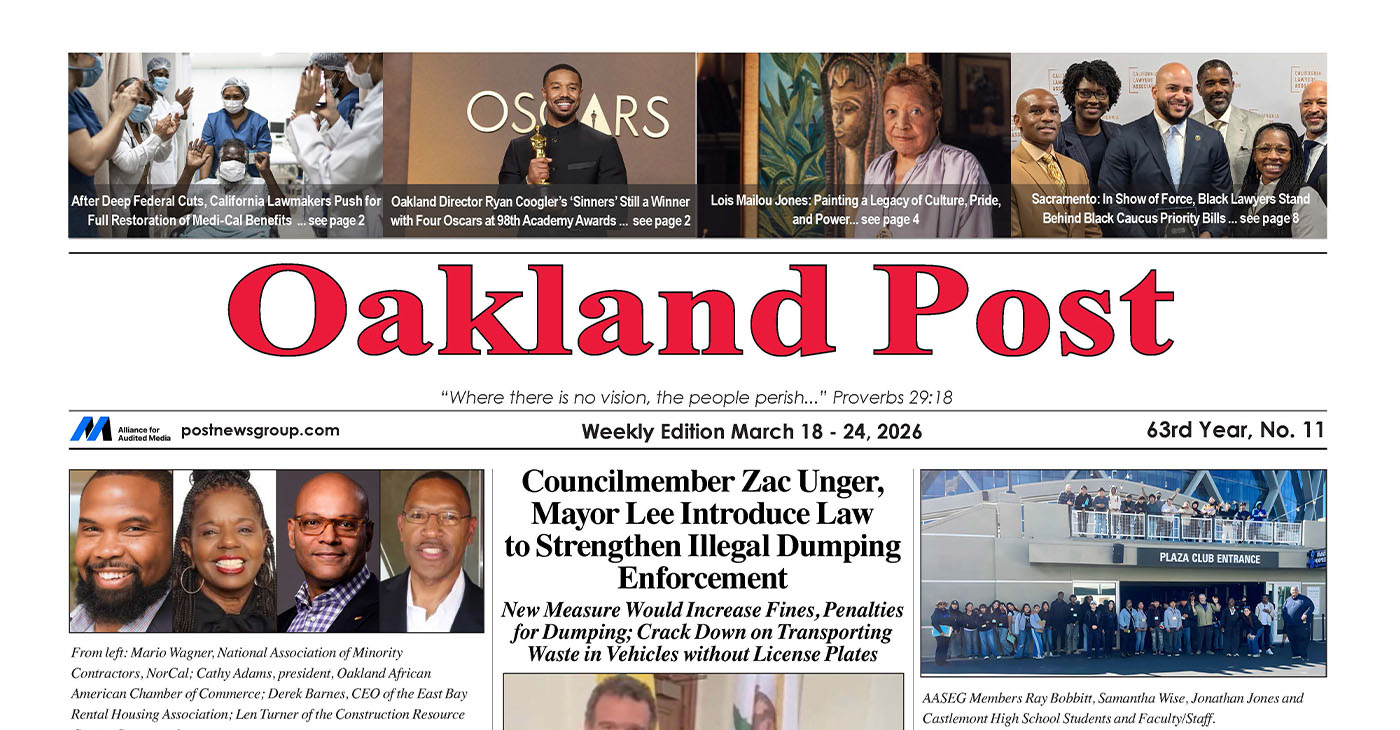
To enlarge your view of this issue, use the slider, magnifying glass icon or full page icon in the lower right corner of the browser window.

Activism
Oakland Post: Week of March 11 -17, 2026
The printed Weekly Edition of the Oakland Post: Week of March 11 – 17, 2026
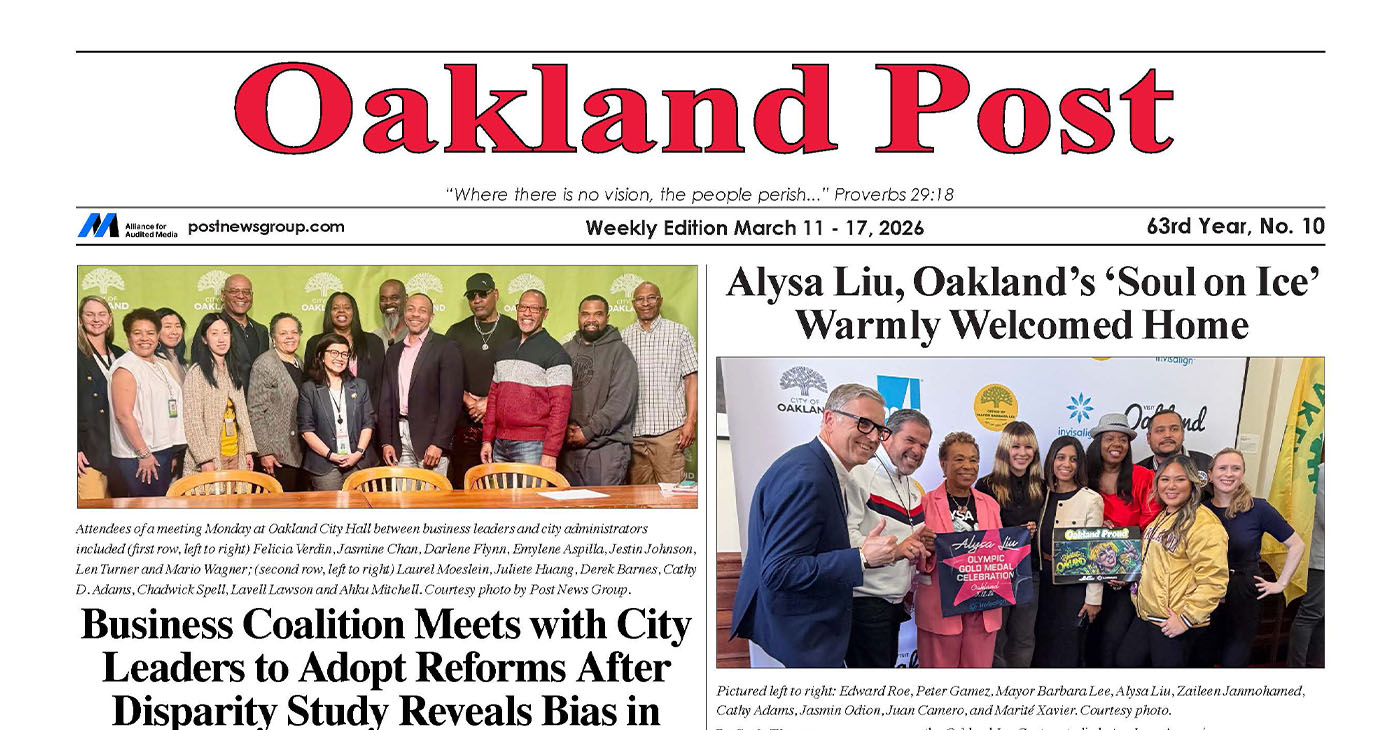
To enlarge your view of this issue, use the slider, magnifying glass icon or full page icon in the lower right corner of the browser window.
Activism
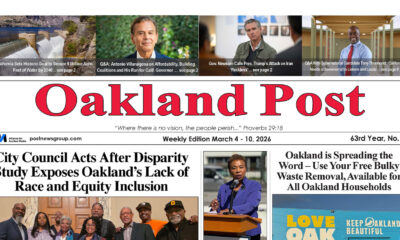
Oakland Post: Week of March 4 – 10, 2026
The printed Weekly Edition of the Oakland Post: Week of March 4 – 10, 2026
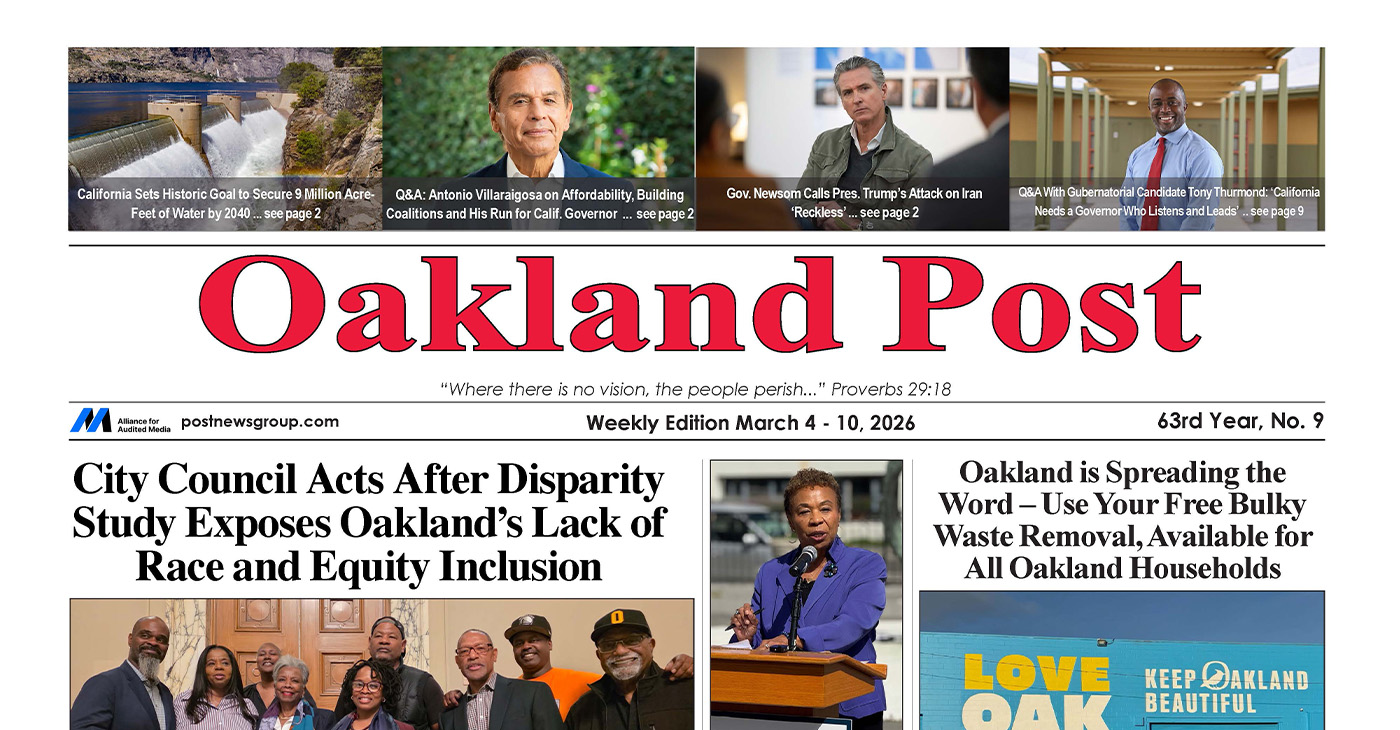
To enlarge your view of this issue, use the slider, magnifying glass icon or full page icon in the lower right corner of the browser window.

WORK FROM HOME
Home-based business with potential monthly income of $10K+ per month. A proven training system and website provided to maximize business effectiveness. Perfect job to earn side and primary income. Contact Lynne for more details: Lynne4npusa@gmail.com 800-334-0540


Black Artists in America, Installation Three Wraps at the Dixon Gallery and Gardens

Grief, Advocacy, and Education: A Counselor Reflects on Black Maternal Health

Future of Florida’s Black History Museum in Limbo

New Research Shows the Many Benefits of Early Learning

South Hampton K-8 Students Among Top 10 Finalists for Samsung’s ‘Solve for Tomorrow’ Competition

Cuba: No Negotiation with US on the President or Political System

Brooklyn Academy of Music Names Jamaican-Born Tamara McCaw as President

Trinidad & Tobego – U.S. Launches WhatsApp Channel for American Citizens in the Country

Oakland Post: Week of March 18 – 24, 2026

AI Innovation vs. Ethics and Environmental Impact

AI, Web3, and Digital Reparations

What If You Owned Your AI Agent?

Season 7, Episode 3 – January Reporter’s Roundtable 📱

Season 7, Episode 3 – January Reporter’s Roundtable

AI, Media, and Power | Part 2, Real-World Impacts and Tradeoffs

Oakland Post: Week of February 11 – 17, 2026

Reflecting on Black History Milestones in Birmingham AL

CITY OF SAN LEANDRO STATE OF CALIFORNIA PUBLIC WORKS DEPARTMENT ENGINEERING DIVISION NOTICE TO BIDDERS FOR ANNUAL STREET OVERLAY/REHABILITATION 2019-21 – PHASE III

Oakland Post: Week of February 18 – 24, 2026

PRESS ROOM: NBA Hall of Fame Nominee Terry Cummings Joins 100 Black Men of DeKalb County to Launch Victory & Values Initiative

Oakland Post: Week of February 25 – March 3, 2026

Trump’s MAGA Allies are Creating Executive Order Plan to Steal the 2026 Midterms

U.S. manufacturing rebounds – how foundry services are adapting to rising demand

OP-ED: One Hundred Years of Black Workers Telling the Truth

Advancements in solar technology that are changing the way we power the world

Chase Oakland Community Center Hosts Alley-Oop Accelerator Building Community and Opportunity for Bay Area Entrepreneurs

Poll Shows Support for Policies That Help Families Afford Child Care

Oakland Post: Week of March 4 – 10, 2026

PRESS ROOM: Civil Rights TV Launches in Selma as the World’s First 24/7 Civil Rights Television Network

Woman’s Search for Family’s Roots Leads to Ancestor John T. Ward – A Successful Entrepreneur and Conductor on the Underground Railroad

Hyundai Ioniq 5 Parking, Safety, and 360 View #shorts

2025 Ioniq 5 New Wiper & Powerful Performance! #shorts

Electric SUV Range: Is 259 Miles Enough? #shorts

EV Charging: How Fast Can You Charge an Electric Vehicle? #shorts

Biometric Cooling… Messaging Seats…Come on! 2025 Infiniti QX80 Autograph 4WD

Charged Up: Witness the Magic of a Fully Electric Car! #shorts

Range Rover Sport PHEV Included…: See What’s Inside This Luxury SUV! #shorts

Invisible Hood View: Perfect Parking with X-Ray Vision! #shorts

AI Is Reshaping Black Healthcare: Promise, Peril, and the Push for Improved Results in California

ESSAY: Technology and Medicine, a Primary Care Point of View

Sanctuary Cities

The RESISTANCE – FREEDOM NOW

STATE OF THE PEOPLE: Freddie

ECONOMIC BOYCOTT DAY!!!!!

I told You So
-
 #NNPA BlackPress4 weeks ago
Poll Shows Support for Policies That Help Families Afford Child Care
-
 Activism4 weeks ago
Oakland Post: Week of March 4 – 10, 2026
-
 #NNPA BlackPress3 weeks ago
Woman’s Search for Family’s Roots Leads to Ancestor John T. Ward – A Successful Entrepreneur and Conductor on the Underground Railroad
-

 #NNPA BlackPress4 weeks ago
OP-ED: NNPA Launches 2026 “Leadership Matters” Video Series
-

 #NNPA BlackPress3 weeks ago
Advocates Raise Alarm Over ICE Operation, MOU and Detention Risks in Baltimore County
-

 #NNPA BlackPress3 weeks ago
COMMENTARY: Women of Color Shape Our Past and Future
-

 #NNPA BlackPress3 weeks ago
Pete Buttigieg to Join Mayor Randall Woodfin for Community Town Hall in Birmingham
-

 Activism2 weeks ago
Oakland Post: Week of March 11 -17, 2026
