
Activism
OPINION: Don’t Look Far. Honor the Black History Around You
We invite all Americans to celebrate Black History Month, too. It is all around us. There’s Black history to learn about in your neighborhoods, at your jobs, in your city and in your churches. Knowing about the struggles and contributions of Black Americans can enrich our understanding of each other and the hard-won freedoms Americans of all backgrounds often take for granted.

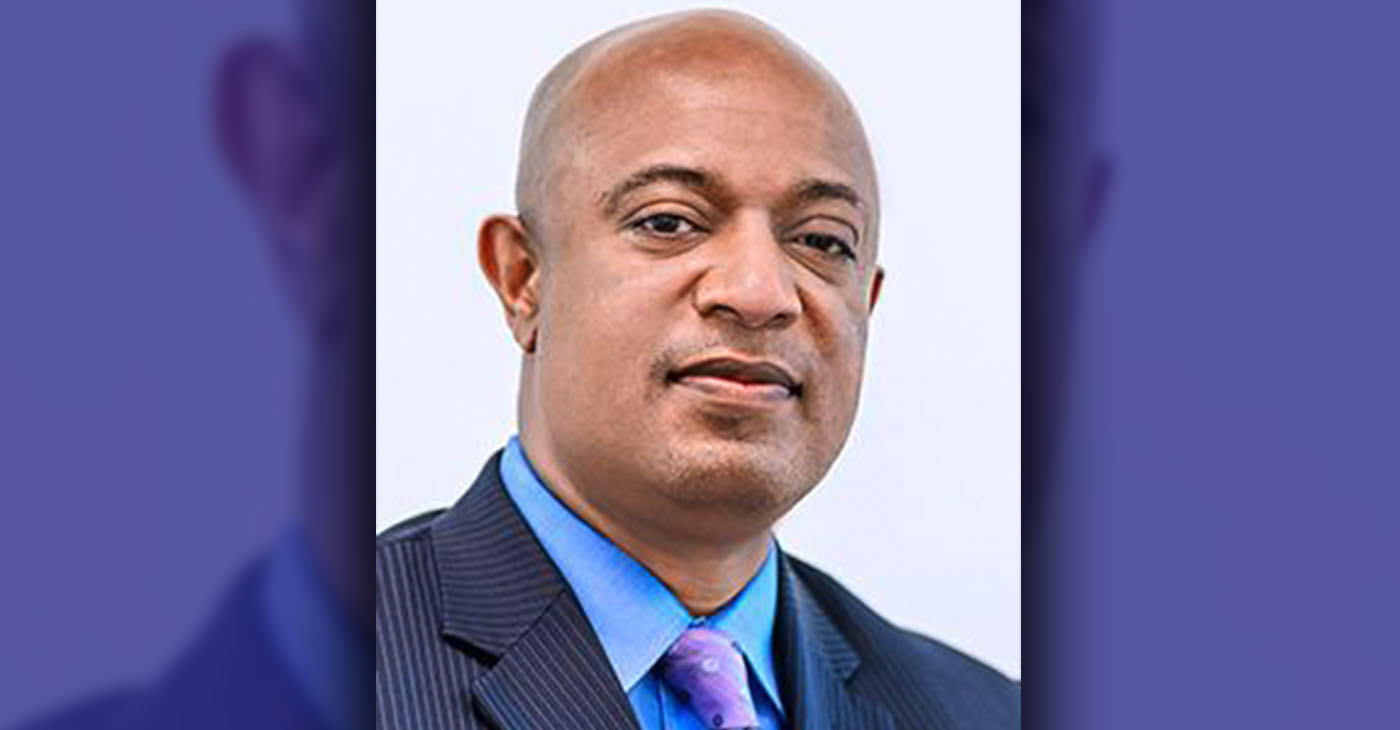
By Chief John Keene, Special to California Black Media Partners
Happy Black History Month.
It seems media coverage of Black History Month this year is getting lost in the merry-go-round of breaking news stories– from shifting COVID guidelines and skyrocketing food and gas prices to shocking crime stories and growing concerns about our military getting involved in Ukraine. Add to that the constant distractions of TikTok, Facebook reels and other social media platforms all competing for our attention.
But whether or not the media gives Black History Month the attention it deserves, most African Americans realize how important it is to commemorate our history – and its important contribution to American history. So, we pause to honor our past, celebrate our forebears and pat ourselves on the back for the many contributions we have made to this country.
And we invite all Americans to celebrate Black History Month, too. It is all around us. There’s Black history to learn about in your neighborhoods, at your jobs, in your city and in your churches. Knowing about the struggles and contributions of Black Americans can enrich our understanding of each other and the hard-won freedoms Americans of all backgrounds often take for granted.
As the chief probation officer for San Mateo County, and as the current president of the Chief Probation Officers of California, I have a very important responsibility in the positions that I hold to sustain a legacy built by many before me who have paved the way.
In probation, as in society, it is vital that all cultures are recognized, and Black history is no different. It is important for our deputies and staff to know that the path to get here was paved by the trials and tribulations of the people before us.
Most African Americans in the 1940s and 1950s were limited to opportunities within correctional facilities and did not have the opportunities to start off as deputy probation officers or elevate to that rank. Shockingly, the first Black deputy probation officers and staff were not widely known to be employed around the country until the 1970s and 1980s.
Today, over 20% of deputy probation officers in California are African American. That diversity extends to gender (51% are women), and other races as well (72% of deputy probation officers are non-white).
Probation today is even further diversified by educational backgrounds (the majority of officers have four-year degrees), and many probation departments employ former justice system-involved individuals. Importantly, Probation’s diversity also extends to our leadership with just over 10% of probation chiefs in California being African American.
On the shoulders of African American pathbreakers, we take our seats as leaders of our profession with honor and humility. For me, the weight of leading the association of the leaders of our profession is a reflection of the important role of Black History in probation that has led to the diversity and inclusion we see now.
The weight and responsibility of this history, I carry proudly.
With that diversity comes cultural competency and lived experiences. That understanding and sensibility equips probation to be an indispensable aspect of the criminal justice system.
It is the connection between punishment and rehabilitation, breaking down barriers to help justice-involved people turn their lives around and leave the system permanently – creating long-term, sustainable safety in our communities. It is also what attracts even greater diversity to our ranks: this desire to help people succeed.
As a former police officer, attorney, deputy probation officer and now hief, my experience has helped me tremendously in feeling a sense of empathy for the life experiences of the people we serve. It has helped me understand the challenges of young people I talk to with who have had tough upbringings. As African Americans, working through barriers is something that we know first-hand and reducing barriers is a central component to rehabilitation.
Often, we must even go beyond that to see the difference between rehabilitation and habilitation, or helping someone who has only known a difficult life to gain the tools to create a new one that sets them on a healthier path. To help them succeed, we as probation officers often become much more – serving as teachers, mentors and role models.
Sometimes the people we serve think the challenges they face are unique to them, but we can often relate because we too have lived many of those experiences or we have encountered them within our own backgrounds. It breaks the ice, builds points of connection, reduces barriers, and opens a moment for them to pause and listen and let their guard down to learn and grow.
Now, in my new role as president of the Chief Probation Officers of California, I do this work on a broader scale, often working through policy conversations and larger fiscal decisions and assessing their implications.
My work in these positions continues to be informed by my own unique background, experiences, and cultural understandings. Black History Month gives us the space and time to reflect on how we got here, but also where we would like to go. It is my privilege to be in a position now to help shape that future for my own children and their children.
Chief John Keene was appointed chief probation officer of San Mateo County in June of 2013. Chief Keene brings more than 20 years of law enforcement experience to his role. Prior to his appointment as Chief, he served as deputy chief probation officer in Alameda County.







Activism
Oakland Post: Week of April 8 – 14, 2026
The printed Weekly Edition of the Oakland Post: Week of April 8 – 14, 2026

To enlarge your view of this issue, use the slider, magnifying glass icon or full page icon in the lower right corner of the browser window.
Activism
Oakland Post: Week of April 1 – 7, 2026
The printed Weekly Edition of the Oakland Post: Week of April 1 – 7, 2026
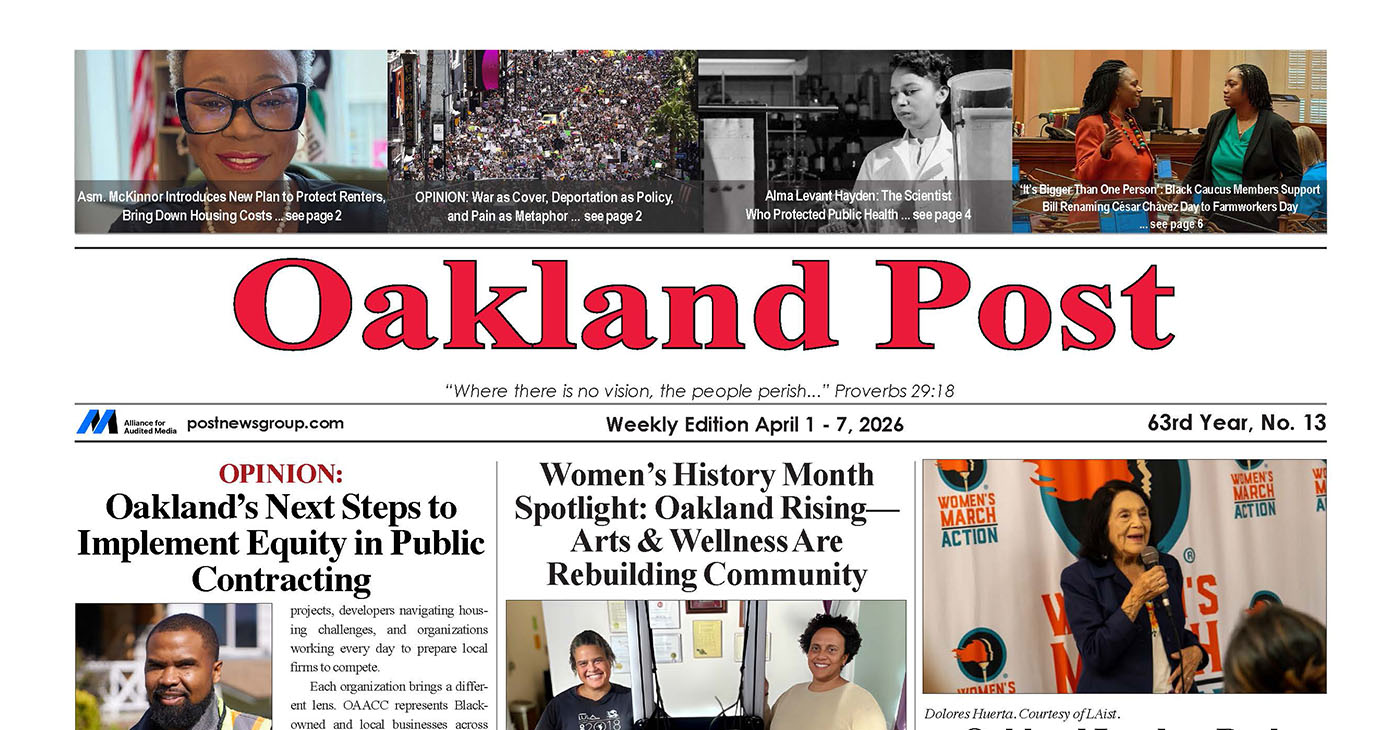
To enlarge your view of this issue, use the slider, magnifying glass icon or full page icon in the lower right corner of the browser window.
Activism
Oakland Post: Week of March 18 – 24, 2026
The printed Weekly Edition of the Oakland Post: Week of March 18 – 24, 2026

To enlarge your view of this issue, use the slider, magnifying glass icon or full page icon in the lower right corner of the browser window.

WORK FROM HOME
Home-based business with potential monthly income of $10K+ per month. A proven training system and website provided to maximize business effectiveness. Perfect job to earn side and primary income. Contact Lynne for more details: Lynne4npusa@gmail.com 800-334-0540


Oakland Post: Week of April 8 – 14, 2026

Oakland Post: Week of April 1 – 7, 2026

Black Artists in America, Installation Three Wraps at the Dixon Gallery and Gardens

Grief, Advocacy, and Education: A Counselor Reflects on Black Maternal Health

Future of Florida’s Black History Museum in Limbo

New Research Shows the Many Benefits of Early Learning

South Hampton K-8 Students Among Top 10 Finalists for Samsung’s ‘Solve for Tomorrow’ Competition

Cuba: No Negotiation with US on the President or Political System

Brooklyn Academy of Music Names Jamaican-Born Tamara McCaw as President

Trinidad & Tobego – U.S. Launches WhatsApp Channel for American Citizens in the Country

Oakland Post: Week of March 18 – 24, 2026

AI Innovation vs. Ethics and Environmental Impact

AI, Web3, and Digital Reparations

What If You Owned Your AI Agent?

Season 7, Episode 3 – January Reporter’s Roundtable 📱

Reflecting on Black History Milestones in Birmingham AL

Oakland Post: Week of February 25 – March 3, 2026

Oakland Post: Week of March 4 – 10, 2026

PRESS ROOM: NBA Hall of Fame Nominee Terry Cummings Joins 100 Black Men of DeKalb County to Launch Victory & Values Initiative

Trump’s MAGA Allies are Creating Executive Order Plan to Steal the 2026 Midterms
Oakland Post: Week of March 18 – 24, 2026

U.S. manufacturing rebounds – how foundry services are adapting to rising demand

Oakland Post: Week of March 11 -17, 2026

Poll Shows Support for Policies That Help Families Afford Child Care

OP-ED: One Hundred Years of Black Workers Telling the Truth

Advancements in solar technology that are changing the way we power the world

Financial Wellness and Mental Health: Managing Money Stress in College

Woman’s Search for Family’s Roots Leads to Ancestor John T. Ward – A Successful Entrepreneur and Conductor on the Underground Railroad

COMMENTARY: Women of Color Shape Our Past and Future

PRESS ROOM: Civil Rights TV Launches in Selma as the World’s First 24/7 Civil Rights Television Network

Hyundai Ioniq 5 Parking, Safety, and 360 View #shorts

2025 Ioniq 5 New Wiper & Powerful Performance! #shorts

Electric SUV Range: Is 259 Miles Enough? #shorts

EV Charging: How Fast Can You Charge an Electric Vehicle? #shorts

Biometric Cooling… Messaging Seats…Come on! 2025 Infiniti QX80 Autograph 4WD

Charged Up: Witness the Magic of a Fully Electric Car! #shorts

Range Rover Sport PHEV Included…: See What’s Inside This Luxury SUV! #shorts

Invisible Hood View: Perfect Parking with X-Ray Vision! #shorts

AI Is Reshaping Black Healthcare: Promise, Peril, and the Push for Improved Results in California

ESSAY: Technology and Medicine, a Primary Care Point of View

Sanctuary Cities

The RESISTANCE – FREEDOM NOW

STATE OF THE PEOPLE: Freddie

ECONOMIC BOYCOTT DAY!!!!!

I told You So
-
 Activism3 weeks ago
Oakland Post: Week of March 18 – 24, 2026
-
 Activism3 weeks ago
Oakland Post: Week of March 11 -17, 2026
-
 Advice3 weeks ago
Financial Wellness and Mental Health: Managing Money Stress in College
-
 #NNPA BlackPress3 weeks ago
Brooklyn Academy of Music Names Jamaican-Born Tamara McCaw as President
-
 #NNPA BlackPress2 weeks ago
Grief, Advocacy, and Education: A Counselor Reflects on Black Maternal Health
-
 #NNPA BlackPress2 weeks ago
New Research Shows the Many Benefits of Early Learning
-
 #NNPA BlackPress2 weeks ago
Black Artists in America, Installation Three Wraps at the Dixon Gallery and Gardens
-

 Advice4 weeks ago
Women & Wealth: Tips for Navigating Your Lifelong Financial Journey
