
Opinion
OPINION: Remembering the Sin and Shame of Lynching in America

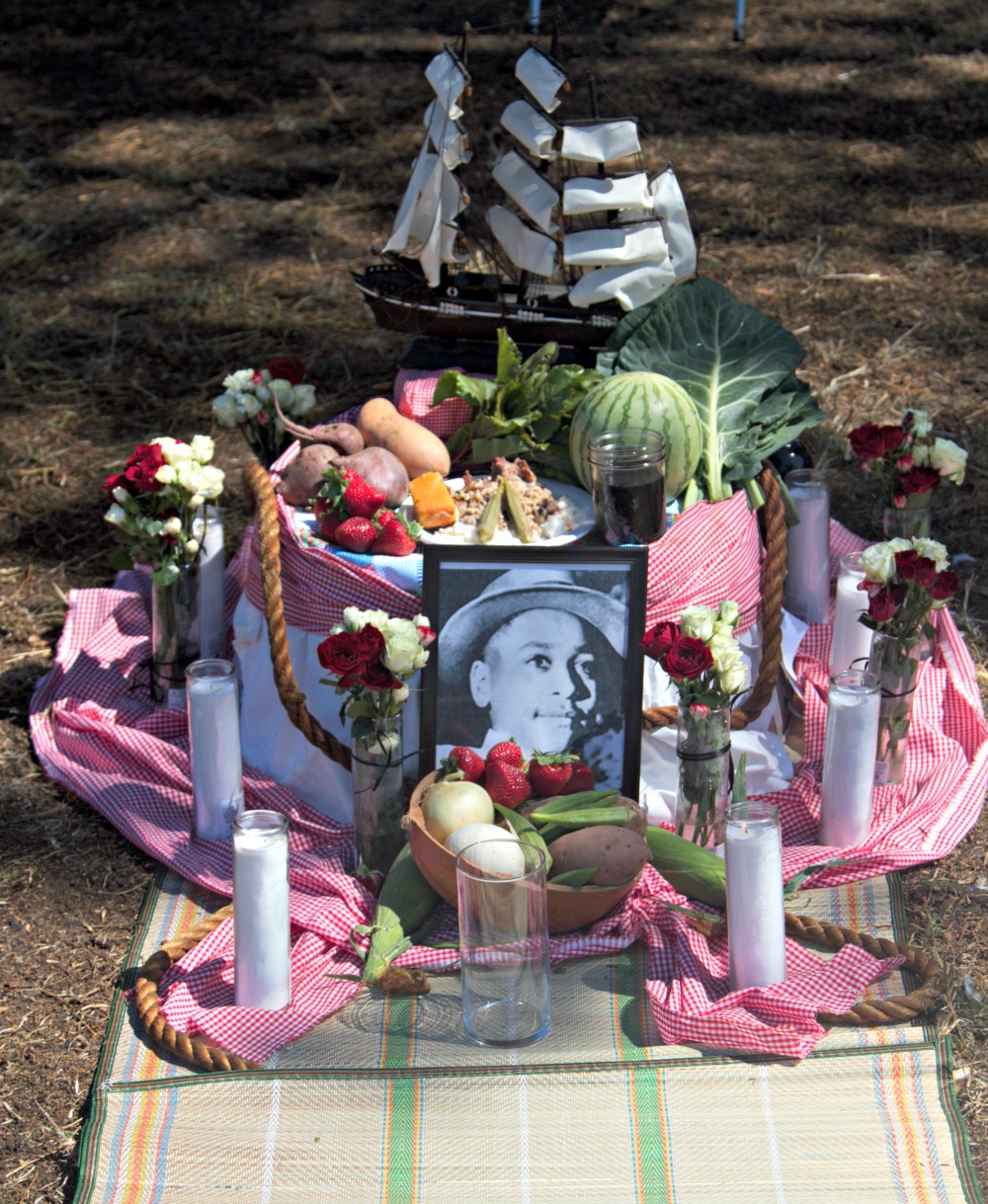
The lynching rope is part of the altar for Omnira Institute’s ‘Ritual of Remembrance’ Juneteenth celebration on June 10 at Lake Merritt.
“Where there’s a will, there’s a way,” the old folks used to say when facing obstacles, often under their breaths.
“Where there’s a tree, there’s a rope,” is the next line, almost a rejoinder, acknowledging the constancy of unpredictable trouble, an expression fraught with grief, fear and loss.
One that a Black child born in the North in the 1950s didn’t know referred to the South’s “Strange Fruit.”
I am not sure if you can see it, the rope, on the altar, honoring and remembering the victims of white supremacy, lynched individually or in pairs or groups, these descendants of enslaved people whose only (proven) crime was to be Black. They were all killed by “person or persons unknown,” yet for decades after the Emancipation Proclamation, lynchings were very public events often occurring on the courthouse lawn.
 Town newspapers sometimes announced the day and time the spectacle would take place and trains were specially scheduled to transport the spectators: men, women, and even small children. Newspapers covered lynchings in graphic detail. Photographs showed desecrated bodies of Black people surrounded by triumphant sometimes even grinning white spectators. Again, “the persons unknown.” Black people certainly knew who terrorized them. The memory of such horrors haunted Black communities, a hobbling fear lasting generations. The frequency of the lynchings would stimulate the Great Migration, surging right after World War I.
The most renown lynching was of 14-year-old Emmett Till in 1955, and the blood lust of the South appeared to wane under the withering scorn of the world. But the lynching of the Civil Rights workers in 1963 revealed otherwise as the search for their bodies in the river turned up many more, defiled, unidentified, unburied, unmourned. Like the tabloids showing the victorious crowds, social media in 2017 allows us to see ‘lynchings’ in real time.
There are so many, I honestly don’t have the heart to keep up.
Two weeks ago I glanced at an account on Facebook. Below three school portraits of impossibly young Black males, the headline was almost a taunt: “Did you know these youth were killed by the police this week? …Neither did we.” Then, on Monday I received another Facebook notice of a pregnant, mentally- challenged Black woman in Seattle killed by police in front of her other children.
I am doing my best, as our people say, to stay or be “woke,” but I confess I did not have the stomach to read further. It is 2017, and lynching not only continues, it is increasing. Like the mobs of the old days, police become judge, jury and executioner. Hidden under police department policy, the names of “persons unknown” are not released until the victim’s memory (ex. Mike Brown) is sullied.
On the rare occasion that police are actually tried for murder, lackluster prosecution ensures that they are seldom convicted. And now it’s not just the police, but individual white men who decide they want to kill Black people just because they feel like it. Timothy Caughman, a homeless Black man in New York, was stabbed to death in March by a man who came from Maryland for that express purpose.
In the 1920s and 1930s, not ‘giving ground’ to a white person, like refusing to step off the sidewalk or even bumping into a white girl while running to catch a train, were lynchable offenses, and it appears they are again. Five days before his graduation in May, Bowie State College student Richard Collins III was stabbed to death while waiting for an Uber ride for refusing to “yield ground” to a white University of Maryland student.
“Where there’s a will, there’s a way; where there’s a tree there’s a rope,” the old folks said.
I had been directed by spirit to make a noose with the coarse rope, but I didn’t know how. I am glad I didn’t. Symbolically, it would knot the possibility inherent in the third line, the last utterance of this trinity.
“Where there’s life, there’s hope.” Yes. And I hope that the ancestors understood.


Activism
Oakland Post: Week of September 9 – 15, 2026
The printed Weekly Edition of the Oakland Post: Week of September 9 – 15, 2026

To enlarge your view of this issue, use the slider, magnifying glass icon or full page icon in the lower right corner of the browser window.
Activism
Oakland Post: Week of September 2 – 8, 2026
The printed Weekly Edition of the Oakland Post: Week of September 2 – 8, 2026
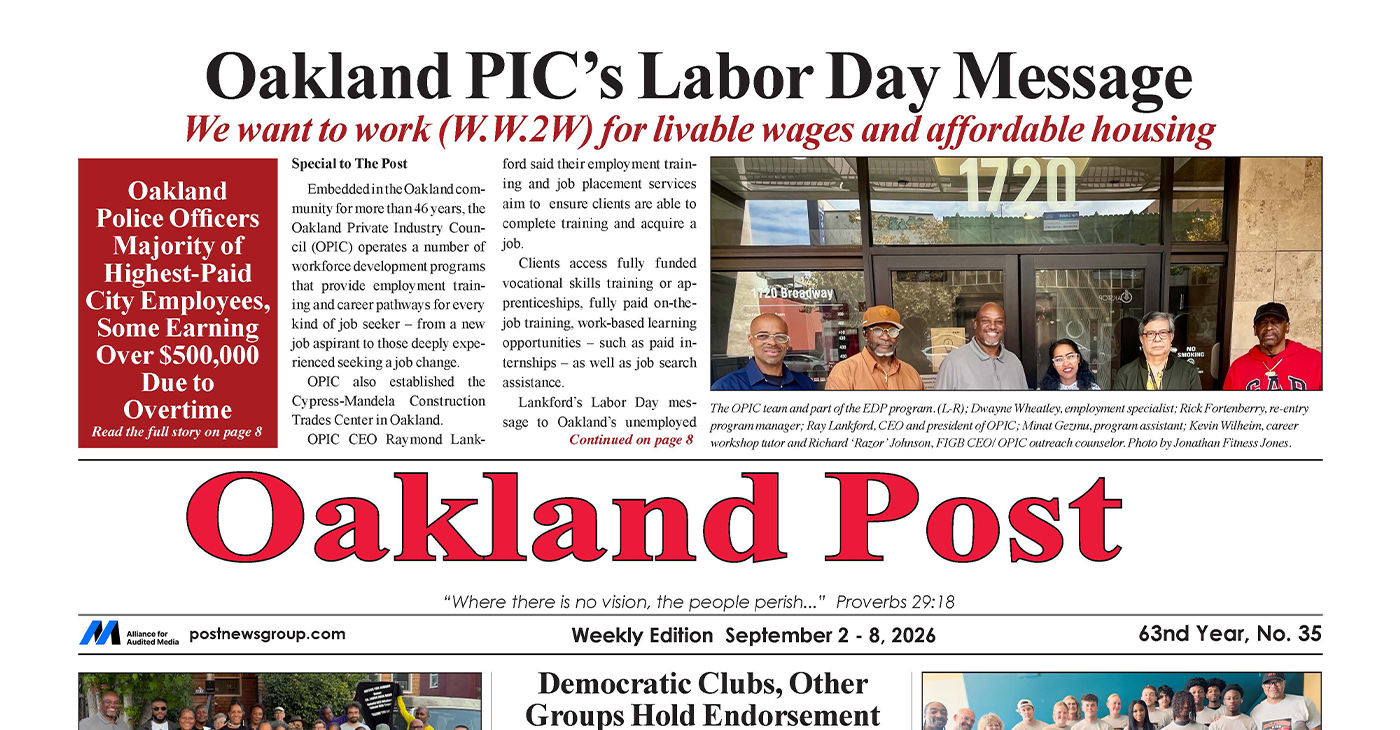
To enlarge your view of this issue, use the slider, magnifying glass icon or full page icon in the lower right corner of the browser window.
Activism
Oakland Post: Week of August 26 – September 1, 2026
The printed Weekly Edition of the Oakland Post: Week of August 26 – September 1, 2026
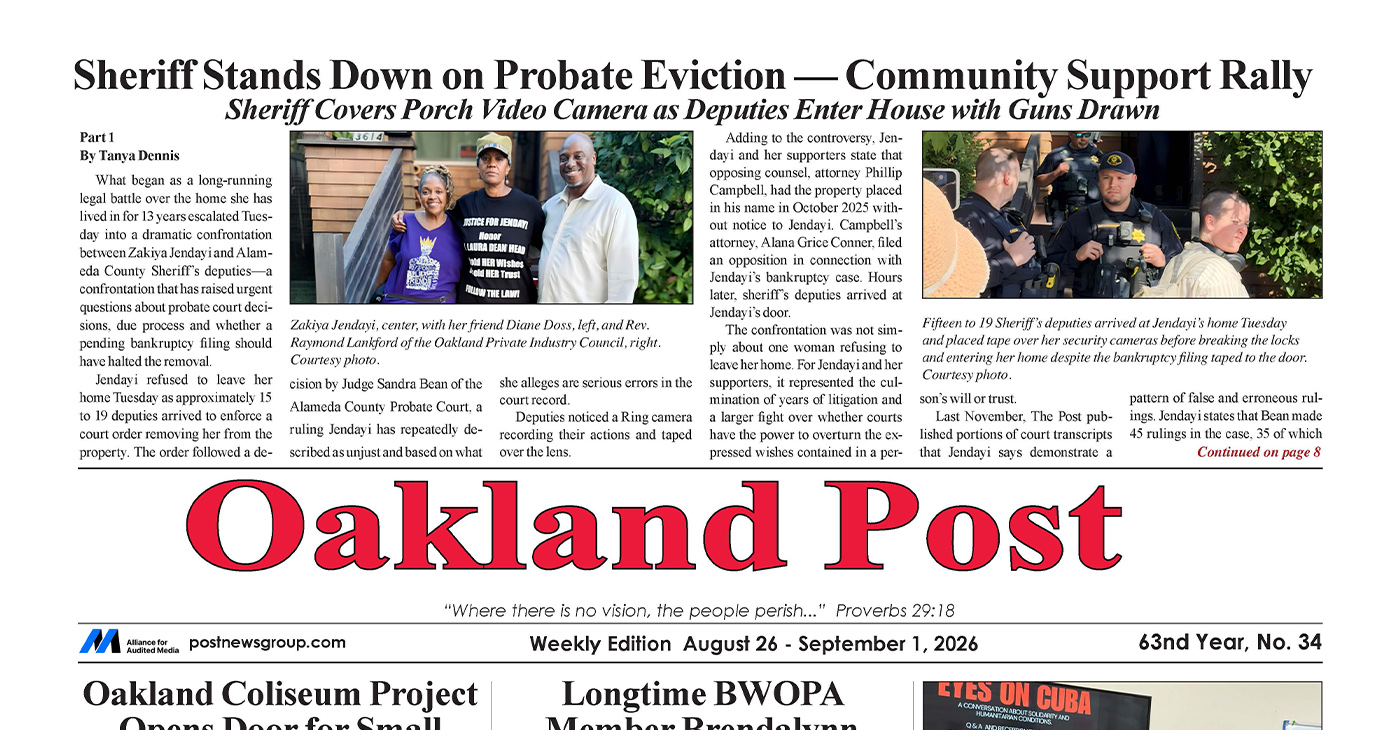
To enlarge your view of this issue, use the slider, magnifying glass icon or full page icon in the lower right corner of the browser window.


Port of Oakland, Army Corps Sign Historic Harbor Design Agreement

Democratic Clubs Interview Candidates for Oakland School Board

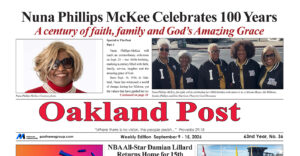
Nuna Phillips-McKee Celebrates 100 Years: ‘A Century of Faith, Family and God’s Amazing Grace!’

D.A. Ursula Jones Dickson: Terminix to Pay $3.15 Million Over Illegal Disposal of Pesticides, Customer Records

REPORT: Community Level Policy Is Impacting Homelessness and Drug Abuse in California
OPINION: AI Needs to Know Who Is the Boss
Goldi-Locs and Two (or Three) Bears in the Forest in California Hills

Election Watch 2026: 85% of Eligible Voters in California Are Registered

Don’t Let scammers Crash Your School Year

BOOK REVIEW — Curved Air: A Biography of Sickle Cell Anemia and the Quest to Cure the First Molecular Disease

California’s Legal Cannabis Market Hits $8 Billion as State Touts Progress on Fighting Drugs, Crime

Blacks and Latinos Clash Over LA’s Barrio Run; Mayor Karen Bass Calls for Dialogue Across Racial, Neighborhood Lines

Asm. Smallwood-Cuevas’s Bill Repealing ‘Racist’ CalWORKs ‘Man-in-the-House’ Rule Clears Legislature

Asm. Smallwood-Cuevas’s Bill Repealing ‘Racist’ CalWORKs ‘Man-in-the-House’ Rule Clears Legislature

‘Ready to See These Bills Become Law’: Sen. Weber’s Package of 15 Bills Advance to Gov. Newsom’s Desk

Department of Homeland Security Demands California Secretary of State Shirley N. Weber Scrub Voter Rolls

New Judge Could Decide if Karmelo Anthony Gets a New Trial

“The Power to See Threats Sooner”: Gov. Newsom, Safety Officials Showcase California’s Investments in Hi-Tech Wildfire Prevention

Alpha Kappa Alpha Sorority, Inc. Celebrates New North Atlantic Regional Director

California Sen. Padilla Joins Colleagues to Introduce Bill Imposing Term Limits on Supreme Court Justices

Less Affluent School Districts, Including Sacramento City, Face Threat of State Takeover

Car Wash Workers Cope with Lingering Impacts of ICE Raids

Oakland Post: Week of July 29 – August 4, 2026

How Oakland’s Courtsmith is Scaling its Business and Local Impact

ESSAY: California Can Close Its Colorectal Cancer Gap

Oakland Post: Week of August 5 – 11, 2026

As Part of Your Back-to- School Checklist, Vaccinate

Oakland ‘Port Serves as a Powerful Engine for Good Jobs and Economic Development

Gov. Newsom Signs New Affordable Housing Legislation

Gov. Newsom Announces $109.6 Million in Funding for 278 Supportive Homes in Bakersfield, Contra Costa, Sacramento and Fresno

The Conversation With Al McFarlane 6/23/26

Media Monday 6/22/26

LIVE! ASK ALMA! — TUES. 6.23.26 7PM EST

Car Buying Secrets: 4 Hidden Checks Before You Sign!

Is This 550 HP Charger Worth YOUR Money? AutoNetwork Review

Celebrating Juneteenth – Frederick Douglass on education and resistance

LIVE! — ASK ALMA! — TUES. 6.19.26 7PM EST

Hyundai Ioniq 5 Parking, Safety, and 360 View #shorts

2025 Ioniq 5 New Wiper & Powerful Performance! #shorts

Electric SUV Range: Is 259 Miles Enough? #shorts

EV Charging: How Fast Can You Charge an Electric Vehicle? #shorts

Biometric Cooling… Messaging Seats…Come on! 2025 Infiniti QX80 Autograph 4WD

Charged Up: Witness the Magic of a Fully Electric Car! #shorts

Range Rover Sport PHEV Included…: See What’s Inside This Luxury SUV! #shorts

Invisible Hood View: Perfect Parking with X-Ray Vision! #shorts
-
 Community4 weeks ago
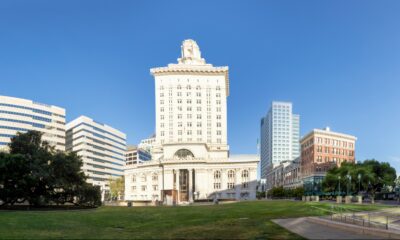
Four Candidates, Including Incumbent Barbara Lee, Qualify for Oakland Mayor’s Race
-

 Commentary2 weeks ago
Standoff for Justice: Our Homes Are Worth Fighting For
-

 Business2 weeks ago
Gubernatorial Candidate Steve Hilton Blasts California New Tire Rules; Newsom Hits Back
-

 Activism2 weeks ago
Oakland Post: Week of August 26 – September 1, 2026
-

 Education2 weeks ago
Gov. Newsom’s Latest Appointees Include Sacramento Advocate for Formerly Incarcerated Students; State’s New Tech Chief
-

 Business2 weeks ago
Frontier Airlines’ Return to Oakland Airport Brings Flights, Jobs and Opportunity
-

 Community2 weeks ago
Big City Mayors Ask for “Yes” Vote on Housing Bond Measure; Conservatives Say “No”
-

 Business2 weeks ago
Oakland Coliseum Project Opens Door for Small Businesses to Build Bigger
