
Activism
OPINION: Black and Asians Are United No Matter What the New York Times Says
Blacks and Asians may not have done anything at the level or speed as the Times expected to happen over the past year. But it doesn’t mean “nothing” is happening. Communities around the country, Black and Asian, are working together because we all want the same thing– a sense of peace and safety where we live and work.

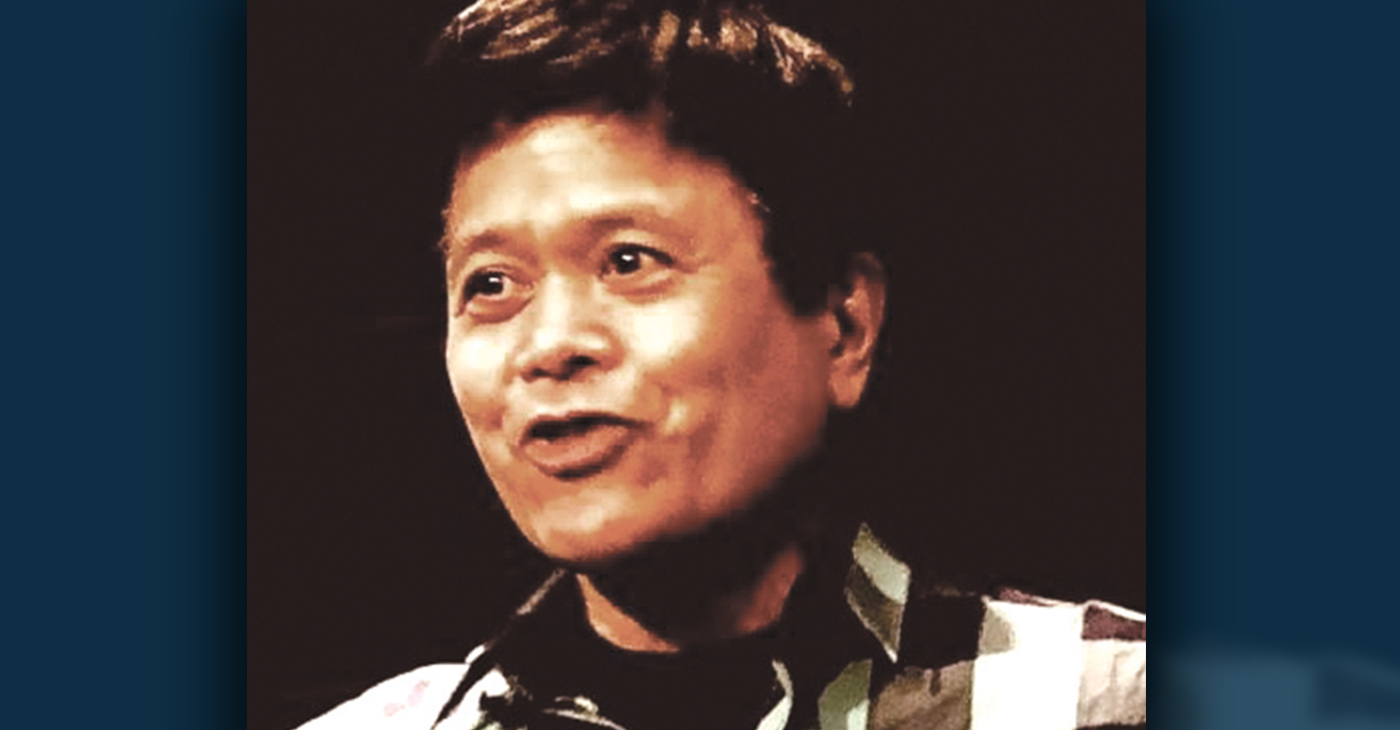
By Emil Guillermo

On CNN, Lisa Ling showcased one group in Oakland where Black youth are working with other young Asian Americans to provide escort services for elderly Asians. It’s no big deal, unless you’re among the elderly, scared by what is happening in our neighborhoods.
It’s an example of the grassroots efforts that show a real unity among Blacks and Asians. And it defies what you may have read in the New York Times.
Recently, that paper published the article “In Fight Against Violence, Asian And Black Activists Struggle to Agree,” subtitled, “Calls for unity have ebbed over disagreement on one main issue: policing.”
Really?
Since there is no central Black/Asian forum nationally, enterprising reporters are left to do a kind of journalism that on the surface seems legit, but all it does is put a fine point on nothing.
It’s done this way. Come up with a hypothesis. Talk to a selected group of historians, activists, commentators, which of course, shows the bias of the reporter. Present the group’s individual opinions — note I said opinion, not facts — and let all that become the driver of the hypothesis.
Present what you have with the sharpest point possible. Voila, a news story.
Was the Times truthful? Partially, but it also magnified its view into something larger than it is.
Blacks and Asians may not have done anything at the level or speed as the Times expected to happen over the past year. But it doesn’t mean “nothing” is happening. Communities around the country, Black and Asian, are working together because we all want the same thing– a sense of peace and safety where we live and work.
And a sense of justice when we are done wrong. Ask Angelo Quinto’s family.
Last Christmas, Quinto, a 30-year-old Filipino American Navy veteran from Antioch was having a “mental episode” when his family called the police seeking assistance. Quinto was cuffed and held face to the ground.
Sound familiar? It was the “George Floyd” police move, and Quinto was under the knee of an Antioch cop. Quinto lost consciousness, then died later at a hospital. Was that good policing?
The police have denied doing anything wrong and have escaped any responsibility so far. But Quinto’s family is seeking a wrongful death suit against the City of Antioch.
The family called the police for help, not for them to kill their family member. The family has hired John Burris, the noted Oakland civil rights attorney.
Blacks and Asians are working together.
Recently, there has been a rash of crimes committed by Blacks on Asians, notably in San Jose, Calif. But when these crimes happen, they don’t generally reflect the sentiments of communities, just the criminals. You can’t use that to fan the narrative of “communities at war.”
In a Twitter thread, here’s the reaction of the group #StopAAPIHate, which has monitored crimes against Asians during the pandemic.
“By focusing on the divide between AAPIs and Black communities over policing, this [New York Times] article adds to an all-too common and often exaggerated narrative of tensions between AAPIs and other communities of color,” the group tweeted.
“According to our recent survey, AAPIs believe the top three solutions to anti-AAPI hate are actually education, community-based initiatives and civil rights enforcement,” the thread added.
Policing is an issue, sure. But not as significant a divide among us as the Times makes it sound.
It’s different from the hot rhetoric of the mainstream that stumbles over the word “defunding” as if it means abolition of police, vs. “retraining,” or the “reallocating of resources,” which actually helps people get what they need when they call police.
Here’s the question that must be asked: Why do police so often become the “bad guys”?
It’s an issue we must pursue in 2022. Together.
But don’t be mistaken: Black and Asian communities are working together. We want the same thing — a sense of peace and safety where we live and work. And a sense of justice when we are done wrong.
Emil Guillermo is a journalist and commentator. Listen to his show on Facebook on EmilGuillermo.Media. Or on www.amok.com









Activism
Oakland Post: Week of September 30 – October 6, 2026
The printed Weekly Edition of the Oakland Post: Week of September 30 – October 6, 2026
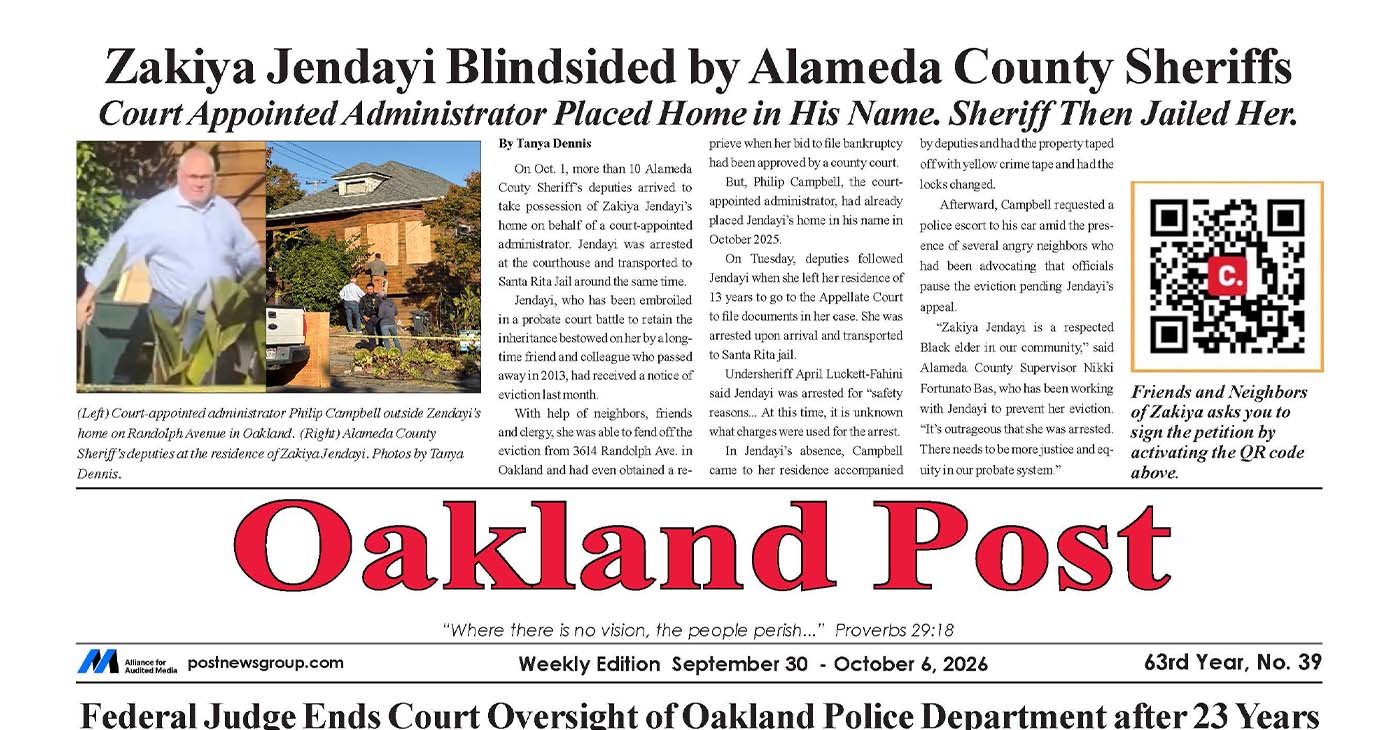
To enlarge your view of this issue, use the slider, magnifying glass icon or full page icon in the lower right corner of the browser window.
Activism
Oakland Post: Week of September 23 – 29, 2026
The printed Weekly Edition of the Oakland Post: Week of September 23 – 29, 2026

To enlarge your view of this issue, use the slider, magnifying glass icon or full page icon in the lower right corner of the browser window.
Activism
Oakland Post: Week of September 16 – 22, 2026
The printed Weekly Edition of the Oakland Post: Week of September 16 – 22, 2026

To enlarge your view of this issue, use the slider, magnifying glass icon or full page icon in the lower right corner of the browser window.


Listening as a Lifeline: A Doula’s Witness to Black Maternal Health

New Protections for Ticket Buyers: Gov. Newsom Signs Assemblymember Isaac Bryan’s Bill

‘We Don’t Talk Trash — We Pick Up Trash!’

Zakiya Jendayi Arrested, Locked Out of Home by Sheriff’s Deputies

Oakland Post: Week of September 30 – October 6, 2026

Asm. Corey Jackson Announces Launch of 24-Hour Childcare in His District

IN MEMORIAM: The Rev. Leon “Sonny” Clark, Longtime Orange County Pastor and Community Leader, Dies at 72

Poll: Becerra Widens His Lead Over Hilton; Californians Split on Wealth Tax

From Historic Memories to New Possibilities: Oakland Celebrates Coliseum 60

County Office of Education Says OUSD Finances Are Getting Healthier, Materially Stronger

LIVE FREE Sunday Dinner Brings Faith, Fellowship and Civic Conversation to Oakland

Remembering Chauncey Bailey as Student Journalists Face Threats to Truth-Telling

BLACspace Cooperative Invites Bay Area to Experience Oakland’s Black Cultural Ecosystem Through a BLAC Map Tour + Party

In Wake of Death on Doorstep, Williams Chapel Baptist Church Calls for Better Care, Funding for Unhoused

Oakland Centenarian Nuna McKee Honored!

Standoff for Justice: Our Homes Are Worth Fighting For

Oakland Post: Week of August 26 – September 1, 2026

Frontier Airlines’ Return to Oakland Airport Brings Flights, Jobs and Opportunity

Gubernatorial Candidate Steve Hilton Blasts California New Tire Rules; Newsom Hits Back

Chef Sharon Lee Blends Culinary Excellence, Education and Empowerment

Jackie Wright Champions Bay Area Stories, Filmmakers and Cultural Institutions

Misnamed ‘Parent’ PAC Seeks to Influence Oakland School Board Elections

Oakland Coliseum Project Opens Door for Small Businesses to Build Bigger

Big City Mayors Ask for “Yes” Vote on Housing Bond Measure; Conservatives Say “No”

Gov. Newsom’s Latest Appointees Include Sacramento Advocate for Formerly Incarcerated Students; State’s New Tech Chief

Longtime BWOPA Member Brendalyn Goodall Appointed to California Workforce Development Board

Gov. Newsom Signs Law Shielding Immigration Aid Workers From Doxing Threats

Secretary of State Shirley N. Weber Urges Californians to Vote Early as Voter ID Battle Intensifies

Oakland Post: Week of September 2 – 8, 2026

IN MEMORIAM: Dolly Parton Dead at 80 — How She Built a Legacy of Love and Earned Her Place in Black Culture

The Conversation With Al McFarlane 6/23/26

Media Monday 6/22/26

LIVE! ASK ALMA! — TUES. 6.23.26 7PM EST

Car Buying Secrets: 4 Hidden Checks Before You Sign!

Is This 550 HP Charger Worth YOUR Money? AutoNetwork Review

Celebrating Juneteenth – Frederick Douglass on education and resistance

LIVE! — ASK ALMA! — TUES. 6.19.26 7PM EST

Hyundai Ioniq 5 Parking, Safety, and 360 View #shorts

2025 Ioniq 5 New Wiper & Powerful Performance! #shorts

Electric SUV Range: Is 259 Miles Enough? #shorts

EV Charging: How Fast Can You Charge an Electric Vehicle? #shorts

Biometric Cooling… Messaging Seats…Come on! 2025 Infiniti QX80 Autograph 4WD

Charged Up: Witness the Magic of a Fully Electric Car! #shorts

Range Rover Sport PHEV Included…: See What’s Inside This Luxury SUV! #shorts

Invisible Hood View: Perfect Parking with X-Ray Vision! #shorts
-
 Community3 weeks ago
Misnamed ‘Parent’ PAC Seeks to Influence Oakland School Board Elections
-
 Activism4 weeks ago
Oakland Post: Week of September 2 – 8, 2026
-

 Activism3 weeks ago
Oakland Post: Week of September 9 – 15, 2026
-

 Community3 weeks ago
Richmond Tiny House Village Farm & Garden Set to Open Gates on Sept. 26
-

 Black History3 weeks ago
Latest Massacre in Haiti Reveals Cruelty U.S. Deportations
-

 Black History3 weeks ago
OPINION: Nolan Wells’ Death One of Several Signifying Racial Terror Lives on in U.S. South
-

 Business2 weeks ago
Mayor Lee Announces $1 Million Kaiser Permanente Grant for Pilot Program to Address Homelessness, Clean Up Public Spaces throughout Oakland
-

 Community3 weeks ago
Democratic Clubs Interview Candidates for Oakland School Board
