
Activism
OPINION: Alzheimer’s Drugs Decision Has Deeper Impact on Health of Blacks, Other Minorities
Regulators at the Center for Medicare & Medicaid Services (CMS) are fully aware that Alzheimer’s disease is a devastating disease that affects more than 6 million Americans, 80% of whom are Medicare beneficiaries. Among Americans 65 and older, Blacks have the highest percentage of Alzheimer’s disease, 13.8%, according to the Centers of Disease Control and Prevention (CDC). In fact, the Alzheimer’s Association reports that older Blacks are twice as likely to have Alzheimer’s disease than whites.


By Isadore Hall
Special to California Black Media
Last spring, the Food and Drug Administration (FDA) approved the first new Alzheimer’s disease therapy since 2003. For the 6 million-plus people living with the fatal disease in the United States, the availability of a medicine designed to treat the underlying cause of their ailment was a significant breakthrough.
However, it appears very few of those 6 million Alzheimer’s patients will receive this promising new treatment because of regulators at the Center for Medicare & Medicaid Services (CMS).
CMS is the federal government office that oversees health coverage of more than 100 million people through Medicare, Medicaid, the Children’s Health Insurance Program, and the Health Insurance Marketplace. One of the agency’s main functions is strengthening and modernizing the nation’s health care system to provide access to high quality care at lower costs.
In January, CMS launched a process called a National Coverage Determination (NCD) to decide whether Medicare would pay for this newly approved Alzheimer’s therapy or not. Their draft decision: Medicare, as the insurer of roughly 62 million Americans, would not cover this medicine.
The proposed NCD applies to an entire class of Alzheimer’s drugs, which could impact the current FDA approved drug, aducanumab, as well as future drug therapies in this class. Given the regulatory governance granted to the FDA by Congressional order, it is my opinion this element of the NCD is over-reaching and creates a divisive relationship between two of the most critical federal agencies in the country, FDA and CMS.
This decision would also require certain Alzheimer drugs already in development (which may have different demographic and efficacy profiles) to be subjected to a CED process that lacks its own data and does not take into consideration diversity, inclusion, and efficacy.
Furthermore, and most important, the proposed NCD betrays the commitment articulated by President Joe Biden in his Executive Order on Advancing Racial Equity and Support for Underserved Communities Through the Federal Government.
“Equal opportunity is the bedrock of American democracy, and our diversity is one of our country’s greatest strengths. But for too many, the American Dream remains out of reach. Entrenched disparities in our laws and public policies, and in our public and private institutions, have often denied that equal opportunity to individuals and communities,” Biden states in the document.
“Our country faces converging economic, health, and climate crises that have exposed and exacerbated inequities, while a historic movement for justice has highlighted the unbearable human costs of systemic racism,” the president’s statement continued.
“Our Nation deserves an ambitious whole-of-government equity agenda that matches the scale of the opportunities and challenges that we face. It is therefore the policy of my Administration that the Federal Government should pursue a comprehensive approach to advancing equity for all, including people of color and others who have been historically underserved, marginalized, and adversely affected by persistent poverty and inequality.”
I know that CMS is fully aware that Alzheimer’s disease is a devastating disease that affects more than 6 million Americans, 80% of whom are Medicare beneficiaries. Among Americans 65 and older, Blacks have the highest percentage of Alzheimer’s disease, 13.8%, according to the Centers of Disease Control and Prevention (CDC). In fact, the Alzheimer’s Association reports that older Blacks are twice as likely to have Alzheimer’s disease than whites.
African Americans are also mostly likely to be undiagnosed for Alzheimer’s Disease, according to the National Institutes of Health. Therefore, we are also most likely to be untreated.
This issue is very personal for me.
My grandmother lost her fight to Alzheimer’s Disease in 2017. I often watched her feeling helpless as she suffered from this horrifying and painful disease.
Like my grandma, millions of other grandparents, parents and loved ones bear the burdens of this disease and die from it every day.
What would it take for us to do right by them? For us to make sure that as we search for a cure, people who are living with it are receiving the best possible treatments?
CMS must modify its proposed determination to cover all FDA-approved Alzheimer’s therapies. This would give patients, social workers and physicians the ability to make collaborative decisions in the best interests of those suffering from Alzheimer’s disease.
Isadore Hall is a former California State Senator and Assemblymember from the Los Angeles Area. He currently sits on the California Agricultural Labor Relations Board.












Activism
Oakland Post: Week of April 1 – 7, 2026
The printed Weekly Edition of the Oakland Post: Week of April 1 – 7, 2026
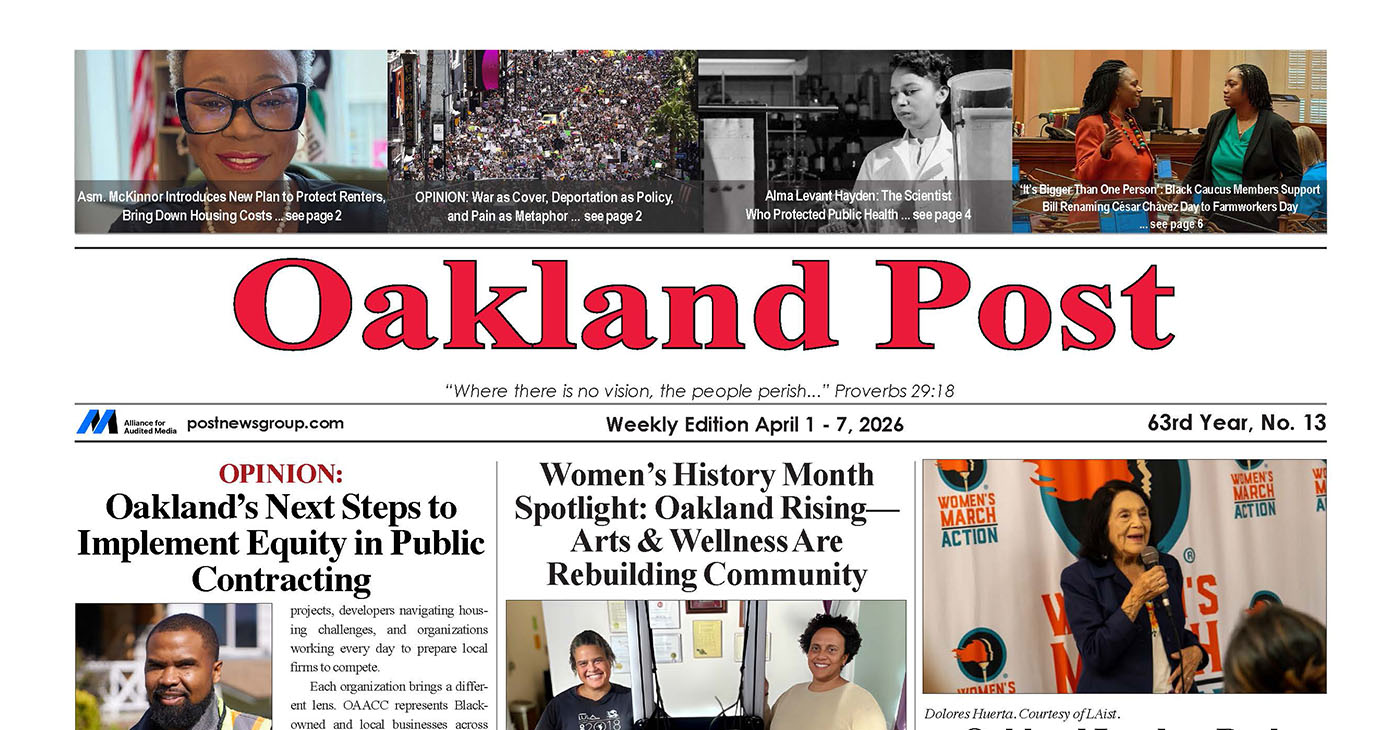
To enlarge your view of this issue, use the slider, magnifying glass icon or full page icon in the lower right corner of the browser window.
Activism
Oakland Post: Week of March 18 – 24, 2026
The printed Weekly Edition of the Oakland Post: Week of March 18 – 24, 2026
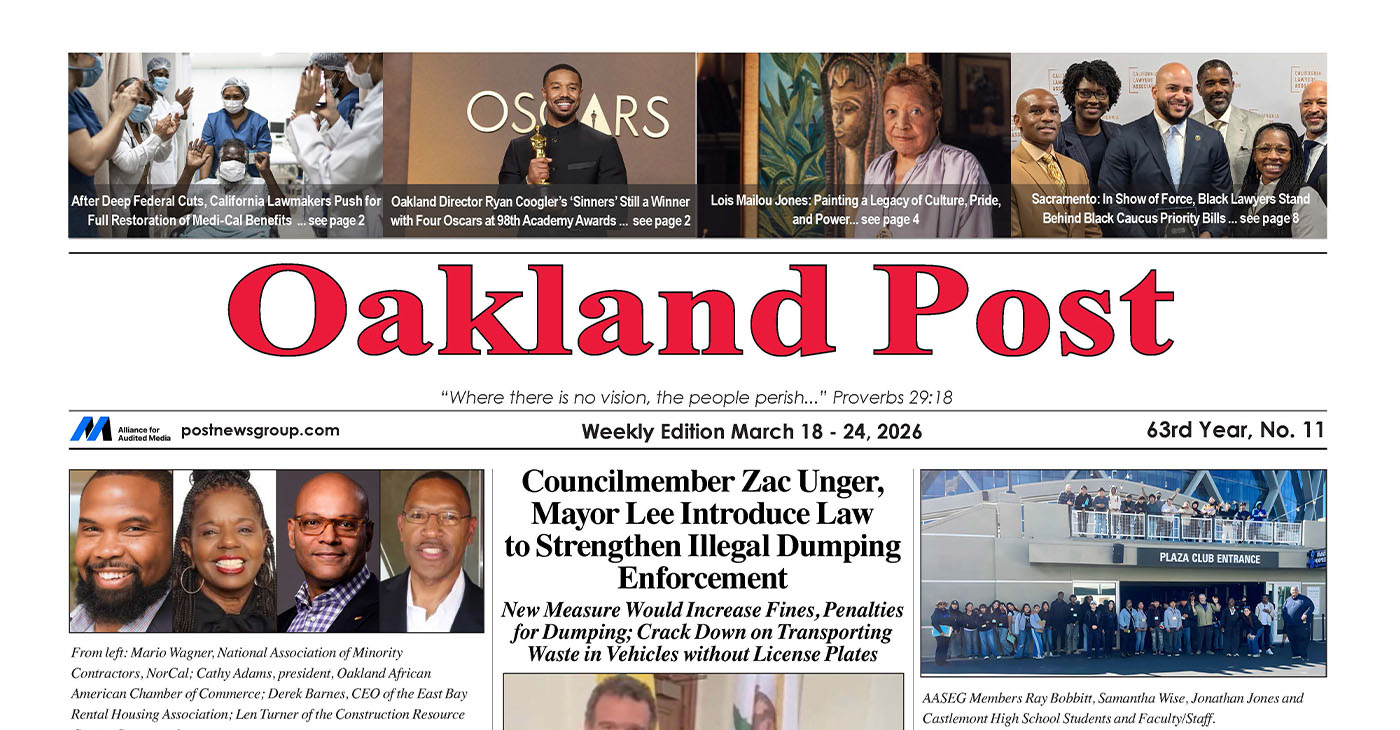
To enlarge your view of this issue, use the slider, magnifying glass icon or full page icon in the lower right corner of the browser window.
Activism
Oakland Post: Week of March 11 -17, 2026
The printed Weekly Edition of the Oakland Post: Week of March 11 – 17, 2026
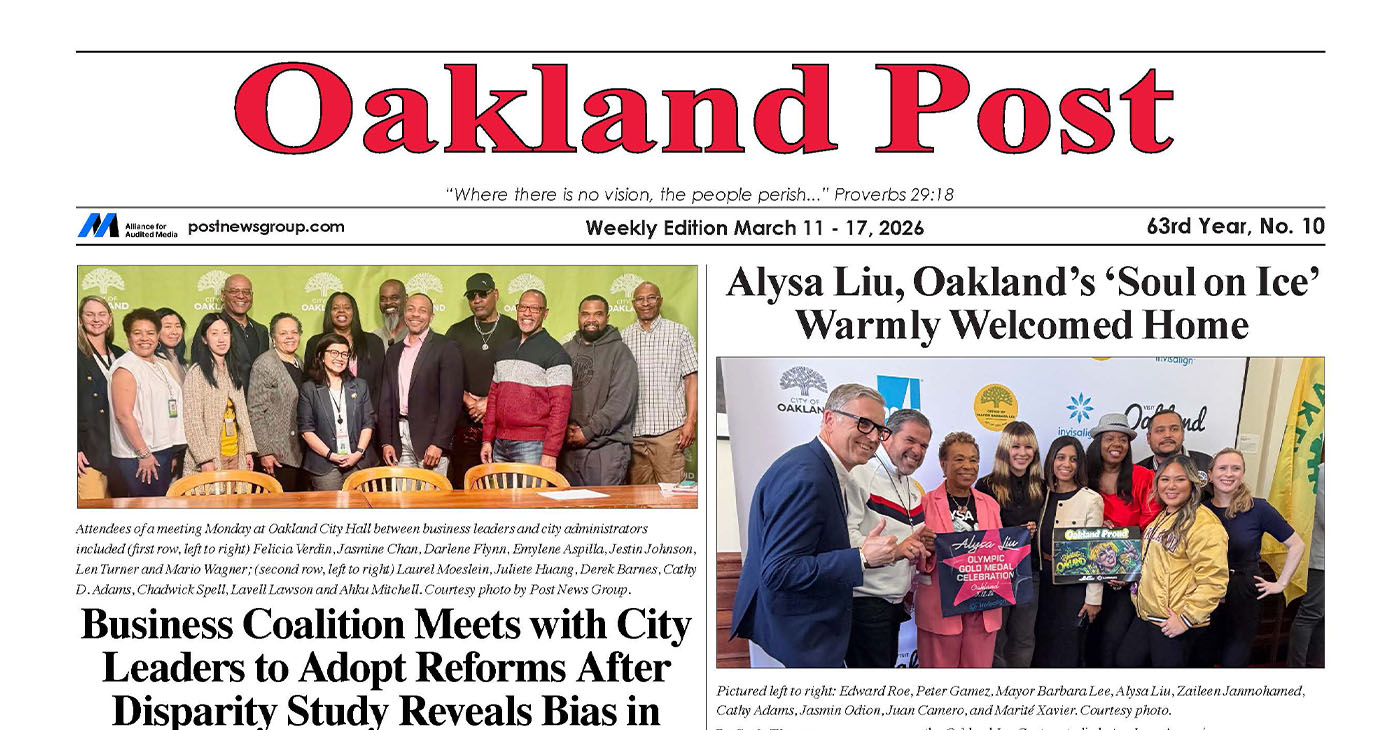
To enlarge your view of this issue, use the slider, magnifying glass icon or full page icon in the lower right corner of the browser window.


WORK FROM HOME
Home-based business with potential monthly income of $10K+ per month. A proven training system and website provided to maximize business effectiveness. Perfect job to earn side and primary income. Contact Lynne for more details: Lynne4npusa@gmail.com 800-334-0540


Oakland Post: Week of April 1 – 7, 2026

Black Artists in America, Installation Three Wraps at the Dixon Gallery and Gardens

Grief, Advocacy, and Education: A Counselor Reflects on Black Maternal Health

Future of Florida’s Black History Museum in Limbo

New Research Shows the Many Benefits of Early Learning

South Hampton K-8 Students Among Top 10 Finalists for Samsung’s ‘Solve for Tomorrow’ Competition

Cuba: No Negotiation with US on the President or Political System

Brooklyn Academy of Music Names Jamaican-Born Tamara McCaw as President

Trinidad & Tobego – U.S. Launches WhatsApp Channel for American Citizens in the Country

Oakland Post: Week of March 18 – 24, 2026

AI Innovation vs. Ethics and Environmental Impact

AI, Web3, and Digital Reparations

What If You Owned Your AI Agent?

Season 7, Episode 3 – January Reporter’s Roundtable 📱

Season 7, Episode 3 – January Reporter’s Roundtable

Reflecting on Black History Milestones in Birmingham AL

Oakland Post: Week of February 25 – March 3, 2026

Oakland Post: Week of March 4 – 10, 2026

PRESS ROOM: NBA Hall of Fame Nominee Terry Cummings Joins 100 Black Men of DeKalb County to Launch Victory & Values Initiative

Trump’s MAGA Allies are Creating Executive Order Plan to Steal the 2026 Midterms

U.S. manufacturing rebounds – how foundry services are adapting to rising demand

Poll Shows Support for Policies That Help Families Afford Child Care

Oakland Post: Week of March 11 -17, 2026

OP-ED: One Hundred Years of Black Workers Telling the Truth
Oakland Post: Week of March 18 – 24, 2026

Advancements in solar technology that are changing the way we power the world

Woman’s Search for Family’s Roots Leads to Ancestor John T. Ward – A Successful Entrepreneur and Conductor on the Underground Railroad

Financial Wellness and Mental Health: Managing Money Stress in College

COMMENTARY: Women of Color Shape Our Past and Future

PRESS ROOM: Civil Rights TV Launches in Selma as the World’s First 24/7 Civil Rights Television Network

Hyundai Ioniq 5 Parking, Safety, and 360 View #shorts

2025 Ioniq 5 New Wiper & Powerful Performance! #shorts

Electric SUV Range: Is 259 Miles Enough? #shorts

EV Charging: How Fast Can You Charge an Electric Vehicle? #shorts

Biometric Cooling… Messaging Seats…Come on! 2025 Infiniti QX80 Autograph 4WD

Charged Up: Witness the Magic of a Fully Electric Car! #shorts

Range Rover Sport PHEV Included…: See What’s Inside This Luxury SUV! #shorts

Invisible Hood View: Perfect Parking with X-Ray Vision! #shorts

AI Is Reshaping Black Healthcare: Promise, Peril, and the Push for Improved Results in California

ESSAY: Technology and Medicine, a Primary Care Point of View

Sanctuary Cities

The RESISTANCE – FREEDOM NOW

STATE OF THE PEOPLE: Freddie

ECONOMIC BOYCOTT DAY!!!!!

I told You So
-
 Activism3 weeks ago
Oakland Post: Week of March 11 -17, 2026
-
 Activism3 weeks ago
Oakland Post: Week of March 18 – 24, 2026
-
 Advice3 weeks ago
Financial Wellness and Mental Health: Managing Money Stress in College
-
 #NNPA BlackPress2 weeks ago
Brooklyn Academy of Music Names Jamaican-Born Tamara McCaw as President
-
 #NNPA BlackPress2 weeks ago
Grief, Advocacy, and Education: A Counselor Reflects on Black Maternal Health
-

 Advice4 weeks ago
Women & Wealth: Tips for Navigating Your Lifelong Financial Journey
-
 #NNPA BlackPress2 weeks ago
New Research Shows the Many Benefits of Early Learning
-
 #NNPA BlackPress2 weeks ago
Black Artists in America, Installation Three Wraps at the Dixon Gallery and Gardens
