
Opinion
OP-ED: California Cover Up?

By Winslow Rouse
Between 1999 and 2007, public records suggest the judges of the State of California disobeyed the legislature by issuing a whole generation of mandatory restraining orders on void and unenforceable Judicial Council forms. The result was the false arrests and jailing of possible over 12,000 young men between the ages of 25 and 34, who were taken from their communities without notice or probable cause.
According to public documents, despite the requirements of amended Family Code Section 63899 (f) and the new Penal Code Section 12021 (g)(3), on January 1, 2000 the judicial Council republished the unrevised January 1, 1999 editions of three of the most widely used restraining order forms, the DV-110 (Order to Show Cause and Temporary Restraining Order), the DV-130 (Restraining Order After Hearing), and the MC-220 (Protective Order in Criminal Proceeding).
These forms each contained a Notice Regarding Firearms printed in bold type which prohibited respondents from purchasing or receiving a firearm while subject to a restraining order, but failed to prohibit owning or possessing a firearm. They were also ambiguous, telling respondents that while the courts have the authority to order the surrender of firearms, it is only if a restraining order is issued at the noticed hearing that respondents may then be required to give up their firearms.

It was not until July 1, 2000, that the Judicial Council revised the Notice Regarding Firearms in these forms to warn respondents they were prohibited from owning, possessing, purchasing, or receiving a firearm while they were subject to a restraining order. The revision informed respondents that at the hearing on the matter the court will order them to give up any firearms they may already own or possess.
California’s judges were allegedly told on four separate occasions that these orders were void. The courts simply disregarded the requirements of the newly enacted Senate Bill 218 (1999) and the legally binding decisions of their own governing agency, the Judicial Council of California, which unmistakably informed the judges that every restraining order form published after a legislative deadline of January 1, 2000, was void and unenforceable.
Because void orders do not, never did, and never can legally exist, no statute of limitations bars lawsuits to set void orders aside. So now, possibly thousands of people who were harmed by these void forms can sue for the damage they have suffered, which could total billions of dollars.
Judges are required to know the law, so every judge who issued, upheld or enforced one of these void restraining orders knew or should have known that the judicial Council forms on which the restraining orders were issued were themselves void and unenforceable.
Because void orders convey no jurisdiction, the courts had no authority over these void orders except to set them aside, which they have yet to do.
Since the courts had no jurisdiction over these void orders, the judges involved in this cover-up have no defense for their misconduct. For the last twelve years the judiciary has been scrambling to cover up these void orders, even though that has required the false arrest, conviction, and imprisonment of thousands of innocent people.












Activism
Oakland Post: Week of September 9 – 15, 2026
The printed Weekly Edition of the Oakland Post: Week of September 9 – 15, 2026

To enlarge your view of this issue, use the slider, magnifying glass icon or full page icon in the lower right corner of the browser window.
Activism
Oakland Post: Week of September 2 – 8, 2026
The printed Weekly Edition of the Oakland Post: Week of September 2 – 8, 2026
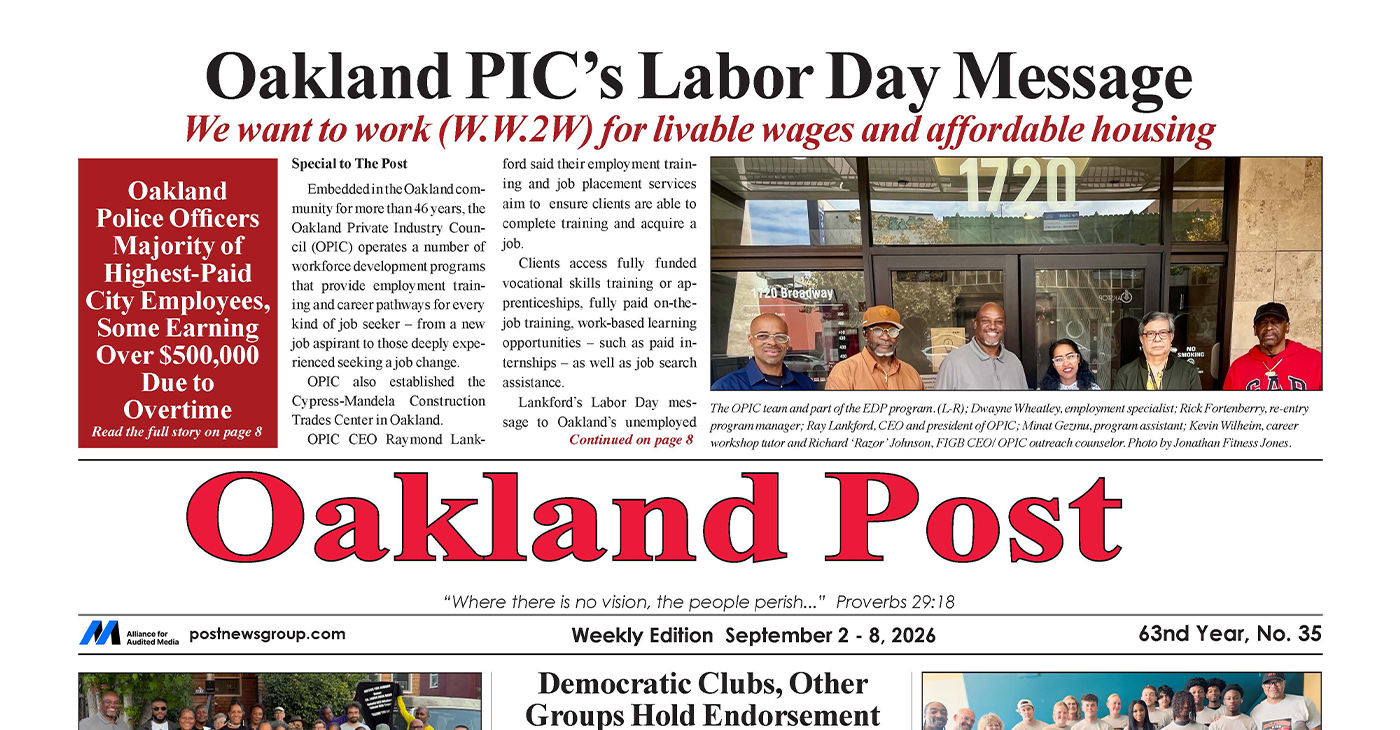
To enlarge your view of this issue, use the slider, magnifying glass icon or full page icon in the lower right corner of the browser window.
Activism
Oakland Post: Week of August 26 – September 1, 2026
The printed Weekly Edition of the Oakland Post: Week of August 26 – September 1, 2026
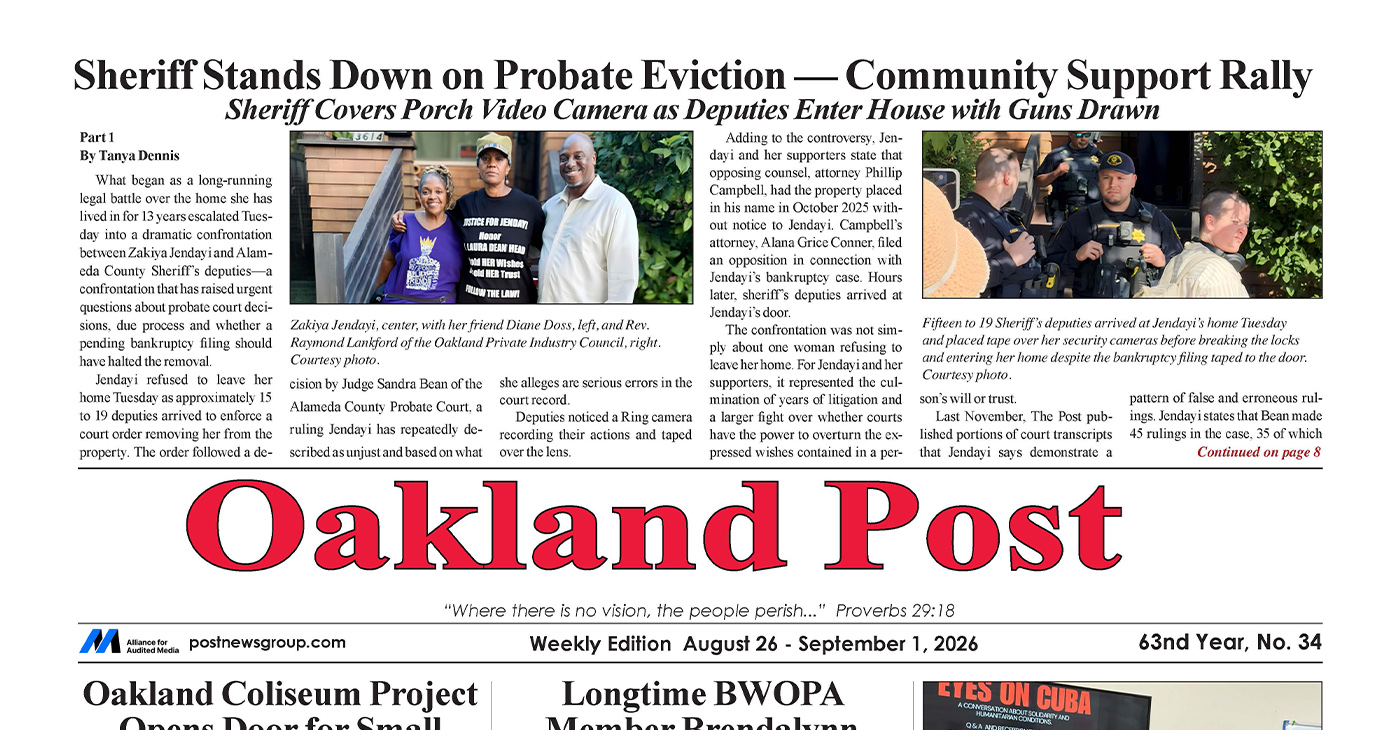
To enlarge your view of this issue, use the slider, magnifying glass icon or full page icon in the lower right corner of the browser window.



Democratic Clubs Interview Candidates for Oakland School Board

Nuna Phillips-McKee Celebrates 100 Years: ‘A Century of Faith, Family and God’s Amazing Grace!’

D.A. Ursula Jones Dickson: Terminix to Pay $3.15 Million Over Illegal Disposal of Pesticides, Customer Records

REPORT: Community Level Policy Is Impacting Homelessness and Drug Abuse in California
OPINION: AI Needs to Know Who Is the Boss
Goldi-Locs and Two (or Three) Bears in the Forest in California Hills

Election Watch 2026: 85% of Eligible Voters in California Are Registered

Don’t Let scammers Crash Your School Year

BOOK REVIEW — Curved Air: A Biography of Sickle Cell Anemia and the Quest to Cure the First Molecular Disease

California’s Legal Cannabis Market Hits $8 Billion as State Touts Progress on Fighting Drugs, Crime

Blacks and Latinos Clash Over LA’s Barrio Run; Mayor Karen Bass Calls for Dialogue Across Racial, Neighborhood Lines

Asm. Smallwood-Cuevas’s Bill Repealing ‘Racist’ CalWORKs ‘Man-in-the-House’ Rule Clears Legislature

Asm. Smallwood-Cuevas’s Bill Repealing ‘Racist’ CalWORKs ‘Man-in-the-House’ Rule Clears Legislature

‘Ready to See These Bills Become Law’: Sen. Weber’s Package of 15 Bills Advance to Gov. Newsom’s Desk

‘Ready to See These Bills Become Law’: Sen. Weber’s Package of 15 Bills Advance to Gov. Newsom’s Desk

Department of Homeland Security Demands California Secretary of State Shirley N. Weber Scrub Voter Rolls

New Judge Could Decide if Karmelo Anthony Gets a New Trial

“The Power to See Threats Sooner”: Gov. Newsom, Safety Officials Showcase California’s Investments in Hi-Tech Wildfire Prevention

Alpha Kappa Alpha Sorority, Inc. Celebrates New North Atlantic Regional Director

California Sen. Padilla Joins Colleagues to Introduce Bill Imposing Term Limits on Supreme Court Justices

Less Affluent School Districts, Including Sacramento City, Face Threat of State Takeover

Car Wash Workers Cope with Lingering Impacts of ICE Raids

Oakland Post: Week of July 29 – August 4, 2026

How Oakland’s Courtsmith is Scaling its Business and Local Impact

ESSAY: California Can Close Its Colorectal Cancer Gap

Oakland Post: Week of August 5 – 11, 2026

As Part of Your Back-to- School Checklist, Vaccinate

Oakland ‘Port Serves as a Powerful Engine for Good Jobs and Economic Development

Gov. Newsom Signs New Affordable Housing Legislation

Gov. Newsom Announces $109.6 Million in Funding for 278 Supportive Homes in Bakersfield, Contra Costa, Sacramento and Fresno

The Conversation With Al McFarlane 6/23/26

Media Monday 6/22/26

LIVE! ASK ALMA! — TUES. 6.23.26 7PM EST

Car Buying Secrets: 4 Hidden Checks Before You Sign!

Is This 550 HP Charger Worth YOUR Money? AutoNetwork Review

Celebrating Juneteenth – Frederick Douglass on education and resistance

LIVE! — ASK ALMA! — TUES. 6.19.26 7PM EST

Hyundai Ioniq 5 Parking, Safety, and 360 View #shorts

2025 Ioniq 5 New Wiper & Powerful Performance! #shorts

Electric SUV Range: Is 259 Miles Enough? #shorts

EV Charging: How Fast Can You Charge an Electric Vehicle? #shorts

Biometric Cooling… Messaging Seats…Come on! 2025 Infiniti QX80 Autograph 4WD

Charged Up: Witness the Magic of a Fully Electric Car! #shorts

Range Rover Sport PHEV Included…: See What’s Inside This Luxury SUV! #shorts

Invisible Hood View: Perfect Parking with X-Ray Vision! #shorts
-
 Community4 weeks ago
Less Affluent School Districts, Including Sacramento City, Face Threat of State Takeover
-
 Commentary4 weeks ago
ESSAY: California Can Close Its Colorectal Cancer Gap
-

 Business4 weeks ago
California Hispanic Chambers of Commerce Unveils: ‘Powering the Future’ Theme for 47th Annual Statewide Convention
-

 Community4 weeks ago
Four Candidates, Including Incumbent Barbara Lee, Qualify for Oakland Mayor’s Race
-

 Activism4 weeks ago
Oakland Post: Week of August 12 – 18, 2026
-

 Business4 weeks ago
From Blueprint to Breakthrough: Tackling Affordable Housing in Oakland
-

 Black History4 weeks ago
Oakland Observes Black August with Block Parties, Film Showings, Workshops
-

 Commentary4 weeks ago
COMMENTARY: Why Local School Tax Measure G1 Will Not Be on the November Ballot
