
Opinion
Op-Ed: State Complicit in Affordable Housing Crisis

By James Vann
Part III
Oakland’s longstanding rental and affordable housing crises continue relentlessly. To the shame of local policymakers, very little has been done at a significant magnitude to alleviate residents’ suffering.
<p>
On its own, the market does not stem displacement or produce renter protections and affordable housing.
Only governments can perform these functions. Left to its own devises, the market will not provide housing to meet the mounting needs of lower income residents, who are an ever-growing majority of residents.
The state government is not innocent. Actions and non-actions at the state level have mostly made the local housing crisis worse.
Three particularly egregious state programs cripple local efforts to address housing problems: the Ellis Act of 1985, the Costa-Hawkins Housing Act of 1995, and the “Palmer vs. City of Los Angeles Decision” of 2009.
The Ellis Act permits wholesale, no-cause eviction of tenants when an owner no longer desires to operate rental housing — often a ploy to evict current tenants to make way for more expensive rents.
Costa-Hawkins — an accomplishment led by Gregory McConnell of Oakland and acknowledged with great pride on his website — erodes rent control by deregulating controlled units following each vacancy.
More recently, the Palmer Decision eliminated the ability of cities to impose inclusionary housing requirements to provide specified percentages of affordable units within a market development of rental housing.

The roots of the Costa-Hawkins Act are local. For years, State Senator David Roberti (LA), Judiciary Committee Chair, blocked the heinous Costa-Hawkins bill in committee.
When Senator Roberti was termed out in 1994, Berkeley’s beloved and presumed liberal Senator Nicholas Petris was appointed the seceding chair.
As one of his first acts, Senator Petris, a Berkeley resident and rental property owner, betrayed his local constituents and released the Costa-Hawkins bill to the Republican-controlled legislature.
The bill was passed overwhelmingly by the Republican house, and has since been a plague on renters and rent control programs all over the state.
While there may be little local residents can do to change federal housing policies, this is not at all true of state laws. There are urgently needed programs that can be implemented by the state that will significantly relieve the crisis being endured by tenants, artists, homeless and low-income households.
Despite having both a Democratic governor and solid majority legislature, there are no indications that needed improvements will occur without consistent mass organizing and ongoing pressure.
Here are some of the actions that are needed:
- Declare a general “State of Emergency in Rental Housing” to permit a period of relief from the epidemic of astronomical rent increases and no-cause evictions so that remedial programs can be proposed.
- Repeal the Costa-Hawkins Rental Housing Law, which greatly restricts the ability of cities to establish, monitor, and maintain equitable regulations or fair rents and unwarranted evictions.
Repeal the Ellis Act, which permits wholesale elimination of rental buildings and mass eviction of current tenants, allowing units to be replaced with luxury condominiums.
- Reverse the L.A. Superior Court’s Palmer Decision, which prohibits cities from enacting inclusionary zoning — a program that formerly permitted cities to require that a percentage of a market development (usually 15 percent to 30 percent) must be affordable to lower income households.
Before the Palmer Decision, every city in the Bay Area had an inclusionary housing requirement – except Oakland.
- Use a large portion of the state budget’s surplus to create a fund for local communities to build housing for very low-, and low-income individuals and families. Presently, persons on fixed income, Social Security, SSI, or disability can only be served by federal Section 8 Housing Choice Vouchers and the quantity of these units is woefully below the need.
- Make it illegal to reject a tenant’s rent, or to claim non-receipt, as the basis for issuing a three-day notice, followed by subsequent Unlawful Retainer eviction of an otherwise fully compliant tenant.
- Establish a fund and program of loans and grants to Land Trusts. These developments are one of the only forms available for permanently affordable housing that does not escalate with irrational markets or inflation.
- Establish a fund and program of loans and grants to enable cities to purchase abandoned and vacated industrial buildings to be made available for affordable sale or rental to artists and community non-profit social services organizations.
- Enact an administrative procedure to authorize city and county attorneys to initiate legal action against patterns and practices of owner harassment of tenants. Present state law puts the responsibility on tenants to file suits in small claims or superior courts — a remedy that is not affordable to many.
- Reinstitute Redevelopment and Tax Increment Financing, programs that for decades enabled cities to build affordable housing.
Enact statewide bonds of $2 billion to finance the development of “mini-home communities” for homeless persons and families.
- Enact statewide bonds of $5 billion to aid developments of critically needed affordable housing.


Activism
Oakland Post: Week of September 9 – 15, 2026
The printed Weekly Edition of the Oakland Post: Week of September 9 – 15, 2026

To enlarge your view of this issue, use the slider, magnifying glass icon or full page icon in the lower right corner of the browser window.
Activism
Oakland Post: Week of September 2 – 8, 2026
The printed Weekly Edition of the Oakland Post: Week of September 2 – 8, 2026
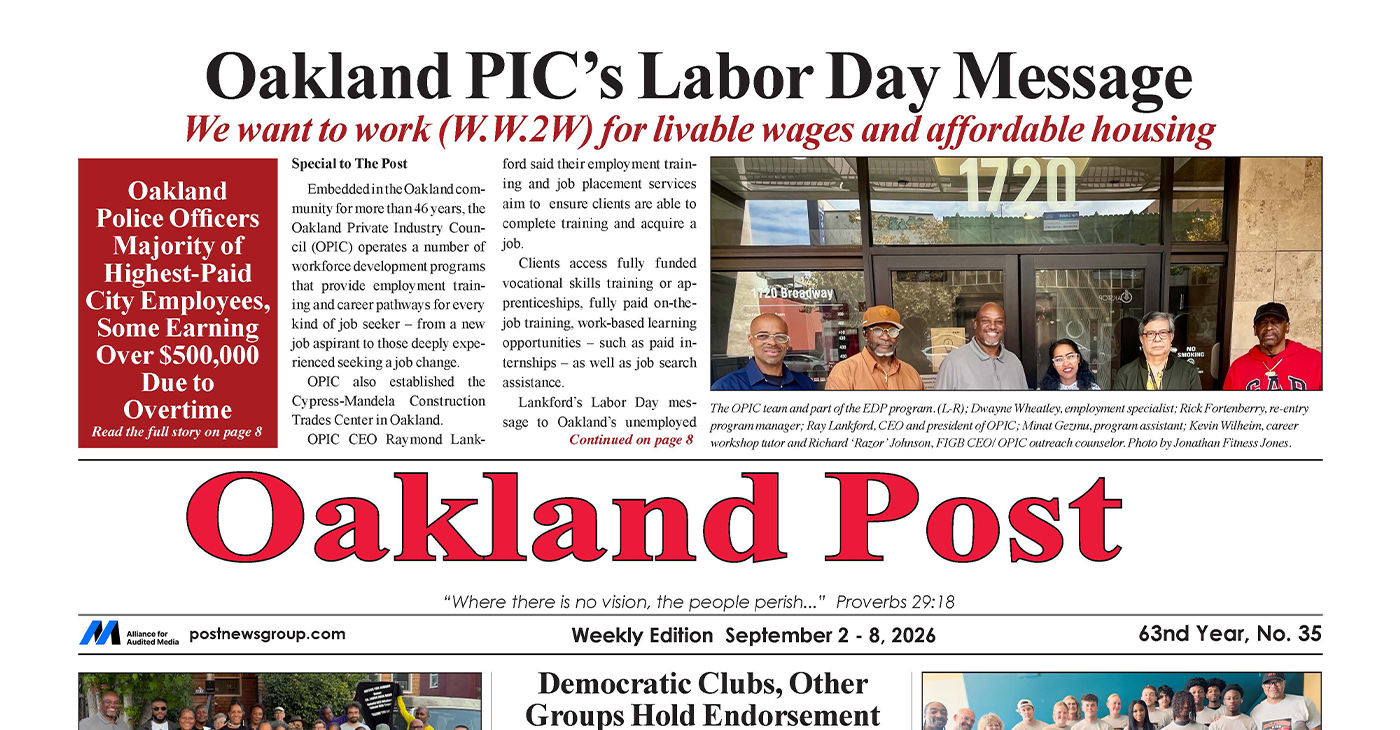
To enlarge your view of this issue, use the slider, magnifying glass icon or full page icon in the lower right corner of the browser window.
Activism
Oakland Post: Week of August 26 – September 1, 2026
The printed Weekly Edition of the Oakland Post: Week of August 26 – September 1, 2026
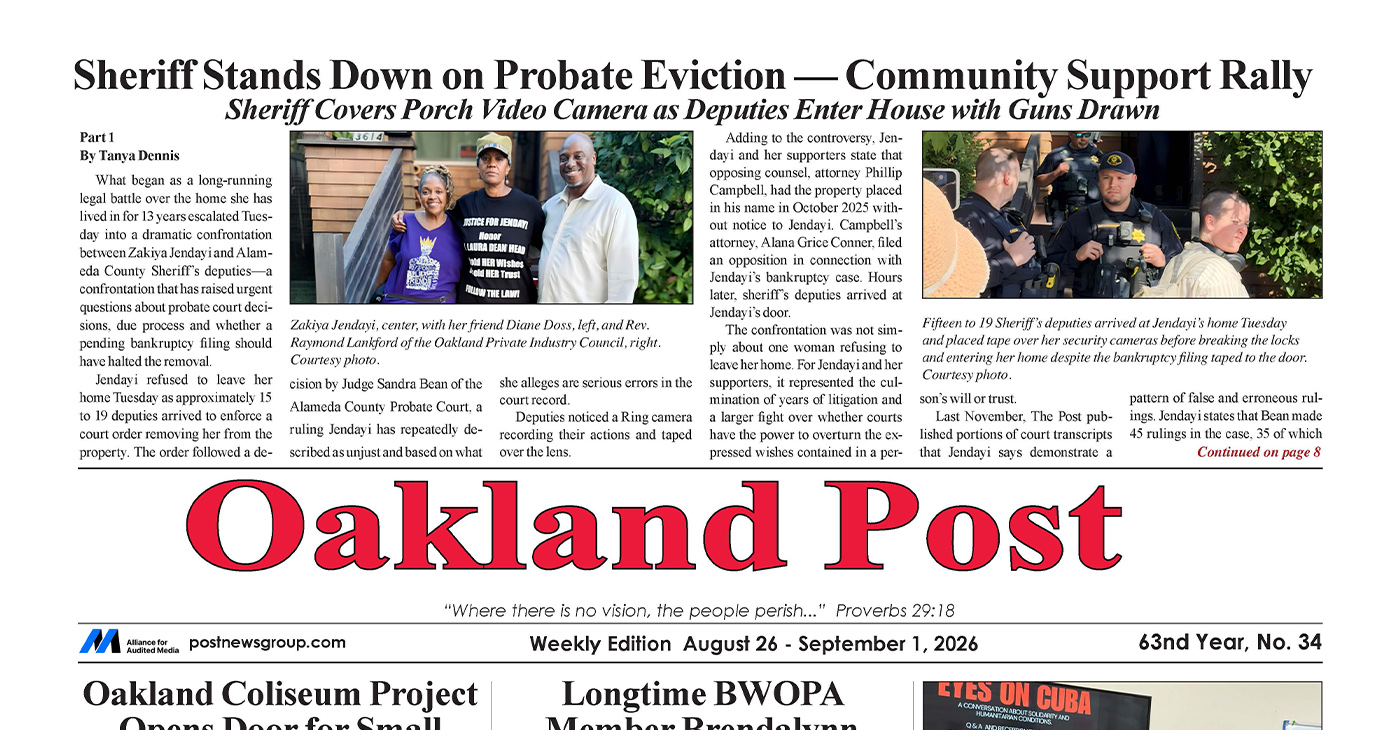
To enlarge your view of this issue, use the slider, magnifying glass icon or full page icon in the lower right corner of the browser window.



Port of Oakland, Army Corps Sign Historic Harbor Design Agreement

Democratic Clubs Interview Candidates for Oakland School Board

Nuna Phillips-McKee Celebrates 100 Years: ‘A Century of Faith, Family and God’s Amazing Grace!’

D.A. Ursula Jones Dickson: Terminix to Pay $3.15 Million Over Illegal Disposal of Pesticides, Customer Records

REPORT: Community Level Policy Is Impacting Homelessness and Drug Abuse in California
OPINION: AI Needs to Know Who Is the Boss
Goldi-Locs and Two (or Three) Bears in the Forest in California Hills

Election Watch 2026: 85% of Eligible Voters in California Are Registered

Don’t Let scammers Crash Your School Year

BOOK REVIEW — Curved Air: A Biography of Sickle Cell Anemia and the Quest to Cure the First Molecular Disease

California’s Legal Cannabis Market Hits $8 Billion as State Touts Progress on Fighting Drugs, Crime

Blacks and Latinos Clash Over LA’s Barrio Run; Mayor Karen Bass Calls for Dialogue Across Racial, Neighborhood Lines

Asm. Smallwood-Cuevas’s Bill Repealing ‘Racist’ CalWORKs ‘Man-in-the-House’ Rule Clears Legislature

Asm. Smallwood-Cuevas’s Bill Repealing ‘Racist’ CalWORKs ‘Man-in-the-House’ Rule Clears Legislature

‘Ready to See These Bills Become Law’: Sen. Weber’s Package of 15 Bills Advance to Gov. Newsom’s Desk

Department of Homeland Security Demands California Secretary of State Shirley N. Weber Scrub Voter Rolls

New Judge Could Decide if Karmelo Anthony Gets a New Trial

“The Power to See Threats Sooner”: Gov. Newsom, Safety Officials Showcase California’s Investments in Hi-Tech Wildfire Prevention

Alpha Kappa Alpha Sorority, Inc. Celebrates New North Atlantic Regional Director

California Sen. Padilla Joins Colleagues to Introduce Bill Imposing Term Limits on Supreme Court Justices

Less Affluent School Districts, Including Sacramento City, Face Threat of State Takeover

Car Wash Workers Cope with Lingering Impacts of ICE Raids

Oakland Post: Week of July 29 – August 4, 2026

How Oakland’s Courtsmith is Scaling its Business and Local Impact

ESSAY: California Can Close Its Colorectal Cancer Gap

Oakland Post: Week of August 5 – 11, 2026

As Part of Your Back-to- School Checklist, Vaccinate

Oakland ‘Port Serves as a Powerful Engine for Good Jobs and Economic Development

Gov. Newsom Signs New Affordable Housing Legislation

Gov. Newsom Announces $109.6 Million in Funding for 278 Supportive Homes in Bakersfield, Contra Costa, Sacramento and Fresno

The Conversation With Al McFarlane 6/23/26

Media Monday 6/22/26

LIVE! ASK ALMA! — TUES. 6.23.26 7PM EST

Car Buying Secrets: 4 Hidden Checks Before You Sign!

Is This 550 HP Charger Worth YOUR Money? AutoNetwork Review

Celebrating Juneteenth – Frederick Douglass on education and resistance

LIVE! — ASK ALMA! — TUES. 6.19.26 7PM EST

Hyundai Ioniq 5 Parking, Safety, and 360 View #shorts

2025 Ioniq 5 New Wiper & Powerful Performance! #shorts

Electric SUV Range: Is 259 Miles Enough? #shorts

EV Charging: How Fast Can You Charge an Electric Vehicle? #shorts

Biometric Cooling… Messaging Seats…Come on! 2025 Infiniti QX80 Autograph 4WD

Charged Up: Witness the Magic of a Fully Electric Car! #shorts

Range Rover Sport PHEV Included…: See What’s Inside This Luxury SUV! #shorts

Invisible Hood View: Perfect Parking with X-Ray Vision! #shorts
-

 Business4 weeks ago
California Hispanic Chambers of Commerce Unveils: ‘Powering the Future’ Theme for 47th Annual Statewide Convention
-

 Community4 weeks ago
Four Candidates, Including Incumbent Barbara Lee, Qualify for Oakland Mayor’s Race
-

 Activism4 weeks ago
Oakland Post: Week of August 12 – 18, 2026
-

 Black History4 weeks ago
Oakland Observes Black August with Block Parties, Film Showings, Workshops
-

 Commentary4 weeks ago
COMMENTARY: Why Local School Tax Measure G1 Will Not Be on the November Ballot
-

 Commentary2 weeks ago
Standoff for Justice: Our Homes Are Worth Fighting For
-

 Business2 weeks ago
Gubernatorial Candidate Steve Hilton Blasts California New Tire Rules; Newsom Hits Back
-

 Activism2 weeks ago
Oakland Post: Week of August 26 – September 1, 2026
