
Opinion
OP-ED: Reclaiming True Religious Decorum

By Richard Wembe Johnson, Folsom Prison
It’s time that people stop with the veiled innuendos and a subtle jab toward each other’s professed religions. Not only is it irresponsible and disrespectful, it is dangerous.
There are certainly enough religious beliefs, faiths and denominations to reach every single person on earth.
A close examination of unrest and turmoil in the world, putting aside the almighty dollar, will reveal that religion is the root cause of most of the carnage and evil toward other faiths in the name of devotion, love and religious fervor
The two most exalted and glorified are Islam and Christianity. For example, during the 11th, 12th and 13th centuries, the Christian Crusades were launched against the Muslims to take the Holy Lands.
Within the Christian faith there are numerous separations and denominations with unresolved differences, often creating chaos and disorder.
This same characterization of internal differences can equally be attributed to the State of Islam throughout the world. And, also here in America, we observe numerous variations such as the Black Nation of Islam, Sunnis, Shiites and other believers, all following different edicts of Islam.
With so many opposing factions there is a basis for eventual violence and mayhem, and this is exactly what is going on all over the world and in the United States.

Even though people are entitled to their differences, they are not entitled to disrespect other religions or beliefs under the guise of free speech.
You don’t have to agree, like, or practice someone else’s religion in order to show them the same consideration that you would like to be afforded for your belief or non-belief.
I was raised a Christian, yet I respect all others religious beliefs. I believe that they also have the fundamental right to practice their beliefs.
I firmly disagree with anyone trying to cram their faith down another’s throat by means of intimidation, coercion, force or violence.
The very core essence of any religion is supposed to be about a real connection to God, Allah, or whatever you choose to refer to as God.
Through this understanding, your life is supposed to be guided by divine righteousness in compliance with showing love, respect and tolerance toward one another.
Instead, we are witnessing conflicts over the Bible and guns, the Torah and precision guided missiles, the Koran and I.E.D, (improvised explosive devices). This is blasphemy under any examination.
According to some reliable sources of religious data, there are at least 72 different sects practicing Islam and untold versions of Christianity. At the same time, research shows the fastest growing segment relative to religion is the masses are abandoning religion out of pure disgust.
George Jackson, the renowned prison activist and revolutionary author said, “Settle your quarrels, come together, and understand the reality of your circumstances that poor half-butchered lives can be saved. Reclaim your humanity:”
These words are even more meaningful today than they were many decades ago.
The fate of religion rests not on what is said but rather what is done to ensure that all religion is given its due diligence, unfettered by crookedness.


Activism
Oakland Post: Week of September 2 – 8, 2026
The printed Weekly Edition of the Oakland Post: Week of September 2 – 8, 2026
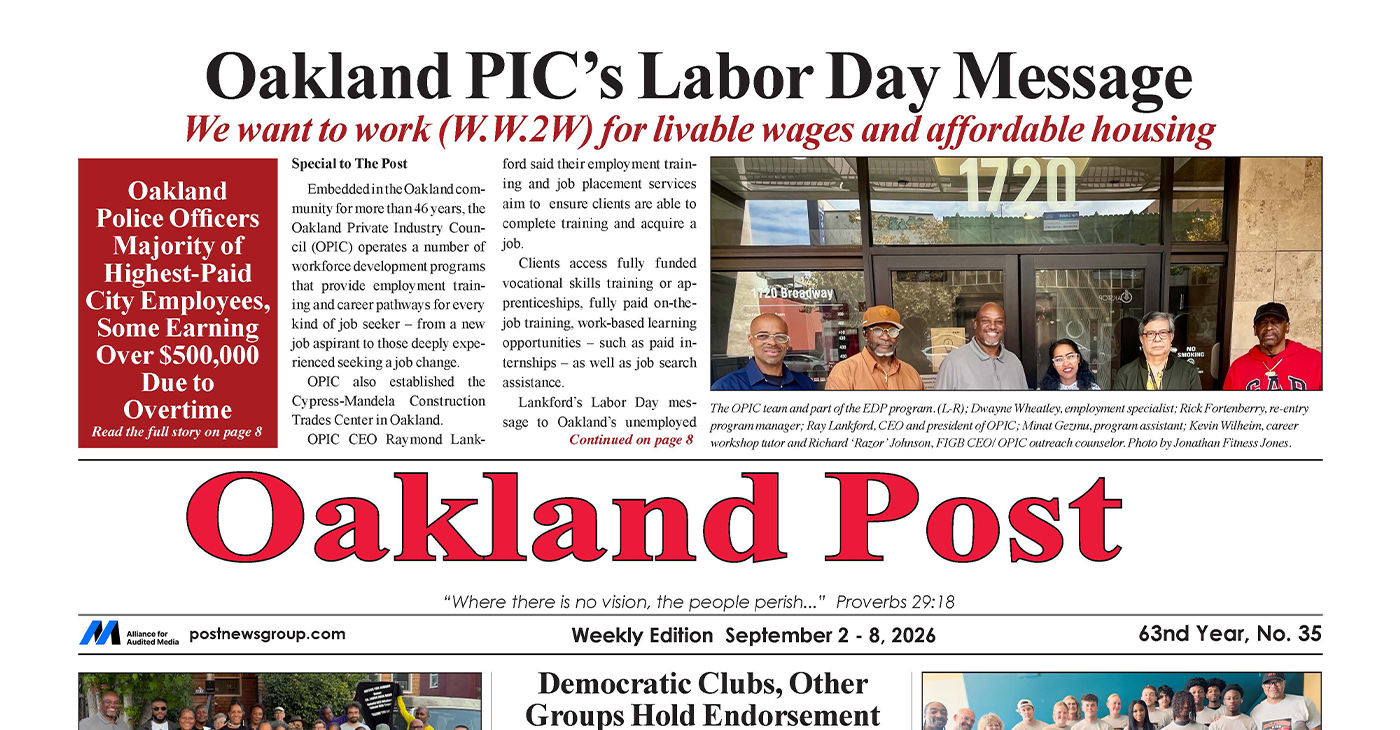
To enlarge your view of this issue, use the slider, magnifying glass icon or full page icon in the lower right corner of the browser window.
Activism
Oakland Post: Week of August 26 – September 1, 2026
The printed Weekly Edition of the Oakland Post: Week of August 26 – September 1, 2026
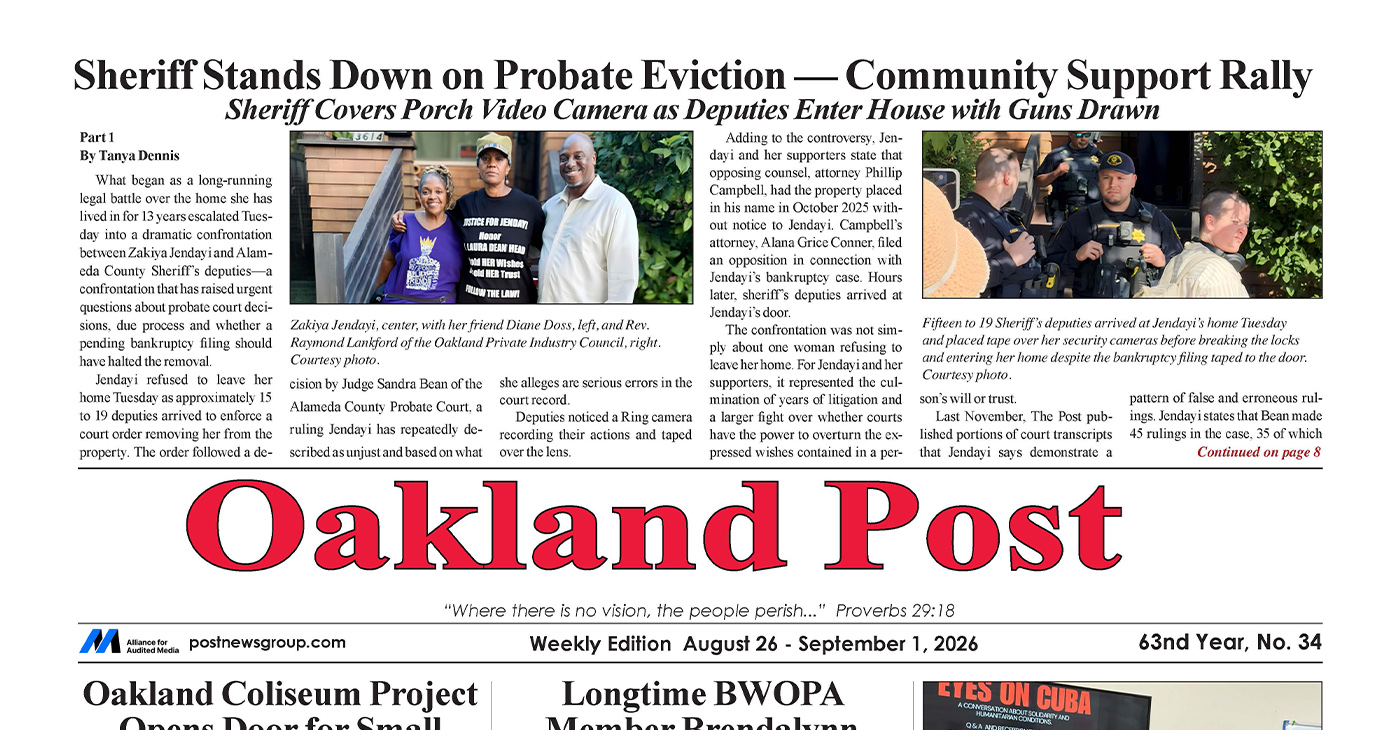
To enlarge your view of this issue, use the slider, magnifying glass icon or full page icon in the lower right corner of the browser window.
Activism
Oakland Post: Week of August 19 – 25, 2026
The printed Weekly Edition of the Oakland Post: Week of August 18 – 25, 2026

To enlarge your view of this issue, use the slider, magnifying glass icon or full page icon in the lower right corner of the browser window.


Prostate Cancer is Twice as Likely to Kill Black Men. Talking to Your Doctor Could Help Save Your Life

Oakland Post: Week of September 2 – 8, 2026

Longtime BWOPA Member Brendalyn Goodall Appointed to California Workforce Development Board

Jackie Wright Champions Bay Area Stories, Filmmakers and Cultural Institutions

Chef Sharon Lee Blends Culinary Excellence, Education and Empowerment

‘Passing a Law Isn’t The Finish Line’: California Assembly Evaluates Implementation, Results

OPINION: Angie Nixon Will Turn You Into a Democratic Socialist If Donald Trump Hasn’t Already

Gov. Newsom Signs Law Shielding Immigration Aid Workers From Doxing Threats

BOOK REVIEW: Every Inch of a Lady

Big City Mayors Ask for “Yes” Vote on Housing Bond Measure; Conservatives Say “No”

Madeline M. Turner: The Inventor Who Made Juicing Easier

Gubernatorial Candidate Steve Hilton Blasts California New Tire Rules; Newsom Hits Back

Frontier Airlines’ Return to Oakland Airport Brings Flights, Jobs and Opportunity

Secretary of State Shirley N. Weber Urges Californians to Vote Early as Voter ID Battle Intensifies

Gov. Newsom’s Latest Appointees Include Sacramento Advocate for Formerly Incarcerated Students; State’s New Tech Chief

Department of Homeland Security Demands California Secretary of State Shirley N. Weber Scrub Voter Rolls

New Judge Could Decide if Karmelo Anthony Gets a New Trial

“The Power to See Threats Sooner”: Gov. Newsom, Safety Officials Showcase California’s Investments in Hi-Tech Wildfire Prevention

Alpha Kappa Alpha Sorority, Inc. Celebrates New North Atlantic Regional Director

California Sen. Padilla Joins Colleagues to Introduce Bill Imposing Term Limits on Supreme Court Justices

Less Affluent School Districts, Including Sacramento City, Face Threat of State Takeover

Car Wash Workers Cope with Lingering Impacts of ICE Raids

COMMENTARY: You Are Already Paying for the AI Boom

California Bill Would Let Abuse Victims Use Trauma as Legal Defense for Violent Crime

Oakland Post: Week of July 29 – August 4, 2026

How Oakland’s Courtsmith is Scaling its Business and Local Impact

ESSAY: California Can Close Its Colorectal Cancer Gap

As Part of Your Back-to- School Checklist, Vaccinate

Oakland Post: Week of August 5 – 11, 2026

Oakland ‘Port Serves as a Powerful Engine for Good Jobs and Economic Development

The Conversation With Al McFarlane 6/23/26

Media Monday 6/22/26

LIVE! ASK ALMA! — TUES. 6.23.26 7PM EST

Car Buying Secrets: 4 Hidden Checks Before You Sign!

Is This 550 HP Charger Worth YOUR Money? AutoNetwork Review

Celebrating Juneteenth – Frederick Douglass on education and resistance

LIVE! — ASK ALMA! — TUES. 6.19.26 7PM EST

Hyundai Ioniq 5 Parking, Safety, and 360 View #shorts

2025 Ioniq 5 New Wiper & Powerful Performance! #shorts

Electric SUV Range: Is 259 Miles Enough? #shorts

EV Charging: How Fast Can You Charge an Electric Vehicle? #shorts

Biometric Cooling… Messaging Seats…Come on! 2025 Infiniti QX80 Autograph 4WD

Charged Up: Witness the Magic of a Fully Electric Car! #shorts

Range Rover Sport PHEV Included…: See What’s Inside This Luxury SUV! #shorts

Invisible Hood View: Perfect Parking with X-Ray Vision! #shorts
-
 Community4 weeks ago
Less Affluent School Districts, Including Sacramento City, Face Threat of State Takeover
-
 Commentary4 weeks ago
ESSAY: California Can Close Its Colorectal Cancer Gap
-
 Business4 weeks ago
California Hispanic Chambers of Commerce Unveils: ‘Powering the Future’ Theme for 47th Annual Statewide Convention
-
 Community4 weeks ago
Four Candidates, Including Incumbent Barbara Lee, Qualify for Oakland Mayor’s Race
-
 Activism4 weeks ago
Oakland Post: Week of August 12 – 18, 2026
-

 Business4 weeks ago
From Blueprint to Breakthrough: Tackling Affordable Housing in Oakland
-
 Black History4 weeks ago
Oakland Observes Black August with Block Parties, Film Showings, Workshops
-

 Commentary4 weeks ago
COMMENTARY: Why Local School Tax Measure G1 Will Not Be on the November Ballot
