
Opinion
OP-ED: How to Win Elections Behind the Cotton Curtain

We won the Voting Rights Act of 1965 at Selma, combining the power of a principled mass movement led by Dr. King and a compassionate president who did the right thing despite the heavy political price.
What was that cost? Well, President Johnson said it best at the time, when he told his aides that we’d “just lost the South for a generation.”
The civil rights movement made the moral move by marching across the bridge at Selma. LBJ did the right thing by signing the Voting Rights Act into law, knowing the price his party would pay.
The Jefferson Davis Democrats in the South did the wrong thing by responding to the “Southern strategy” of Richard Nixon and the racial dog whistles of Ronald Reagan. Due to race, the once-solid Democratic South switched over to become today’s solid Republican South.
Now it’s been half a century. Not just a generation, as LBJ foretold, but two-and-a-half generations — and still the Republican Party dominates below the Mason-Dixon Line.
As Rachel Maddow brought up in last week’s presidential forum, the Democratic Party in today’s South has been “hollowed out,” with only a handful of successful statewide Democratic candidates.
As long as that situation exists, the Democrats will be able to win the presidency, but what about the Senate and House?
The sad irony is that the South has benefited the most from the civil rights movement, whites and African-Americans together.
The tearing down of the “Cotton Curtain” by the civil rights martyrs and marchers meant that the South could join our modern economy. Population jumped.
The South could finally have professional sports teams. The civil rights movement forced the development of integrated football teams at Southern colleges that now dominate the sport.
The Olympics could be held in Atlanta in 1996, with Muhammad Ali and Stevie Wonder at the closing ceremonies. Toyota and Mercedes Benz could locate plants in the South, providing better jobs than cotton ever had.
Yet Southern politicians, stuck in the politics of fear, still poke at racial wounds for short-term success.
In order to starve the government, Southern politicians still refuse to invest in infrastructure across the region. Rebuilding our ports and harbors, investing in jobs programs that would employ white and African-American workers, preparing our coasts to survive the future Katrina-like storms that climate change will bring, accepting the Medicaid expansion that would provide needed health care for so many families — these public policy initiatives would develop the region even more, and open up the futures for so many young Southerners.
Yet too many politicians and voters continue to choose race over reason. White working-class Southern voters continue to run from race, choosing the party that backs both tax cuts and job cuts.
This is a political odd couple that makes no sense. Half a century after the Voting Rights Act, too many Southern voters are still afraid of change, even when it would benefit them.
How do we break through?
First of all, former Democratic National Committee Chair Howard Dean was right — we need a 50-state strategy. We need to compete everywhere in the country, from the local level to the state level to the presidency.
The Democratic Party in the South needs to rebuild, to move from the outhouse to the courthouse to the statehouse to the White House.
Second, candidate Barack Obama showed us how we win in the South — with a message of hope and change, combined with a massive voter registration effort and a huge voter turnout.
In 2008, that combination carried Florida, North Carolina and Virginia. In 2012, Florida and Virginia again went blue, with North Carolina barely missing out.
Third, we need to battle voter suppression. Sen. Bernie Sanders was right when he pointed out that too many Republican leaders are “cowards” for repressing the African-American vote. Bernie also mentioned universal voter registration during.
Rachel Maddow’s forum, and right afterwards, in an interview with Chris Matthews, he raised an idea that I have been pushing for — a constitutional amendment to guarantee the right to vote to every American. And we must protect and restore the power of the Voting Rights Act.
Fourth, we need to invest bottom-up in the South, economically and politically. If we raise wages, provide health care for everyone and open up voter registration to all our people, hope will rise, the South will develop, and people’s lives will be better.
If white working-class families choose hope over fear, their lives will improve — and so will those of Southern Latinos and African-Americans. And Democrats will be able to win elections again.


Activism
Oakland Post: Week of September 9 – 15, 2026
The printed Weekly Edition of the Oakland Post: Week of September 9 – 15, 2026

To enlarge your view of this issue, use the slider, magnifying glass icon or full page icon in the lower right corner of the browser window.
Activism
Oakland Post: Week of September 2 – 8, 2026
The printed Weekly Edition of the Oakland Post: Week of September 2 – 8, 2026
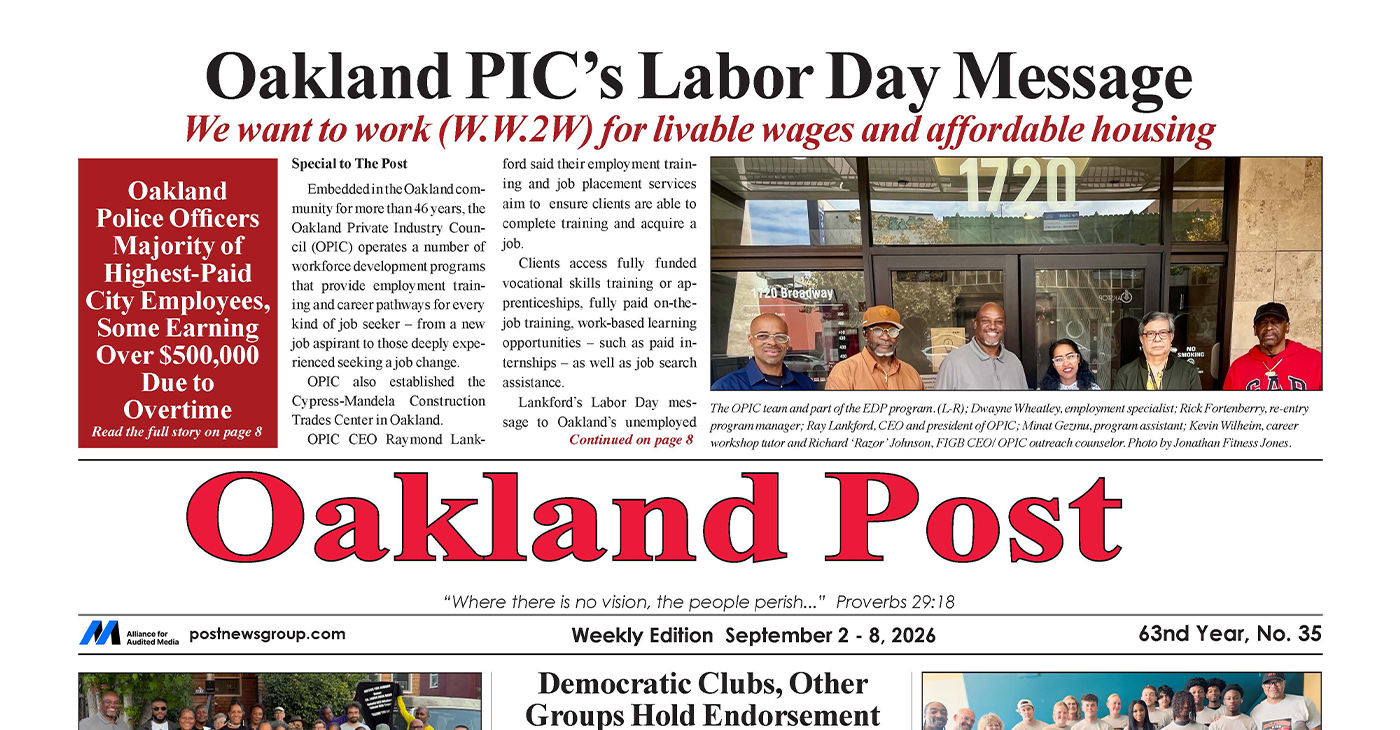
To enlarge your view of this issue, use the slider, magnifying glass icon or full page icon in the lower right corner of the browser window.
Activism
Oakland Post: Week of August 26 – September 1, 2026
The printed Weekly Edition of the Oakland Post: Week of August 26 – September 1, 2026
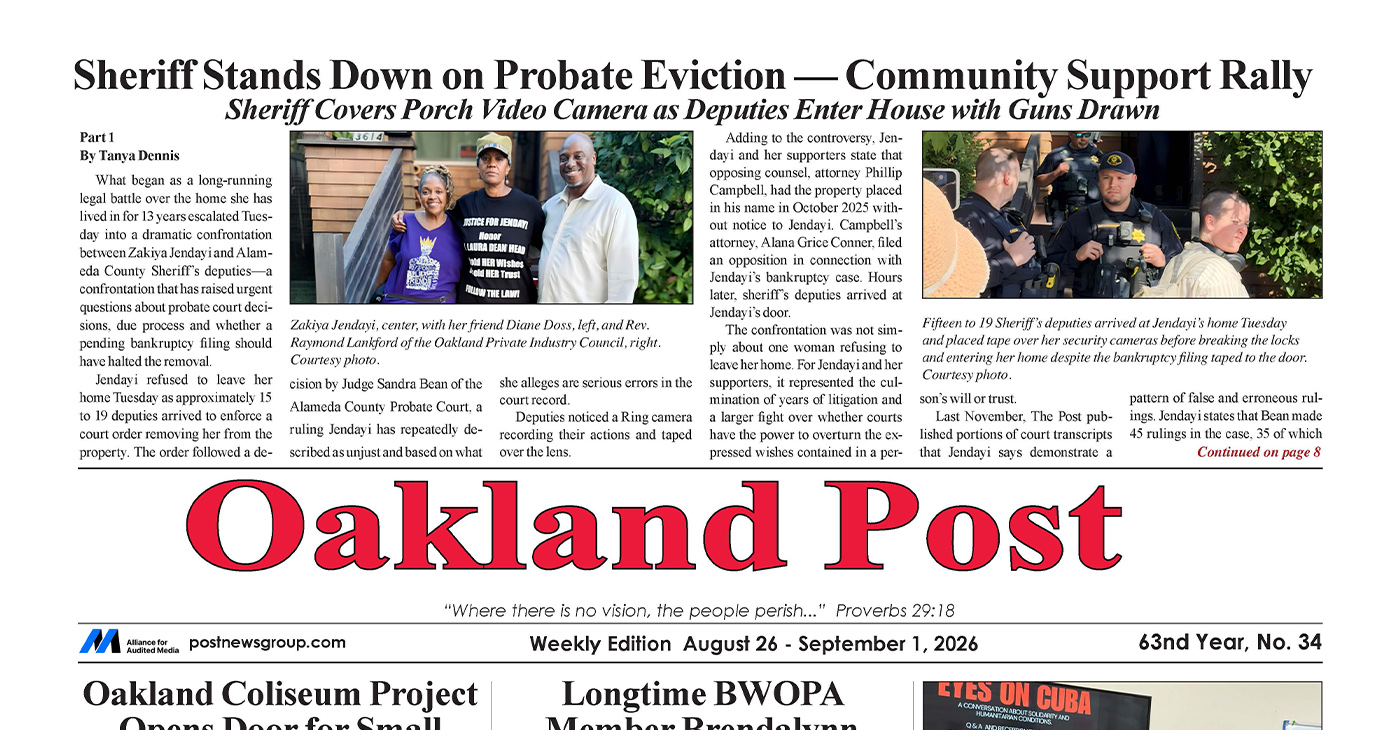
To enlarge your view of this issue, use the slider, magnifying glass icon or full page icon in the lower right corner of the browser window.



Democratic Clubs Interview Candidates for Oakland School Board

Nuna Phillips-McKee Celebrates 100 Years: ‘A Century of Faith, Family and God’s Amazing Grace!’

D.A. Ursula Jones Dickson: Terminix to Pay $3.15 Million Over Illegal Disposal of Pesticides, Customer Records

REPORT: Community Level Policy Is Impacting Homelessness and Drug Abuse in California
OPINION: AI Needs to Know Who Is the Boss
Goldi-Locs and Two (or Three) Bears in the Forest in California Hills

Election Watch 2026: 85% of Eligible Voters in California Are Registered

Don’t Let scammers Crash Your School Year

BOOK REVIEW — Curved Air: A Biography of Sickle Cell Anemia and the Quest to Cure the First Molecular Disease

California’s Legal Cannabis Market Hits $8 Billion as State Touts Progress on Fighting Drugs, Crime

Blacks and Latinos Clash Over LA’s Barrio Run; Mayor Karen Bass Calls for Dialogue Across Racial, Neighborhood Lines

Asm. Smallwood-Cuevas’s Bill Repealing ‘Racist’ CalWORKs ‘Man-in-the-House’ Rule Clears Legislature

Asm. Smallwood-Cuevas’s Bill Repealing ‘Racist’ CalWORKs ‘Man-in-the-House’ Rule Clears Legislature

‘Ready to See These Bills Become Law’: Sen. Weber’s Package of 15 Bills Advance to Gov. Newsom’s Desk

‘Ready to See These Bills Become Law’: Sen. Weber’s Package of 15 Bills Advance to Gov. Newsom’s Desk

Department of Homeland Security Demands California Secretary of State Shirley N. Weber Scrub Voter Rolls

New Judge Could Decide if Karmelo Anthony Gets a New Trial

“The Power to See Threats Sooner”: Gov. Newsom, Safety Officials Showcase California’s Investments in Hi-Tech Wildfire Prevention

Alpha Kappa Alpha Sorority, Inc. Celebrates New North Atlantic Regional Director

California Sen. Padilla Joins Colleagues to Introduce Bill Imposing Term Limits on Supreme Court Justices

Less Affluent School Districts, Including Sacramento City, Face Threat of State Takeover

Car Wash Workers Cope with Lingering Impacts of ICE Raids

Oakland Post: Week of July 29 – August 4, 2026

How Oakland’s Courtsmith is Scaling its Business and Local Impact

ESSAY: California Can Close Its Colorectal Cancer Gap

Oakland Post: Week of August 5 – 11, 2026

As Part of Your Back-to- School Checklist, Vaccinate

Oakland ‘Port Serves as a Powerful Engine for Good Jobs and Economic Development

Gov. Newsom Signs New Affordable Housing Legislation

Gov. Newsom Announces $109.6 Million in Funding for 278 Supportive Homes in Bakersfield, Contra Costa, Sacramento and Fresno

The Conversation With Al McFarlane 6/23/26

Media Monday 6/22/26

LIVE! ASK ALMA! — TUES. 6.23.26 7PM EST

Car Buying Secrets: 4 Hidden Checks Before You Sign!

Is This 550 HP Charger Worth YOUR Money? AutoNetwork Review

Celebrating Juneteenth – Frederick Douglass on education and resistance

LIVE! — ASK ALMA! — TUES. 6.19.26 7PM EST

Hyundai Ioniq 5 Parking, Safety, and 360 View #shorts

2025 Ioniq 5 New Wiper & Powerful Performance! #shorts

Electric SUV Range: Is 259 Miles Enough? #shorts

EV Charging: How Fast Can You Charge an Electric Vehicle? #shorts

Biometric Cooling… Messaging Seats…Come on! 2025 Infiniti QX80 Autograph 4WD

Charged Up: Witness the Magic of a Fully Electric Car! #shorts

Range Rover Sport PHEV Included…: See What’s Inside This Luxury SUV! #shorts

Invisible Hood View: Perfect Parking with X-Ray Vision! #shorts
-
 Community4 weeks ago
Less Affluent School Districts, Including Sacramento City, Face Threat of State Takeover
-
 Commentary4 weeks ago
ESSAY: California Can Close Its Colorectal Cancer Gap
-
 Business4 weeks ago
California Hispanic Chambers of Commerce Unveils: ‘Powering the Future’ Theme for 47th Annual Statewide Convention
-
 Community4 weeks ago
Four Candidates, Including Incumbent Barbara Lee, Qualify for Oakland Mayor’s Race
-
 Activism4 weeks ago
Oakland Post: Week of August 12 – 18, 2026
-

 Business4 weeks ago
From Blueprint to Breakthrough: Tackling Affordable Housing in Oakland
-
 Black History4 weeks ago
Oakland Observes Black August with Block Parties, Film Showings, Workshops
-

 Commentary4 weeks ago
COMMENTARY: Why Local School Tax Measure G1 Will Not Be on the November Ballot
