
Technology
Online Common Core Testing Lays Bare Tech Divide in Schools


In this April 30, 2015 photo, students line up to take part in new Common Core-aligned standardized tests at the Cuyama Valley High School in New Cuyama, Calif. (AP Photo/Christine Armario)
Christine Armario and Sally Ho, ASSOCIATED PRESS
NEW CUYAMA, Calif. (AP) — Nestled between mountains 60 miles from the nearest city, students at rural California’s Cuyama Valley High School use Internet connections about one-tenth the minimum speed recommended for the modern U.S. classroom.
So when it came time to administer the new Common Core-aligned tests online, the district of 240 students in a valley of oil fields and sugar beet farms faced a challenge.
New Cuyama has no access to fiber optic cables. Some residents live entirely off the grid, relying on solar power and generators. The local telephone company provided a few extra lines, but that only bumped speeds a few megabits.
“We tripled our capacity but it’s still woefully inadequate,” said Paul Chounet, superintendent of the Cuyama Joint Unified School District.
Across the country, school districts in rural areas like New Cuyama and other pockets with low bandwidth are confronting a difficult task: Administering the new standardized tests to students online, laying bare a tech divide in the nation’s classrooms.
Overall, 63 percent of public schools don’t have access to broadband speeds needed for digital learning. The problem is particularly acute in rural and low-income districts: Only 14 percent in those areas meet high-speed internet targets.
“It’s just very uneven all over the country,” Lan Neugent, executive director of the non-profit State Educational Technology Directors Association.
The Federal Communications Commission approved a $1.5 billion spending cap increase for school broadband and Wi-Fi last year that is expected to significantly boost connectivity. State grants linked to Common Core implementation and collaborations with tech and business leaders are also bridging the gap. But those initiatives could take a year or more to connect thousands of schools and testing started in 29 states and the District of Columbia for 12 million students this year.
In the meantime, they’re resorting to alternatives: Testing students in small groups, busing them to other schools and limiting all other internet access while exams are taken.
On a recent testing day in New Cuyama, 11 students filed into the high school’s small computer lab. Even with such a small number of test takers, students said they’d gotten kicked offline and had to log in again.
“It got me off track,” said Brian Olivas, 17.
The Common Core standards adopted in 43 states and the District of Columbia provide uniform benchmarks for what students should know in each grade in reading and math. To aid their adoption, two groups of states received grants from the U.S. Department of Education to develop new assessments required to be computer based.
By administering the tests online, educators can test more skills. Students can be asked, for example, to demonstrate how they would conduct a science experience or solve a math problem, rather than just bubble in an answer.
Some states were already administering their tests by computer. The vast majority, however, had to quickly bring their technology and infrastructure up to speed.
A survey by the Center for Education Policy found most districts had concerns about hardware and internet speeds and more than half said they didn’t expect to have the technology infrastructure in place to administer the test until this year or later.
The tech challenges come as the Common Core standards and testing face continued resistance. Thousands of parents in New York and a handful of other states chose to opt their children out of the new exams this year. And the standards have already become fodder for the 2016 presidential elections, with early Republican contenders like senators Marco Rubio and Ted Cruz dismissing them as a federal intrusion forced on students, even though they were adopted by states.
Ideally, technology can help eliminate achievement gaps between poor and rural students and their more affluent peers. The shift to online testing, however, reveals how wide the digital divide remains. Districts like Chicago Public Schools with large numbers of low-income students have raised questions about whether their students — who often don’t have access to a computer or the Internet at home — are at a disadvantage.
“The implementation of Common Core is bringing these issues more to the forefront,” said Brian Smith, executive director of the nonprofit Education Trust-West. “But this has been an issue that has plagued communities of color and low income communities for years.”
Nevada, Montana and North Dakota all dealt with crippling outages at the hands of their test maker, Measured Progress and Smarter Balanced consortium, believed to be linked to a server capacity issue traced down to initial coding problems. Florida, Colorado, New Jersey and other states also experienced glitches.
In light of those issues, some districts have resorted to the paper test.
In New Cuyama, Chounet expects to get internet speeds up to the recommended 100 megabits per second by next year with the help of a state grant that will connect schools to higher bandwidth.
Chounet said those updates can’t come quick enough.
“Even though we’re isolated we have to provide students the technology skills,” he said. “When they leave here, that’s going to be the expectation.”
_
Associated Press writer Sally Ho reported from Las Vegas.
_
Follow Christine Armario on Twitter: http://www.twitter.com/cearmario.
Follow Sally Ho on Twitter: http://twitter.com/1sallyho.
Copyright 2015 The Associated Press. All rights reserved. This material may not be published, broadcast, rewritten or redistributed.
###






Activism
OP-ED: AB 1349 Puts Corporate Power Over Community
Since Ticketmaster and Live Nation merged in 2010, ticket prices have jumped more than 150 percent. Activities that once fit a family’s budget now take significant disposable income that most working families simply don’t have. The problem is compounded by a system that has tilted access toward the wealthy and white-collar workers. If you have a fancy credit card, you get “presale access,” and if you work in an office instead of a warehouse, you might be able to wait in an online queue to buy a ticket. Access now means privilege.


By Bishop Joseph Simmons, Senior Pastor, Greater St. Paul Baptist Church, Oakland
As a pastor, I believe in the power that a sense of community can have on improving people’s lives. Live events are one of the few places where people from different backgrounds and ages can share the same space and experience – where construction workers sit next to lawyers at a concert, and teenagers enjoy a basketball game with their grandparents. Yet, over the past decade, I’ve witnessed these experiences – the concerts, games, and cultural events where we gather – become increasingly unaffordable, and it is a shame.
These moments of connection matter as they form part of the fabric that holds communities together. But that fabric is fraying because of Ticketmaster/Live Nation’s unchecked control over access to live events. Unfortunately, AB 1349 would only further entrench their corporate power over our spaces.
Since Ticketmaster and Live Nation merged in 2010, ticket prices have jumped more than 150 percent. Activities that once fit a family’s budget now take significant disposable income that most working families simply don’t have. The problem is compounded by a system that has tilted access toward the wealthy and white-collar workers. If you have a fancy credit card, you get “presale access,” and if you work in an office instead of a warehouse, you might be able to wait in an online queue to buy a ticket. Access now means privilege.

Power over live events is concentrated in a single corporate entity, and this regime operates without transparency or accountability – much like a dictator. Ticketmaster controls 80 percent of first-sale tickets and nearly a third of resale tickets, but they still want more. More power, more control for Ticketmaster means higher prices and less access for consumers. It’s the agenda they are pushing nationally, with the help of former Trump political operatives, who are quietly trying to undo the antitrust lawsuit launched against Ticketmaster/Live Nation under President Biden’s DOJ.
That’s why I’m deeply concerned about AB 1349 in its current form. Rather than reining in Ticketmaster’s power, the bill risks strengthening it, aligning with Trump. AB 1349 gives Ticketmaster the ability to control a consumer’s ticket forever by granting Ticketmaster’s regime new powers in state law to prevent consumers from reselling or giving away their tickets. It also creates new pathways for Ticketmaster to discriminate and retaliate against consumers who choose to shop around for the best service and fees on resale platforms that aren’t yet controlled by Ticketmaster. These provisions are anti-consumer and anti-democratic.
California has an opportunity to stand with consumers, to demand transparency, and to restore genuine competition in this industry. But that requires legislation developed with input from the community and faith leaders, not proposals backed by the very company causing the harm.
Will our laws reflect fairness, inclusion, and accountability? Or will we let corporate interests tighten their grip on spaces that should belong to everyone? I, for one, support the former and encourage the California Legislature to reject AB 1349 outright or amend it to remove any provisions that expand Ticketmaster’s control. I also urge community members to contact their representatives and advocate for accessible, inclusive live events for all Californians. Let’s work together to ensure these gathering spaces remain open and welcoming to everyone, regardless of income or background.

Alameda County
OPINION: Argent Materials Oakland CleanTech Community Asset Helps Those In Need
Alameda County Supervisor Lena Tam had this to say about Argent Materials as an Oakland community asset: “Congratulations to Argent Materials and its President and Founder, Bill Crotinger! The company is now fully operational, recycling an impressive 99.99% of concrete and asphalt debris, which helps divert thousands of tons of construction waste from landfills. They are also proud to announce that 50% of their team consists of local hires. In celebration of Thanksgiving, and despite stormy weather last week, the Alameda County Sheriffs, alongside Mr. Crotinger and Argent Materials’ dedicated staff distributed turkeys and pies as a heartfelt gesture of gratitude to the community.”

Zennie Abraham
CEO, Zennie62Media
Argent Materials, the Oakland business that turns old concrete and asphalt into new construction products, generally goes by “Argent Materials Oakland CleanTech” but should be called “Argent Materials East Oakland CleanTech for The Community”. Here’s why.
First, Argent Materials is located at 8300 Baldwin St, right in the Coliseum Industrial Zone, just a three-minute drive from the Oakland-Alameda County Coliseum Complex. That’s in East Oakland, and just a city-block walk from the Oakland Coliseum BART Station.
Second, Argent Materials has been a friend to East Oakland and what some, like the members of the Oakland Private Industry Council, would call a “community asset”. In 2024, Argent Materials founder and President Bill Crotinger was named Leader of the Year by the Oakland Private Industry Council (OPIC) “I was humbled and honored to be named Leader of the Year by the Oakland Private Industry Council. Truly an honor. My heartfelt thanks to my friend and mentor Pastor Raymond Lankford and all the wonderful people at OPIC.”
Alameda County Supervisor Lena Tam had this to say about Argent Materials as an Oakland community asset: “Congratulations to Argent Materials and its President and Founder, Bill Crotinger! The company is now fully operational, recycling an impressive 99.99% of concrete and asphalt debris, which helps divert thousands of tons of construction waste from landfills. They are also proud to announce that 50% of their team consists of local hires. In celebration of Thanksgiving, and despite stormy weather last week, the Alameda County Sheriffs, alongside Mr. Crotinger and Argent Materials’ dedicated staff distributed turkeys and pies as a heartfelt gesture of gratitude to the community.”
ABI Foundry reports that Argent Materials led a community clean up for the residents and businesses of Russett Street as well as San Leandro Street. An ABI Foundry team member said “Bill Crotinger at Argent Materials spearheaded the initiative to clean San Leandro street, from Hegenburger to 98th Ave. along the side of BART. AB&I enjoyed participating along with Acts Full Gospel C.O.G.I.C (Men of Valor), Good Hope Missionary Baptist Church-Oakland (Reverend Michael Jones) and Argent Materials. You should see how it looks now. It is AMAZING! It takes an ambitious mind to make a difference block by block.”
What Is Cleantech And Why Is It Important to Oakland And Argent Materials?
Clean technology (Clean Tech) refers to products, services, and processes that mitigate negative environmental impacts by increasing energy efficiency, promoting resource sustainability, and minimizing waste and pollution, ultimately contributing to a low-carbon, and more sustainable economy.
What is The Clean Tech of Argent Materials of Oakland?
In Argent Materials’ context, “cleantech” refers to their sustainable business model which includes recycling concrete and asphalt into new aggregate materials, diverting waste from landfills, and using renewable diesel for their fleet to achieve carbon neutrality and protect the environment. This business approach Argent Materials uses aligns with the broader definition of cleantech, which involves products, services, and processes that reduce negative environmental impacts through resource efficiency and environmental protection
Clean Tech, or green tech as Argent Materials of Oakland does it, is defined as any technology that minimizes negative environmental impact by reducing human consumption of natural resources and by promoting more sustainable and efficient resource use.
Argent Materials will continue to be a cleantech community asset to Oakland well into the future.
Stay tuned.
Activism
Golden State Warriors Program Is Inspiring Next Generation of Female Engineers
Breaking down barriers and biases that deter young girls from pursuing STEAM subjects is essential for creating a level playing field and ensuring equal opportunities for all. By challenging stereotypes and promoting a culture of inclusivity and diversity in STEAM fields, experts believe young girls can be empowered to pursue their interests and aspirations without limitations confidently. Encouraging mentorship, providing access to resources, and celebrating girls’ achievements in STEAM are all crucial steps in creating a supportive environment that fosters success.
By Y’Anad Burrell
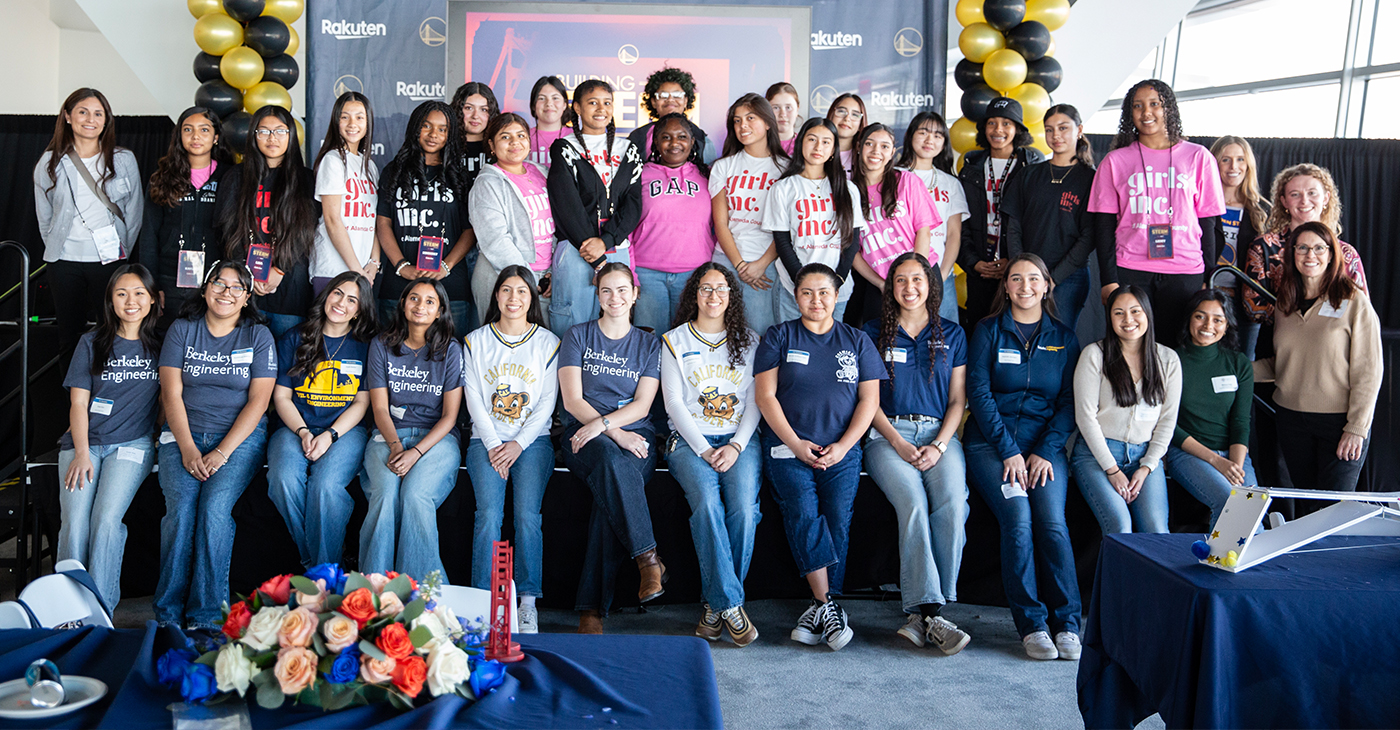
The Golden State Warriors and e-commerce giant Rakuten are joining forces to inspire the next generation of female engineers through Building STEAM Futures, part of The City Calls campaign.
Organizers say the initiative is founded on the idea that science, technology, engineering, arts, and mathematics (STEAM) are crucial fields for innovation and progress, and empowering young girls to pursue careers in these areas is more important than ever. Studies consistently show that girls are underrepresented in STEAM fields, resulting in a gender disparity that limits potential and hinders diversity.
Breaking down barriers and biases that deter young girls from pursuing STEAM subjects is essential for creating a level playing field and ensuring equal opportunities for all. By challenging stereotypes and promoting a culture of inclusivity and diversity in STEAM fields, experts believe young girls can be empowered to pursue their interests and aspirations without limitations confidently. Encouraging mentorship, providing access to resources, and celebrating girls’ achievements in STEAM are all crucial steps in creating a supportive environment that fosters success.
On Saturday, March 8, International Women’s Day, the Warriors and Rakuten hosted 20 middle school girls from Girls Inc. of Alameda County at Chase Center’s Above the Rim for a hands-on bridge-building experience. The young girls from Girls, Inc. of Alameda County had an opportunity to design, build and test their own bridge prototypes and learn the fundamentals of bridge construction from the Engineering Alliance and the UC Berkeley Steel Bridge Team.
This STEAM experience for the girls followed the first session in January, where they took a behind-the-scenes tour of the Golden Gate Bridge, learning about its design and construction from industry experts. The City Calls campaign, tipped off with the unveiling the Warriors’ new bridge-themed City Edition jerseys and court design earlier this year.

WORK FROM HOME
Home-based business with potential monthly income of $10K+ per month. A proven training system and website provided to maximize business effectiveness. Perfect job to earn side and primary income. Contact Lynne for more details: Lynne4npusa@gmail.com 800-334-0540


COMMENTARY: Women of Color Shape Our Past and Future

Woman’s Search for Family’s Roots Leads to Ancestor John T. Ward – A Successful Entrepreneur and Conductor on the Underground Railroad

Advocates Raise Alarm Over ICE Operation, MOU and Detention Risks in Baltimore County

Pete Buttigieg to Join Mayor Randall Woodfin for Community Town Hall in Birmingham

WATCH: Week One – NNPA’s “Leadership Matters” Video Series

Oakland Post: Week of March 4 – 10, 2026

OP-ED: NNPA Launches 2026 “Leadership Matters” Video Series

PRESS ROOM: PMG and Cranbrook Horizons-Upward Bound Launch Journey Fellowship Cohort 2

Los Angeles Summit Brings Together Leaders to Tackle Poverty and Affordability

Civil Rights TV Launches 24/7 Network Focused on Black History, Education and Equity

REVIEW: The Ultimate Hot Girl Summer Getaway: Sunseeker Resort Florida

COMMENTARY: How You Stop a Prescription Medicine is as Important as How You Start

PRESS ROOM: From Congress to Corporate America: NNPA Spotlights Visionaries in New Video Series

Poll Shows Support for Policies That Help Families Afford Child Care

Oakland Post: Week of February 25 – March 3, 2026

Oakland Post: Week of January 28, 2025 – February 3, 2026

Life Expectancy in Marin City, a Black Community, Is 15-17 Years Less than the Rest of Marin County

California Launches Study on Mileage Tax to Potentially Replace Gas Tax as Republicans Push Back

Community Celebrates Turner Group Construction Company as Collins Drive Becomes Turner Group Drive

Book Review: Books on Black History and Black Life for Kids

Discrimination in City Contracts

COMMENTARY: The Biases We Don’t See — Preventing AI-Driven Inequality in Health Care

Post Newspaper Invites NNPA to Join Nationwide Probate Reform Initiative

Black History Events in the East Bay

Medi-Cal Cares for You and Your Baby Every Step of the Way

Art of the African Diaspora Celebrates Legacy and Community at Richmond Art Center

COMMENTARY: The National Protest Must Be Accompanied with Our Votes

New Bill, the RIDER Safety Act, Would Support Transit Ambassadors and Safety on Public Transit

Oakland Post: Week of February 4 – 10, 2026

Oakland Post: Week of February 11 – 17, 2026

Hyundai Ioniq 5 Parking, Safety, and 360 View #shorts

2025 Ioniq 5 New Wiper & Powerful Performance! #shorts

Electric SUV Range: Is 259 Miles Enough? #shorts

EV Charging: How Fast Can You Charge an Electric Vehicle? #shorts

Biometric Cooling… Messaging Seats…Come on! 2025 Infiniti QX80 Autograph 4WD

Charged Up: Witness the Magic of a Fully Electric Car! #shorts

Range Rover Sport PHEV Included…: See What’s Inside This Luxury SUV! #shorts

Invisible Hood View: Perfect Parking with X-Ray Vision! #shorts

AI Is Reshaping Black Healthcare: Promise, Peril, and the Push for Improved Results in California

ESSAY: Technology and Medicine, a Primary Care Point of View

Sanctuary Cities

The RESISTANCE – FREEDOM NOW

STATE OF THE PEOPLE: Freddie

ECONOMIC BOYCOTT DAY!!!!!

I told You So
-
 Activism4 weeks ago
Oakland Post: Week of February 11 – 17, 2026
-

 #NNPA BlackPress3 weeks ago
Reflecting on Black History Milestones in Birmingham AL
-

 Bay Area4 weeks ago
CITY OF SAN LEANDRO STATE OF CALIFORNIA PUBLIC WORKS DEPARTMENT ENGINEERING DIVISION NOTICE TO BIDDERS FOR ANNUAL STREET OVERLAY/REHABILITATION 2019-21 – PHASE III
-

 #NNPA BlackPress3 weeks ago
PRESS ROOM: NBA Hall of Fame Nominee Terry Cummings Joins 100 Black Men of DeKalb County to Launch Victory & Values Initiative
-

 #NNPA BlackPress3 weeks ago
U.S. manufacturing rebounds – how foundry services are adapting to rising demand
-

 Activism4 weeks ago
Oakland Post: Week of February 18 – 24, 2026
-

 #NNPA BlackPress3 weeks ago
OP-ED: One Hundred Years of Black Workers Telling the Truth
-

 #NNPA BlackPress3 weeks ago
Advancements in solar technology that are changing the way we power the world
