
Politics
Obama Proposes Publicly Funded Community College for All


President Barack Obama speaks at Central High School, Thursday, Jan. 8, 2015, in Phoenix, about the recovering housing sector. (AP Photo/Carolyn Kaster)
NEDRA PICKLER, Associated Press
WASHINGTON (AP) — President Barack Obama wants publicly funded community college available to all Americans, a sweeping proposal that would make higher education as accessible as a high school diploma to boost weak U.S. wages and skills for the modern workforce.
The initiative’s price tag has yet to be revealed, and it faces a Republican Congress averse to big new spending programs. Obama was promoting the idea in a visit Friday to Pellissippi State Community College in Knoxville, Tennessee, and in a video message posted to Facebook Thursday evening.
“Put simply, what I’d like to do is to see the first two years of community college free for everybody who is willing to work for it,” Obama said in the video. He spoke seated on the front of his desk from his office aboard Air Force One, in the midst of a three-day tour to preview the agenda he’ll be outlining in his Jan. 20 in the State of the Union address.

“It’s something that we can accomplish, and it’s something that will train our work force so that we can compete with anybody in the world,” Obama said.
Administration officials on a conference call with reporters Thursday evening said the funding details would come out later with the president’s budget next month. They estimated 9 million students could participate and save an average of $3,800 in tuition per year. That suggests an annual cost in the tens of billions of dollars.
Students would qualify if they attend at least half-time, maintain a 2.5 GPA and make progress toward completing a degree or certificate program. Participating schools would have to meet certain academic requirements.
The White House said the federal government would pick up 75 percent of the cost and the final quarter would come from states that opt into the program.
The idea got a chilly response from House Speaker John Boehner’s office. “With no details or information on the cost, this seems more like a talking point than a plan,” said spokesman Cory Fritz.
In his 2013 State of the Union address, Obama proposed universal preschool, which Congress did not take up because of cost. Obama policy adviser Cecilia Munoz pointed out that even without federal action, many states are taking up the idea and expanding preschool.
And she pointed out that a Republican — Tennessee Gov. Bill Haslam — last year signed into law a pioneering scholarship program called Tennessee Promise that provides free community and technical college tuition for two years. It has drawn 58,000 applicants, almost 90 percent of the state’s high school seniors. Munoz said Obama’s proposal, America’s College Promise, was inspired by the popular Tennessee plan and a similar program in Chicago.
Sen. Lamar Alexander, R-Tenn., a former education secretary who is set to take over the Senate committee that oversees education, said states and not the federal government should follow Tennessee’s lead. He said Washington’s role should be to reduce paperwork for the student aid application and fund Pell grants for low-income students that would result from an expansion of community college enrollment.
“The reason Tennessee can afford Tennessee Promise is that 56 percent of our state’s community college students already have a federal Pell grant, which averages $3,300, to help pay for the average $3,800-per-year tuition. The state pays the difference — $500 on average,” Alexander said in a written statement issued just before he boarded Air Force One for the trip along with fellow Tennessee Republican Sen. Bob Corker.
Obama also was being joined on the Tennessee visit by Vice President Joe Biden. They also planned to visit a manufacturing facility, Techmer PM in Clinton, Tennessee, to promote a second proposal to create a fund to help low-wage workers with high potential get training in growing fields like energy, information technology and advanced manufacturing.
___
Education Writer Kimberly Hefling contributed to this story
___
Follow Nedra Pickler on Twitter at https://twitter.com/nedrapickler
Copyright 2015 The Associated Press. All rights reserved. This material may not be published, broadcast, rewritten or redistributed.







Activism
Oakland Post: Week of March 18 – 24, 2026
The printed Weekly Edition of the Oakland Post: Week of March 18 – 24, 2026

To enlarge your view of this issue, use the slider, magnifying glass icon or full page icon in the lower right corner of the browser window.
Activism
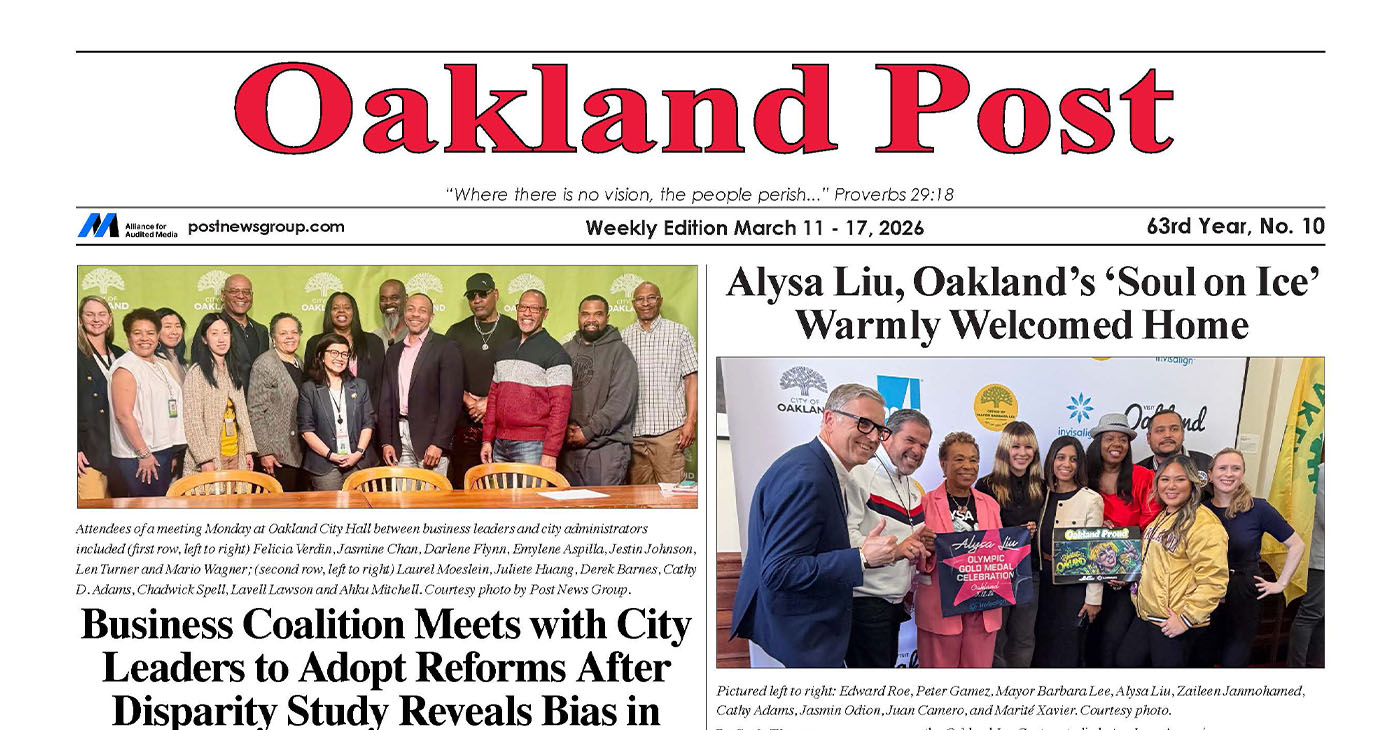
Oakland Post: Week of March 11 -17, 2026
The printed Weekly Edition of the Oakland Post: Week of March 11 – 17, 2026
To enlarge your view of this issue, use the slider, magnifying glass icon or full page icon in the lower right corner of the browser window.
Activism
Oakland Post: Week of March 4 – 10, 2026
The printed Weekly Edition of the Oakland Post: Week of March 4 – 10, 2026

To enlarge your view of this issue, use the slider, magnifying glass icon or full page icon in the lower right corner of the browser window.


WORK FROM HOME
Home-based business with potential monthly income of $10K+ per month. A proven training system and website provided to maximize business effectiveness. Perfect job to earn side and primary income. Contact Lynne for more details: Lynne4npusa@gmail.com 800-334-0540


Black Artists in America, Installation Three Wraps at the Dixon Gallery and Gardens

Grief, Advocacy, and Education: A Counselor Reflects on Black Maternal Health

Future of Florida’s Black History Museum in Limbo

New Research Shows the Many Benefits of Early Learning

South Hampton K-8 Students Among Top 10 Finalists for Samsung’s ‘Solve for Tomorrow’ Competition

Cuba: No Negotiation with US on the President or Political System

Brooklyn Academy of Music Names Jamaican-Born Tamara McCaw as President

Trinidad & Tobego – U.S. Launches WhatsApp Channel for American Citizens in the Country

Oakland Post: Week of March 18 – 24, 2026

AI Innovation vs. Ethics and Environmental Impact

AI, Web3, and Digital Reparations

What If You Owned Your AI Agent?

Season 7, Episode 3 – January Reporter’s Roundtable 📱

Season 7, Episode 3 – January Reporter’s Roundtable

AI, Media, and Power | Part 2, Real-World Impacts and Tradeoffs

Reflecting on Black History Milestones in Birmingham AL

CITY OF SAN LEANDRO STATE OF CALIFORNIA PUBLIC WORKS DEPARTMENT ENGINEERING DIVISION NOTICE TO BIDDERS FOR ANNUAL STREET OVERLAY/REHABILITATION 2019-21 – PHASE III

Oakland Post: Week of February 18 – 24, 2026

Oakland Post: Week of February 25 – March 3, 2026

PRESS ROOM: NBA Hall of Fame Nominee Terry Cummings Joins 100 Black Men of DeKalb County to Launch Victory & Values Initiative

Trump’s MAGA Allies are Creating Executive Order Plan to Steal the 2026 Midterms

Oakland Post: Week of March 4 – 10, 2026

Chase Oakland Community Center Hosts Alley-Oop Accelerator Building Community and Opportunity for Bay Area Entrepreneurs

U.S. manufacturing rebounds – how foundry services are adapting to rising demand

Poll Shows Support for Policies That Help Families Afford Child Care

OP-ED: One Hundred Years of Black Workers Telling the Truth

Advancements in solar technology that are changing the way we power the world

Woman’s Search for Family’s Roots Leads to Ancestor John T. Ward – A Successful Entrepreneur and Conductor on the Underground Railroad

Oakland Post: Week of March 11 -17, 2026

COMMENTARY: Women of Color Shape Our Past and Future

Hyundai Ioniq 5 Parking, Safety, and 360 View #shorts

2025 Ioniq 5 New Wiper & Powerful Performance! #shorts

Electric SUV Range: Is 259 Miles Enough? #shorts

EV Charging: How Fast Can You Charge an Electric Vehicle? #shorts

Biometric Cooling… Messaging Seats…Come on! 2025 Infiniti QX80 Autograph 4WD

Charged Up: Witness the Magic of a Fully Electric Car! #shorts

Range Rover Sport PHEV Included…: See What’s Inside This Luxury SUV! #shorts

Invisible Hood View: Perfect Parking with X-Ray Vision! #shorts

AI Is Reshaping Black Healthcare: Promise, Peril, and the Push for Improved Results in California

ESSAY: Technology and Medicine, a Primary Care Point of View

Sanctuary Cities

The RESISTANCE – FREEDOM NOW

STATE OF THE PEOPLE: Freddie

ECONOMIC BOYCOTT DAY!!!!!

I told You So
-
 Activism4 weeks ago
Oakland Post: Week of March 4 – 10, 2026
-
 #NNPA BlackPress4 weeks ago
Woman’s Search for Family’s Roots Leads to Ancestor John T. Ward – A Successful Entrepreneur and Conductor on the Underground Railroad
-
 Activism3 weeks ago
Oakland Post: Week of March 11 -17, 2026
-
 #NNPA BlackPress4 weeks ago
COMMENTARY: Women of Color Shape Our Past and Future
-

 #NNPA BlackPress4 weeks ago
Advocates Raise Alarm Over ICE Operation, MOU and Detention Risks in Baltimore County
-

 Advice3 weeks ago
Financial Wellness and Mental Health: Managing Money Stress in College
-

 #NNPA BlackPress4 weeks ago
Pete Buttigieg to Join Mayor Randall Woodfin for Community Town Hall in Birmingham
-
 Activism2 weeks ago
Oakland Post: Week of March 18 – 24, 2026
