
Bay Area
Oakland Needs a Level Playing Field
Build It at the Coliseum and They Will Come!

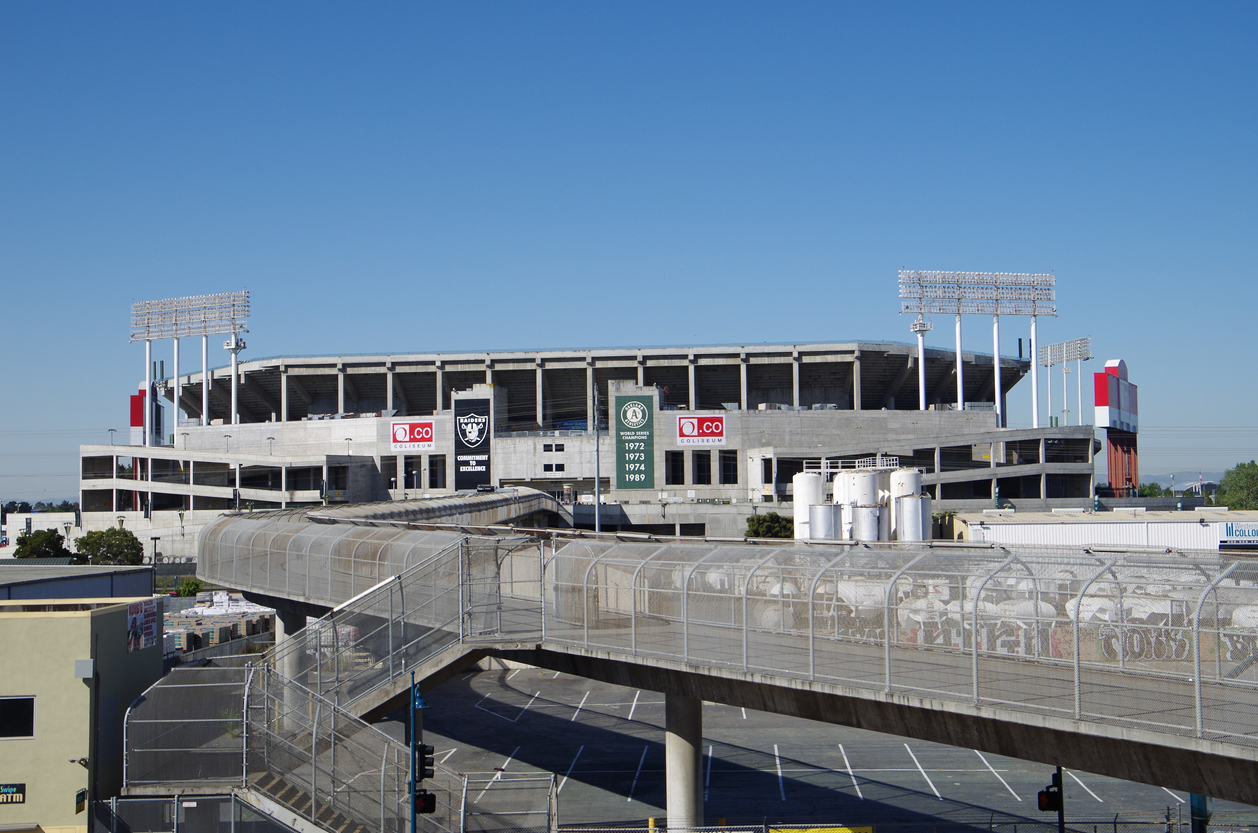
Something stinks about the Oakland A’s claim that the Oakland Coliseum is an unfit site for a new baseball stadium. Why can’t the Oakland A’s build a new state-of-the-art stadium, entertainment venues, and affordable and market rate housing at the Coliseum? Is it because the Coliseum is located in a predominately Black community?
This moment presents a great opportunity to bring major construction and new life to the people of East Oakland. Oakland’s progressive City Council must not fall for the A’s bullying threat that they will leave town if they don’t get a sweetheart deal to build a new stadium and luxury condos at Howard Terminal. If the A’s won’t build at the Coliseum, and help the people of East Oakland, let them leave.
The Coliseum was constructed in 1966. Ever since, loyal fans have attended games at the Coliseum without incident. Never once has a major incident occurred because the Coliseum is surrounded by Black folks. The only fights we know about were between Raiders fans. So, what are the A’s afraid of?
Look at the facts. We have heard claims that the Coliseum may have water table issues. Are they telling us that a waterfront stadium won’t have water issues? The stadium’s field could be lifted higher and leveled.

They say fans want a downtown stadium with easy access so they can attend games after work. Howard Terminal is not downtown, and it does not have easy access. To get to Howard Terminal, fans will have to dodge trucks and trains on busy road and rail routes. At one point, the A’s acknowledged that fact and offered up a gondola system, but we have not heard of that recently. Probably because they realized it does not make sense. (Imagine 15,000+ people trying to get in a gondola after a night game.)
By comparison, the Coliseum is located next to a BART station with a link to Oakland International Airport and it has an Amtrak stop right next door for out-of-town fans. The Coliseum also has adjacent bus routes along with freeway access and vast parking.
The A’s say they need to build luxury condos to help finance stadium construction costs. By implication, they are saying they could not sell luxury condos in the area where the Coliseum is located. This is the same kind of nonsense we heard years ago. Back then, we were told that major developers would not build anywhere in Oakland. Well, look around.
Consider this as well. The A’s threaten that if they don’t get their way, they will move to Las Vegas. They back up that threat with visits to alternative sites in Nevada. That belies their claims that they must have a downtown waterfront stadium. None of the potential Las Vegas sites are downtown and there are no waterfronts in the entire state.
The Coliseum has it all. It has been a successful venue for decades. It has great access. It is in a tax-favored enterprise zone. It is shovel-ready with none of the major environmental requirements that complicate the Howard Terminal site. Further, building at the Coliseum would be a life-changing boost to people living in an area that desperately needs major development.
The Oakland A’s have had a proud history in Oakland’s Black community. It brought us great heroes like Vida Blue, Rickey Henderson, Reggie Jackson, John “Blue Moon” Odom, Dave “Hendu” Henderson, Claudell Washington, Mike Norris and Dave Stewart who did much to promote Blacks in baseball and the well-being of our African American communities. Oakland was once a major incubator for future Black baseball stars. No longer! The A’s snub of East Oakland will cause the deterioration of Black baseball fans in Oakland to accelerate.
It is a shame that corporate greed is spoiling a wonderful history. We hope John Fisher and Dave Kaval wake up and see that their insulting behavior hurts Oakland’s Black community, baseball, and themselves.
In the coming weeks, this paper will continue to look at issues surrounding the A’s new stadium. Articles, opinions and commentaries will focus on Howard Terminal’s potential for gentrification of a historically Black neighborhood, disruption of industrial businesses, elimination of family sustaining wages, raiding of hundreds of millions of dollars of public funds that should be used for services like homelessness, housing for very low-income residents, public safety, street repairs, fire safety, how disrespecting black communities has led to significant erosion of Black support for baseball throughout the nation, and more. Please stay tuned and please raise your voice.
We want the A’s to build at the Coliseum. That would be great for the community, the team, and the relationship between A’s and Major League Baseball and Black people! If the A’s choose not to build at the Coliseum, perhaps they can sell the team to the African American Sports and Entertainment Group (AASEG) or a similar qualified owner group that would be happy to build a state-of-the-art stadium, entertainment and housing at the Coliseum. AASEG wants a level field where everyone in East Oakland has a fair and equal chance to succeed.
We do, too!











Activism
Oakland Post: Week of September 16 – 22, 2026
The printed Weekly Edition of the Oakland Post: Week of September 16 – 22, 2026


To enlarge your view of this issue, use the slider, magnifying glass icon or full page icon in the lower right corner of the browser window.

Activism
Oakland Post: Week of September 9 – 15, 2026
The printed Weekly Edition of the Oakland Post: Week of September 9 – 15, 2026

To enlarge your view of this issue, use the slider, magnifying glass icon or full page icon in the lower right corner of the browser window.
Activism
Oakland Post: Week of September 2 – 8, 2026
The printed Weekly Edition of the Oakland Post: Week of September 2 – 8, 2026
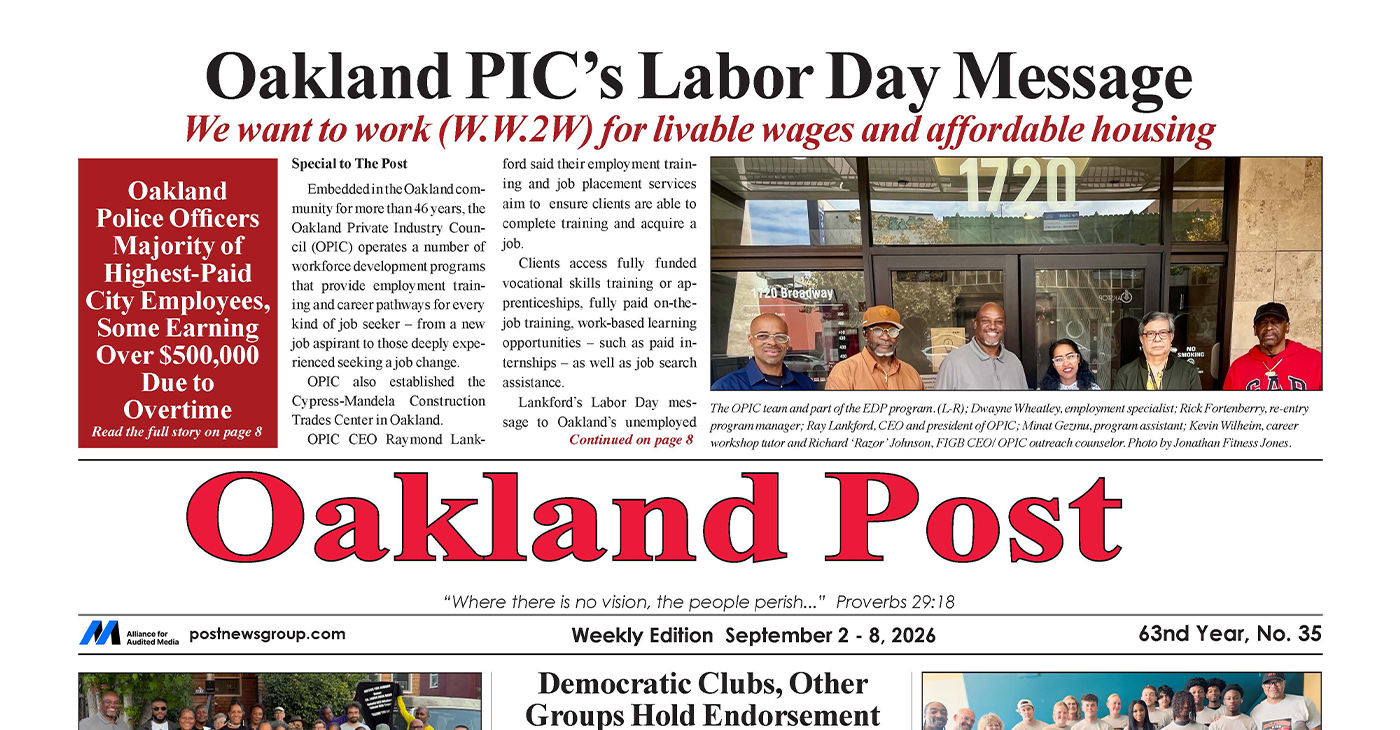
To enlarge your view of this issue, use the slider, magnifying glass icon or full page icon in the lower right corner of the browser window.


On Your November Ballot: Prop 38 Would Allocate $8.4 Billion to Immunology and Immunotherapy Funding

Ask California: Golden State Releases New AI Chatbot

Asm. Isaac Bryan’s Bill Banning California Police From ICE Side Jobs Reaches Newsom’s Desk

Assemblymember LaShae Sharp-Collins’s Bill Would Pause Law Enforcement’s Use of Shock Gloves Pending Study

BOOK REVIEW: ‘Laws of Solomon’ Reveals Tender Heart of Former Child Soldier

OPINION: The New American Fear – From 9-11 to AI

Passing for White, Fighting for Black America: The Courage of Walter White

Oakland People’s Arms Embargo Coalition Demands End to Military Shipments Thru Oakland

Barbara Lee Mourns Gloria Steinem, Remembers a Friendship Rooted in Equality

Event Preview: ‘Fashion v. Fascism’ – A Runway Revolution Is Coming to the Bay Area

Two Looming Threats Every Alameda County Elder Should Know About

Oakland Mayor Reads to Children at Bookout Block Party at Marcus Books Store

Tradition Comes to the Streets in 11th Annual Black-Eyed Pea Festival at the Freedom Farmers Market

Attorney General Rob Bonta Continues Opposition to President Trump’s Tariff Regime

Neighborhood Empowerment Day in Deep East Oakland Brings Community Together After Recent Tragedy

Department of Homeland Security Demands California Secretary of State Shirley N. Weber Scrub Voter Rolls

“The Power to See Threats Sooner”: Gov. Newsom, Safety Officials Showcase California’s Investments in Hi-Tech Wildfire Prevention

California Sen. Padilla Joins Colleagues to Introduce Bill Imposing Term Limits on Supreme Court Justices

Less Affluent School Districts, Including Sacramento City, Face Threat of State Takeover

Car Wash Workers Cope with Lingering Impacts of ICE Raids

ESSAY: California Can Close Its Colorectal Cancer Gap

As Part of Your Back-to- School Checklist, Vaccinate

Oakland ‘Port Serves as a Powerful Engine for Good Jobs and Economic Development

Gov. Newsom Announces $109.6 Million in Funding for 278 Supportive Homes in Bakersfield, Contra Costa, Sacramento and Fresno

California Hispanic Chambers of Commerce Unveils: ‘Powering the Future’ Theme for 47th Annual Statewide Convention

Congresswoman Simon Demands Investigation into Trump’s Abuse of Emergency Powers for Coal Export Terminal in West Oakland

Four Candidates, Including Incumbent Barbara Lee, Qualify for Oakland Mayor’s Race

Oakland Post: Week of August 12 – 18, 2026

From Blueprint to Breakthrough: Tackling Affordable Housing in Oakland

Oakland Observes Black August with Block Parties, Film Showings, Workshops

The Conversation With Al McFarlane 6/23/26

Media Monday 6/22/26

LIVE! ASK ALMA! — TUES. 6.23.26 7PM EST

Car Buying Secrets: 4 Hidden Checks Before You Sign!

Is This 550 HP Charger Worth YOUR Money? AutoNetwork Review

Celebrating Juneteenth – Frederick Douglass on education and resistance

LIVE! — ASK ALMA! — TUES. 6.19.26 7PM EST

Hyundai Ioniq 5 Parking, Safety, and 360 View #shorts

2025 Ioniq 5 New Wiper & Powerful Performance! #shorts

Electric SUV Range: Is 259 Miles Enough? #shorts

EV Charging: How Fast Can You Charge an Electric Vehicle? #shorts

Biometric Cooling… Messaging Seats…Come on! 2025 Infiniti QX80 Autograph 4WD

Charged Up: Witness the Magic of a Fully Electric Car! #shorts

Range Rover Sport PHEV Included…: See What’s Inside This Luxury SUV! #shorts

Invisible Hood View: Perfect Parking with X-Ray Vision! #shorts
-

 Commentary3 weeks ago
Standoff for Justice: Our Homes Are Worth Fighting For
-

 Activism3 weeks ago
Oakland Post: Week of August 26 – September 1, 2026
-

 Business3 weeks ago
Gubernatorial Candidate Steve Hilton Blasts California New Tire Rules; Newsom Hits Back
-

 Business3 weeks ago
Frontier Airlines’ Return to Oakland Airport Brings Flights, Jobs and Opportunity
-

 Business3 weeks ago
Chef Sharon Lee Blends Culinary Excellence, Education and Empowerment
-

 Education3 weeks ago
Gov. Newsom’s Latest Appointees Include Sacramento Advocate for Formerly Incarcerated Students; State’s New Tech Chief
-

 Business3 weeks ago
Oakland Coliseum Project Opens Door for Small Businesses to Build Bigger
-

 Community3 weeks ago
Big City Mayors Ask for “Yes” Vote on Housing Bond Measure; Conservatives Say “No”
