
Bay Area
Oakland NAACP Calls on Oakland Mayor to Rehire Former OPD Chief LeRonne Armstrong
The arbitration hearing conducted by retired federal judge Maria Rivera has issued a 54-page opinion, which the Oakland NAACP says has found that the “investigation which formed the basis for his initial termination was unreliable.”


Mayor reiterates that chief was fired for “knee-jerk” response to criticisms and “poor judgment”

By Ken Epstein
The Oakland NAACP has issued a statement calling on Mayor Sheng Thao to rehire fired Oakland Chief of Police LeRonne Armstrong, citing a non-binding arbitrator’s report that is not publicly available, though some people have obtained the leaked document.
The arbitration hearing conducted by retired federal judge Maria Rivera has issued a 54-page opinion, which the Oakland NAACP says has found that the “investigation which formed the basis for his initial termination was unreliable.”
However, in a statement issued this week, Mayor Thao stood by her decision to fire the former chief, saying he was terminated not for failing to punish an officer guilty for misconduct but because Armstrong responded to criticisms of how he handled the officer’s misconduct by denouncing the significance of the misconduct and protesting federal court oversight of OPD.
Rivera wrote in her report that “the discipline imposed on Chief Armstrong should be reversed and removed from his personnel record,” the NACCP alleged in a press statement about the arbitration report, which is considered a personnel matter and not available to the public.
“This was a complete vindication of Chief Armstrong that established he had done nothing to warrant his termination,” wrote the Oakland NAACP, which has been in the forefront of public pressure defending the chief.

Judge Rivera further said *the parties should meet and confer, together with their counsel, to discuss the viability of resolving the dispute in a manner to be negotiated, including the possibility of reinstatement,” the NAACP press release said.
“Too much time has been wasted playing politics, while Oaklanders are terrorized by violence and the crimes they face daily and businesses are driven from the city,” said Cynthia Adams, Oakland NAACP president.
In her statement, Thao said, ““At the beginning of this year, I was faced with the difficult decision of how Oakland and our police department could ensure our commitment to accountability and reform in light of a troubling report illustrating failures within our disciplinary process.”
Continuing, she said, “I placed then-Chief Armstrong on administrative leave so that I could take careful consideration of the best path forward. During that period, I was troubled by then-Chief Armstrong’s many statements indicating that he saw no need for deep reflection or change within the department.”
When faced with the case of an officer who was involved in a hit-and-run accident and failed to report it, and “whether OPD failed to rigorously investigate it,” Chief Armstrong “immediately dismissed the allegations as ‘mistakes and not systematic problems, ‘and insisted the officer had already been held accountable, Mayor Thao said.
“My decision was based on Mr. Armstrong’s knee-jerk response to the outside investigator’s report and the poor judgment it revealed, not on the report itself,” the mayor said.
“That lack of leadership led me to lose confidence in his commitment to reform, and his ability to serve Oakland as a credible messenger and partner to the federal court and federal monitor in finally ending 20 years of oversight,” she said.
“Mr. Armstrong had a right under state law to object to his termination and have a neutral hearing officer make non-binding recommendations to the City,” according to Mayor Thao.
“While I similarly cannot publicly discuss the hearing officer’s findings, since they are personnel records, I will say that there was no recommendation that I reverse my decision to move the department forward under new leadership… Neither my administration nor the federal court agreed with Mr. Armstrong that the findings could be written off as ‘mistakes,’” she said.
A news story from KQED, which examined the arbitrator’s report, said that the arbitrator found that the original investigation that led to Armstrong’s suspension early this year for mishandling a police officer’s misconduct case had many inaccuracies and urged Mayor Thao to meet with Armstrong to discuss the possibility of reinstatement.”
“It would be wise for both parties, and of great benefit to the citizens of Oakland, to avoid the costs and related toll of protracted litigation,” the arbitrator wrote.
However, the arbitrator’s report did not go as far as calling for Armstrong to be reinstated. The report also rejected Armstrong’s claim he was fired because he was a whistleblower and found no evidence to back up the former chief’s claim that the federal monitor was improperly raising issues to extend the federal court’s oversight of OPD to enrich himself at the city’s expense.
The arbitrator also “did not fully endorse Armstrong’s claims that he was fired for exercising his First Amendment rights,” according to KQED.
KQED also said that under the Oakland City Charter, Mayor Thao does not have the authority to rehire a police chief. “Instead, the chief must go through the police commission’s hiring process,” according to KQED.














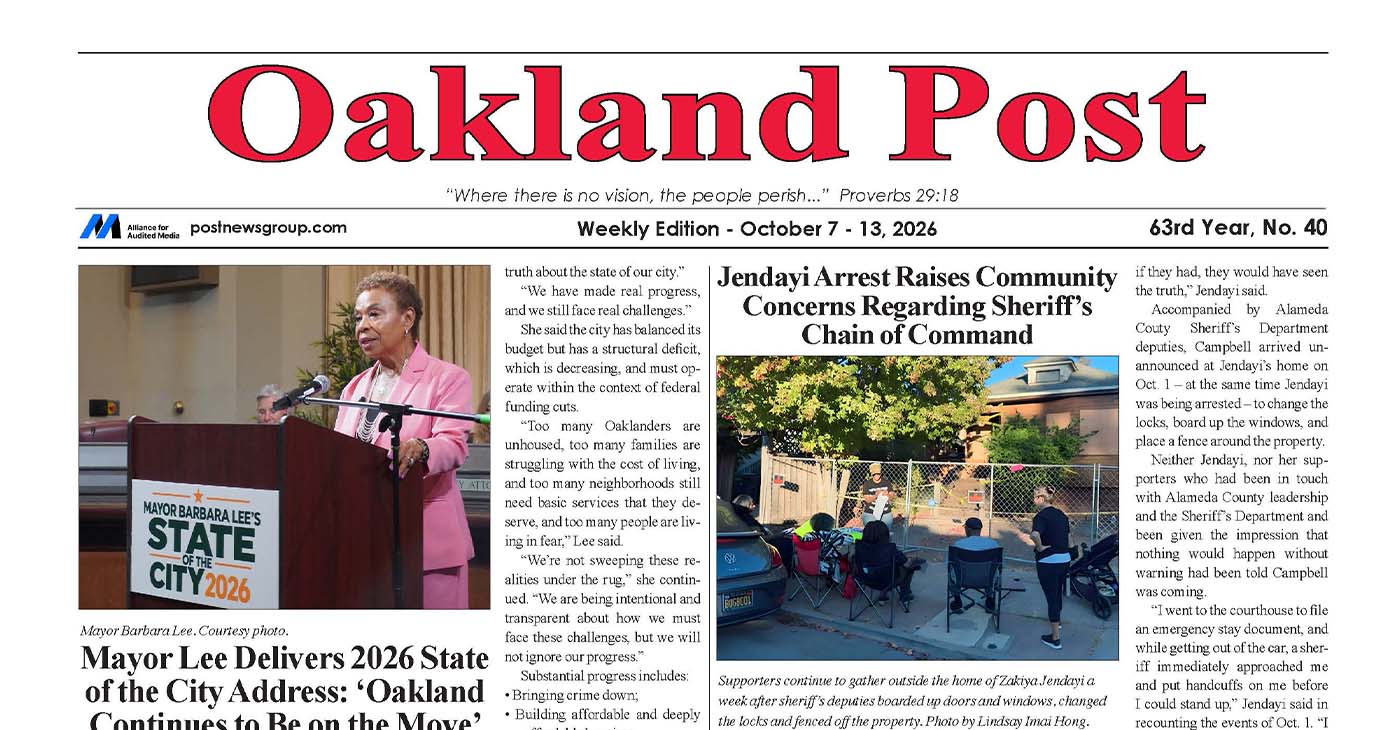
To enlarge your view of this issue, use the slider, magnifying glass icon or full page icon in the lower right corner of the browser window.
Activism
Oakland Post: Week of September 30 – October 6, 2026
The printed Weekly Edition of the Oakland Post: Week of September 30 – October 6, 2026

To enlarge your view of this issue, use the slider, magnifying glass icon or full page icon in the lower right corner of the browser window.
Activism
Oakland Post: Week of September 23 – 29, 2026
The printed Weekly Edition of the Oakland Post: Week of September 23 – 29, 2026

To enlarge your view of this issue, use the slider, magnifying glass icon or full page icon in the lower right corner of the browser window.



WCCUSD Joins Statewide Organic School Food Purchasing Cooperative

Democrats, Community Groups Back Measure EE to Change How Oakland Is Governed

Four Tips to Help You Plan a Holiday “Staycation”

Veterans Housing Project Proposed for South Richmond
PRESS ROOM: Transformative Justice Coalition 2026 Voting Rights Champion Awards Reception ‘Yesterday Is Today: The Battle For Voting Rights

Mayor Lee Delivers 2026 State of the City Address: ‘Oakland Continues to Be on the Move’

Oakland Awarded More than $14 Million in State Funding

Jendayi Arrest Raises Community Concerns Regarding Sheriff’s Chain of Command

Marin County Supes Expand Small Business Options with Home Kitchen Pilot Program

Allen Temple Baptist Church Hosts Free Prostate Cancer Screenings on Oct. 17

AC Transit Labor Unions Back Director Joel Young

Locals Can Get Locally Grown Produce Delivered Through Urban Tilth

‘ICE-Free Marin’ Supporters Press Supervisors as County Drafts Enforcement Restrictions

Oakland Post: Week of October 7 – 13, 2026

Ghana’s Ministry of Foreign Affairs Publishes Global Circle’s Vatican Reparations Call in Special Edition Alongside Heads of State

Misnamed ‘Parent’ PAC Seeks to Influence Oakland School Board Elections

Oakland Post: Week of September 2 – 8, 2026

Oakland Post: Week of September 9 – 15, 2026

Richmond Tiny House Village Farm & Garden Set to Open Gates on Sept. 26

Latest Massacre in Haiti Reveals Cruelty U.S. Deportations

OPINION: Nolan Wells’ Death One of Several Signifying Racial Terror Lives on in U.S. South

Poll: Becerra Widens His Lead Over Hilton; Californians Split on Wealth Tax

County Office of Education Says OUSD Finances Are Getting Healthier, Materially Stronger

Mayor Lee Announces $1 Million Kaiser Permanente Grant for Pilot Program to Address Homelessness, Clean Up Public Spaces throughout Oakland

Democratic Clubs Interview Candidates for Oakland School Board

Oakland People’s Arms Embargo Coalition Demands End to Military Shipments Thru Oakland

BLACspace Cooperative Invites Bay Area to Experience Oakland’s Black Cultural Ecosystem Through a BLAC Map Tour + Party

Oakland Post: Week of September 16 – 22, 2026

Two Looming Threats Every Alameda County Elder Should Know About

Zakiya Jendayi Arrested, Locked Out of Home by Sheriff’s Deputies

The Conversation With Al McFarlane 6/23/26

Media Monday 6/22/26

LIVE! ASK ALMA! — TUES. 6.23.26 7PM EST

Car Buying Secrets: 4 Hidden Checks Before You Sign!

Is This 550 HP Charger Worth YOUR Money? AutoNetwork Review

Celebrating Juneteenth – Frederick Douglass on education and resistance

LIVE! — ASK ALMA! — TUES. 6.19.26 7PM EST

Hyundai Ioniq 5 Parking, Safety, and 360 View #shorts

2025 Ioniq 5 New Wiper & Powerful Performance! #shorts

Electric SUV Range: Is 259 Miles Enough? #shorts

EV Charging: How Fast Can You Charge an Electric Vehicle? #shorts

Biometric Cooling… Messaging Seats…Come on! 2025 Infiniti QX80 Autograph 4WD

Charged Up: Witness the Magic of a Fully Electric Car! #shorts

Range Rover Sport PHEV Included…: See What’s Inside This Luxury SUV! #shorts

Invisible Hood View: Perfect Parking with X-Ray Vision! #shorts
-
 Economy3 weeks ago
Poll: Becerra Widens His Lead Over Hilton; Californians Split on Wealth Tax
-
 Business3 weeks ago
County Office of Education Says OUSD Finances Are Getting Healthier, Materially Stronger
-
 Business3 weeks ago
Mayor Lee Announces $1 Million Kaiser Permanente Grant for Pilot Program to Address Homelessness, Clean Up Public Spaces throughout Oakland
-
 Uncategorized3 weeks ago
Oakland People’s Arms Embargo Coalition Demands End to Military Shipments Thru Oakland
-
 Art3 weeks ago
BLACspace Cooperative Invites Bay Area to Experience Oakland’s Black Cultural Ecosystem Through a BLAC Map Tour + Party
-
 Activism3 weeks ago
Oakland Post: Week of September 16 – 22, 2026
-
 Community3 weeks ago
Two Looming Threats Every Alameda County Elder Should Know About
-
 Lead Story2 weeks ago
Zakiya Jendayi Arrested, Locked Out of Home by Sheriff’s Deputies
