
Bay Area
Oakland Loses Court Battle Over Coal Terminal for the Second Time


The City of Oakland was rebuffed for a second time in its attempt to prevent the shipment of coal through Insight Terminal Solutions (ITS) under a contract with Oversize Bulk Commodity Terminal (OBOT) at the Oakland Army Base.
On May 26, 2020, the United States Ninth Circuit Court of Appeal upheld a May 15, 2018, ruling by US District Court Judge Vince Chhabria that the City of Oakland failed to prove that the transportation of coal through the city posed a substantial health and safety hazard to Oakland residents.
Judge Chhabria found that Oakland lacked substantial evidence to prove coal shipment was substantially dangerous because the record it relied on “was riddled with inaccuracies, major evidentiary gaps, erroneous assumptions, and faulty analyses.” The court further found that emissions estimates provided by Environmental Science Associates (“ESA”) were “unreliable based on five flaws in ESA’s analysis.”
Based upon those findings, and others, Judge Chhabria ruled that the city breached its 2013 contract with OBOT, the master developer of the terminal. OBOT may now be eligible for hundreds of millions of dollars in damages caused by the city’s failure to issue the necessary permits to begin construction of the terminal. These damages will ultimately be shouldered by Oakland’s taxpayers.
After hearing city and community concerns about the project, ITS, the terminal builder and operator, tried to strike a compromise. ITS’s proposed compromise included: a.) building a state-of-the-art terminal with hermetically sealed loading and transporting systems to prevent dust from escaping during the processing of coal and all other commodities, b.) a community benefits package totaling $6 million a year for 66 years controlled by a citizen commission which would decide how money should be allocated, and c.) a phasing out of coal processing by 2040, which is five years ahead of Gov. Gavin Newsom’s goal of ending fossil fuels usage by 2045 as published in SB 100. ITS’s proposal was not accepted.
The city played a risky game and lost. Now that the Court of Appeals has affirmed the lower court’s decisions in favor of the developers, ITS is not required to offer any mitigations or community benefits under the terms of the court ruling.
Nevertheless, ITS’ CEO, John Siegel, has said he will stand by his commitment to community benefits under the Oakland Initiative. “No matter whether the court requires this or not, we want to help underserved communities with jobs and benefits. We believe we all do better when everyone has a chance to benefit.”
Siegel went on to say he is still willing to talk to the city about other concessions and that ultimate decisions on those issues depend on how the city moves forward.
The City Council approved a development agreement with a unanimous vote on June 18, 2013. Importantly, Judge Chhabria found, and the court of appeals affirmed, “the agreement did not limit the types of bulk goods that could be shipped through the terminal. And prior to its execution, Oakland had some indication that coal was one of the potential commodities that might be handled.”
The Court ruled that after the city had entered into an agreement, to prevent the shipment of coal through the terminal, it would have to prove that such shipment created a substantial health and safety risk to residents. On June 27, 2016, the City Council passed a resolution declaring that the transport of coal posed a health and safety hazard to residents. They based that determination in large part ESA’s severely flawed study presented at a City Council hearing.
“The question now is will the City Council throw good money after bad?” asked Greg McConnell, a consultant working with ITS. McConnell – who has more than three decades of experience navigating choppy political waters – points out that the city currently has an estimated $120 million deficit, and he questioned whether it makes sense to spend hundreds of thousands more continuing to appeal a decision that has already lost twice in court.
“At a time when the city is reeling from major budget shortfalls and planning to lay off workers and cut vital services that taxpayers desperately need, it does not make sense to continue wasting money on this losing case,” McConnell stated. “That would be a double whammy to Oakland residents.”







Activism
Oakland Post: Week of August 5 – 11, 2026
The printed Weekly Edition of the Oakland Post: Week of August 5 – 11, 2026

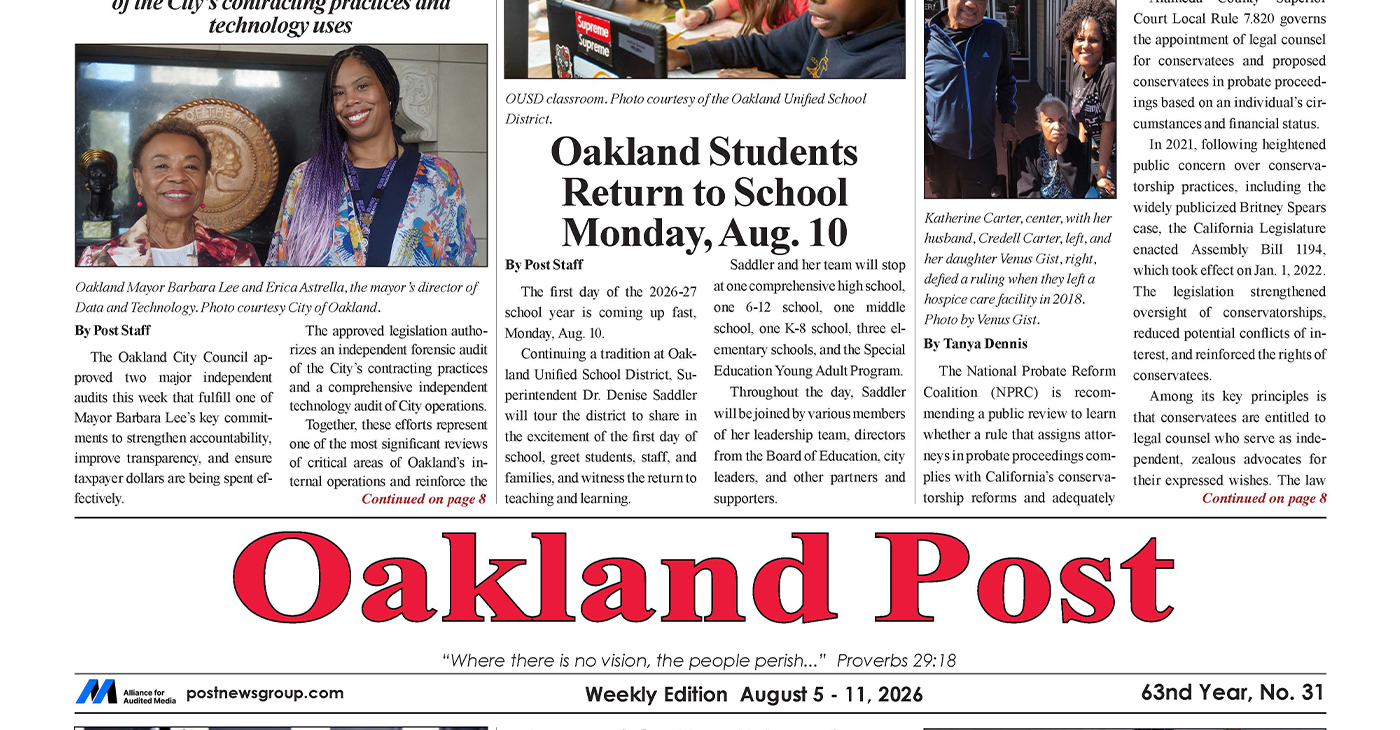
To enlarge your view of this issue, use the slider, magnifying glass icon or full page icon in the lower right corner of the browser window.

Activism
Oakland Post: Week of July 29 – August 4, 2026
The printed Weekly Edition of the Oakland Post: Week of July 29 – August 4, 2026

To enlarge your view of this issue, use the slider, magnifying glass icon or full page icon in the lower right corner of the browser window.
Activism
Oakland Post: Week of July 22 – 28, 2026
The printed Weekly Edition of the Oakland Post: Week of July 22 – 28, 2026

To enlarge your view of this issue, use the slider, magnifying glass icon or full page icon in the lower right corner of the browser window.

WORK FROM HOME
Home-based business with potential monthly income of $10K+ per month. A proven training system and website provided to maximize business effectiveness. Perfect job to earn side and primary income. Contact Lynne for more details: Lynne4npusa@gmail.com 800-334-0540


Car Wash Workers Cope with Lingering Impacts of ICE Raids

Misty Copeland Shapes Ballet’s Tomorrow

As Part of Your Back-to- School Checklist, Vaccinate

As Part of Your Back-to- School Checklist, Vaccinate

Congresswoman Simon Demands Investigation into Trump’s Abuse of Emergency Powers for Coal Export Terminal in West Oakland

OPINION: The Philippines Isn’t Foreign When Your Family Still Lives There

Asm. McKinnor’s Bill Banning Drones Above Outdoor Entertainment Events Awaits Senate Decision

California Sen. Padilla Joins Colleagues to Introduce Bill Imposing Term Limits on Supreme Court Justices

Department of Homeland Security Demands California Secretary of State Shirley N. Weber Scrub Voter Rolls

George Cook: The Inventor Who Made Fishing Smarter

Gov. Newsom Announces $109.6 Million in Funding for 278 Supportive Homes in Bakersfield, Contra Costa, Sacramento and Fresno

Rep. Kamlager Dove Demands Care, Justice for Man Shot by ICE

“The Power to See Threats Sooner”: Gov. Newsom, Safety Officials Showcase California’s Investments in Hi-Tech Wildfire Prevention

100 Black Wings’ Team Oakland Youth Athletes Heading to Taiwan for 2026 International Children’s Games

Oakland ‘Port Serves as a Powerful Engine for Good Jobs and Economic Development
Department of Homeland Security Demands California Secretary of State Shirley N. Weber Scrub Voter Rolls

Oakland Children’s Hospital Workers and Patients Rally for Pediatric Medical Care

New Judge Could Decide if Karmelo Anthony Gets a New Trial
“The Power to See Threats Sooner”: Gov. Newsom, Safety Officials Showcase California’s Investments in Hi-Tech Wildfire Prevention

Alpha Kappa Alpha Sorority, Inc. Celebrates New North Atlantic Regional Director

Surveillance Pricing Fight: State Senate Debates Bill Banning Retailers from Using AI to Set Prices Based on a Buyer’s Profile

Mount Zion MBC, Church of Jesus Christ of Latter-day Saints Partner to Bring 29,000 Meals to Alameda County
California Sen. Padilla Joins Colleagues to Introduce Bill Imposing Term Limits on Supreme Court Justices

Starting This Summer, California Car Buyers Can Get an Instant $3500 Off the Cost of Electric Vehicles

COMMENTARY: You Are Already Paying for the AI Boom

California Bill Would Let Abuse Victims Use Trauma as Legal Defense for Violent Crime

Fed Court to Decide Landmark First Amendment Case

Gov. Gavin Newsom Signs Law Streamlining Affordable Housing Rules

Oakland Celebrates $125 Million Coliseum Sale
Car Wash Workers Cope with Lingering Impacts of ICE Raids

The Conversation With Al McFarlane 6/23/26

Media Monday 6/22/26

LIVE! ASK ALMA! — TUES. 6.23.26 7PM EST

Car Buying Secrets: 4 Hidden Checks Before You Sign!

Is This 550 HP Charger Worth YOUR Money? AutoNetwork Review

Celebrating Juneteenth – Frederick Douglass on education and resistance

LIVE! — ASK ALMA! — TUES. 6.19.26 7PM EST

Hyundai Ioniq 5 Parking, Safety, and 360 View #shorts

2025 Ioniq 5 New Wiper & Powerful Performance! #shorts

Electric SUV Range: Is 259 Miles Enough? #shorts

EV Charging: How Fast Can You Charge an Electric Vehicle? #shorts

Biometric Cooling… Messaging Seats…Come on! 2025 Infiniti QX80 Autograph 4WD

Charged Up: Witness the Magic of a Fully Electric Car! #shorts

Range Rover Sport PHEV Included…: See What’s Inside This Luxury SUV! #shorts

Invisible Hood View: Perfect Parking with X-Ray Vision! #shorts
-
 Featured5 days ago
Department of Homeland Security Demands California Secretary of State Shirley N. Weber Scrub Voter Rolls
-
 Business3 weeks ago
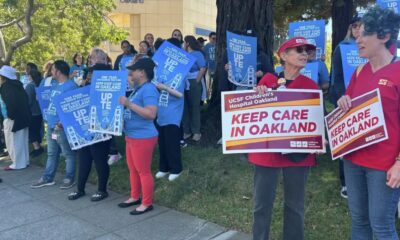
Oakland Children’s Hospital Workers and Patients Rally for Pediatric Medical Care
-
 #NNPA BlackPress2 weeks ago
New Judge Could Decide if Karmelo Anthony Gets a New Trial
-
 Environment5 days ago
“The Power to See Threats Sooner”: Gov. Newsom, Safety Officials Showcase California’s Investments in Hi-Tech Wildfire Prevention
-
 Black History2 weeks ago
Alpha Kappa Alpha Sorority, Inc. Celebrates New North Atlantic Regional Director
-
 Business3 weeks ago
Surveillance Pricing Fight: State Senate Debates Bill Banning Retailers from Using AI to Set Prices Based on a Buyer’s Profile
-
 Business3 weeks ago
Mount Zion MBC, Church of Jesus Christ of Latter-day Saints Partner to Bring 29,000 Meals to Alameda County
-
 Featured5 days ago
California Sen. Padilla Joins Colleagues to Introduce Bill Imposing Term Limits on Supreme Court Justices
