
Activism
Oakland Knows the Difficulty of Police Reform
“We know something is wrong, when one side in the bargaining process eventually amasses such an imbalance of power that it seems to operate as an autonomous unit, almost independent of its employer,” said Henderson.


On the one-year anniversary of the death of George Floyd, one is tempted to consider a sense progress. Perhaps if you’re hopeful and optimistic. For the realists, any report card of progress would have to be a bit delusional.
Yes, within a year, former Minneapolis police officer Derek Chauvin– who placed his knee on the back of the neck of George Floyd long enough to cause asphyxiation–has been convicted on all three counts of murder.
As expected, it’s on appeal while he’s imprisoned. But Chauvin was not defended by his chief, let alone the ranks of those upholding police standards and training in the Minneapolis Police Dept. And that was a big deal. To me, it was the reason the perp, a cop, was convicted.
That’s a lot in one year.
But does it herald a sustainable difference in policing anywhere, let alone Minneapolis? Will it radiate justice, or is it just a one-off?
It can’t be a one-off if indeed #BLM. But that’s where we appear to be one year after George Floyd.

We are still taking baby steps towards the promised land.
If you don’t think so, consider the history of policing in Oakland in just the last 20 years.
Consider the notorious Riders case around the turn of the millennium, where some Oakland cops were accused of kidnapping, planting evidence, kicking down doors, searching without a warrant. And all against East and West Oakland residents who posed no threat to the arresting officers.
There was a class action lawsuit against the police that ended in the largest negotiated settlement agreement (NSA) in Oakland municipal history on March 14, 2003.
It called for the city to pay $10.9 million to the class members. And it included 31 reforms to be made by the department, included policies on use of force, racial profiling, and updating technology like wearing cam-recorders.
Simple, right? Obtainable within a year or two, of course….not.
To this day, Oakland has had a new chief every two years, and many of the NSA’s reforms have not been fulfilled.
One chief, brought in from the internal affairs division, looked like he would make a breakthrough, but in 2006, a sex scandal within the department involving a victim of sex-trafficking snared 12 officers.
The real scandal, however, was that chief’s failure to disclose the scandal to the court’s monitor. That was his undoing.
This accounting all comes from the honorable Thelton Henderson, the now retired federal judge who oversaw that NSA. In a lecture given this Spring at Berkeley Law School, Henderson expressed his frustration that the NSA he oversaw had been passed on to a new judge.
But the fact that we are now 18 years trying to bring about police reform, show how near impossible it is.
“Herculean,” said Henderson. He believes it’s because policing has taken the “war on crime” idea literally, turning police into “soldiers, or an occupying force with battle armor and tanks and assault weapons ready to do battle with the communities they have vowed to protect and serve.”
Add to that the labor unions, who constantly remind the public of the dangerousness of the job.
But no one understands the danger the unions play in public safety.
“We know something is wrong, when one side in the bargaining process eventually amasses such an imbalance of power that it seems to operate as an autonomous unit, almost independent of its employer,” said Henderson.
This is from the judge who oversaw the negotiated settlement in the Riders case. Henderson’s indicating the real power that unions have to put the needs of the police above the city and its people.
The police unions have taken collective bargaining to the point where they harm our democratic society.
You see why to assess where we are one year after George Floyd is way too soon.
Police reform? America is hamstrung by labor policy.
Without labor reform we’ll be inching along toward the policing we deserve.
Emil Guillermo is a journalist and commentator. Twitter @emilamok; Watch his vlog on Facebook @emilguillermo.media ; Or on www.amok.com








Activism
Oakland Post: Week of March 18 – 24, 2026
The printed Weekly Edition of the Oakland Post: Week of March 18 – 24, 2026


To enlarge your view of this issue, use the slider, magnifying glass icon or full page icon in the lower right corner of the browser window.

Activism
Oakland Post: Week of March 11 -17, 2026
The printed Weekly Edition of the Oakland Post: Week of March 11 – 17, 2026
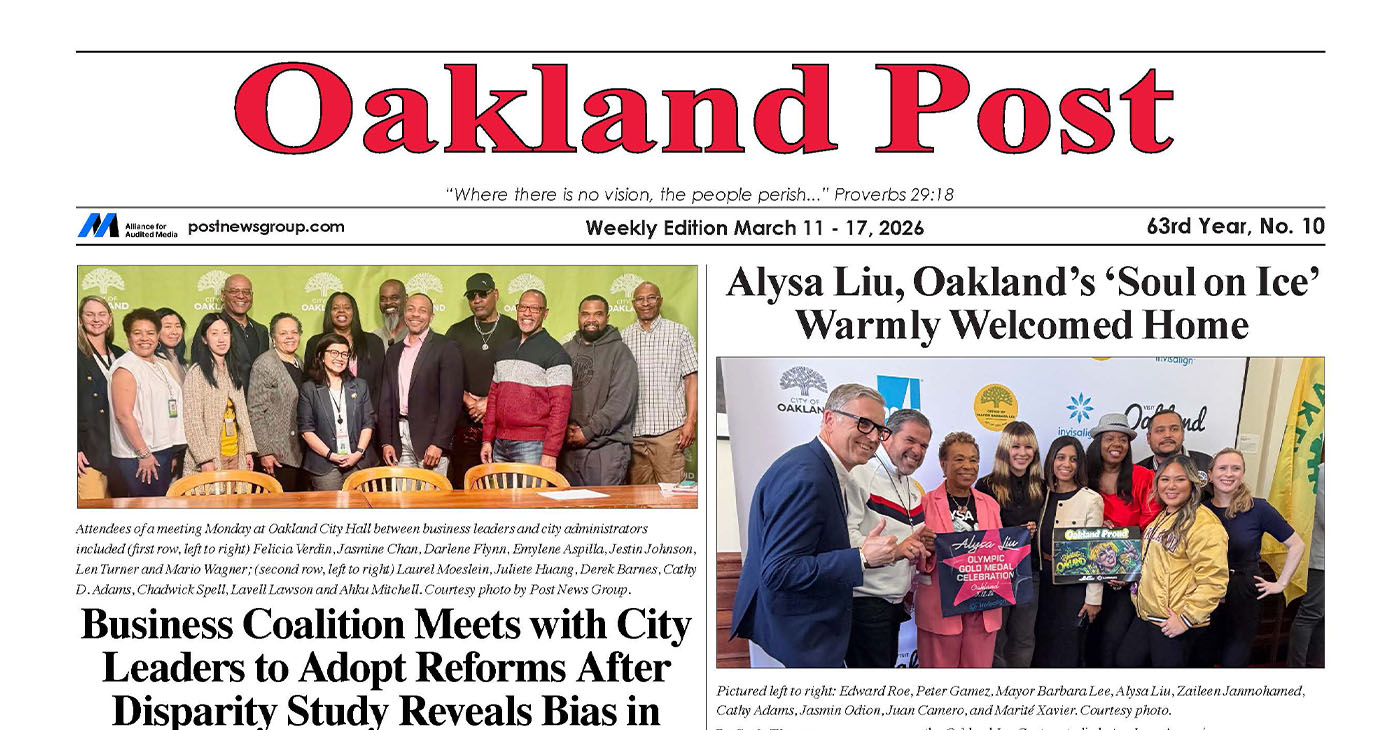
To enlarge your view of this issue, use the slider, magnifying glass icon or full page icon in the lower right corner of the browser window.
Activism
Oakland Post: Week of March 4 – 10, 2026
The printed Weekly Edition of the Oakland Post: Week of March 4 – 10, 2026

To enlarge your view of this issue, use the slider, magnifying glass icon or full page icon in the lower right corner of the browser window.

WORK FROM HOME
Home-based business with potential monthly income of $10K+ per month. A proven training system and website provided to maximize business effectiveness. Perfect job to earn side and primary income. Contact Lynne for more details: Lynne4npusa@gmail.com 800-334-0540


Black Artists in America, Installation Three Wraps at the Dixon Gallery and Gardens

Grief, Advocacy, and Education: A Counselor Reflects on Black Maternal Health

Future of Florida’s Black History Museum in Limbo

New Research Shows the Many Benefits of Early Learning

South Hampton K-8 Students Among Top 10 Finalists for Samsung’s ‘Solve for Tomorrow’ Competition

Cuba: No Negotiation with US on the President or Political System

Brooklyn Academy of Music Names Jamaican-Born Tamara McCaw as President

Trinidad & Tobego – U.S. Launches WhatsApp Channel for American Citizens in the Country

Oakland Post: Week of March 18 – 24, 2026

AI Innovation vs. Ethics and Environmental Impact

AI, Web3, and Digital Reparations

What If You Owned Your AI Agent?

Season 7, Episode 3 – January Reporter’s Roundtable 📱

Season 7, Episode 3 – January Reporter’s Roundtable

AI, Media, and Power | Part 2, Real-World Impacts and Tradeoffs

Oakland Post: Week of February 11 – 17, 2026

Reflecting on Black History Milestones in Birmingham AL

CITY OF SAN LEANDRO STATE OF CALIFORNIA PUBLIC WORKS DEPARTMENT ENGINEERING DIVISION NOTICE TO BIDDERS FOR ANNUAL STREET OVERLAY/REHABILITATION 2019-21 – PHASE III

Oakland Post: Week of February 18 – 24, 2026

PRESS ROOM: NBA Hall of Fame Nominee Terry Cummings Joins 100 Black Men of DeKalb County to Launch Victory & Values Initiative

Oakland Post: Week of February 25 – March 3, 2026

Trump’s MAGA Allies are Creating Executive Order Plan to Steal the 2026 Midterms

U.S. manufacturing rebounds – how foundry services are adapting to rising demand

OP-ED: One Hundred Years of Black Workers Telling the Truth

Advancements in solar technology that are changing the way we power the world

Chase Oakland Community Center Hosts Alley-Oop Accelerator Building Community and Opportunity for Bay Area Entrepreneurs

Poll Shows Support for Policies That Help Families Afford Child Care

Oakland Post: Week of March 4 – 10, 2026

PRESS ROOM: Civil Rights TV Launches in Selma as the World’s First 24/7 Civil Rights Television Network

Ghana Mourns a Son of the African World

Hyundai Ioniq 5 Parking, Safety, and 360 View #shorts

2025 Ioniq 5 New Wiper & Powerful Performance! #shorts

Electric SUV Range: Is 259 Miles Enough? #shorts

EV Charging: How Fast Can You Charge an Electric Vehicle? #shorts

Biometric Cooling… Messaging Seats…Come on! 2025 Infiniti QX80 Autograph 4WD

Charged Up: Witness the Magic of a Fully Electric Car! #shorts

Range Rover Sport PHEV Included…: See What’s Inside This Luxury SUV! #shorts

Invisible Hood View: Perfect Parking with X-Ray Vision! #shorts

AI Is Reshaping Black Healthcare: Promise, Peril, and the Push for Improved Results in California

ESSAY: Technology and Medicine, a Primary Care Point of View

Sanctuary Cities

The RESISTANCE – FREEDOM NOW

STATE OF THE PEOPLE: Freddie

ECONOMIC BOYCOTT DAY!!!!!

I told You So
-
 #NNPA BlackPress4 weeks ago
Poll Shows Support for Policies That Help Families Afford Child Care
-
 Activism3 weeks ago
Oakland Post: Week of March 4 – 10, 2026
-

 #NNPA BlackPress3 weeks ago
Woman’s Search for Family’s Roots Leads to Ancestor John T. Ward – A Successful Entrepreneur and Conductor on the Underground Railroad
-

 #NNPA BlackPress4 weeks ago
OP-ED: NNPA Launches 2026 “Leadership Matters” Video Series
-

 #NNPA BlackPress3 weeks ago
Advocates Raise Alarm Over ICE Operation, MOU and Detention Risks in Baltimore County
-

 #NNPA BlackPress3 weeks ago
COMMENTARY: Women of Color Shape Our Past and Future
-

 #NNPA BlackPress3 weeks ago
Pete Buttigieg to Join Mayor Randall Woodfin for Community Town Hall in Birmingham
-
 Activism2 weeks ago
Oakland Post: Week of March 11 -17, 2026
