
Bay Area
Oakland A’s Moving Closer to Ballpark Approval


A’s President Dave Kaval told the Post that he wants the upcoming February meeting, that was set by residents who have participated in the Community Benefits Agreement process, to be an opportunity where the process of continued community involvement can occur.
The meeting will be held on Monday, Feb. 10, from 6:30 p.m. to 8:30 p.m. at the Calif. State University East Bay Oakland Center, 1000 Broadway in Oakland.
“We’re really happy to be partnered with the city and the Port of Oakland, to ensure that we have a robust community benefits plan, with the ballpark, other neighborhoods and residential communities, that we’re planning at the Howard Terminal site,” Kaval said.
After more than two years of extensive outreach in East and West Oakland, the A’s have also hosted meetings for the residents to gather and discuss community benefits for the new ballpark and surrounding development.
With 150 community members in attendance, the Community Benefits Agreement process launched on Jan. 11 to identify seven cohort topics of concern.
They include: Economic Development, Housing, Transportation, Community Health and Safety, Education, Environment, and Community History/Culture Keeping.
Continuing, Kaval said “We’re excited about key stakeholders and community members across Oakland, but of course in West Oakland especially, because that’s where we’re building, to get people’s feedback on key areas and key cohorts, including affordable housing, workforce development, and environmental justice. Our project can help Oakland in a variety of ways. And that’s something we’re committed to and I think this process shows, that we’re walking the walk.”
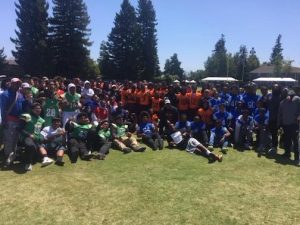
Kaval said his organization is continuing to lead the charge on community involvement, “especially when it comes to local and minority business.”
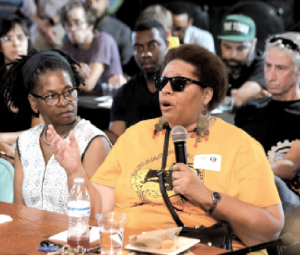
For the past two years, the A’s have hosted meetings for community members to gather and discuss community benefits for the team’s proposed new ballpark. The City is now overseeing the official CBA process. Speaking at one of the meetings is Ms. Alvirdia Owens. Photo by Oakland A’s.
The team’s plan incorporates more employment opportunities for small businesses that want to expand their staff and revenues.
Website information will be linked to the City of Oakland’s website as the Oakland A’s move closer to the final vote.
“The environmental review will be released on Valentine’s Day. We’re as close as we’ve ever been,” explained Kaval.
“We are working with the city now, and we’re negotiating a development agreement that will specify how we’re going to proceed,” he said. “I think there’s a lot of learning from the Oakland Army base, in terms of how they’ve done their outreach in staffing with the logistics jobs, construction, and transportation jobs, and I think we’re going to look for a similar solution in our case. But, I think that’s something we’re going to hammer out over the next couple of months.”
When asked if the A’s plan is flexible enough to include community involvement, Kaval said, “We’re open to get folks’ input on the best way to approach it. It’s not just jobs, it’s also contracting with businesses that are either minority-owned or locally-owned in Oakland. That’s another big part in this too, they’re people who have businesses in West Oakland and East Oakland. Our project can give them a lot of work for their own business to help them expand. We see a way for them to add more staff, earn more money as well.”
“We are definitely going to be expanding, especially as we get closer to opening our new stadium,” said Kaval. “And that’s going to include everything from needing people to build the venue, designing it, project management, as well as digital design and creating content along with our own marketing department.”
Kaval said his organization remains committed to diversity inclusion:
“We have a pretty robust outreach program that runs by Andre Chambers, who is the Head of our People Operations Department,” he said. “We’re looking for people locally to fulfill these positions within the front office. We feel we can incorporate a great group of people who are Oakland-based, rooted in Oakland, and committed to opening this new ballpark.”
The City of Oakland’s website will have all upcoming meetings and information on involving the new ballpark at the Howard Terminal site.
For details, go to City of Oakland website at www.oaklandca.gov/projects/oakland-waterfront-ballpark-district








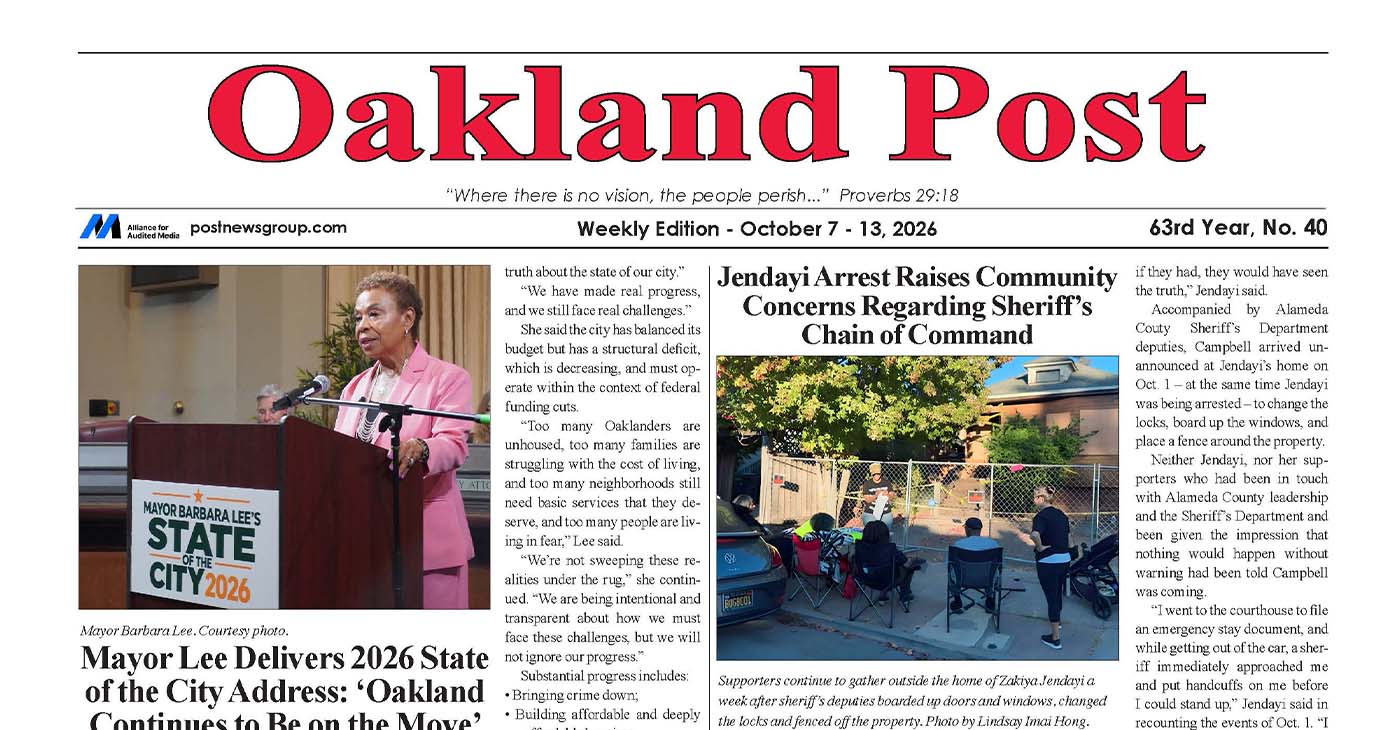
To enlarge your view of this issue, use the slider, magnifying glass icon or full page icon in the lower right corner of the browser window.


Activism
Oakland Post: Week of September 30 – October 6, 2026
The printed Weekly Edition of the Oakland Post: Week of September 30 – October 6, 2026


To enlarge your view of this issue, use the slider, magnifying glass icon or full page icon in the lower right corner of the browser window.
Activism
Oakland Post: Week of September 23 – 29, 2026
The printed Weekly Edition of the Oakland Post: Week of September 23 – 29, 2026

To enlarge your view of this issue, use the slider, magnifying glass icon or full page icon in the lower right corner of the browser window.


OP-ED: The Black Church Writes AI’s Next Chapter

OP-ED: The Black Church Writes AI’s Next Chapter

WCCUSD Joins Statewide Organic School Food Purchasing Cooperative

Democrats, Community Groups Back Measure EE to Change How Oakland Is Governed

Four Tips to Help You Plan a Holiday “Staycation”

Veterans Housing Project Proposed for South Richmond
PRESS ROOM: Transformative Justice Coalition 2026 Voting Rights Champion Awards Reception ‘Yesterday Is Today: The Battle For Voting Rights

Mayor Lee Delivers 2026 State of the City Address: ‘Oakland Continues to Be on the Move’

Oakland Awarded More than $14 Million in State Funding

Jendayi Arrest Raises Community Concerns Regarding Sheriff’s Chain of Command

Marin County Supes Expand Small Business Options with Home Kitchen Pilot Program

Allen Temple Baptist Church Hosts Free Prostate Cancer Screenings on Oct. 17

AC Transit Labor Unions Back Director Joel Young

Locals Can Get Locally Grown Produce Delivered Through Urban Tilth

‘ICE-Free Marin’ Supporters Press Supervisors as County Drafts Enforcement Restrictions

Misnamed ‘Parent’ PAC Seeks to Influence Oakland School Board Elections

Oakland Post: Week of September 2 – 8, 2026

Oakland Post: Week of September 9 – 15, 2026

Richmond Tiny House Village Farm & Garden Set to Open Gates on Sept. 26

Poll: Becerra Widens His Lead Over Hilton; Californians Split on Wealth Tax

Latest Massacre in Haiti Reveals Cruelty U.S. Deportations

County Office of Education Says OUSD Finances Are Getting Healthier, Materially Stronger

OPINION: Nolan Wells’ Death One of Several Signifying Racial Terror Lives on in U.S. South

Mayor Lee Announces $1 Million Kaiser Permanente Grant for Pilot Program to Address Homelessness, Clean Up Public Spaces throughout Oakland

BLACspace Cooperative Invites Bay Area to Experience Oakland’s Black Cultural Ecosystem Through a BLAC Map Tour + Party

Democratic Clubs Interview Candidates for Oakland School Board

Oakland Post: Week of September 16 – 22, 2026

Oakland People’s Arms Embargo Coalition Demands End to Military Shipments Thru Oakland

Zakiya Jendayi Arrested, Locked Out of Home by Sheriff’s Deputies

Two Looming Threats Every Alameda County Elder Should Know About

The Conversation With Al McFarlane 6/23/26

Media Monday 6/22/26

LIVE! ASK ALMA! — TUES. 6.23.26 7PM EST

Car Buying Secrets: 4 Hidden Checks Before You Sign!

Is This 550 HP Charger Worth YOUR Money? AutoNetwork Review

Celebrating Juneteenth – Frederick Douglass on education and resistance

LIVE! — ASK ALMA! — TUES. 6.19.26 7PM EST

Hyundai Ioniq 5 Parking, Safety, and 360 View #shorts

2025 Ioniq 5 New Wiper & Powerful Performance! #shorts

Electric SUV Range: Is 259 Miles Enough? #shorts

EV Charging: How Fast Can You Charge an Electric Vehicle? #shorts

Biometric Cooling… Messaging Seats…Come on! 2025 Infiniti QX80 Autograph 4WD

Charged Up: Witness the Magic of a Fully Electric Car! #shorts

Range Rover Sport PHEV Included…: See What’s Inside This Luxury SUV! #shorts

Invisible Hood View: Perfect Parking with X-Ray Vision! #shorts
-
 Economy3 weeks ago
Poll: Becerra Widens His Lead Over Hilton; Californians Split on Wealth Tax
-
 Business3 weeks ago
County Office of Education Says OUSD Finances Are Getting Healthier, Materially Stronger
-
 Business4 weeks ago
Mayor Lee Announces $1 Million Kaiser Permanente Grant for Pilot Program to Address Homelessness, Clean Up Public Spaces throughout Oakland
-
 Art3 weeks ago
BLACspace Cooperative Invites Bay Area to Experience Oakland’s Black Cultural Ecosystem Through a BLAC Map Tour + Party
-
 Uncategorized4 weeks ago
Oakland People’s Arms Embargo Coalition Demands End to Military Shipments Thru Oakland
-
 Activism4 weeks ago
Oakland Post: Week of September 16 – 22, 2026
-
 Lead Story2 weeks ago
Zakiya Jendayi Arrested, Locked Out of Home by Sheriff’s Deputies
-
 Community4 weeks ago
Two Looming Threats Every Alameda County Elder Should Know About

1 Comment