
Commentary
New York May Join Other States in Ending Cash Bails
NNPA NEWSWIRE — “Defendants charged with certain non-violent crimes should be presumptively released. But there are a small number of crimes which we believe prosecutors should have the opportunity to rebut the presumption of release at arraignment,” said District Attorneys Association of the State of New York (DAASNY) President and Albany County District Attorney David Soares.

By Stacy M. Brown, NNPA Newswire National Correspondent
@StacyBrownMedia
A 2017 report revealed how the use of cash bails in the city of Los Angeles spawned a massive industry built on the backs of poor communities of color.
The report, released by UCLA’s Million Dollar Hoods Research team, which conducts data mapping projects about the Los Angeles jail system, found that from 2012 to 2016, more than $19 billion in cash bail was levied against people arrested by the Los Angeles Police Department – a figure researchers said only reflected what was set during LAPD bookings and did not include adjustments later made by courts.
The UCLA team concluded that “city residents pay a steep price before their innocence or guilt has been determined,” and noted that the amount of bail levied disproportionately fell onto low-income Blacks and Latinos.
In August 2018, Gov. Jerry Brown responded by signing Senate Bill 10, which takes away cash bail as an option for those who’ve been arrested to be released from jail awaiting trial.
Instead, counties will now follow a pretrial risk assessment algorithm approved by judges to determine whether a defendant should be released, based on the level of the offense.
Also in 2018, Atlanta officials said they too were considering eliminating cash bails.

Many other states began to follow, or at least contemplate the move.
In New York, Democratic Sen. Kirsten Gillibrand recently joined the Rev. Al Sharpton at a news conference where she unveiled plans to co-sponsor a bill that would do away with bail for nonviolent crimes on the federal level and provide incentives for states that follow suit.
The bill would require that states implement alternative pre-trial systems and reduce pre-trial jail populations if they wish to receive federal funding as part of this incentive program, Gillibrand said.
Also, it would withhold grant funding from states that continue to utilize cash bail.
“There’s an inherent bias that assumes that people who can afford bail will show up to court and those who cannot, will not,” Sharpton said.
“We are just saying that we should not have a nation that detains people based on their economic standing or their race, which also is based in many cases on their economic standing. The bond industry is an absolutely horrendous idea to make profits off detaining people who could be innocent,” he said.
After studying the issue for 21 months, the New York State Justice Task Force has released a report setting forth a number of recommendations regarding ending the use of cash bail in New York State.
The District Attorneys Association of the State of New York (DAASNY) has endorsed the recommendations and has now urged lawmakers to examine the study and embrace some of the specific elements in their efforts to improve the bail system in New York.
“Our number one concern is to make sure any changes to the bail system in New York are safe and meaningful,” said DAASNY President and Albany County District Attorney David Soares.
“Defendants charged with certain non-violent crimes should be presumptively released. But there are a small number of crimes which we believe prosecutors should have the opportunity to rebut the presumption of release at arraignment,” Soares said.
Formed to eradicate wrongful convictions, promote fairness, effectiveness and efficiency in the criminal justice system, the Justice Task Force is recommending that defendants facing misdemeanors and certain non-violent felonies be released either on their own recognizance or with the least restrictive non-monetary conditions.
“While everyone at the table does not necessarily agree on every given topic, I can assure you that all the elements and proposals were thoroughly discussed and vetted by this group,” said Soares said.
“I can only hope our lawmakers in Albany take the time to do the same.”
The Task Force also recommended that the presumption of release could be rebutted if there is a significant risk the defendant will not return to court or if the defendant poses a credible threat to an identifiable person or group of persons.
“I believe this would still provide prosecutors with the tools to make sure that dangerous people are not out on the streets causing further harm,” Soares said.




Activism
Oakland Post: Week of March 18 – 24, 2026
The printed Weekly Edition of the Oakland Post: Week of March 18 – 24, 2026

To enlarge your view of this issue, use the slider, magnifying glass icon or full page icon in the lower right corner of the browser window.
Advice
Financial Wellness and Mental Health: Managing Money Stress in College
While everyone’s financial situation is unique, several common sources of stress have the potential to strain your financial health. These include financial and economic uncertainty, existing debts, unexpected expenses, and mental or physical health changes. Financial stress may differ from situation to situation, but understanding the factors contributing to yours may help you begin to craft a plan for your unique circumstances.

Sponsored by JPMorganChase
As a college student, managing financial responsibilities can be stressful.
If you’ve found yourself staying up late thinking about your finances or just feeling anxious overall about your financial future, you’re not alone. In one survey, 78% of college students who reported financial stress had negative impacts on their mental health, and 59% considered dropping out. While finances can impact overall stress, taking steps to manage your finances can support your mental, emotional and physical well-being.
When it comes to money, the sources of stress may look different for each student, but identifying the underlying causes and setting goals accordingly may help you feel more confident about your financial future.
Consider these strategies to help improve your financial wellness and reduce stress.
Understand what causes financial stress
While everyone’s financial situation is unique, several common sources of stress have the potential to strain your financial health. These include financial and economic uncertainty, existing debts, unexpected expenses, and mental or physical health changes. Financial stress may differ from situation to situation, but understanding the factors contributing to yours may help you begin to craft a plan for your unique circumstances.
2. Determine your financial priorities
Start by reflecting on your financial priorities. For students this often includes paying for school or paying off student loans, studying abroad, saving for spring break, building an emergency fund, paying down credit card debt or buying a car. Name the milestones that are most important to you, and plan accordingly.
3. Create a plan and stick to it
While setting actionable goals starts you on the journey to better financial health, it’s essential to craft a plan to follow through. Identifying and committing to a savings plan may give you a greater sense of control over your finances, which may help reduce your stress. Creating and sticking to a budget allows you to better track where your money is going so you may spend less and save more.
4. Pay down debt
Many students have some form of debt and want to make progress toward reducing their debt obligations. One option is the debt avalanche method, which focuses on paying off your debt with the highest interest rate first, then moving on to the debt with the next-highest interest rate. Another is the debt snowball method, which builds momentum by paying off your smallest debt balance, and then working your way up to the largest amounts.
5. Build your financial resilience
Some financial stress may be inevitable, but building financial resilience may allow you to overcome obstacles more easily. The more you learn about managing your money, for instance, the more prepared you’ll feel if the unexpected happens. Growing your emergency savings also may increase resilience since you’ll be more financially prepared to cover unexpected expenses or pay your living expenses.
6. Seek help and support
Many colleges have resources to help students experiencing financial stress, like financial literacy courses or funds that provide some assistance for students in need. Talk to your admissions counselor or advisor about your concerns, and they can direct you to sources of support. Your school’s counseling center can also be a great resource for mental health assistance if you’re struggling with financial stress.
The bottom line
Financial stress can affect college students’ health and wellbeing, but it doesn’t have to derail your dreams. Setting smart financial goals and developing simple plans to achieve them may help ease your stress. Revisit and adjust your plan as needed to ensure it continues to work for you, and seek additional support on campus as needed to help keep you on track.
JPMorgan Chase Bank, N.A. Member FDIC
© 2026 JPMorgan Chase & Co.
Activism
Oakland Post: Week of March 11 -17, 2026
The printed Weekly Edition of the Oakland Post: Week of March 11 – 17, 2026
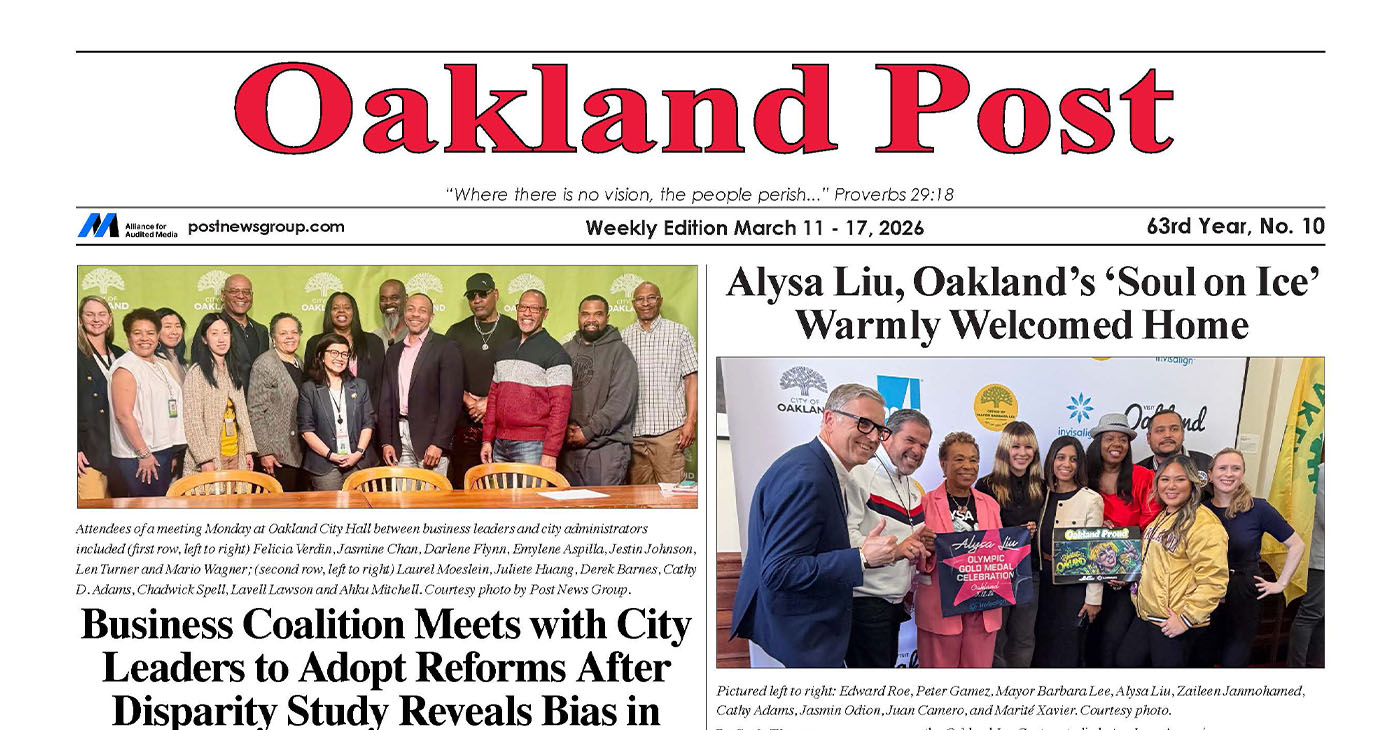
To enlarge your view of this issue, use the slider, magnifying glass icon or full page icon in the lower right corner of the browser window.

WORK FROM HOME
Home-based business with potential monthly income of $10K+ per month. A proven training system and website provided to maximize business effectiveness. Perfect job to earn side and primary income. Contact Lynne for more details: Lynne4npusa@gmail.com 800-334-0540


Black Artists in America, Installation Three Wraps at the Dixon Gallery and Gardens

Grief, Advocacy, and Education: A Counselor Reflects on Black Maternal Health

Future of Florida’s Black History Museum in Limbo

New Research Shows the Many Benefits of Early Learning

South Hampton K-8 Students Among Top 10 Finalists for Samsung’s ‘Solve for Tomorrow’ Competition

Cuba: No Negotiation with US on the President or Political System

Brooklyn Academy of Music Names Jamaican-Born Tamara McCaw as President

Trinidad & Tobego – U.S. Launches WhatsApp Channel for American Citizens in the Country

Oakland Post: Week of March 18 – 24, 2026

AI Innovation vs. Ethics and Environmental Impact

AI, Web3, and Digital Reparations

What If You Owned Your AI Agent?

Season 7, Episode 3 – January Reporter’s Roundtable 📱

Season 7, Episode 3 – January Reporter’s Roundtable

AI, Media, and Power | Part 2, Real-World Impacts and Tradeoffs

Oakland Post: Week of February 11 – 17, 2026

Reflecting on Black History Milestones in Birmingham AL

CITY OF SAN LEANDRO STATE OF CALIFORNIA PUBLIC WORKS DEPARTMENT ENGINEERING DIVISION NOTICE TO BIDDERS FOR ANNUAL STREET OVERLAY/REHABILITATION 2019-21 – PHASE III

Oakland Post: Week of February 18 – 24, 2026

PRESS ROOM: NBA Hall of Fame Nominee Terry Cummings Joins 100 Black Men of DeKalb County to Launch Victory & Values Initiative

Oakland Post: Week of February 25 – March 3, 2026

Trump’s MAGA Allies are Creating Executive Order Plan to Steal the 2026 Midterms

U.S. manufacturing rebounds – how foundry services are adapting to rising demand

OP-ED: One Hundred Years of Black Workers Telling the Truth

Chase Oakland Community Center Hosts Alley-Oop Accelerator Building Community and Opportunity for Bay Area Entrepreneurs

Poll Shows Support for Policies That Help Families Afford Child Care

Oakland Post: Week of March 4 – 10, 2026

Advancements in solar technology that are changing the way we power the world

PRESS ROOM: Civil Rights TV Launches in Selma as the World’s First 24/7 Civil Rights Television Network

Woman’s Search for Family’s Roots Leads to Ancestor John T. Ward – A Successful Entrepreneur and Conductor on the Underground Railroad

Hyundai Ioniq 5 Parking, Safety, and 360 View #shorts

2025 Ioniq 5 New Wiper & Powerful Performance! #shorts

Electric SUV Range: Is 259 Miles Enough? #shorts

EV Charging: How Fast Can You Charge an Electric Vehicle? #shorts

Biometric Cooling… Messaging Seats…Come on! 2025 Infiniti QX80 Autograph 4WD

Charged Up: Witness the Magic of a Fully Electric Car! #shorts

Range Rover Sport PHEV Included…: See What’s Inside This Luxury SUV! #shorts

Invisible Hood View: Perfect Parking with X-Ray Vision! #shorts

AI Is Reshaping Black Healthcare: Promise, Peril, and the Push for Improved Results in California

ESSAY: Technology and Medicine, a Primary Care Point of View

Sanctuary Cities

The RESISTANCE – FREEDOM NOW

STATE OF THE PEOPLE: Freddie

ECONOMIC BOYCOTT DAY!!!!!

I told You So
-
 Activism4 weeks ago
Oakland Post: Week of March 4 – 10, 2026
-
 #NNPA BlackPress3 weeks ago
Woman’s Search for Family’s Roots Leads to Ancestor John T. Ward – A Successful Entrepreneur and Conductor on the Underground Railroad
-

 #NNPA BlackPress4 weeks ago
OP-ED: NNPA Launches 2026 “Leadership Matters” Video Series
-

 #NNPA BlackPress3 weeks ago
Advocates Raise Alarm Over ICE Operation, MOU and Detention Risks in Baltimore County
-

 #NNPA BlackPress3 weeks ago
COMMENTARY: Women of Color Shape Our Past and Future
-

 #NNPA BlackPress3 weeks ago
Pete Buttigieg to Join Mayor Randall Woodfin for Community Town Hall in Birmingham
-

 Activism2 weeks ago
Oakland Post: Week of March 11 -17, 2026
-

 #NNPA BlackPress4 weeks ago
PRESS ROOM: PMG and Cranbrook Horizons-Upward Bound Launch Journey Fellowship Cohort 2
