
Activism
New California Law Considers “Full Context” of Domestic Abuse Survivors’ Lives
Economic justice is a near-immediate, tangible solution to improve life for criminalized survivors of domestic violence. Many survivors hail from predominantly Black and Brown communities, which experience glaring income gaps, and oftentimes they take on the burden of childbearing while juggling the responsibilities of working and taking care of the children, she added.


Charlene Muhammad | Oakland Post
Advocates for victims of domestic violence, including organizations like the Family Violence Law Center in Oakland, are applauding a new California law that was introduced by Sen. Sydney Kamlager (D-Los Angeles). The legislation passed both the Assembly and Senate last fall. It was signed into law by Gov. Newsom in October, and it took effect Jan. 1.
Assembly Bill (AB) 124, also known as the “Justice for Survivors” bill, provides support to survivors of violence, including intimate partner violence, sexual violence, and human trafficking.
AB 124 makes provisions for California’s criminal justice system to consider the full context of a person’s circumstances and experiences throughout the court process.
“The idea is more trauma informed sentencing, but I think it starts even before survivors even enter the criminal justice system. I think it’s really important to focus on the responders to the crisis,” stated Nashi Gunasekara, Housing and Gender Justice advocate at the Family Violence Law Center, which advocates for justice and healthy relationships by helping diverse communities in Alameda County heal from domestic violence and sexual assault.
“How responders complete paperwork, their judgment and assessments can all very drastically change the trajectory of a survivor in the criminal justice system, to the point where they may not even enter it, she said. “That’s almost how decisive these those moments of crisis intervention can be.”
According to statistics released by the American Civil Liberties Union, nearly 60 % of female state prisoners nationwide and as many as 94 % of certain female prison populations experienced physical or sexual abuse before being incarcerated.
“Black women make up 25% of the incarcerated population in California, yet are only 5% of the adult population, demonstrating an overrepresentation of Black women in prison. Similar disparities exist for other individuals of color, including Latinx, Asian and Pacific Islander, and Indigenous communities,” states the “Justice for Survivors” fact sheet, dated May 26, 2021.
Advocates who supported AB 124 say the legislation is particularly useful for survivors who have been criminalized, because the idea is to take into account factors like a history of abuse or domestic violence, mental illness, and others that may lead to certain moments of crisis when charging or sentencing individuals.
“When you have the right people there, responding to these moments of crises where law enforcement may not be entirely equipped with the information and knowledge to assess those situations correctly, I think we’re not only helping survivors heal, but we’re helping communities as well,” Gunasekara explained.
Part of Family Violence Law Center’s work is helping people to recognize the ways in which survivors can get caught up in the criminal justice system. That includes curbing the continued stigma for survivors of domestic violence and sexual assaults by reversing cultural messages that place blame and responsibility for abuse on survivors themselves, said Marissa Seko, Family Violence Intervention Unit Manager at the organization.
It is important to get the message out about what real accountability looks like for people who have caused harm, she urged.
Power and control, in relationships and within the larger culture are fundamental, core structures that allow domestic violence to continue, according to Seko. One of her clients has been repeatedly victimized by her abuser calling police and filing false Child Protective Services reports as retaliation for trying to leave the relationship, Seko shared.
When a person who is causing the harm has more race or gender privilege than the person they are abusing, they can sometimes use the system against that survivor. That plays out in the ability to pay for lawyers, fight through family law boards, and believability when police are called, according to Seko.
Her agency commonly sees abusers using the system against survivors and weaponizing privileges they have against people with less knowledge or access, she said.
Economic justice is a near-immediate, tangible solution to improve life for criminalized survivors of domestic violence, according to Seko. Many survivors hail from predominantly Black and Brown communities, which experience glaring income gaps, and oftentimes they take on the burden of childbearing while juggling the responsibilities of working and taking care of the children, she added.
According to the National Network to End Domestic Violence, financial abuse occurs in 99% of domestic violence cases, and is often cited by victims of abuse as the main reason that they stayed with or returned to an abusive partner.
“It’s hard to survive or make decisions when one feels economically insecure,” said Seko.







Activism
Oakland Post: Week of September 23 – 29, 2026
The printed Weekly Edition of the Oakland Post: Week of September 23 – 29, 2026
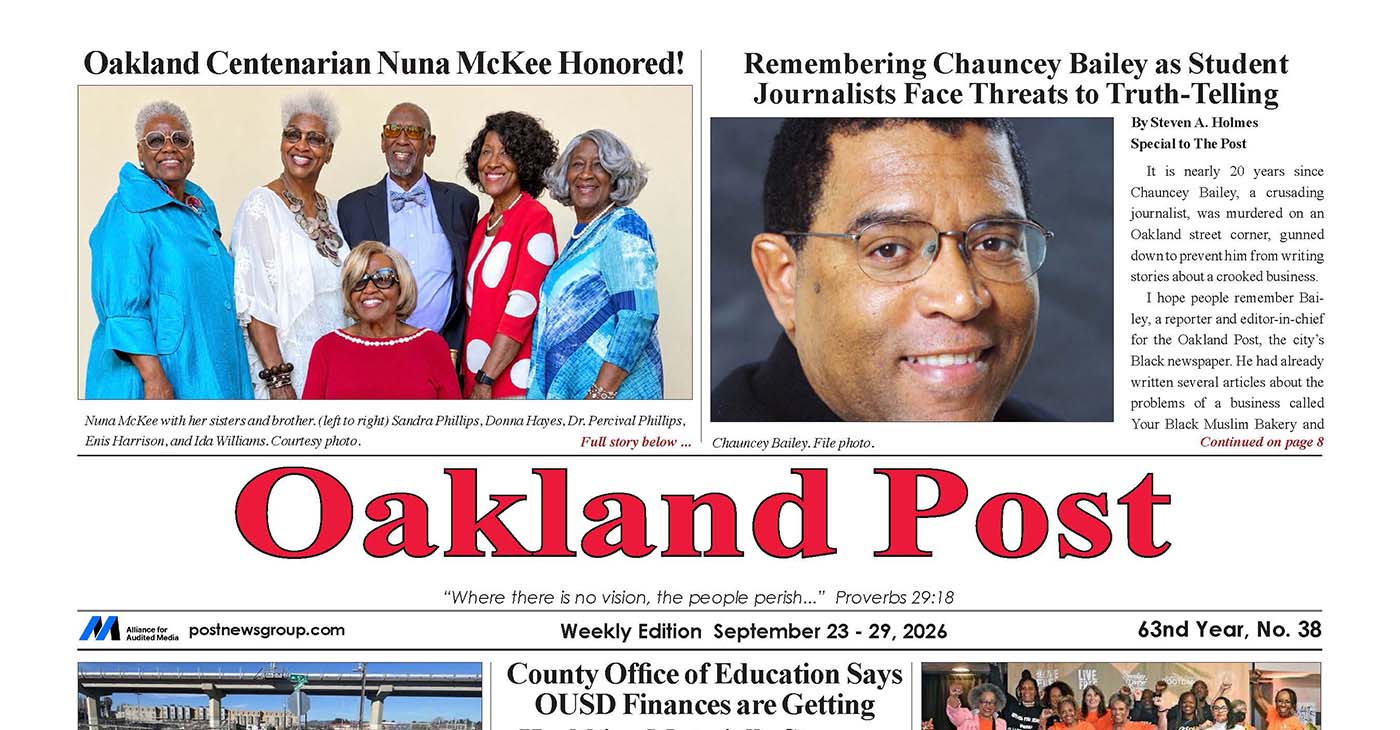
To enlarge your view of this issue, use the slider, magnifying glass icon or full page icon in the lower right corner of the browser window.
Activism
Oakland Post: Week of September 16 – 22, 2026
The printed Weekly Edition of the Oakland Post: Week of September 16 – 22, 2026

To enlarge your view of this issue, use the slider, magnifying glass icon or full page icon in the lower right corner of the browser window.
Activism
Oakland Post: Week of September 9 – 15, 2026
The printed Weekly Edition of the Oakland Post: Week of September 9 – 15, 2026

To enlarge your view of this issue, use the slider, magnifying glass icon or full page icon in the lower right corner of the browser window.



Asm. Corey Jackson Announces Launch of 24-Hour Childcare in His District

IN MEMORIAM: The Rev. Leon “Sonny” Clark, Longtime Orange County Pastor and Community Leader, Dies at 72

Poll: Becerra Widens His Lead Over Hilton; Californians Split on Wealth Tax

From Historic Memories to New Possibilities: Oakland Celebrates Coliseum 60

County Office of Education Says OUSD Finances Are Getting Healthier, Materially Stronger

LIVE FREE Sunday Dinner Brings Faith, Fellowship and Civic Conversation to Oakland

Remembering Chauncey Bailey as Student Journalists Face Threats to Truth-Telling

BLACspace Cooperative Invites Bay Area to Experience Oakland’s Black Cultural Ecosystem Through a BLAC Map Tour + Party

In Wake of Death on Doorstep, Williams Chapel Baptist Church Calls for Better Care, Funding for Unhoused

Oakland Centenarian Nuna McKee Honored!

Caribbean Nations Produce Action Plan Calling for UK Reparations Over Slavery

Oakland Post: Week of September 23 – 29, 2026

Doulas Are Helping Black California Moms Navigate Pregnancy–Even as High Mortality Rates Persist

Newsom Signs Addictive Social Media Law to Protect Kids

On Your November Ballot: Prop 38 Would Allocate $8.4 Billion to Immunology and Immunotherapy Funding

Standoff for Justice: Our Homes Are Worth Fighting For

Oakland Post: Week of August 26 – September 1, 2026

Frontier Airlines’ Return to Oakland Airport Brings Flights, Jobs and Opportunity

Gubernatorial Candidate Steve Hilton Blasts California New Tire Rules; Newsom Hits Back

Chef Sharon Lee Blends Culinary Excellence, Education and Empowerment

Jackie Wright Champions Bay Area Stories, Filmmakers and Cultural Institutions

Big City Mayors Ask for “Yes” Vote on Housing Bond Measure; Conservatives Say “No”

Oakland Coliseum Project Opens Door for Small Businesses to Build Bigger

Gov. Newsom’s Latest Appointees Include Sacramento Advocate for Formerly Incarcerated Students; State’s New Tech Chief

Misnamed ‘Parent’ PAC Seeks to Influence Oakland School Board Elections

Longtime BWOPA Member Brendalyn Goodall Appointed to California Workforce Development Board

Gov. Newsom Signs Law Shielding Immigration Aid Workers From Doxing Threats

Secretary of State Shirley N. Weber Urges Californians to Vote Early as Voter ID Battle Intensifies

Oakland Post: Week of September 2 – 8, 2026

IN MEMORIAM: Dolly Parton Dead at 80 — How She Built a Legacy of Love and Earned Her Place in Black Culture

The Conversation With Al McFarlane 6/23/26

Media Monday 6/22/26

LIVE! ASK ALMA! — TUES. 6.23.26 7PM EST

Car Buying Secrets: 4 Hidden Checks Before You Sign!

Is This 550 HP Charger Worth YOUR Money? AutoNetwork Review

Celebrating Juneteenth – Frederick Douglass on education and resistance

LIVE! — ASK ALMA! — TUES. 6.19.26 7PM EST

Hyundai Ioniq 5 Parking, Safety, and 360 View #shorts

2025 Ioniq 5 New Wiper & Powerful Performance! #shorts

Electric SUV Range: Is 259 Miles Enough? #shorts

EV Charging: How Fast Can You Charge an Electric Vehicle? #shorts

Biometric Cooling… Messaging Seats…Come on! 2025 Infiniti QX80 Autograph 4WD

Charged Up: Witness the Magic of a Fully Electric Car! #shorts

Range Rover Sport PHEV Included…: See What’s Inside This Luxury SUV! #shorts

Invisible Hood View: Perfect Parking with X-Ray Vision! #shorts
-
 Community3 weeks ago
Misnamed ‘Parent’ PAC Seeks to Influence Oakland School Board Elections
-
 Activism4 weeks ago
Oakland Post: Week of September 2 – 8, 2026
-

 Community3 weeks ago
Richmond Tiny House Village Farm & Garden Set to Open Gates on Sept. 26
-

 Activism3 weeks ago
Oakland Post: Week of September 9 – 15, 2026
-

 Black History3 weeks ago
Latest Massacre in Haiti Reveals Cruelty U.S. Deportations
-

 Black History3 weeks ago
OPINION: Nolan Wells’ Death One of Several Signifying Racial Terror Lives on in U.S. South
-

 Community3 weeks ago
Democratic Clubs Interview Candidates for Oakland School Board
-

 Business2 weeks ago
Mayor Lee Announces $1 Million Kaiser Permanente Grant for Pilot Program to Address Homelessness, Clean Up Public Spaces throughout Oakland
