
Health
Measles Outbreak in Dollars and Cents: It Costs Taxpayers Bigtime


Pediatrician Charles Goodman vaccinates 1 year-old Cameron Fierro with the measles-mumps-rubella vaccine, or MMR vaccine at his practice in Northridge, Calif., Thursday, Jan. 29, 2015. (AP Photo/Damian Dovarganes)
(Forbes) – The official measles count is up to 121 cases in 17 states, the CDC reported on Monday, and 85 percent of those resulted from the outbreak stemming from the Disneyland exposure. That’s more cases than were seen in all of 2012 – and it’s only February.
Much virtual ink has been spilled in the past several weeks about what an awful disease measles can be, about the impact of irresponsible doctors’ advice, and about the ramifications of not vaccinating on those unable to be vaccinated.
But only a handful of folks have talked about costs. Measles is expensive. Really expensive. And even if you live in a highly vaccinated area with no outbreaks, a measles case in your state – that’s a third of the U.S. right now – still means health department tax dollars diverted from other programs to deal with a disease that was eliminated from the U.S. in 2000.














Black History
Five Hospitals Said No! Who Will Help Annette Henry Recover?
Annette Henry, a 67-year-old Oakland woman, is struggling to access essential medical care after a devastating stroke left her with a rare neuropathic pain syndrome. Despite medical documentation confirming her need for inpatient rehabilitation, five different Bay Area hospitals have denied her admission, often citing her inability to meet rigid therapy thresholds. Her family’s efforts to seek intervention from state and federal lawmakers have yielded no results, leaving Henry at home without a clear path to recovery. To see how these systemic failures are impacting her health, read more.


A tangle of red tape and contradictions between health providers and Medicare rules have impeded an Oakland woman’s ability to recover from a stroke she had last year.
Her family – who are her caretakers – have reached out to various professionals and state and federal lawmakers for help to no avail.
At 67, Annette Henry needs inpatient stroke rehabilitation after a devastating stroke in May 2025. Since then, multiple Bay Area hospitals have denied it. She was accepted into a rehabilitation facility in June 2025 but discharged prematurely in July, in essentially the same condition.
Three hospitals where she was a patient pushed skilled nursing over inpatient rehabilitation. Two more declined referrals.

Now at home, Henry is caught in a system that measures her need for treatment against the limitations treatment should address.
Medical professionals have documented her need for a higher level of care.
In August 2025, a Medicare Quality Improvement Organization (QIO) overturned Henry’s discharge from an inpatient rehabilitation facility (IRF).
The QIO’s independent physician reviewer found she had not received the “intensive therapy program outlined on admission,” according to the Aug. 30, 2025, determination letter. Yet the decision did not secure her readmission or guarantee continued rehabilitation.
Henry has central post-stroke pain, a rare neuropathic pain syndrome that can make movement and touch intensely painful. Her pain specialist recommended inpatient rehabilitation alongside pain management.
Nevertheless, facilities have cited her inability to tolerate three hours of daily therapy as a reason to deny inpatient rehabilitation.
That practice raises questions about Medicare coverage policy. In Hooper v. Sullivan, No. H-80-99 (D. Conn. 1989), the court recorded the parties’ agreement that denials based on numerical utilization screens, diagnostic screens, treatment norms, the “three-hour rule,” or other “rules of thumb” were not appropriate.
CMS subsequently cited Hooper in its Aug. 7, 2009, final rule (74 Fed. Reg. 39762, 39794). The policy is also addressed in the Medicare Benefit Policy Manual, Chapter 1, Section 110, and CMS’s June 1 Review Choice Demonstration for IRF Services: Operational Guide.
These authorities underscore the need for individualized assessments rather than rigid numerical thresholds.
The central contradiction is stark: the pain and disability that make rehabilitation necessary have been cited as reasons to deny it. UCSF Stanyan’s April 7 discharge summary for Henry states that acute rehabilitation unit (ARU) placement was declined for “inability to tolerate three hours of therapy daily.” Without appropriate treatment, Henry risks further decline.
Her records document complications associated with prolonged immobility.
Orthopedics documented flexion contractures of the small and ring fingers on March 19.
Chest imaging on April 1 showed bibasilar dependent atelectasis, a condition involving reduced inflation of the lower portions of both lungs. These concerns can be examined through her medical records and photographs.
“What does a ‘not reasonable’ discharge look like?” her family asks. For them, it looks like an appeal decision recognizing a problem without ensuring a remedy: repeated referrals, denials and a patient still without the rehabilitation her treating professionals have recommended.
The family has sought help from the California Department of Public Health and the federal Office for Civil Rights to no avail. They contacted U.S. Rep. Lateefah Simon in June 2025, while Henry was in rehabilitation; Senator Alex Padilla in May 2026; and Senator Adam Schiff in September 2026.
DeCuir says the family received no meaningful assistance and was redirected to the QIO or advised working with a social worker after Henry had already been discharged.
The consequences extend beyond rehabilitation. The family reports that Henry has struggled to attend in-person specialist or any appointments and needs in-person evaluation and treatment for complications, recommended evaluations, health screenings and preventive care.
Her mobility limitations have become barriers to broader medical care. Every office tells her their office is not set up to accommodate her. This has happened with specialty care, out-patient services, screenings and physical therapy.
Henry is a Black woman on Medicare, and her family believes her experience raises concerns about unequal access to intensive rehabilitation. Research has documented disparities in discharge to inpatient rehabilitation rather than skilled nursing, underscoring the importance of individualized review.
CMS, state regulators and healthcare providers should examine Henry’s records, assess her needs on their clinical merits and explain how the applicable coverage standards were applied, and whether they are being enforced.
Rehabilitation is not a reward for patients who can already tolerate treatment. It is care intended to help people recover function. Henry’s case asks whether a system designed to support recovery can leave a patient without a path to it.

Business
SEIU Local 1000 and State of California Will Continue to Negotiate New Labor Contract
Thousands of California state employees represented by SEIU Local 1000 recently staged a one-day walkout to protest stalled contract negotiations with Governor Gavin Newsom’s administration. The union, which represents approximately 100,000 public workers, is demanding a 20% wage increase over three years and an end to mandatory four-day in-person work requirements. While the initial strike has concluded, union leadership warns that further demonstrations are likely if the state continues to reject their demands for better pay and telework flexibility. Negotiations are expected to continue as both sides seek a resolution. Read more.
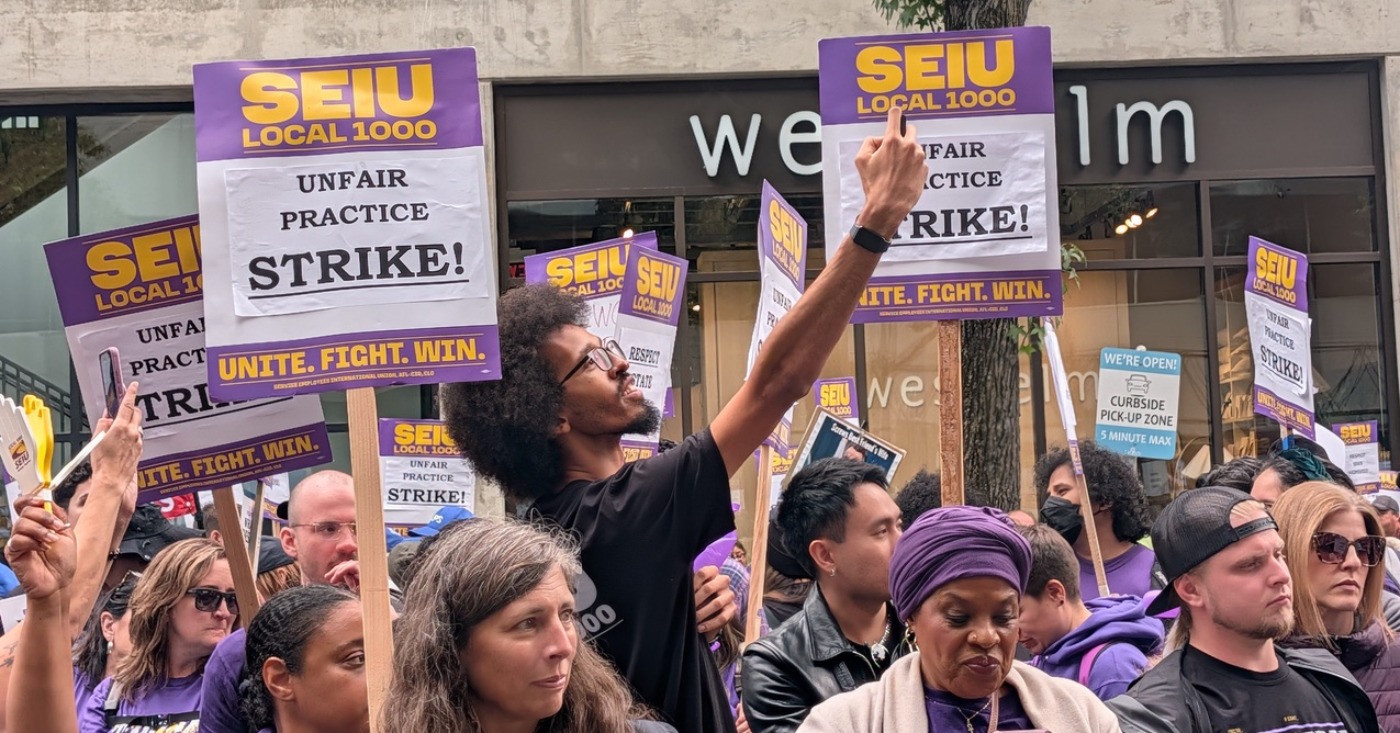
After the Service Employees International Union (SEIU) Local 1000 labor contract expired June 30 and talks with Gov. Gavin Newsom’s administration stalled, the union stepped up its efforts to secure a new agreement, saying its demands had gone unheeded.
On Oct. 21, thousands of state employees represented by SEIU Local 1000 staged a one-day walkout to protest alleged unfair labor practices during negotiations with Gov. Gavin Newsom’s administration.
Although the strike has ended, SEIU Local 1000 President Anica Walls said further demonstrations or an expanded strike are highly likely if contract negotiations remain stalled. The union represents approximately 100,000 public employees statewide.
“We are out here because our jobs matter,” Wells said. “If they continue to refuse to bargain with us in good faith, we are prepared to escalate.”
Sen. Lola Smallwood-Cuevas (D-Los Angeles) expressed support for SEIU Local 1000’s labor action in an Instagram post, emphasizing the importance of fair treatment for workers.
“I stand in complete solidarity with SEIU Local 1000,” Smallwood-Cuevas stated. “More than 100,000 state workers they represent are on strike today fighting for good-faith bargaining, fair treatment, and a contract that reflects the value of the essential public services they provide every day—all things that should be a given for the workers our state relies on the most.”

Smallwood-Cuevas, a member of the California Legislative Black Caucus (CLBC) added, “When California’s workers hold the line, the whole nation pays attention.”
According to union representatives, SEIU Local 1000 is seeking a contract that addresses rising living costs and provides greater workplace flexibility. The union is demanding a 20% wage increase over three years and an end to Gov. Gavin Newsom’s requirement that state employees work in person four days a week.
The union is also seeking increased state contributions toward employee health care benefits to reduce workers’ out-of-pocket costs.
On Sept. 18, Newsom vetoed Assembly Bill 1729, authored by Assemblymember Alex Lee (D-San Jose), which sought to expand telework opportunities for state employees.
The bill would have required state agencies to offer telework options or provide written justifications for requiring employees to work in person. Supporters argued that telework could save taxpayers approximately $225 million annually by reducing office space and parking costs while lowering vehicle emissions and improving employee retention.
Newsom said the legislation would limit state departments’ flexibility to manage their workforces and evaluate telework exemptions individually. He has also emphasized the benefits of in-person collaboration.
“I want people to come back to work, reengage, rediscover, collaborate, coordinate, develop relationships, friendships, and fall in love,” Newsom said in July. “You get three-day weekends. Four years ago, that would’ve been a triumph. Now it’s a burden.”
Union organizers described the Oct. 21 walkout as a one-day unfair labor practice strike, rather than an indefinite work stoppage. The action was intended to demonstrate solidarity and increase pressure on the state during negotiations.
SEIU Local 1000 has been without a contract since its previous three-year agreement expired June 30. Negotiations are expected to resume.
Responding to the statewide walkout, the California Department of Human Resources (CalHR) said it “remains focused on achieving a fair and responsible agreement with SEIU Local 1000 and continues to be available at the bargaining table.”
Black History
Oakland Strong: Building Champions and Healthier Generations
Entrepreneur Mike Jenkins is revitalizing youth wellness in Oakland through Oakland Strong, a world-class strength-training facility in Jack London Square. After providing a decade of free training in Fruitvale, the program moved and rebranded while continuing to produce national and international weightlifting champions. Jenkins aims to counter community health challenges by teaching Olympic-style lifting and nutrition to children ages 8 to 18. As the program seeks new ways to sustain its free services, local partnerships are forming to support these elite young athletes. Read more.

Mike Jenkins is a serial entrepreneur with a vision to make a lasting impact in Oakland.
Raised in a military family in the Pinole area, Jenkins played basketball at Merritt College before continuing his athletic career at Sacramento State.
His lifelong interest in health and wellness led him to consider a troubling reality: as members of the Black community age, health challenges often increase. Jenkins believes investing in health is an investment in wealth, and he has made it his mission to give Oakland’s youth a stronger foundation for life.
Years ago, Jenkins invested in young people by building Speed Power Strength, a world-class strength-training facility in the Fruitvale neighborhood. For 10 years, the facility served hundreds of children, providing training entirely free of charge. Displaced by gentrification, the program eventually found a new home in Jack London Square.
That move inspired a new name: Oakland Strong, reflecting both the program’s mission and its pride in the city it represents.
“When we found the new home, I needed to put a spotlight on what we were doing– producing the strongest kids in Oakland – so I named our new location Oakland Strong,” Jenkins explained. “We are known nationally and internationally, so when we compete, our city’s name is on our chest.”

Through Olympic weightlifting, governed nationally by USA Weightlifting, the program has developed an extraordinary record. Its athletes have earned 10 national championships, a team national championship, and international titles. Today, two Oakland Strong athletes are Olympic hopefuls.
This past summer, Oakland had three athletes at the Olympic Training Center in Colorado Springs at the same time. One was Olympic figure skating champion Alysa Liu. The other two were Oakland Strong’s Robert Whitlock and Rucker Johnson, there for a weightlifting camp for Olympic hopefuls.
Whitlock, an Oakland Technical High School student, began training at age 10. Now a three-time consecutive national champion, two-time Pan American champion, and Team USA representative, Whitlock also holds an American record while maintaining straight A’s in school.
“If Oakland can’t support these kinds of kids, then what are we doing?” Jenkins asks.
Oakland Strong continues offering free training in Jack London Square to young people ages 8-18. The program welcomes girls as well as boys, with approximately 12 kids currently participating with room for 20.
With limited city support for free youth programs, Jenkins must find other ways to sustain the work.
When Carlyle Chicken Wings opened nearby, he approached the owner with an idea connecting nutrition and community investment. Because Oakland Strong teaches healthy eating alongside athletic training, they developed the Oakland Strong Bowl, a protein-focused meal. Carlyle will contribute $2 from each bowl sold to support the program.
For Jenkins, the mission extends far beyond medals and records. He wants to create generational health by teaching young people habits they can carry into adulthood and share with their families.
The strongest legacy, he believes, is not simply producing champions, but building healthier generations who understand their worth, their potential, and the importance of investing in themselves.



Five Hospitals Said No! Who Will Help Annette Henry Recover?

Oakland NAACP, BWOPA Speak Out Against Alleged Harassment of Black Women Political Leaders

COMMENTARY: Oakland’s Black Students Have Gained Ground: We Shouldn’t Stop Now

From Backyard Grilling to Jack London Square: Jamale Carlyle’s Chicken Wing Success Story

SEIU Local 1000 and State of California Will Continue to Negotiate New Labor Contract

OPINION: We Can Restore Checks and Balances on Trump

AG Bonta Announces Action on Cryptocurrency, Sextortion Fraud – Increasingly Targeting Gen-Z

21st Annual Taste of Soul: California’s Largest Black Street Festival Comes Alive With Culture, Music and Connections

Michael Shiner: The Enslaved Man Who Wrote His Way into American History

COMMENTARY: Your California Living Trust Could Be Next: When Evidence Isn’t Enough

Loop Capital’s James Reynolds Keynotes the OAACC 23rd Annual Business Awards Luncheon

Post News Group Nov. 3 Election Endorsements

Oakland Latino Chamber of Commerce Hosts CHCC Convention, Generating $3 Million in Economic Impact

OPINION: OUSD Kids Are Eager to Learn. Our Board Is Holding Them Back

Oakland Strong: Building Champions and Healthier Generations

Listening as a Lifeline: A Doula’s Witness to Black Maternal Health

Doulas Are Helping Black California Moms Navigate Pregnancy–Even as High Mortality Rates Persist

Poll: Becerra Widens His Lead Over Hilton; Californians Split on Wealth Tax

Zakiya Jendayi Arrested, Locked Out of Home by Sheriff’s Deputies

County Office of Education Says OUSD Finances Are Getting Healthier, Materially Stronger

Mayor Lee Announces $1 Million Kaiser Permanente Grant for Pilot Program to Address Homelessness, Clean Up Public Spaces throughout Oakland

Oakland People’s Arms Embargo Coalition Demands End to Military Shipments Thru Oakland

BLACspace Cooperative Invites Bay Area to Experience Oakland’s Black Cultural Ecosystem Through a BLAC Map Tour + Party

From Historic Memories to New Possibilities: Oakland Celebrates Coliseum 60

BOOK REVIEW: ‘Laws of Solomon’ Reveals Tender Heart of Former Child Soldier

On Your November Ballot: Prop 38 Would Allocate $8.4 Billion to Immunology and Immunotherapy Funding

Oakland Post: Week of September 16 – 22, 2026

Tradition Comes to the Streets in 11th Annual Black-Eyed Pea Festival at the Freedom Farmers Market

Two Looming Threats Every Alameda County Elder Should Know About

It’s Time to Lose Weight Before the Holidays

The Conversation With Al McFarlane 6/23/26

Media Monday 6/22/26

LIVE! ASK ALMA! — TUES. 6.23.26 7PM EST

Car Buying Secrets: 4 Hidden Checks Before You Sign!

Is This 550 HP Charger Worth YOUR Money? AutoNetwork Review

Celebrating Juneteenth – Frederick Douglass on education and resistance

LIVE! — ASK ALMA! — TUES. 6.19.26 7PM EST

Hyundai Ioniq 5 Parking, Safety, and 360 View #shorts

2025 Ioniq 5 New Wiper & Powerful Performance! #shorts

Electric SUV Range: Is 259 Miles Enough? #shorts

EV Charging: How Fast Can You Charge an Electric Vehicle? #shorts

Biometric Cooling… Messaging Seats…Come on! 2025 Infiniti QX80 Autograph 4WD

Charged Up: Witness the Magic of a Fully Electric Car! #shorts

Range Rover Sport PHEV Included…: See What’s Inside This Luxury SUV! #shorts

Invisible Hood View: Perfect Parking with X-Ray Vision! #shorts
-
 Black History4 weeks ago
Listening as a Lifeline: A Doula’s Witness to Black Maternal Health
-
 Lead Story4 weeks ago
Zakiya Jendayi Arrested, Locked Out of Home by Sheriff’s Deputies
-
 Community2 weeks ago
It’s Time to Lose Weight Before the Holidays
-
 Community2 weeks ago
Mayor Barbara Lee Holds Special State of the City Address in Deep East Oakland
-

 Activism4 weeks ago
Oakland Post: Week of September 30 – October 6, 2026
-

 Featured3 weeks ago
Oakland Awarded More than $14 Million in State Funding
-

 Business4 weeks ago
OP-ED: Proposition 44 Would Put a Price on Trust
-
 Community3 weeks ago
‘ICE-Free Marin’ Supporters Press Supervisors as County Drafts Enforcement Restrictions
Health
Measles Outbreak in Dollars and Cents: It Costs Taxpayers Bigtime
Pediatrician Charles Goodman vaccinates 1 year-old Cameron Fierro with the measles-mumps-rubella vaccine, or MMR vaccine at his practice in Northridge, Calif., Thursday, Jan. 29, 2015. (AP Photo/Damian Dovarganes)
(Forbes) – The official measles count is up to 121 cases in 17 states, the CDC reported on Monday, and 85 percent of those resulted from the outbreak stemming from the Disneyland exposure. That’s more cases than were seen in all of 2012 – and it’s only February.
Much virtual ink has been spilled in the past several weeks about what an awful disease measles can be, about the impact of irresponsible doctors’ advice, and about the ramifications of not vaccinating on those unable to be vaccinated.
But only a handful of folks have talked about costs. Measles is expensive. Really expensive. And even if you live in a highly vaccinated area with no outbreaks, a measles case in your state – that’s a third of the U.S. right now – still means health department tax dollars diverted from other programs to deal with a disease that was eliminated from the U.S. in 2000.
Black History
Five Hospitals Said No! Who Will Help Annette Henry Recover?
Annette Henry, a 67-year-old Oakland woman, is struggling to access essential medical care after a devastating stroke left her with a rare neuropathic pain syndrome. Despite medical documentation confirming her need for inpatient rehabilitation, five different Bay Area hospitals have denied her admission, often citing her inability to meet rigid therapy thresholds. Her family’s efforts to seek intervention from state and federal lawmakers have yielded no results, leaving Henry at home without a clear path to recovery. To see how these systemic failures are impacting her health, read more.
A tangle of red tape and contradictions between health providers and Medicare rules have impeded an Oakland woman’s ability to recover from a stroke she had last year.
Her family – who are her caretakers – have reached out to various professionals and state and federal lawmakers for help to no avail.
At 67, Annette Henry needs inpatient stroke rehabilitation after a devastating stroke in May 2025. Since then, multiple Bay Area hospitals have denied it. She was accepted into a rehabilitation facility in June 2025 but discharged prematurely in July, in essentially the same condition.
Three hospitals where she was a patient pushed skilled nursing over inpatient rehabilitation. Two more declined referrals.
Now at home, Henry is caught in a system that measures her need for treatment against the limitations treatment should address.
Medical professionals have documented her need for a higher level of care.
In August 2025, a Medicare Quality Improvement Organization (QIO) overturned Henry’s discharge from an inpatient rehabilitation facility (IRF).
The QIO’s independent physician reviewer found she had not received the “intensive therapy program outlined on admission,” according to the Aug. 30, 2025, determination letter. Yet the decision did not secure her readmission or guarantee continued rehabilitation.
Henry has central post-stroke pain, a rare neuropathic pain syndrome that can make movement and touch intensely painful. Her pain specialist recommended inpatient rehabilitation alongside pain management.
Nevertheless, facilities have cited her inability to tolerate three hours of daily therapy as a reason to deny inpatient rehabilitation.
That practice raises questions about Medicare coverage policy. In Hooper v. Sullivan, No. H-80-99 (D. Conn. 1989), the court recorded the parties’ agreement that denials based on numerical utilization screens, diagnostic screens, treatment norms, the “three-hour rule,” or other “rules of thumb” were not appropriate.
CMS subsequently cited Hooper in its Aug. 7, 2009, final rule (74 Fed. Reg. 39762, 39794). The policy is also addressed in the Medicare Benefit Policy Manual, Chapter 1, Section 110, and CMS’s June 1 Review Choice Demonstration for IRF Services: Operational Guide.
These authorities underscore the need for individualized assessments rather than rigid numerical thresholds.
The central contradiction is stark: the pain and disability that make rehabilitation necessary have been cited as reasons to deny it. UCSF Stanyan’s April 7 discharge summary for Henry states that acute rehabilitation unit (ARU) placement was declined for “inability to tolerate three hours of therapy daily.” Without appropriate treatment, Henry risks further decline.
Her records document complications associated with prolonged immobility.
Orthopedics documented flexion contractures of the small and ring fingers on March 19.
Chest imaging on April 1 showed bibasilar dependent atelectasis, a condition involving reduced inflation of the lower portions of both lungs. These concerns can be examined through her medical records and photographs.
“What does a ‘not reasonable’ discharge look like?” her family asks. For them, it looks like an appeal decision recognizing a problem without ensuring a remedy: repeated referrals, denials and a patient still without the rehabilitation her treating professionals have recommended.
The family has sought help from the California Department of Public Health and the federal Office for Civil Rights to no avail. They contacted U.S. Rep. Lateefah Simon in June 2025, while Henry was in rehabilitation; Senator Alex Padilla in May 2026; and Senator Adam Schiff in September 2026.
DeCuir says the family received no meaningful assistance and was redirected to the QIO or advised working with a social worker after Henry had already been discharged.
The consequences extend beyond rehabilitation. The family reports that Henry has struggled to attend in-person specialist or any appointments and needs in-person evaluation and treatment for complications, recommended evaluations, health screenings and preventive care.
Her mobility limitations have become barriers to broader medical care. Every office tells her their office is not set up to accommodate her. This has happened with specialty care, out-patient services, screenings and physical therapy.
Henry is a Black woman on Medicare, and her family believes her experience raises concerns about unequal access to intensive rehabilitation. Research has documented disparities in discharge to inpatient rehabilitation rather than skilled nursing, underscoring the importance of individualized review.
CMS, state regulators and healthcare providers should examine Henry’s records, assess her needs on their clinical merits and explain how the applicable coverage standards were applied, and whether they are being enforced.
Rehabilitation is not a reward for patients who can already tolerate treatment. It is care intended to help people recover function. Henry’s case asks whether a system designed to support recovery can leave a patient without a path to it.
Business
SEIU Local 1000 and State of California Will Continue to Negotiate New Labor Contract
Thousands of California state employees represented by SEIU Local 1000 recently staged a one-day walkout to protest stalled contract negotiations with Governor Gavin Newsom’s administration. The union, which represents approximately 100,000 public workers, is demanding a 20% wage increase over three years and an end to mandatory four-day in-person work requirements. While the initial strike has concluded, union leadership warns that further demonstrations are likely if the state continues to reject their demands for better pay and telework flexibility. Negotiations are expected to continue as both sides seek a resolution. Read more.
After the Service Employees International Union (SEIU) Local 1000 labor contract expired June 30 and talks with Gov. Gavin Newsom’s administration stalled, the union stepped up its efforts to secure a new agreement, saying its demands had gone unheeded.
On Oct. 21, thousands of state employees represented by SEIU Local 1000 staged a one-day walkout to protest alleged unfair labor practices during negotiations with Gov. Gavin Newsom’s administration.
Although the strike has ended, SEIU Local 1000 President Anica Walls said further demonstrations or an expanded strike are highly likely if contract negotiations remain stalled. The union represents approximately 100,000 public employees statewide.
“We are out here because our jobs matter,” Wells said. “If they continue to refuse to bargain with us in good faith, we are prepared to escalate.”
Sen. Lola Smallwood-Cuevas (D-Los Angeles) expressed support for SEIU Local 1000’s labor action in an Instagram post, emphasizing the importance of fair treatment for workers.
“I stand in complete solidarity with SEIU Local 1000,” Smallwood-Cuevas stated. “More than 100,000 state workers they represent are on strike today fighting for good-faith bargaining, fair treatment, and a contract that reflects the value of the essential public services they provide every day—all things that should be a given for the workers our state relies on the most.”
Smallwood-Cuevas, a member of the California Legislative Black Caucus (CLBC) added, “When California’s workers hold the line, the whole nation pays attention.”
According to union representatives, SEIU Local 1000 is seeking a contract that addresses rising living costs and provides greater workplace flexibility. The union is demanding a 20% wage increase over three years and an end to Gov. Gavin Newsom’s requirement that state employees work in person four days a week.
The union is also seeking increased state contributions toward employee health care benefits to reduce workers’ out-of-pocket costs.
On Sept. 18, Newsom vetoed Assembly Bill 1729, authored by Assemblymember Alex Lee (D-San Jose), which sought to expand telework opportunities for state employees.
The bill would have required state agencies to offer telework options or provide written justifications for requiring employees to work in person. Supporters argued that telework could save taxpayers approximately $225 million annually by reducing office space and parking costs while lowering vehicle emissions and improving employee retention.
Newsom said the legislation would limit state departments’ flexibility to manage their workforces and evaluate telework exemptions individually. He has also emphasized the benefits of in-person collaboration.
“I want people to come back to work, reengage, rediscover, collaborate, coordinate, develop relationships, friendships, and fall in love,” Newsom said in July. “You get three-day weekends. Four years ago, that would’ve been a triumph. Now it’s a burden.”
Union organizers described the Oct. 21 walkout as a one-day unfair labor practice strike, rather than an indefinite work stoppage. The action was intended to demonstrate solidarity and increase pressure on the state during negotiations.
SEIU Local 1000 has been without a contract since its previous three-year agreement expired June 30. Negotiations are expected to resume.
Responding to the statewide walkout, the California Department of Human Resources (CalHR) said it “remains focused on achieving a fair and responsible agreement with SEIU Local 1000 and continues to be available at the bargaining table.”
Black History
Oakland Strong: Building Champions and Healthier Generations
Entrepreneur Mike Jenkins is revitalizing youth wellness in Oakland through Oakland Strong, a world-class strength-training facility in Jack London Square. After providing a decade of free training in Fruitvale, the program moved and rebranded while continuing to produce national and international weightlifting champions. Jenkins aims to counter community health challenges by teaching Olympic-style lifting and nutrition to children ages 8 to 18. As the program seeks new ways to sustain its free services, local partnerships are forming to support these elite young athletes. Read more.
Mike Jenkins is a serial entrepreneur with a vision to make a lasting impact in Oakland.
Raised in a military family in the Pinole area, Jenkins played basketball at Merritt College before continuing his athletic career at Sacramento State.
His lifelong interest in health and wellness led him to consider a troubling reality: as members of the Black community age, health challenges often increase. Jenkins believes investing in health is an investment in wealth, and he has made it his mission to give Oakland’s youth a stronger foundation for life.
Years ago, Jenkins invested in young people by building Speed Power Strength, a world-class strength-training facility in the Fruitvale neighborhood. For 10 years, the facility served hundreds of children, providing training entirely free of charge. Displaced by gentrification, the program eventually found a new home in Jack London Square.
That move inspired a new name: Oakland Strong, reflecting both the program’s mission and its pride in the city it represents.
“When we found the new home, I needed to put a spotlight on what we were doing– producing the strongest kids in Oakland – so I named our new location Oakland Strong,” Jenkins explained. “We are known nationally and internationally, so when we compete, our city’s name is on our chest.”
Through Olympic weightlifting, governed nationally by USA Weightlifting, the program has developed an extraordinary record. Its athletes have earned 10 national championships, a team national championship, and international titles. Today, two Oakland Strong athletes are Olympic hopefuls.
This past summer, Oakland had three athletes at the Olympic Training Center in Colorado Springs at the same time. One was Olympic figure skating champion Alysa Liu. The other two were Oakland Strong’s Robert Whitlock and Rucker Johnson, there for a weightlifting camp for Olympic hopefuls.
Whitlock, an Oakland Technical High School student, began training at age 10. Now a three-time consecutive national champion, two-time Pan American champion, and Team USA representative, Whitlock also holds an American record while maintaining straight A’s in school.
“If Oakland can’t support these kinds of kids, then what are we doing?” Jenkins asks.
Oakland Strong continues offering free training in Jack London Square to young people ages 8-18. The program welcomes girls as well as boys, with approximately 12 kids currently participating with room for 20.
With limited city support for free youth programs, Jenkins must find other ways to sustain the work.
When Carlyle Chicken Wings opened nearby, he approached the owner with an idea connecting nutrition and community investment. Because Oakland Strong teaches healthy eating alongside athletic training, they developed the Oakland Strong Bowl, a protein-focused meal. Carlyle will contribute $2 from each bowl sold to support the program.
For Jenkins, the mission extends far beyond medals and records. He wants to create generational health by teaching young people habits they can carry into adulthood and share with their families.
The strongest legacy, he believes, is not simply producing champions, but building healthier generations who understand their worth, their potential, and the importance of investing in themselves.
-
Black History4 weeks ago
Listening as a Lifeline: A Doula’s Witness to Black Maternal Health
-
Lead Story4 weeks ago
Zakiya Jendayi Arrested, Locked Out of Home by Sheriff’s Deputies
-
Community2 weeks ago
It’s Time to Lose Weight Before the Holidays
-
Community2 weeks ago
Mayor Barbara Lee Holds Special State of the City Address in Deep East Oakland
-
Activism4 weeks ago
Oakland Post: Week of September 30 – October 6, 2026
-
Featured3 weeks ago
Oakland Awarded More than $14 Million in State Funding
-
Business4 weeks ago
OP-ED: Proposition 44 Would Put a Price on Trust
-
Community3 weeks ago
‘ICE-Free Marin’ Supporters Press Supervisors as County Drafts Enforcement Restrictions

Leave a Reply