
Bay Area
Mayor London Breed Announces Plan to Reform City’s Small Sites Housing Acquisition Program
“Our Small Sites program is an important part of our overall strategy to make housing affordable to all San Franciscans,” said Mayor Breed. “Preserving rent-controlled housing helps keep people in their homes, protects against displacement and evictions, and creates more stability in our neighborhoods as we make crucial decisions to build more housing in all neighborhoods. We are committed to working with our non-profit partners to reform and strengthen this program so we can make impactful investments in our upcoming budget and support the long-term viability of the Small Sites program.”


Improvements made in partnership with non-profits that help administer the program will ensure long-term success of important housing preservation and anti-displacement program
Mayor London N. Breed and Supervisors Myrna Melgar and Ahsha Safaí announced on Tuesday the next steps to strengthen and reform San Francisco’s Small Sites Program, which preserves rent-controlled buildings and prevents tenant displacement.
First launched in 2014, the City has helped acquire 47 buildings (368 units of affordable housing) through the Small Sites Program.
The Small Sites Program is run by the Mayor’s Office of Housing and Community Development (MOHCD), which works to acquire and preserve at-risk rental housing with three to 25 units.
The program was created to establish long-term affordable housing in smaller properties throughout San Francisco that are particularly vulnerable to market pressure that results in property sales, increased evictions, and rising tenant rents.
In the face of the increasing pressure, the Small Sites Program helps San Franciscans avoid displacement or eviction by providing loans to non-profit organizations to successfully remove these sites from the market and restrict them as permanently affordable housing.
While the program has been an important tool, challenges have impacted implementation and acquisition. Mayor Breed sat down with non-profit partners who work with the City on administering the program and agreed to a plan to reform over the coming months to ensure the long-term viability of the Small Sites Program. Those commitments include:

- Undergoing a study on how to make the program more efficient and the model more applicable. This study will be conducted by the Housing Accelerator Fund (HAF), which partners with the City on housing preservation and acquisition efforts. HAF’s recommendations are due in January.
- Considering reform recommendations from the City’s housing partners.
- Implementing programmatic reforms by the end of March 2022.
- Supporting capacity in the City’s non-profit partners to make small sites deals and ensure that the buildings are financially sustainable.
- Modernizing and reforming programming rules to ensure broader applicability geographically, including in neighborhoods currently left out of the program because of income limitations.
- Ensuring that vacant units are immediately filled.
“Our Small Sites program is an important part of our overall strategy to make housing affordable to all San Franciscans,” said Mayor Breed. “Preserving rent-controlled housing helps keep people in their homes, protects against displacement and evictions, and creates more stability in our neighborhoods as we make crucial decisions to build more housing in all neighborhoods. We are committed to working with our non-profit partners to reform and strengthen this program so we can make impactful investments in our upcoming budget and support the long-term viability of the Small Sites program.”
“San Francisco’s vitality is dependent on keeping our current residents stably housed. The Small Sites Acquisition Program has so much untapped potential to save our diminishing rent-controlled housing stock and to keep our communities intact. We need to be bold and shift the way we have been doing things to meet this moment. Our City’s economic recovery is dependent on investing in the residents and businesses that are struggling to stay here,” stated Supervisor Myrna Melgar.
“The Small Sites program preserves existing affordable units for working families here in San Francisco through acquisition,” said Supervisor Ahsha Safaí. “Together with Mayor Breed and Supervisor Melgar’s leadership – we have renewed our support for this vital program and San Francisco’s middle-income families. We are committed to working with our local non-profit partners and I’m proud to help lead this process to increase affordable housing options for San Francisco’s working families.”
“We thank the Mayor for renewing her commitment to the City’s housing acquisition and affordable preservation program,” said Malcolm Yeung, executive director of the Chinatown Community Development Center. “While this has been a critical tool in preventing displacement of our most vulnerable residents, it has not always worked as planned. Not only do we have to expand accessibility to a broader range of San Franciscans, especially our lowest income, we have to make the program sustainable for the organizations that are doing the work of acquiring, rehabbing, and operating the housing.”
“MEDA is firmly committed to the proven, targeted approach of the City’s Small Sites Program to fight displacement. Since 2014, our nonprofit has made 33 critical acquisitions, keeping in their longtime homes hundreds of families and dozens of commercial businesses,” said MEDA CEO Luis Granados. “Our Community Real Estate team has been maintaining and growing the program throughout the pandemic, building our own capacity and that of our nonprofit peers so that we are all best positioned to continue to purchase Small Sites apartment buildings. In partnership with the City, we look forward to acquiring additional critical buildings as we further strengthen the program to ensure all properties are financially stable and that every unit becomes home to those most in need of affordable housing.”







Activism
Oakland Post: Week of August 12 – 18, 2026
The printed Weekly Edition of the Oakland Post: Week of August 12 – 18, 2026

To enlarge your view of this issue, use the slider, magnifying glass icon or full page icon in the lower right corner of the browser window.
Activism
Oakland Post: Week of August 5 – 11, 2026
The printed Weekly Edition of the Oakland Post: Week of August 5 – 11, 2026
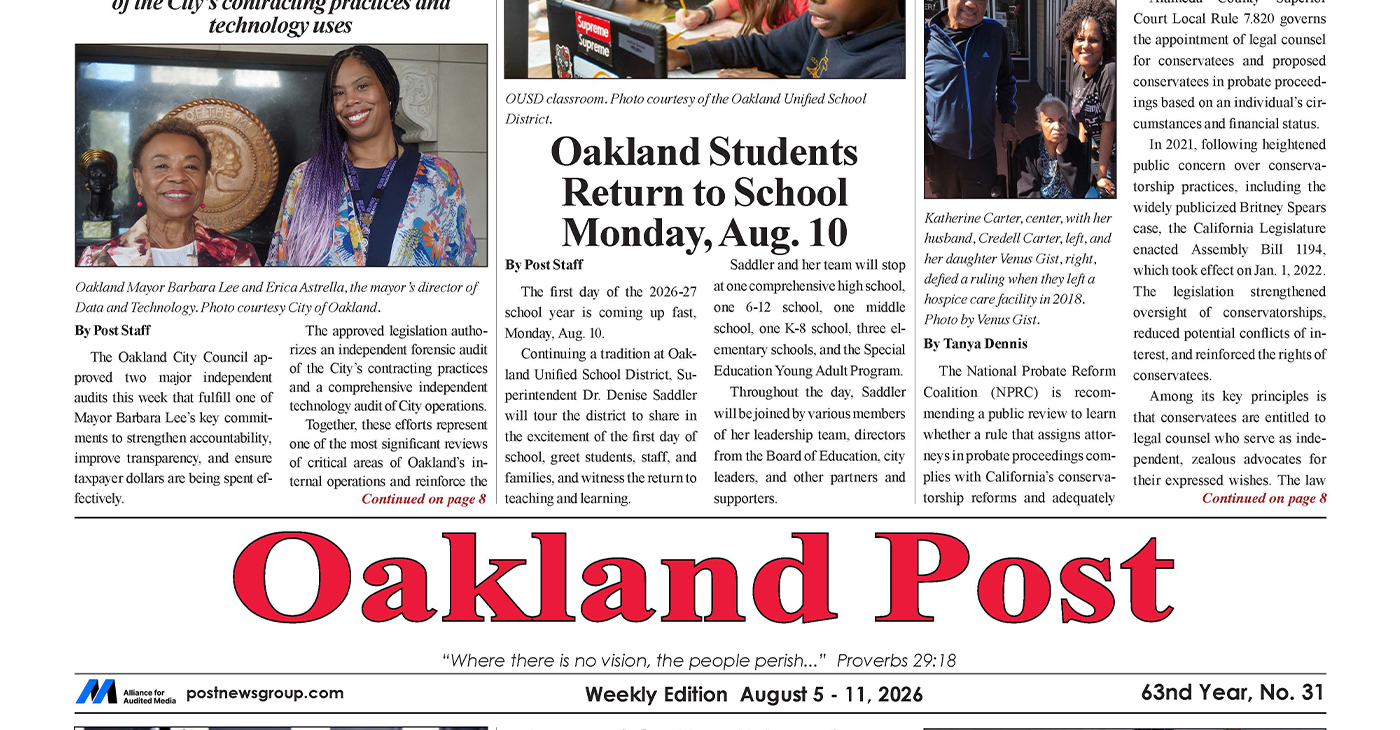
To enlarge your view of this issue, use the slider, magnifying glass icon or full page icon in the lower right corner of the browser window.
Activism
Oakland Post: Week of July 29 – August 4, 2026
The printed Weekly Edition of the Oakland Post: Week of July 29 – August 4, 2026

To enlarge your view of this issue, use the slider, magnifying glass icon or full page icon in the lower right corner of the browser window.

WORK FROM HOME
Home-based business with potential monthly income of $10K+ per month. A proven training system and website provided to maximize business effectiveness. Perfect job to earn side and primary income. Contact Lynne for more details: Lynne4npusa@gmail.com 800-334-0540


Four Candidates, Including Incumbent Barbara Lee, Qualify for Oakland Mayor’s Race

Oakland Observes Black August with Block Parties, Film Showings, Workshops

Oakland Post: Week of August 12 – 18, 2026

COMMENTARY: Why Local School Tax Measure G1 Will Not Be on the November Ballot

California Hispanic Chambers of Commerce Unveils: ‘Powering the Future’ Theme for 47th Annual Statewide Convention

Returning to Its Roots, the Oakland Black-Eyed Pea Festival Partners with the Freedom Farmers Market Sept. 12

Less Affluent School Districts, Including Sacramento City, Face Threat of State Takeover

From Blueprint to Breakthrough: Tackling Affordable Housing in Oakland

NPRC Scores First Advocacy Victory: David Shaw Finally Gets His Wish to ‘Go Home’

ESSAY: California Can Close Its Colorectal Cancer Gap

Car Wash Workers Cope with Lingering Impacts of ICE Raids

Misty Copeland Shapes Ballet’s Tomorrow

As Part of Your Back-to- School Checklist, Vaccinate

As Part of Your Back-to- School Checklist, Vaccinate

Congresswoman Simon Demands Investigation into Trump’s Abuse of Emergency Powers for Coal Export Terminal in West Oakland

Department of Homeland Security Demands California Secretary of State Shirley N. Weber Scrub Voter Rolls

Oakland Children’s Hospital Workers and Patients Rally for Pediatric Medical Care

New Judge Could Decide if Karmelo Anthony Gets a New Trial

“The Power to See Threats Sooner”: Gov. Newsom, Safety Officials Showcase California’s Investments in Hi-Tech Wildfire Prevention

Alpha Kappa Alpha Sorority, Inc. Celebrates New North Atlantic Regional Director

Surveillance Pricing Fight: State Senate Debates Bill Banning Retailers from Using AI to Set Prices Based on a Buyer’s Profile

Mount Zion MBC, Church of Jesus Christ of Latter-day Saints Partner to Bring 29,000 Meals to Alameda County

California Sen. Padilla Joins Colleagues to Introduce Bill Imposing Term Limits on Supreme Court Justices

Starting This Summer, California Car Buyers Can Get an Instant $3500 Off the Cost of Electric Vehicles

COMMENTARY: You Are Already Paying for the AI Boom

California Bill Would Let Abuse Victims Use Trauma as Legal Defense for Violent Crime
Less Affluent School Districts, Including Sacramento City, Face Threat of State Takeover
Car Wash Workers Cope with Lingering Impacts of ICE Raids

Fed Court to Decide Landmark First Amendment Case

Gov. Gavin Newsom Signs Law Streamlining Affordable Housing Rules

The Conversation With Al McFarlane 6/23/26

Media Monday 6/22/26

LIVE! ASK ALMA! — TUES. 6.23.26 7PM EST

Car Buying Secrets: 4 Hidden Checks Before You Sign!

Is This 550 HP Charger Worth YOUR Money? AutoNetwork Review

Celebrating Juneteenth – Frederick Douglass on education and resistance

LIVE! — ASK ALMA! — TUES. 6.19.26 7PM EST

Hyundai Ioniq 5 Parking, Safety, and 360 View #shorts

2025 Ioniq 5 New Wiper & Powerful Performance! #shorts

Electric SUV Range: Is 259 Miles Enough? #shorts

EV Charging: How Fast Can You Charge an Electric Vehicle? #shorts

Biometric Cooling… Messaging Seats…Come on! 2025 Infiniti QX80 Autograph 4WD

Charged Up: Witness the Magic of a Fully Electric Car! #shorts

Range Rover Sport PHEV Included…: See What’s Inside This Luxury SUV! #shorts

Invisible Hood View: Perfect Parking with X-Ray Vision! #shorts
-
 Featured1 week ago
Department of Homeland Security Demands California Secretary of State Shirley N. Weber Scrub Voter Rolls
-
 Business3 weeks ago
Oakland Children’s Hospital Workers and Patients Rally for Pediatric Medical Care
-
 #NNPA BlackPress2 weeks ago
New Judge Could Decide if Karmelo Anthony Gets a New Trial
-
 Environment1 week ago
“The Power to See Threats Sooner”: Gov. Newsom, Safety Officials Showcase California’s Investments in Hi-Tech Wildfire Prevention
-
 Black History2 weeks ago
Alpha Kappa Alpha Sorority, Inc. Celebrates New North Atlantic Regional Director
-
 Business3 weeks ago
Surveillance Pricing Fight: State Senate Debates Bill Banning Retailers from Using AI to Set Prices Based on a Buyer’s Profile
-
 Business3 weeks ago
Mount Zion MBC, Church of Jesus Christ of Latter-day Saints Partner to Bring 29,000 Meals to Alameda County
-
 Featured1 week ago
California Sen. Padilla Joins Colleagues to Introduce Bill Imposing Term Limits on Supreme Court Justices
