
Bay Area
Mayor London Breed Announces Nearly $2 Million in Grants for San Francisco Nonprofit Organizations
All 11 of this year’s NSI grantees provide vital services and resources to low-income residents. Eight of the organizations have Black, Latino, Asian, LGBTQ, or immigrant leadership.

Eleven organizations have received awards designed to protect and expand essential services for people experiencing mental health challenges and homelessness, provide support for low-income and first-generation college students, and create culturally responsive music, dance, and arts access at an affordable housing site in the Mission.
Mayor London N. Breed, the Office of Economic and Workforce Development (OEWD), the Mayor’s Office of Housing and Community Development, the San Francisco Arts Commission, and Community Vision made the announcement on Saturday about $1.96 million in transformative awards for San Francisco nonprofit organizations.
The space acquisition and lease stabilization grants are part of San Francisco’s Nonprofit Sustainability Initiative (NSI), which helps stabilize nonprofits that provide services and support to residents as part of the response to COVID-19 and beyond.
With these awards, the NSI surpasses a milestone, seeding the acquisition of more than 150,000 square feet of newly nonprofit-owned space for organizations that serve low-income residents and are deeply rooted in historically underserved communities and communities of color.
All 11 of this year’s NSI grantees provide vital services and resources to low-income residents. Eight of the organizations have Black, Latino, Asian, LGBTQ, or immigrant leadership.

“This past year has shown us just how important it is that our local San Francisco nonprofit organizations have the tools and resources they need to provide essential services,” said Breed. “The Nonprofit Sustainability Initiative has supported the acquisition of critical community spaces throughout San Francisco. This round of funding will help strengthen organizations that are trusted and deeply rooted in their communities so they can recover and emerge even stronger than before the pandemic.”
These funds are especially critical for ensuring San Francisco’s nonprofit organizations are able to recover from the COVID-19 pandemic and continue to provide critical services and resources for San Franciscans.
For example, in 2019, NSI funds supported the purchase of the property at 701 Alabama St., which was quickly activated last year by the Latino Task Force to distribute food and COVID-19-related assistance to some of San Francisco’s most vulnerable residents.
This round of NSI awards includes $1 million for the Bayview Hunters Point Foundation to acquire permanent space that will be shared with organizations doing complementary work for people experiencing homelessness or seeking mental health and substance abuse services.
Three past NSI awardees, La Cocina, Planned Parenthood, and Mission Kids, opened new facilities this week. A fourth awardee, Community Youth Center of San Francisco, plans to break ground later this spring.
The underlying objective of all NSI programs is to ensure access to quality-of-life resources as well as education, health, and human services for residents of San Francisco, and real estate assistance is a cornerstone of the program.
2021 Nonprofit Sustainability Awardees
Bayview Hunters Point Foundation will use its $1 million awards to catalyze a capital campaign and purchase space at 5815 3rd Street in the Bayview. The 20,470 square foot space will include shared space for organizations offering complementary services, making it easier for clients and their families to access support.
“Bayview Hunters Point Foundation has provided support and empowerment for San Francisco’s most vulnerable and disenfranchised residents since 1971,” said Bayview Hunters Point Foundation Board President Susan Watson. “The Nonprofit Sustainability Initiative acquisition grant will serve as the lead gift for our 50th Anniversary Capital Campaign, making it possible for us to purchase the building we’ve long called home. From this stable base of operations, we will continue to serve those most in need—for the next 50 years and beyond.”
Cultura y Arte Nativa de las Américas was awarded $250,000 to cover renovation costs and $75,000 to pay for architectural and engineering services in support of its new community arts space in the Mission District. 681 Florida Street will be CANA’s first permanent home and will be used for dance rehearsals/performances, recording studio/beat-making lessons, music lessons, marketplace activities, and community events and meetings.
“Funding for our future, permanent art space in the Mission District will bring long-term stability for CANA-Carnaval San Francisco and hundreds of artists, positively impacting our ability to focus on programming and development. This support will help preserve our community and city’s vibrant artistic culture for generations to come,” said Roberto Hernandez, Artistic Director, and Executive Producer.
Japanese Community Youth Council received an award of $83,500 to support the repair and replacement of items required by the relocation of its college access programs to 1710 Octavia Street. The new site will be used to offer academic support and college advising for low-income, first-generation college students. While services are offered onsite at schools throughout San Francisco, the 1710 Octavia site will be used for afterschool, evening, weekend, and summer activities.
“JCYC is extremely pleased to be awarded a relocation grant from the San Francisco Nonprofit Sustainability Initiative which will make it possible for our organization to move into new, long-term program space. We are grateful for the opportunity to utilize these resources to create the most welcoming and safest environment for the children and youth we serve,” said Jon Osaki, Executive Director of the Japanese Community Youth Council.
Other 2021 awardees include Bay Area Video Coalition, Charity Cultural Services Center, Children’s Book Project, Chinese Historical Society of America, Kultivate Labs, Larkin Street Youth Services, The Healing Well, and Youth Art Exchange.
Grants are administered by Community Vision, which will announce the next request for acquisition proposals in June 2021 and offer several workshops with more information. Should funding be approved by the Board of Supervisors, the next round of applications for relocation and renovation grants will open in late 2021. Past program guidelines are available at communityvisionca.org/sfsustainability.. Information about past NSI awardees and current resources can be found at oewd.org/nonprofits.
This report is from the Mayor’s Office of Communication.





Activism
Oakland Post: Week of September 30 – October 6, 2026
The printed Weekly Edition of the Oakland Post: Week of September 30 – October 6, 2026

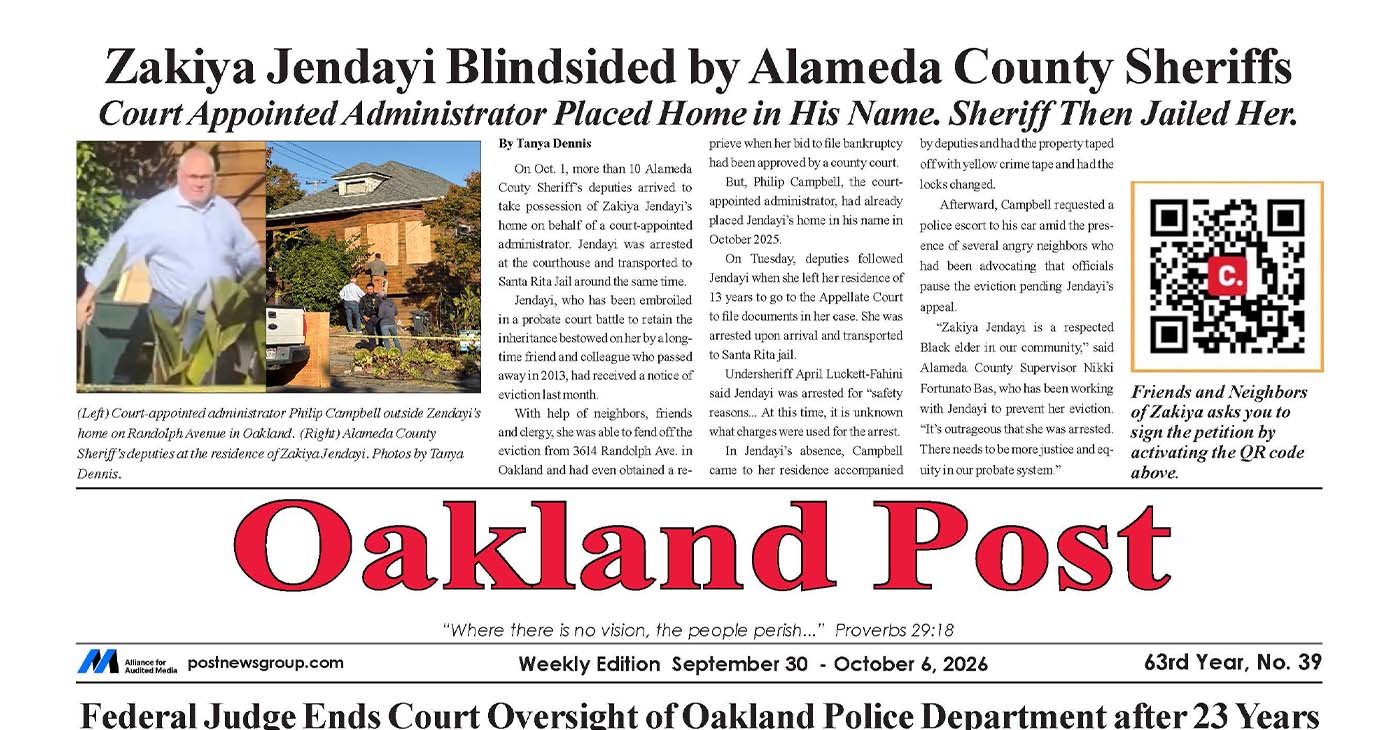
To enlarge your view of this issue, use the slider, magnifying glass icon or full page icon in the lower right corner of the browser window.

Activism
Oakland Post: Week of September 23 – 29, 2026
The printed Weekly Edition of the Oakland Post: Week of September 23 – 29, 2026

To enlarge your view of this issue, use the slider, magnifying glass icon or full page icon in the lower right corner of the browser window.
Activism
Oakland Post: Week of September 16 – 22, 2026
The printed Weekly Edition of the Oakland Post: Week of September 16 – 22, 2026

To enlarge your view of this issue, use the slider, magnifying glass icon or full page icon in the lower right corner of the browser window.



OP-ED: Proposition 44 Would Put a Price on Trust

OP-ED: Proposition 40: It’s Time to Play Chess, Not Checkers

Listening as a Lifeline: A Doula’s Witness to Black Maternal Health

New Protections for Ticket Buyers: Gov. Newsom Signs Assemblymember Isaac Bryan’s Bill

‘We Don’t Talk Trash — We Pick Up Trash!’

Zakiya Jendayi Arrested, Locked Out of Home by Sheriff’s Deputies

Oakland Post: Week of September 30 – October 6, 2026

Asm. Corey Jackson Announces Launch of 24-Hour Childcare in His District

IN MEMORIAM: The Rev. Leon “Sonny” Clark, Longtime Orange County Pastor and Community Leader, Dies at 72

Poll: Becerra Widens His Lead Over Hilton; Californians Split on Wealth Tax

From Historic Memories to New Possibilities: Oakland Celebrates Coliseum 60

County Office of Education Says OUSD Finances Are Getting Healthier, Materially Stronger

LIVE FREE Sunday Dinner Brings Faith, Fellowship and Civic Conversation to Oakland

Remembering Chauncey Bailey as Student Journalists Face Threats to Truth-Telling

BLACspace Cooperative Invites Bay Area to Experience Oakland’s Black Cultural Ecosystem Through a BLAC Map Tour + Party

Standoff for Justice: Our Homes Are Worth Fighting For

Oakland Post: Week of August 26 – September 1, 2026

Frontier Airlines’ Return to Oakland Airport Brings Flights, Jobs and Opportunity

Gubernatorial Candidate Steve Hilton Blasts California New Tire Rules; Newsom Hits Back

Chef Sharon Lee Blends Culinary Excellence, Education and Empowerment

Jackie Wright Champions Bay Area Stories, Filmmakers and Cultural Institutions

Misnamed ‘Parent’ PAC Seeks to Influence Oakland School Board Elections

Oakland Coliseum Project Opens Door for Small Businesses to Build Bigger

Big City Mayors Ask for “Yes” Vote on Housing Bond Measure; Conservatives Say “No”

Gov. Newsom’s Latest Appointees Include Sacramento Advocate for Formerly Incarcerated Students; State’s New Tech Chief

Longtime BWOPA Member Brendalyn Goodall Appointed to California Workforce Development Board

Gov. Newsom Signs Law Shielding Immigration Aid Workers From Doxing Threats

Oakland Post: Week of September 2 – 8, 2026

Secretary of State Shirley N. Weber Urges Californians to Vote Early as Voter ID Battle Intensifies

IN MEMORIAM: Dolly Parton Dead at 80 — How She Built a Legacy of Love and Earned Her Place in Black Culture

The Conversation With Al McFarlane 6/23/26

Media Monday 6/22/26

LIVE! ASK ALMA! — TUES. 6.23.26 7PM EST

Car Buying Secrets: 4 Hidden Checks Before You Sign!

Is This 550 HP Charger Worth YOUR Money? AutoNetwork Review

Celebrating Juneteenth – Frederick Douglass on education and resistance

LIVE! — ASK ALMA! — TUES. 6.19.26 7PM EST

Hyundai Ioniq 5 Parking, Safety, and 360 View #shorts

2025 Ioniq 5 New Wiper & Powerful Performance! #shorts

Electric SUV Range: Is 259 Miles Enough? #shorts

EV Charging: How Fast Can You Charge an Electric Vehicle? #shorts

Biometric Cooling… Messaging Seats…Come on! 2025 Infiniti QX80 Autograph 4WD

Charged Up: Witness the Magic of a Fully Electric Car! #shorts

Range Rover Sport PHEV Included…: See What’s Inside This Luxury SUV! #shorts

Invisible Hood View: Perfect Parking with X-Ray Vision! #shorts
-
 Community3 weeks ago
Misnamed ‘Parent’ PAC Seeks to Influence Oakland School Board Elections
-

 Activism3 weeks ago
Oakland Post: Week of September 9 – 15, 2026
-

 Community3 weeks ago
Richmond Tiny House Village Farm & Garden Set to Open Gates on Sept. 26
-

 Black History3 weeks ago
Latest Massacre in Haiti Reveals Cruelty U.S. Deportations
-

 Black History3 weeks ago
OPINION: Nolan Wells’ Death One of Several Signifying Racial Terror Lives on in U.S. South
-

 Business2 weeks ago
Mayor Lee Announces $1 Million Kaiser Permanente Grant for Pilot Program to Address Homelessness, Clean Up Public Spaces throughout Oakland
-

 Community3 weeks ago
Democratic Clubs Interview Candidates for Oakland School Board
-
 Uncategorized3 weeks ago
NBA All-Star Damian Lillard Returns Home for 15th Annual Backpack Giveaway
