
Politics
Many in Baltimore Community React with Skepticism to O’Malley’s Claims of Progressive Bona Fides


Former Maryland Gov. Martin O’Malley speaks before signing a bill abolishing capital punishment in the state during a ceremony in Annapolis, Md., Thursday, May 2, 2013. (AP Photo/Patrick Semansky)
by Roberto Alejandro
Special to the NNPA from the Afro-American Newspaper
Former Maryland Gov. Martin O’Malley officially entered the presidential race May 30 with a speech in Baltimore’s Federal Hill, but many in Baltimore are skeptical of both his chances as well as the idea that he is a legitimate liberal alternative to Hillary Clinton, the frontrunner for the Democratic presidential nomination.
“[O’Malley’s candidacy] is still a long shot,” wrote John Bullock, professor of political science at Towson University, in a statement to the AFRO. “He is trying to present himself as a credible alternative to Clinton, but that may not be successful unless she falters. In his announcement, he attempted to appeal to progressives, but Bernie Sanders has the strongest record in that area.”
Indeed, O’Malley made his case for the Democratic nomination during his announcement speech on the strength of a series of supposedly progressive accomplishments during his time in city and state government.
“Together, we made our city believe again and we invented a better and new way of governing called CitiStat, and we got things done. Together, we made our state’s public schools the best in the nation. We made college more affordable for more families. . . . We led our people forward through a devastating recession and we took greater care to protect the land, the air, and the waters of our Chesapeake Bay. And we passed the DREAM Act and we passed marriage equality. Together, we raised the minimum wage and we maintained the highest median income of any state in the nation,” said O’Malley, according to a video of his announcement speech on his campaign website.
But it is not only Sanders’s progressive record that O’Malley will have to overcome, but the skepticism of those who lived through the era of these alleged progressive accomplishments and remember it differently.
“It’s the job of people like myself and others who know O’Malley, who directly engaged and challenged his policies as it relates to Black people to elevate the stories about the things that he did during his time as governor, his time as mayor, to push back against that idea (of O’Mally as a progressive),” said Dayvon Love, public policy director for Leaders of a Beautiful Struggle, referring, in part, to O’Malley’s institution of zero tolerance policing during his time as Baltimore City mayor and the O’Malley administration’s support for a $100 million youth jail that was halted by grassroots efforts a number of years ago.
For Leo Burroughs, chairman of the Committee of Concerned Citizens, that history of pursuing policies that were often deleterious to persons of color makes O’Malley more of a “blue dog Democrat” than a tried-and-true liberal.
“[O’Malley is] extraordinarily good at wheeling and dealing in ways that are not in the best interest of the poor, Blacks, or the middle-class. Horrible thought this guy running…but he knows how to reconfigure and reinvent himself,” said Burroughs. “He feigns being some kind of a liberal—this guy was never a liberal; he was always Mr. Zero Tolerance and he’s still Mr. Zero Tolerance.”
To media consultant and political strategist Catalina Byrd, the persons speaking in support of O’Malley at his announcement event were representative of the alleged disconnect between the politician’s rhetoric and policies, of which Burroughs and Love spoke.
“The people that he had speaking for him . . . either weren’t here (in Baltimore City) when he was mayor, or lived outside the city and don’t know what type of mayor he was, or were not impacted—based on their social status, or their fiscal status—by the type of governor that he was, and can’t make the connection and the correlation to how he has failed at every level besides just winning every election. He’s failed in terms of leadership and new direction for both the city and the state,” said Byrd.
In his announcement speech, O’Malley said his accomplishments in Maryland were a function of new leadership and perspective, but it seems he will have to do a better job of convincing the nation this is what he brings to the table than he has some of his previous constituents.










Business
OP-ED: Proposition 44 Would Put a Price on Trust
The danger in Proposition 44 is not only its 90 percent figure. It is that the meaning of “qualifying” spending will be worked out later. A clinic preparing a budget today may not know whether a navigator, health educator, transportation program, outreach worker, technology upgrade, or other patient-support service will be counted the way it expects. Yet the financial consequence of getting it wrong could be immediate.




Business
OP-ED: Proposition 40: It’s Time to Play Chess, Not Checkers
Proposition 40 would impose a one-time 5 percent tax on the wealth of Californians with more than $1 billion in assets. Most of that money would go toward health care, with the remainder supporting food assistance and education-related programs.

Activism
Oakland Post: Week of September 30 – October 6, 2026
The printed Weekly Edition of the Oakland Post: Week of September 30 – October 6, 2026
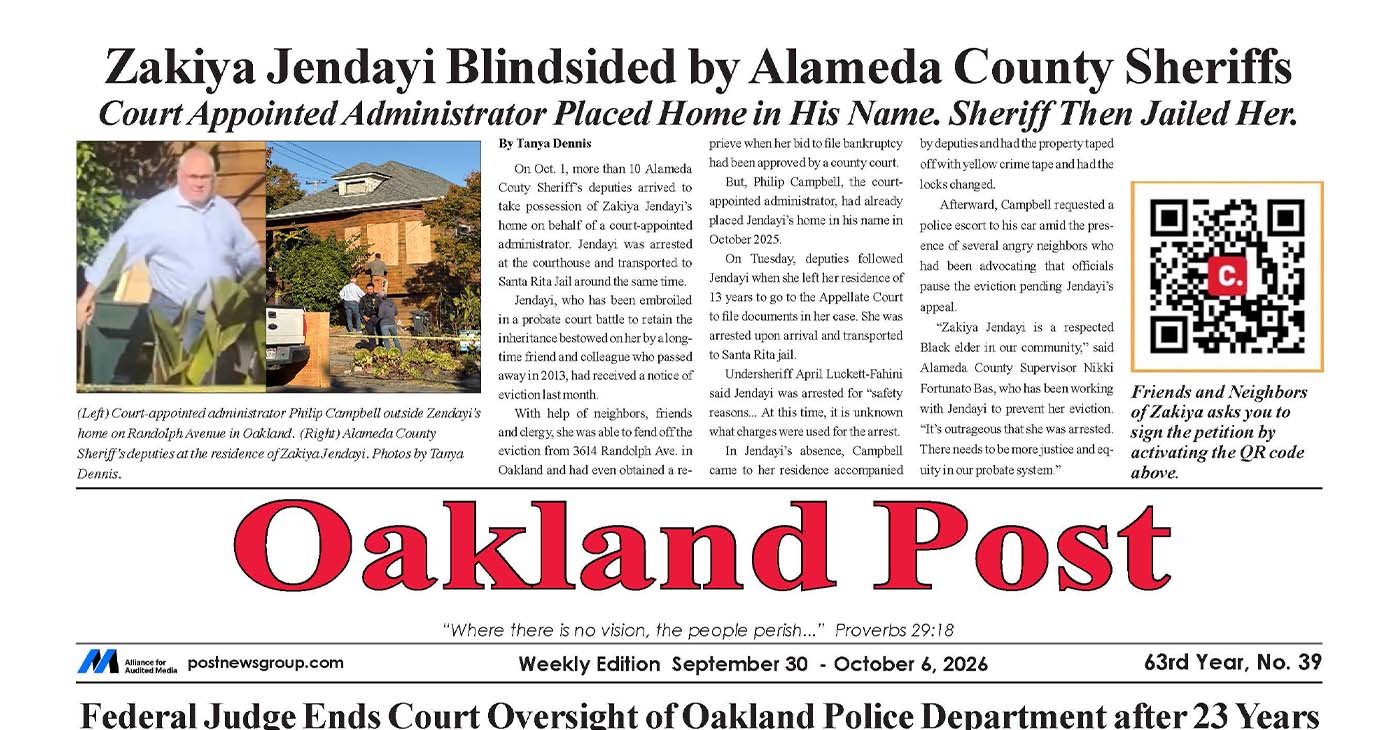
To enlarge your view of this issue, use the slider, magnifying glass icon or full page icon in the lower right corner of the browser window.



OP-ED: Proposition 44 Would Put a Price on Trust

OP-ED: Proposition 40: It’s Time to Play Chess, Not Checkers

Listening as a Lifeline: A Doula’s Witness to Black Maternal Health

New Protections for Ticket Buyers: Gov. Newsom Signs Assemblymember Isaac Bryan’s Bill

‘We Don’t Talk Trash — We Pick Up Trash!’

Zakiya Jendayi Arrested, Locked Out of Home by Sheriff’s Deputies

Oakland Post: Week of September 30 – October 6, 2026

Asm. Corey Jackson Announces Launch of 24-Hour Childcare in His District

IN MEMORIAM: The Rev. Leon “Sonny” Clark, Longtime Orange County Pastor and Community Leader, Dies at 72

Poll: Becerra Widens His Lead Over Hilton; Californians Split on Wealth Tax

From Historic Memories to New Possibilities: Oakland Celebrates Coliseum 60

County Office of Education Says OUSD Finances Are Getting Healthier, Materially Stronger

LIVE FREE Sunday Dinner Brings Faith, Fellowship and Civic Conversation to Oakland

Remembering Chauncey Bailey as Student Journalists Face Threats to Truth-Telling

BLACspace Cooperative Invites Bay Area to Experience Oakland’s Black Cultural Ecosystem Through a BLAC Map Tour + Party

Standoff for Justice: Our Homes Are Worth Fighting For

Oakland Post: Week of August 26 – September 1, 2026

Frontier Airlines’ Return to Oakland Airport Brings Flights, Jobs and Opportunity

Gubernatorial Candidate Steve Hilton Blasts California New Tire Rules; Newsom Hits Back

Chef Sharon Lee Blends Culinary Excellence, Education and Empowerment

Jackie Wright Champions Bay Area Stories, Filmmakers and Cultural Institutions

Misnamed ‘Parent’ PAC Seeks to Influence Oakland School Board Elections

Oakland Coliseum Project Opens Door for Small Businesses to Build Bigger

Big City Mayors Ask for “Yes” Vote on Housing Bond Measure; Conservatives Say “No”

Gov. Newsom’s Latest Appointees Include Sacramento Advocate for Formerly Incarcerated Students; State’s New Tech Chief

Longtime BWOPA Member Brendalyn Goodall Appointed to California Workforce Development Board

Gov. Newsom Signs Law Shielding Immigration Aid Workers From Doxing Threats

Secretary of State Shirley N. Weber Urges Californians to Vote Early as Voter ID Battle Intensifies

Oakland Post: Week of September 2 – 8, 2026

IN MEMORIAM: Dolly Parton Dead at 80 — How She Built a Legacy of Love and Earned Her Place in Black Culture

The Conversation With Al McFarlane 6/23/26

Media Monday 6/22/26

LIVE! ASK ALMA! — TUES. 6.23.26 7PM EST

Car Buying Secrets: 4 Hidden Checks Before You Sign!

Is This 550 HP Charger Worth YOUR Money? AutoNetwork Review

Celebrating Juneteenth – Frederick Douglass on education and resistance

LIVE! — ASK ALMA! — TUES. 6.19.26 7PM EST

Hyundai Ioniq 5 Parking, Safety, and 360 View #shorts

2025 Ioniq 5 New Wiper & Powerful Performance! #shorts

Electric SUV Range: Is 259 Miles Enough? #shorts

EV Charging: How Fast Can You Charge an Electric Vehicle? #shorts

Biometric Cooling… Messaging Seats…Come on! 2025 Infiniti QX80 Autograph 4WD

Charged Up: Witness the Magic of a Fully Electric Car! #shorts

Range Rover Sport PHEV Included…: See What’s Inside This Luxury SUV! #shorts

Invisible Hood View: Perfect Parking with X-Ray Vision! #shorts
-
 Community3 weeks ago
Misnamed ‘Parent’ PAC Seeks to Influence Oakland School Board Elections
-
 Activism4 weeks ago
Oakland Post: Week of September 2 – 8, 2026
-

 Activism3 weeks ago
Oakland Post: Week of September 9 – 15, 2026
-

 Community3 weeks ago
Richmond Tiny House Village Farm & Garden Set to Open Gates on Sept. 26
-

 Black History3 weeks ago
Latest Massacre in Haiti Reveals Cruelty U.S. Deportations
-

 Black History3 weeks ago
OPINION: Nolan Wells’ Death One of Several Signifying Racial Terror Lives on in U.S. South
-

 Business2 weeks ago
Mayor Lee Announces $1 Million Kaiser Permanente Grant for Pilot Program to Address Homelessness, Clean Up Public Spaces throughout Oakland
-

 Community3 weeks ago
Democratic Clubs Interview Candidates for Oakland School Board
