
Bay Area
Madame Secretary: Hon. Shirley N. Weber Reflects on Voting Rights, First Year in Office
Shirley Weber, California’s 31st Secretary of State (SOS),introduced AB 3121, a bill that set up a committee called the Task Force to Study and Develop Reparations Proposals for African Americans. The group is charged with examining California’s involvement in slavery – and how California should compensate the descendants of enslaved Black Americans.

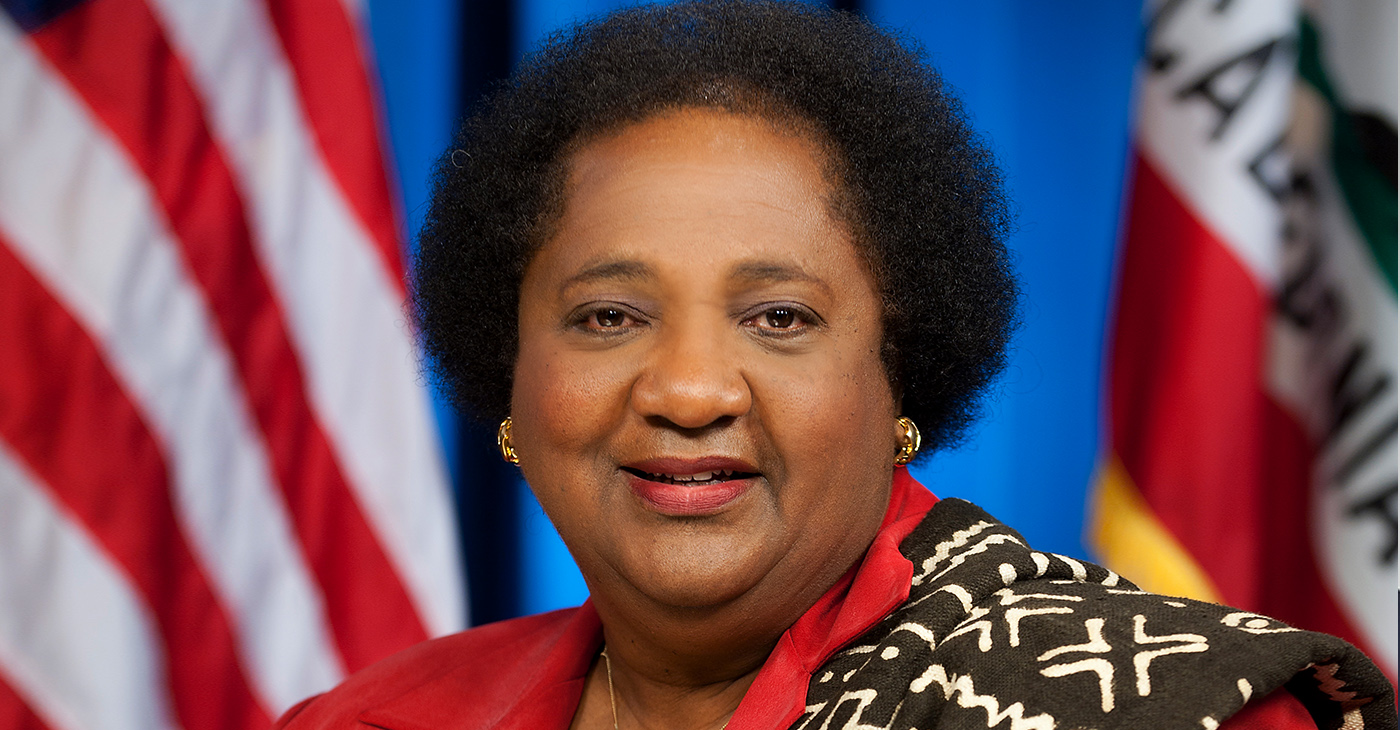
By Tanu Henry | California Black Media
In December 2020, Gov. Gavin Newsom appointed Shirley Weber California’s 31st Secretary of State (SOS), the state’s chief election official.
The first African American to serve in the role – and the fifth Black person to become a constitutional officer in California – Weber took office on Jan. 29, 2021.
Weber has been a central and influential figure in California politics for years. She was an Assemblymember representing the 79th District in San Diego County and chaired the California Legislative Black Caucus (CLBC).
In the Legislature, she introduced groundbreaking bills, including one of the strictest laws governing police use of deadly force in the country. It will protect Californians on “both sides of the badge,” she said, celebrating that legislation, which was supported by the California Police Chiefs Association.
Weber introduced AB 3121, a bill that set up a committee called the Task Force to Study and Develop Reparations Proposals for African Americans. The group is charged with examining California’s involvement in slavery – and how California should compensate the descendants of enslaved Black Americans.
As SOS, Weber is responsible for conducting elections in all 58 counties, managing the operations of the State Archives, and keeping a registry of businesses and nonprofits statewide.

“We passed legislation that gives everybody a vote-by-mail ballot, and we’ve seen that it works” says Weber, sharing details about a major electoral policy change she has implemented as SOS. “We have to make sure that every eligible Californian not only gets the right to vote, but that they are registered to vote and that they show up.”
On January 24, California Black Media interviewed Weber at her Sacramento office.
CBM: As an Assemblymember, you introduced groundbreaking legislation. What has the transition been like, moving from actively creating policy to settling into the administrative role of Secretary of State?
SOS: It’s been interesting, to go from being a legislator where you share the responsibility of representing all Californians with 80 others in the Assembly and another 40 in the Senate.
There, I wasn’t responsible for all registered voters and the protection of those who work at the polls and those who work to register voters.
Over here, you have an administrative role, and we support legislation like the Voting Rights Act.
It’s been somewhat difficult to let go of my District. Fortunately, my daughter is the Assemblymember there now.
CBM: The U.S. Senate did not pass the John Lewis Voting Rights Advancement Act. Why is that significant and why are voting rights so important in America right now?
SOS: When Gov. Newsom asked me to be Secretary of State, the first thing that popped in my mind was voting rights. This wasn’t a position that I had lobbied for. We had made some tremendous changes in the Assembly and passed some groundbreaking legislation.
Speaking to a reporter last December 22nd, I said, ‘This is a critical time because our nation is in peril.’ And he goes, ‘what do you mean?’ I said, ‘Our democracy is in crisis.’ He didn’t understand. When January 6 hit (the insurrection at the U.S. Capitol), people understood.
I recognize this is a difficult and unique time for people in the nation, extremely difficult for African Americans, because most of us who have parents or we ourselves have lived through this struggle for voting rights.
My family understood the power of voting. My parents came out of Arkansas where they never got a chance to vote. My dad was an adult with six kids before he actually got a chance to register to vote in California.
CBM: What can ordinary Californians who care about expanding and protecting voting rights do?
SOS: We need to pay attention. We must fight laws that make it difficult for people to vote. Even though we don’t have that legislation coming out of our Legislature, we have people putting initiatives on the ballot.
California has expanded voting rights so much that people want to limit it. There’s only one group that can’t vote in this state: those who are physically in prison. Everyone else who meets the eligibility requirements in California can vote. And that frightens some people.
CBM: Do you see that movement to counteract the expansion of voting rights here in California or from other states?
SOS: It is coming from within and without. We have to be careful of the deceptive methods used. Take the campaign against bail reform. It had been signed into law. And a group of bail bondsmen took a whole bunch of money, manipulated African Americans and put their faces on television. It confused voters and wiped out this whole effort we had been working on for five or six years.
CBM: Do you think other Secretaries of State across the country will emulate California’s efforts to expand voting rights?
SOS: We are seeing that, especially in states with Democratic leadership. But in other places, we see also them fighting the Voting Rights Act.
Secretaries of State are a unique breed. Many are appointed by governors. Across the nation, people on the Far Right are organizing to get candidates to run for Secretary of State, where before it was seen more as an administrative job with a few other responsibilities. Now, it is seen as a highly political job, especially given the legislation that’s coming out in some places that would empower Legislatures to overturn votes.
CBM: You’ve been in this job for a year. Do you feel like you’ve accomplished your goals?
SOS: I didn’t take this position because I needed to be a constitutional officer, or one day become governor. The question for me was: ‘What does the Secretary of State have to offer in these critical times?’ And obviously it is the defense of our democracy. I was coming in with the idea that we are going to expand our voting base. We have done that.
We’ve also expanded the California Voter Choice Act counties. Half of our counties are Voter Choice Act counties, which gives us additional resources to go into those counties. They are now outvoting the rest of the counties.
Statewide, 88% of eligible Californians are registered right now to vote. My goal is to get it to 100 %.
Is California implementing additional safeguards to make sure irregularities are minimal?
Yes, we are. We have a system that verifies votes. We test every machine in California before every election. We make it possible for people to observe the process. They can’t come and start counting themselves. But they can observe. We do all this with transparency.
CBM: How does it feel to look at that long wall of portraits of past Secretaries of State, and know that your legacy will be enshrined in California history?
SOS: I’m very grateful. When I was sworn in, somebody says you’re the first African American after some 170 years. How does that feel? I said, well – what took so long?











Activism
Oakland Post: Week of September 16 – 22, 2026
The printed Weekly Edition of the Oakland Post: Week of September 16 – 22, 2026

To enlarge your view of this issue, use the slider, magnifying glass icon or full page icon in the lower right corner of the browser window.
Activism
Oakland Post: Week of September 9 – 15, 2026
The printed Weekly Edition of the Oakland Post: Week of September 9 – 15, 2026

To enlarge your view of this issue, use the slider, magnifying glass icon or full page icon in the lower right corner of the browser window.
Activism
Oakland Post: Week of September 2 – 8, 2026
The printed Weekly Edition of the Oakland Post: Week of September 2 – 8, 2026
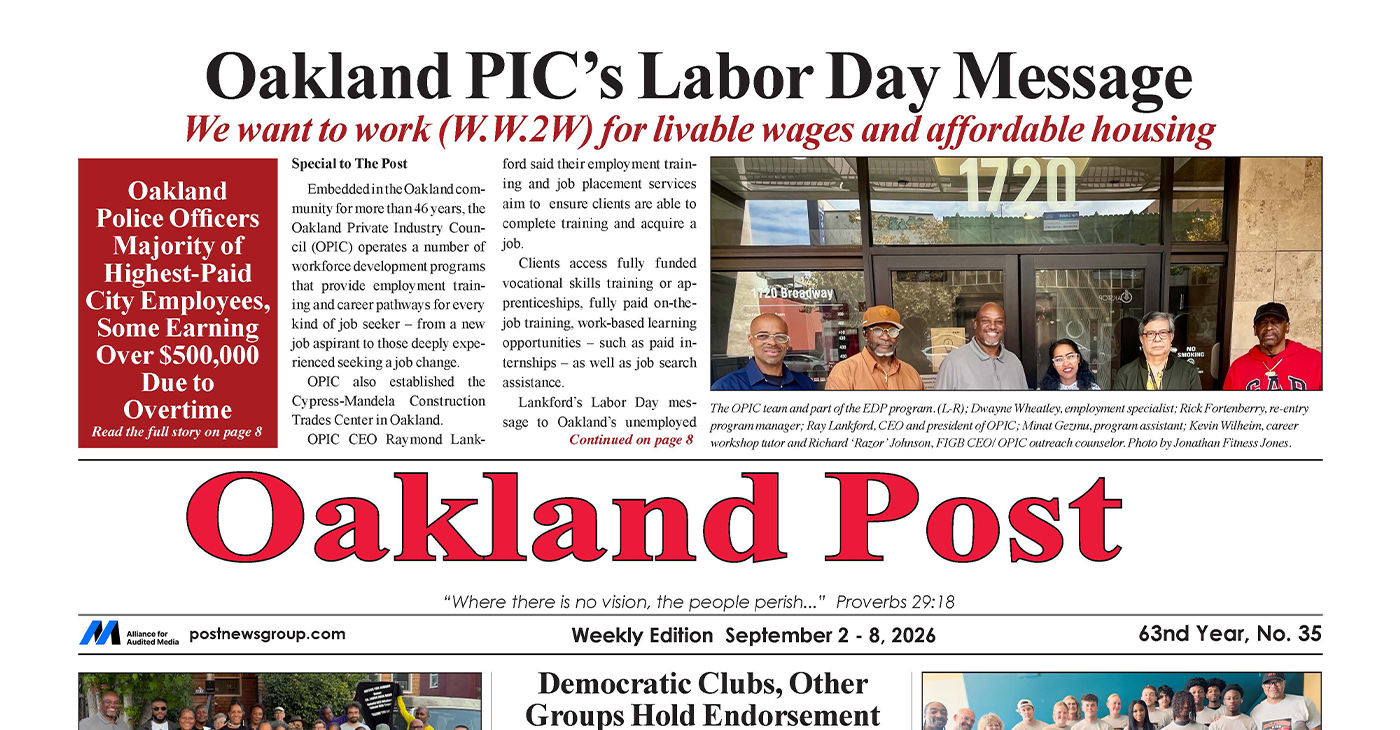
To enlarge your view of this issue, use the slider, magnifying glass icon or full page icon in the lower right corner of the browser window.



Doulas Are Helping Black California Moms Navigate Pregnancy–Even as High Mortality Rates Persist

Newsom Signs Addictive Social Media Law to Protect Kids

On Your November Ballot: Prop 38 Would Allocate $8.4 Billion to Immunology and Immunotherapy Funding

Ask California: Golden State Releases New AI Chatbot

Asm. Isaac Bryan’s Bill Banning California Police From ICE Side Jobs Reaches Newsom’s Desk

Assemblymember LaShae Sharp-Collins’s Bill Would Pause Law Enforcement’s Use of Shock Gloves Pending Study

BOOK REVIEW: ‘Laws of Solomon’ Reveals Tender Heart of Former Child Soldier

OPINION: The New American Fear – From 9-11 to AI

Passing for White, Fighting for Black America: The Courage of Walter White

Oakland People’s Arms Embargo Coalition Demands End to Military Shipments Thru Oakland

Barbara Lee Mourns Gloria Steinem, Remembers a Friendship Rooted in Equality

Event Preview: ‘Fashion v. Fascism’ – A Runway Revolution Is Coming to the Bay Area

Two Looming Threats Every Alameda County Elder Should Know About

Oakland Mayor Reads to Children at Bookout Block Party at Marcus Books Store

Tradition Comes to the Streets in 11th Annual Black-Eyed Pea Festival at the Freedom Farmers Market

Less Affluent School Districts, Including Sacramento City, Face Threat of State Takeover

ESSAY: California Can Close Its Colorectal Cancer Gap

California Hispanic Chambers of Commerce Unveils: ‘Powering the Future’ Theme for 47th Annual Statewide Convention

Four Candidates, Including Incumbent Barbara Lee, Qualify for Oakland Mayor’s Race

Oakland Post: Week of August 12 – 18, 2026

From Blueprint to Breakthrough: Tackling Affordable Housing in Oakland

Oakland Observes Black August with Block Parties, Film Showings, Workshops

COMMENTARY: Why Local School Tax Measure G1 Will Not Be on the November Ballot

Standoff for Justice: Our Homes Are Worth Fighting For

Returning to Its Roots, the Oakland Black-Eyed Pea Festival Partners with the Freedom Farmers Market Sept. 12

NPRC Scores First Advocacy Victory: David Shaw Finally Gets His Wish to ‘Go Home’

Oakland Post: Week of August 26 – September 1, 2026

Frontier Airlines’ Return to Oakland Airport Brings Flights, Jobs and Opportunity

Gubernatorial Candidate Steve Hilton Blasts California New Tire Rules; Newsom Hits Back

Chef Sharon Lee Blends Culinary Excellence, Education and Empowerment

The Conversation With Al McFarlane 6/23/26

Media Monday 6/22/26

LIVE! ASK ALMA! — TUES. 6.23.26 7PM EST

Car Buying Secrets: 4 Hidden Checks Before You Sign!

Is This 550 HP Charger Worth YOUR Money? AutoNetwork Review

Celebrating Juneteenth – Frederick Douglass on education and resistance

LIVE! — ASK ALMA! — TUES. 6.19.26 7PM EST

Hyundai Ioniq 5 Parking, Safety, and 360 View #shorts

2025 Ioniq 5 New Wiper & Powerful Performance! #shorts

Electric SUV Range: Is 259 Miles Enough? #shorts

EV Charging: How Fast Can You Charge an Electric Vehicle? #shorts

Biometric Cooling… Messaging Seats…Come on! 2025 Infiniti QX80 Autograph 4WD

Charged Up: Witness the Magic of a Fully Electric Car! #shorts

Range Rover Sport PHEV Included…: See What’s Inside This Luxury SUV! #shorts

Invisible Hood View: Perfect Parking with X-Ray Vision! #shorts
-
 Commentary4 weeks ago
Standoff for Justice: Our Homes Are Worth Fighting For
-
 Activism4 weeks ago
Oakland Post: Week of August 26 – September 1, 2026
-
 Business4 weeks ago
Frontier Airlines’ Return to Oakland Airport Brings Flights, Jobs and Opportunity
-
 Business4 weeks ago
Gubernatorial Candidate Steve Hilton Blasts California New Tire Rules; Newsom Hits Back
-
 Business4 weeks ago
Chef Sharon Lee Blends Culinary Excellence, Education and Empowerment
-

 Education4 weeks ago
Gov. Newsom’s Latest Appointees Include Sacramento Advocate for Formerly Incarcerated Students; State’s New Tech Chief
-

 Community4 weeks ago
Big City Mayors Ask for “Yes” Vote on Housing Bond Measure; Conservatives Say “No”
-

 Business4 weeks ago
Oakland Coliseum Project Opens Door for Small Businesses to Build Bigger
