
Activism
MacArthur Fellow Dorothy Roberts’ Advocates Restructure of Child Welfare System
Roberts’s early work focused on Black women’s reproductive rights and their fight for reproductive justice. In “Killing the Black Body: Race, Reproduction, and the Meaning of Liberty 1997)”, she analyzes historical and contemporary policies and practices that denied agency to Black women and sought to control their childbearing—from forced procreation during slavery, to coercive sterilization and welfare reform—and advocates for an expanded understanding of reproductive freedom.


Special to The Post
When grants were announced Oct. 1, it was noted that eight of the 22 MacArthur Fellows were African American. Among the recipients of the so-called ‘genius grants’ are scholars, visual and media artists a poet/writer, historian, and dancer/choreographer who each receive $800,000 over a five-year period to spend as they see fit.
Their names are Ruha Benjamin, Jericho Brown, Tony Cokes, Jennifer L. Morgan, Ebony G. Patterson, Shamel Pitts, Jason Reynolds, and Dorothy Roberts. This is the eighth and last in the series highlighting the Black awardees. The report below on Dorothy Roberts is excerpted from the MacArthur Fellows web site.
A graduate of Yale University with a law degree from Harvard, Dorothy Roberts is a legal scholar and public policy researcher exposing racial inequities embedded within health and social service systems.
Sine 2012, she has been a professor of Law and Sociology, and on the faculty in the department of Africana Studies at the University of Pennsylvania.
Roberts’s work encompasses reproductive health, bioethics, and child welfare. She sheds light on systemic inequities, amplifies the voices of those directly affected, and boldly calls for wholesale transformation of existing systems.
Roberts’s early work focused on Black women’s reproductive rights and their fight for reproductive justice. In “Killing the Black Body: Race, Reproduction, and the Meaning of Liberty 1997)”, she analyzes historical and contemporary policies and practices that denied agency to Black women and sought to control their childbearing—from forced procreation during slavery, to coercive sterilization and welfare reform—and advocates for an expanded understanding of reproductive freedom.
This work prompted Roberts to examine the treatment of children of color in the U.S. child welfare system.
After nearly two decades of research and advocacy work alongside parents, social workers, family defense lawyers, and organizations, Roberts has concluded that the current child welfare system is in fact a system of family policing with alarmingly unequal practices and outcomes. Her 2001 book, “Shattered Bonds: The Color of Child Welfare,” details the outsized role that race and class play in determining who is subject to state intervention and the results of those interventions.
Through interviews with Chicago mothers who had interacted with Child Protective Services (CPS), Roberts shows that institutions regularly punish the effects of poverty as neglect.
CPS disproportionately investigates Black and Indigenous families, especially if they are low-income, and children from these families are much more likely than white children to be removed from their families after CPS referral.
In “Torn Apart: How the Child Welfare System Destroys Black Families—and How Abolition Can Build a Safer World (2022),” Roberts traces the historical, cultural, and political forces driving the racial and class imbalance in child welfare interventions.
These include stereotypes about Black parents as negligent, devaluation of Black family bonds, and stigmatization of parenting practices that fall outside a narrow set of norms.
She also shows that blaming marginalized individuals for structural problems, while ignoring the historical roots of economic and social inequality, fails families and communities.
Roberts argues that the engrained oppressive features of the current system render it beyond repair. She calls for creating an entirely new approach focused on supporting families rather than punishing them.
Her support for dismantling the current child welfare system is unsettling to some. Still, her provocation inspires many to think more critically about its poor track record and harmful design.
By uncovering the complex forces underlying social systems and institutions, and uplifting the experiences of people caught up in them, Roberts creates opportunities to imagine and build more equitable and responsive ways to ensure child and family safety.











Activism
Oakland Post: Week of September 23 – 29, 2026
The printed Weekly Edition of the Oakland Post: Week of September 23 – 29, 2026

To enlarge your view of this issue, use the slider, magnifying glass icon or full page icon in the lower right corner of the browser window.
Activism
Oakland Post: Week of September 16 – 22, 2026
The printed Weekly Edition of the Oakland Post: Week of September 16 – 22, 2026

To enlarge your view of this issue, use the slider, magnifying glass icon or full page icon in the lower right corner of the browser window.
Activism
Oakland Post: Week of September 9 – 15, 2026
The printed Weekly Edition of the Oakland Post: Week of September 9 – 15, 2026
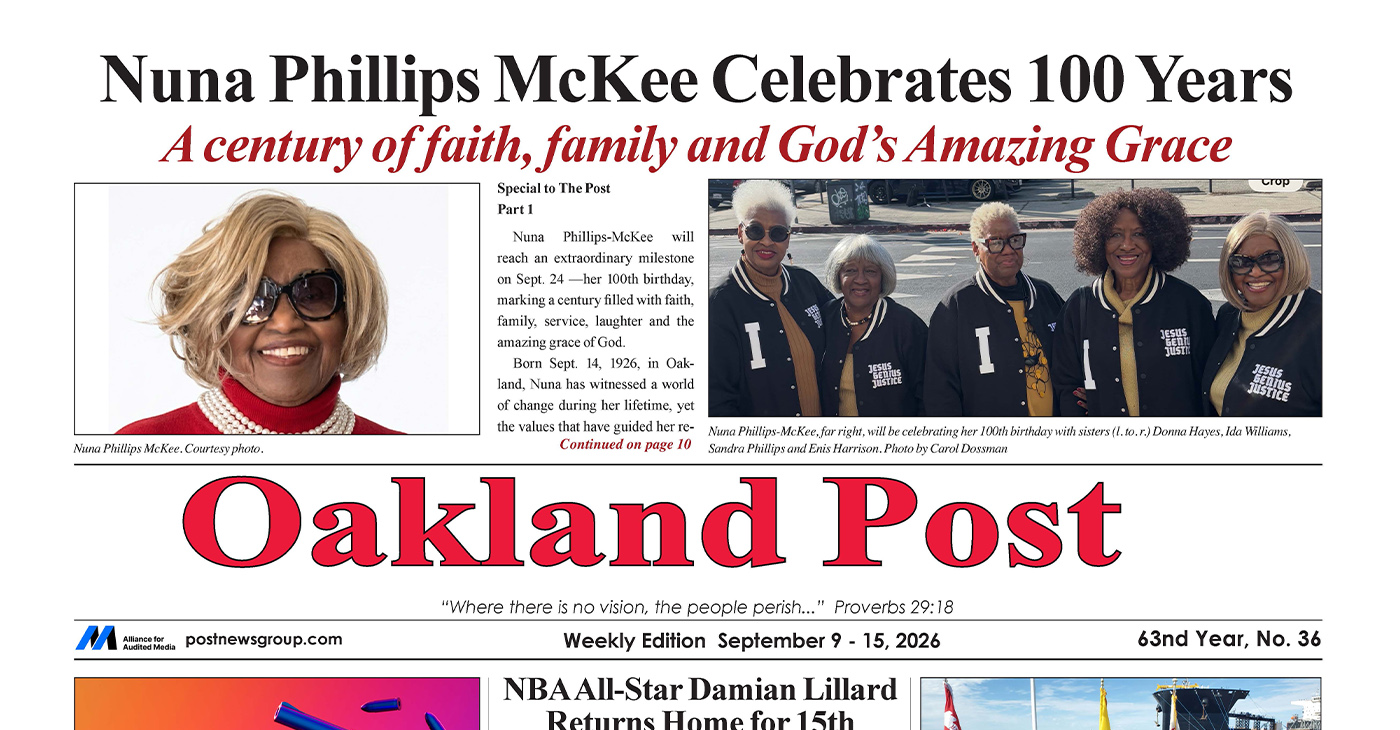
To enlarge your view of this issue, use the slider, magnifying glass icon or full page icon in the lower right corner of the browser window.



Asm. Corey Jackson Announces Launch of 24-Hour Childcare in His District

IN MEMORIAM: The Rev. Leon “Sonny” Clark, Longtime Orange County Pastor and Community Leader, Dies at 72

Poll: Becerra Widens His Lead Over Hilton; Californians Split on Wealth Tax

From Historic Memories to New Possibilities: Oakland Celebrates Coliseum 60

County Office of Education Says OUSD Finances Are Getting Healthier, Materially Stronger

LIVE FREE Sunday Dinner Brings Faith, Fellowship and Civic Conversation to Oakland

Remembering Chauncey Bailey as Student Journalists Face Threats to Truth-Telling

BLACspace Cooperative Invites Bay Area to Experience Oakland’s Black Cultural Ecosystem Through a BLAC Map Tour + Party

In Wake of Death on Doorstep, Williams Chapel Baptist Church Calls for Better Care, Funding for Unhoused

Oakland Centenarian Nuna McKee Honored!

Caribbean Nations Produce Action Plan Calling for UK Reparations Over Slavery

Oakland Post: Week of September 23 – 29, 2026

Doulas Are Helping Black California Moms Navigate Pregnancy–Even as High Mortality Rates Persist

Newsom Signs Addictive Social Media Law to Protect Kids

On Your November Ballot: Prop 38 Would Allocate $8.4 Billion to Immunology and Immunotherapy Funding

Less Affluent School Districts, Including Sacramento City, Face Threat of State Takeover

ESSAY: California Can Close Its Colorectal Cancer Gap

California Hispanic Chambers of Commerce Unveils: ‘Powering the Future’ Theme for 47th Annual Statewide Convention

Four Candidates, Including Incumbent Barbara Lee, Qualify for Oakland Mayor’s Race

Oakland Post: Week of August 12 – 18, 2026

From Blueprint to Breakthrough: Tackling Affordable Housing in Oakland

Oakland Observes Black August with Block Parties, Film Showings, Workshops

COMMENTARY: Why Local School Tax Measure G1 Will Not Be on the November Ballot

Standoff for Justice: Our Homes Are Worth Fighting For

Returning to Its Roots, the Oakland Black-Eyed Pea Festival Partners with the Freedom Farmers Market Sept. 12

Oakland Post: Week of August 26 – September 1, 2026

NPRC Scores First Advocacy Victory: David Shaw Finally Gets His Wish to ‘Go Home’

Frontier Airlines’ Return to Oakland Airport Brings Flights, Jobs and Opportunity

Gubernatorial Candidate Steve Hilton Blasts California New Tire Rules; Newsom Hits Back

Chef Sharon Lee Blends Culinary Excellence, Education and Empowerment

The Conversation With Al McFarlane 6/23/26

Media Monday 6/22/26

LIVE! ASK ALMA! — TUES. 6.23.26 7PM EST

Car Buying Secrets: 4 Hidden Checks Before You Sign!

Is This 550 HP Charger Worth YOUR Money? AutoNetwork Review

Celebrating Juneteenth – Frederick Douglass on education and resistance

LIVE! — ASK ALMA! — TUES. 6.19.26 7PM EST

Hyundai Ioniq 5 Parking, Safety, and 360 View #shorts

2025 Ioniq 5 New Wiper & Powerful Performance! #shorts

Electric SUV Range: Is 259 Miles Enough? #shorts

EV Charging: How Fast Can You Charge an Electric Vehicle? #shorts

Biometric Cooling… Messaging Seats…Come on! 2025 Infiniti QX80 Autograph 4WD

Charged Up: Witness the Magic of a Fully Electric Car! #shorts

Range Rover Sport PHEV Included…: See What’s Inside This Luxury SUV! #shorts

Invisible Hood View: Perfect Parking with X-Ray Vision! #shorts
-
 Commentary4 weeks ago
Standoff for Justice: Our Homes Are Worth Fighting For
-
 Activism4 weeks ago
Oakland Post: Week of August 26 – September 1, 2026
-
 Business4 weeks ago
Frontier Airlines’ Return to Oakland Airport Brings Flights, Jobs and Opportunity
-
 Business4 weeks ago
Gubernatorial Candidate Steve Hilton Blasts California New Tire Rules; Newsom Hits Back
-
 Business4 weeks ago
Chef Sharon Lee Blends Culinary Excellence, Education and Empowerment
-

 Community4 weeks ago
Big City Mayors Ask for “Yes” Vote on Housing Bond Measure; Conservatives Say “No”
-

 Black History4 weeks ago
Jackie Wright Champions Bay Area Stories, Filmmakers and Cultural Institutions
-

 Education4 weeks ago
Gov. Newsom’s Latest Appointees Include Sacramento Advocate for Formerly Incarcerated Students; State’s New Tech Chief
