
Activism
‘Life Over Rent’ Rally Speakers Urge Tenants to Organize, Prepare next Steps

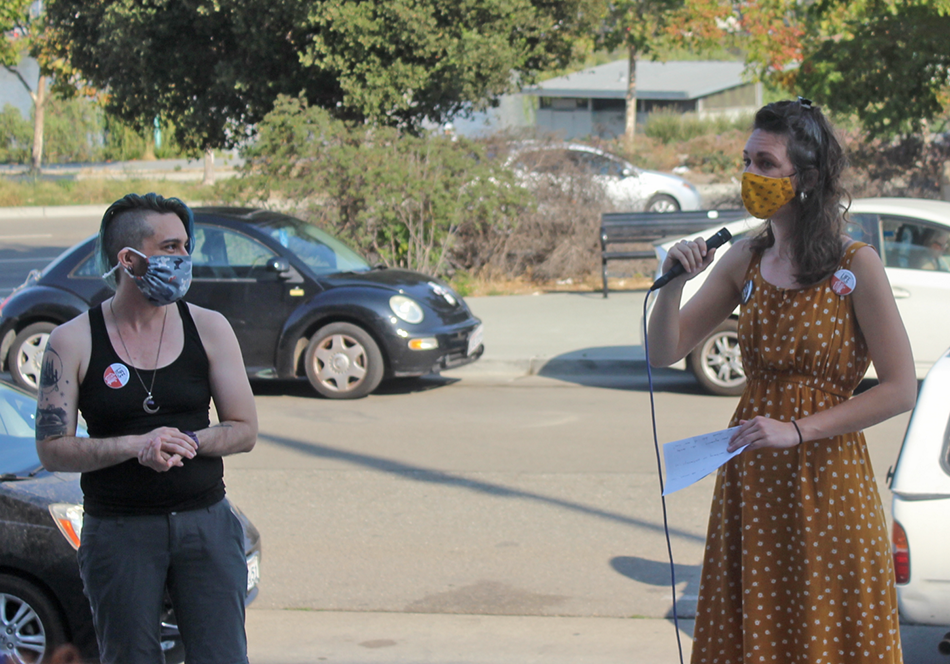
About 175 tenants gathered on the steps of Alameda County’s Superior Courthouse for a rally called Life Over Rent/Nuestrxs Vidas Si Renta No last Saturday.

A Facebook invitation for the rally claimed “Our needs come before our landlord’s profits” and showed that five different tenants’ unions organized the event: Tenants and Neighborhood Councils (TANC), SMC Tenants Council, Lonay Tenants Council, Village Residents Association at UC Berkeley Family Housing and JDW Tenants Union.
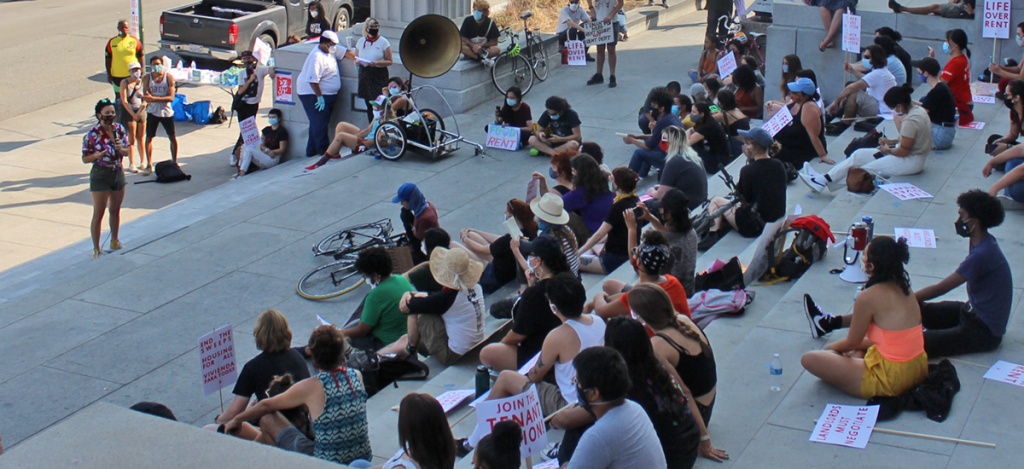
Jourdan Sales (far left) of JDW Tenants Union speaking to tenants at the Life Over Rent / Nuestrxs Vidas Si Renta No rally in front of the Alameda County Courthouse on September 5. Photo by Zack Haber
The invite also listed three goals: canceling rent during the pandemic, recognition and negotiation from landlords of collectively organized tenants, and prohibiting all evictions and expanding unemployment and food stamps for those hit hardest by the pandemic.
Although the day was hot with temperatures in the upper 80s and 90s, the courthouse provided shade where tenants sat in as they listened to about a dozen speakers representing different local grassroots tenant, labor, and housing justice groups.

A march was planned, but it was canceled as smoke increasingly blew into the area. Tenants held signs, mostly in red, some of which read “EVICTIONS = POLICE VIOLENCE,” “BLACK LIVES MATTER, BLACK TENANTS MATTER,” “HOMES FOR ALL, WE WON’T WAIT” and “LANDLORDS MUST NEGOTIATE.”
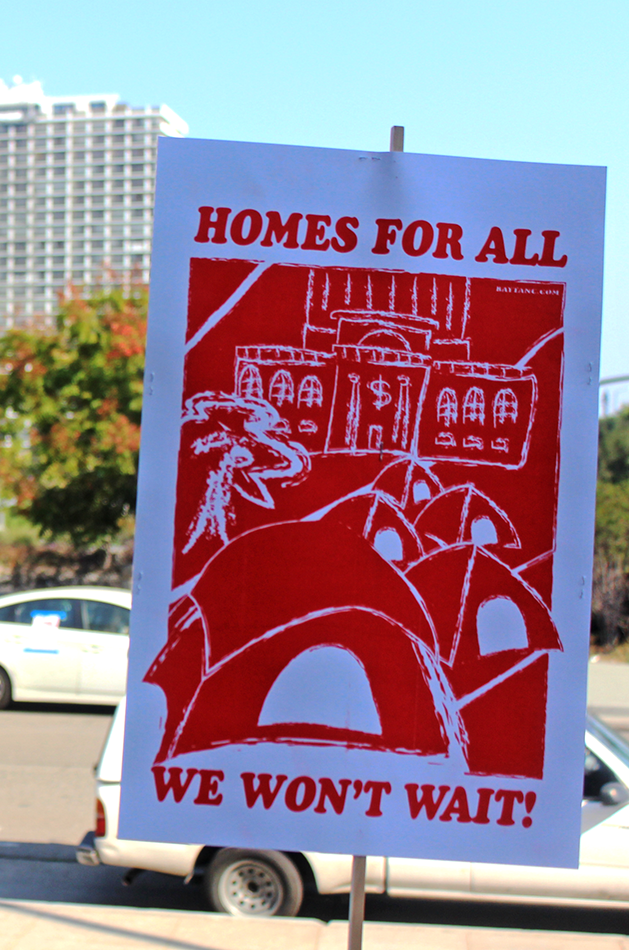
Photo by Zack Haber
Gerald Smith, a former Black Panther who’s currently a member of the Oscar Grant Organizing Committee spoke first and encouraged people to join in the fight to release people from San Quentin State Prison, where currently 26 people have died from COVID-19. Then Smith spoke of lessons he learned participating in The Harlem Rent Strikes in the mid-1960s and highlighted the importance of organized leadership and planning beyond small wins against landlords. After some landlords abandoned buildings during the Harlem strike, Smith said many renters weren’t organized or prepared on how to respond.
“We figured if you beat them, things are going to be all right,” Smith said. “But it’s not going to be all right. As long as capitalism exists it’s not going to be all right. You have to prepare people for the next step.”
Judy Greenspan, a local teacher and member of the Oakland Education Association spoke next and pointed out that COVID-19 could cause massive privatization of schools in addition to evictions if people do not organize well.
ILWU Local 34 president Keith Shanklin spoke against the Howard Terminal Project, which plans to place an Oakland A’s ballpark and market-rate condos in The Port of Oakland, and said it would destroy union longshoreman jobs.
Members of several local tenants’ unions including JDW Tenants Union, SMC Tenants Council and Alice Street Dunsmuir Tenant Union spoke of the need to connect and organize with other tenants, particularly ones who rent from the same landlord.
Jourdan Sales of JDW Tenants Union said her landlord, Justin Douglas Wallway, found a loophole he tried to use to remove rent control from more than 30 of the households he rented to in 2017. But through tenants organizing and collaborating with Centro Legal De La Raza, they were able to close the loophole.
“We actually changed housing legislation,” they said. “This battle took two years before it was won. This isn’t something that’s going to happen overnight. These things that we want to take time.”
Kieryn Darkwater and Casey Busher of Alice Street Dunsmuir Tenant Union spoke of how they have fought to stop their landlord from charging them for utilities they claim they are not legally obligated to pay. As their fight has been hung up in the Rent Adjustment Program and court, they have expanded and worked with the Ivy Hills Tenant Union.
Their landlord has refused to negotiate with them. Together, both groups have 25 units currently on rent strike. They’ve also started meeting regularly and have a bulletin board in their shared laundry room where they lend out tools and help each other with pet sitting.
“We have become our landlord’s worst nightmare,” said Darkwater.
Dayton Andrews of The United Front Against Displacement spoke of unifying unhoused and housed people together, dismantling distinctions between different struggles including housing, immigration, and queer rights.
“We have to come together as a class to oppose the enemies of the people,” said Andrews.








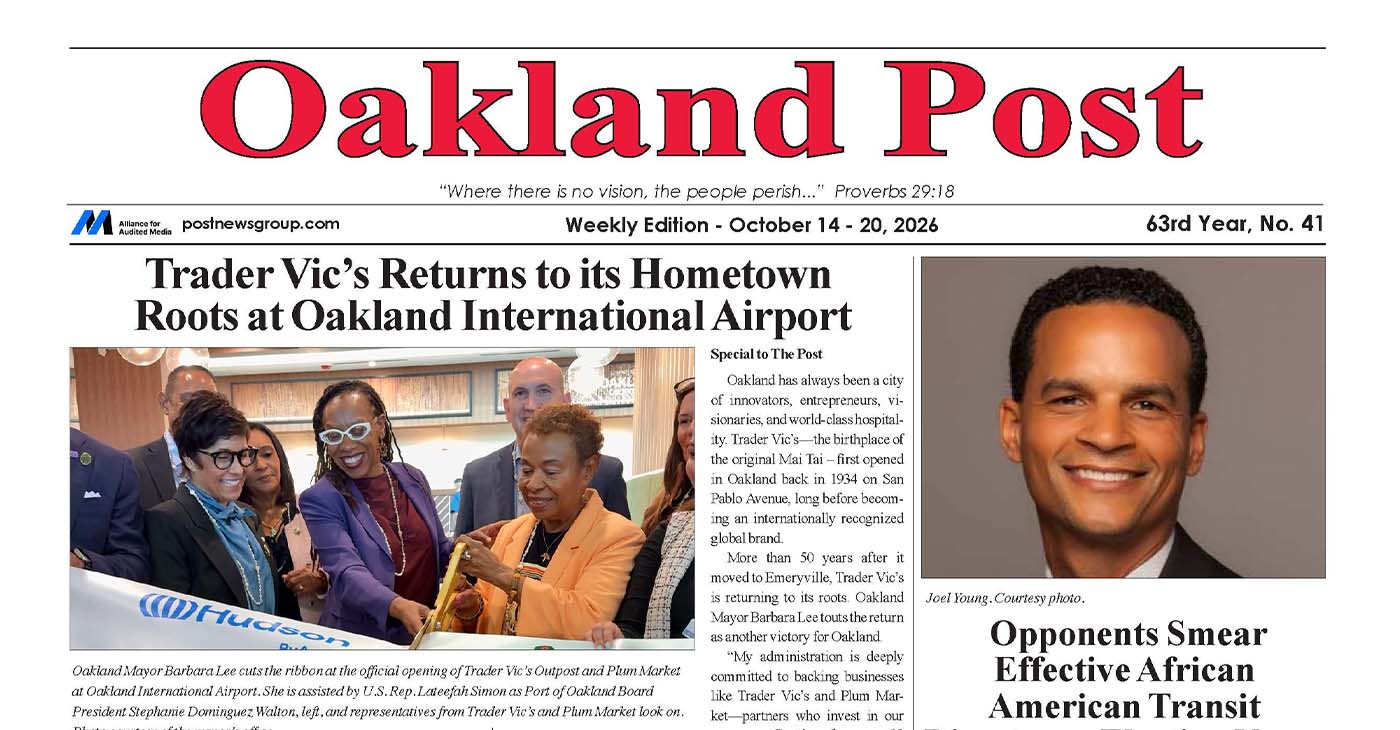
To enlarge your view of this issue, use the slider, magnifying glass icon or full page icon in the lower right corner of the browser window.

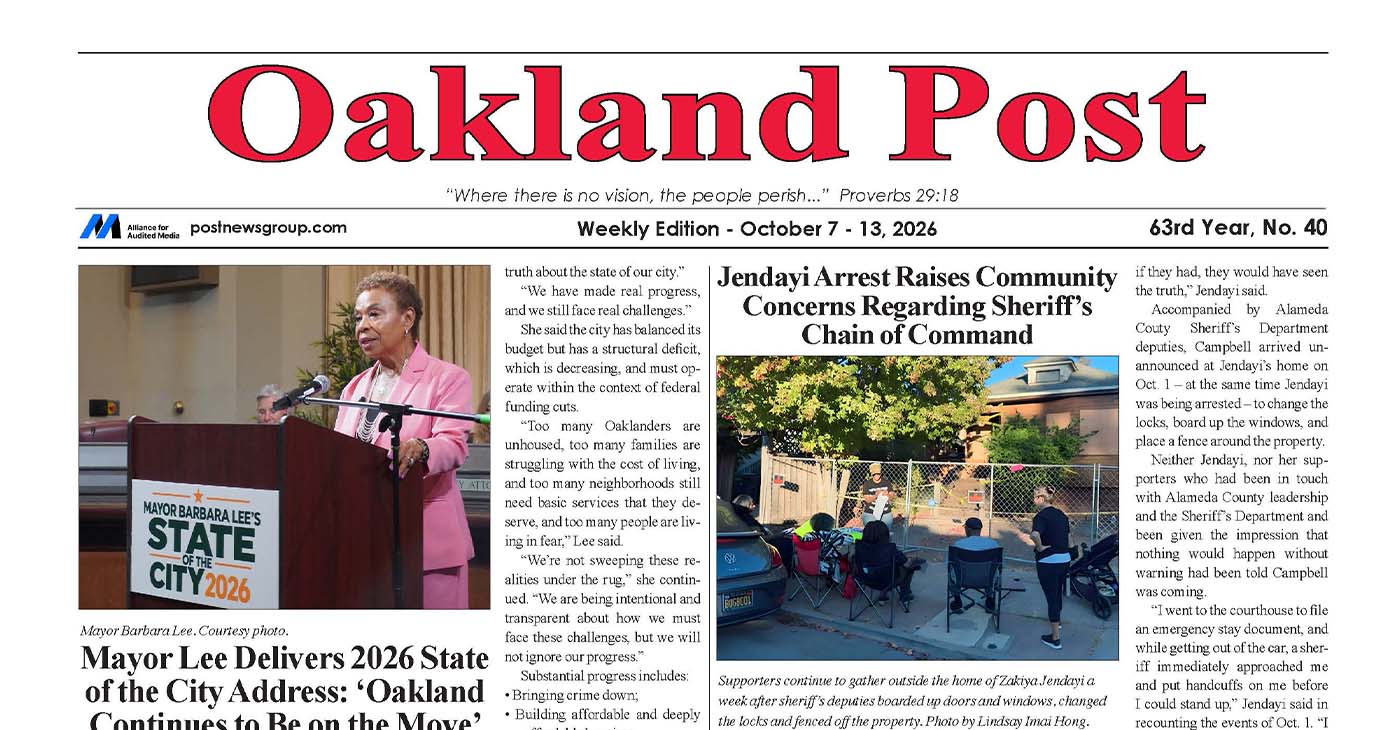
To enlarge your view of this issue, use the slider, magnifying glass icon or full page icon in the lower right corner of the browser window.
Activism
Oakland Post: Week of September 30 – October 6, 2026
The printed Weekly Edition of the Oakland Post: Week of September 30 – October 6, 2026

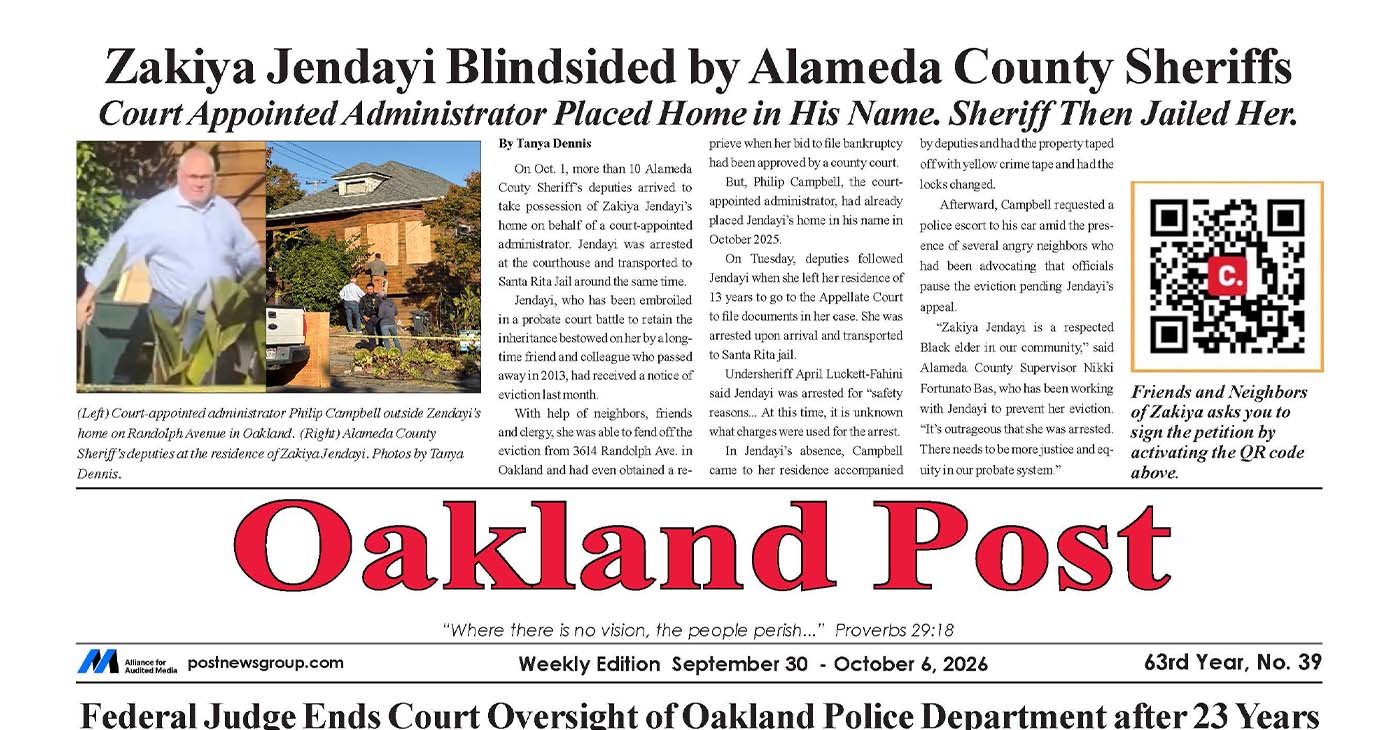
To enlarge your view of this issue, use the slider, magnifying glass icon or full page icon in the lower right corner of the browser window.


Mayor Barbara Lee Holds Special State of the City Address in Deep East Oakland

Practitioners of African Traditional Spirituality Offer Ancestral Reverence Ritual Oct. 31

It’s Time to Lose Weight Before the Holidays

Trader Vic’s Returns to Its Oakland Roots

Oakland Coal Terminal Backed by Trump Would Be Bigger, Dirtier Than Promised, Says Report

Opponents Smear Effective African American Transit Director as Election Nears

Oakland Post: Week of October 14 – 20, 2026

OP-ED: The Black Church Writes AI’s Next Chapter

OP-ED: The Black Church Writes AI’s Next Chapter

WCCUSD Joins Statewide Organic School Food Purchasing Cooperative

Democrats, Community Groups Back Measure EE to Change How Oakland Is Governed

Four Tips to Help You Plan a Holiday “Staycation”

Veterans Housing Project Proposed for South Richmond
PRESS ROOM: Transformative Justice Coalition 2026 Voting Rights Champion Awards Reception ‘Yesterday Is Today: The Battle For Voting Rights

Mayor Lee Delivers 2026 State of the City Address: ‘Oakland Continues to Be on the Move’

Misnamed ‘Parent’ PAC Seeks to Influence Oakland School Board Elections

Poll: Becerra Widens His Lead Over Hilton; Californians Split on Wealth Tax

Listening as a Lifeline: A Doula’s Witness to Black Maternal Health

Oakland Post: Week of September 9 – 15, 2026

County Office of Education Says OUSD Finances Are Getting Healthier, Materially Stronger

Richmond Tiny House Village Farm & Garden Set to Open Gates on Sept. 26

Mayor Lee Announces $1 Million Kaiser Permanente Grant for Pilot Program to Address Homelessness, Clean Up Public Spaces throughout Oakland

Latest Massacre in Haiti Reveals Cruelty U.S. Deportations

Zakiya Jendayi Arrested, Locked Out of Home by Sheriff’s Deputies

OPINION: Nolan Wells’ Death One of Several Signifying Racial Terror Lives on in U.S. South

BLACspace Cooperative Invites Bay Area to Experience Oakland’s Black Cultural Ecosystem Through a BLAC Map Tour + Party

Doulas Are Helping Black California Moms Navigate Pregnancy–Even as High Mortality Rates Persist

Oakland Post: Week of September 16 – 22, 2026

Oakland People’s Arms Embargo Coalition Demands End to Military Shipments Thru Oakland

Democratic Clubs Interview Candidates for Oakland School Board

The Conversation With Al McFarlane 6/23/26

Media Monday 6/22/26

LIVE! ASK ALMA! — TUES. 6.23.26 7PM EST

Car Buying Secrets: 4 Hidden Checks Before You Sign!

Is This 550 HP Charger Worth YOUR Money? AutoNetwork Review

Celebrating Juneteenth – Frederick Douglass on education and resistance

LIVE! — ASK ALMA! — TUES. 6.19.26 7PM EST

Hyundai Ioniq 5 Parking, Safety, and 360 View #shorts

2025 Ioniq 5 New Wiper & Powerful Performance! #shorts

Electric SUV Range: Is 259 Miles Enough? #shorts

EV Charging: How Fast Can You Charge an Electric Vehicle? #shorts

Biometric Cooling… Messaging Seats…Come on! 2025 Infiniti QX80 Autograph 4WD

Charged Up: Witness the Magic of a Fully Electric Car! #shorts

Range Rover Sport PHEV Included…: See What’s Inside This Luxury SUV! #shorts

Invisible Hood View: Perfect Parking with X-Ray Vision! #shorts
-
 Economy4 weeks ago
Poll: Becerra Widens His Lead Over Hilton; Californians Split on Wealth Tax
-
 Black History3 weeks ago
Listening as a Lifeline: A Doula’s Witness to Black Maternal Health
-
 Business4 weeks ago
County Office of Education Says OUSD Finances Are Getting Healthier, Materially Stronger
-
 Lead Story3 weeks ago
Zakiya Jendayi Arrested, Locked Out of Home by Sheriff’s Deputies
-
 Art4 weeks ago
BLACspace Cooperative Invites Bay Area to Experience Oakland’s Black Cultural Ecosystem Through a BLAC Map Tour + Party
-
 Black History4 weeks ago
Doulas Are Helping Black California Moms Navigate Pregnancy–Even as High Mortality Rates Persist
-

 Business4 weeks ago
From Historic Memories to New Possibilities: Oakland Celebrates Coliseum 60
-
 Community4 weeks ago
Asm. Corey Jackson Announces Launch of 24-Hour Childcare in His District
