
Uncategorized
Library, Sheriff Unlock Literary Choices at Jail

Ideas and collaboration lead to expansion and new catalog
Inmates at the Marin County Jail have had access to a modest selection of books for many years. What was missing was a catalog or database to show the incarcerated patrons what else was available if it wasn’t on the shelves.
A collaboration between employees of the Marin County Sheriff’s Office and the Marin County Free Library (MCFL) recently solved the situation, and it’s a page-turner of a story to tell.
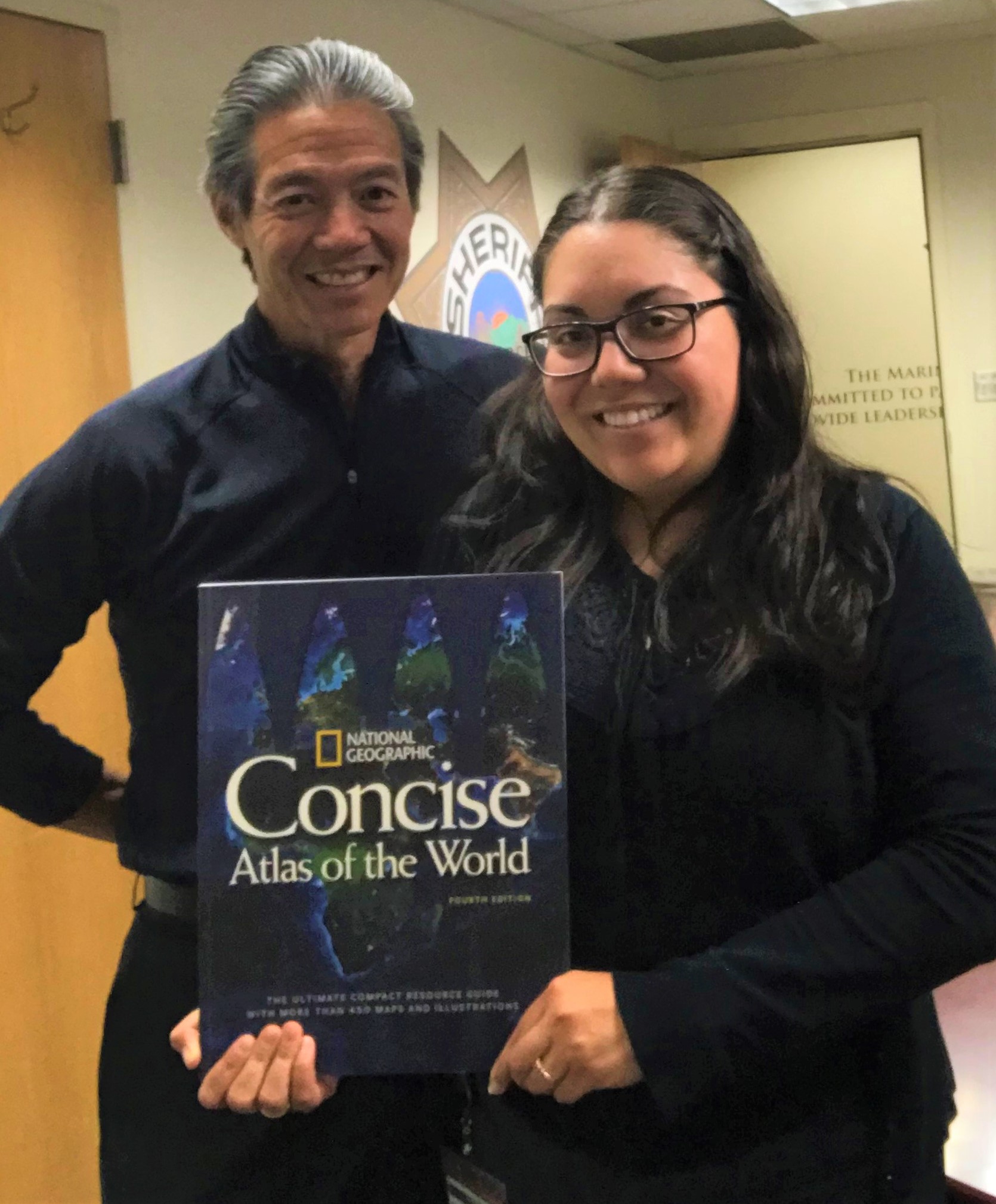
America Velasco, a program coordinator for the Sheriff’s Custody Division team who was hired in November 2018, was eager to improve the selection of materials and create a catalog for the inmates. There were about 2,000 books and a selection of educational DVDs within the jail. With a few ideas in mind, she first talked with Custody Division Reentry Sgt. Michael Dobbins. With his encouragement, Velasco walked up to the information desk at the Civic Center library branch one day in January 2019.
“There are inmates in our custody who escape their reality by reading books, and I wanted to provide them with books from various genres to choose from,” Velasco said. “It’s important for me to know what type of books we have and how many available copies we have to better assist the inmates, so a catalog was needed.”

Elmer Jan, one of the branch’s librarians, remembers the first exchange with Velasco. They both realized it was going to be a tedious and extensive project to catalog each item.
“I expressed an interest in working with America to explore what projects we could address together and so began researching how other public libraries provide service to county jails,” he said.
“I was surprised by their excitement, but I was excited to have Elmer and the rest of his peers on board,” Velasco said.
Jan’s research connected him to the San Francisco Public Library Jail and Reentry Services division staffed by library program manager Rachel Kinnon and librarian Jeanie Austin, who generously shared their resources and experiences.
In May, Jan started visiting the jail on Monday mornings to spend two hours organizing the library materials into genres. He is creating a survey to find out what type of books the inmates would like to read, and Velasco is proactively “weeding” books in poor shape from the jail archive and has initiated a subscription to the Libib cataloging website. MCFL has begun donating new books in direct response to specific inmate requests.
What’s popular? Books on World War II, astronomy, other nonfiction, historical fiction and works by author James Patterson.
“With the library taking patron requests and our response to those requests with Sara Jones’ support, I feel extremely gratified that we have begun providing library service to an underserved population,” said Jan, who is in his 19th year working for MCFL.
At the jail, Velasco normally oversees educational programs, religious services, community resources presentations, training programs and the volunteer program. She evaluates program effectiveness and creates and maintains the program scheduling in all the housing units. With that much interaction with inmates, she already knows the library upgrades are being received well.
“Once we explain to the inmates that we are creating a library catalog and expanding the selection, they are excited about having access to more books than the ones in their housing unit,” she said.
MCFL Director Sara Jones said the departmental collaboration with the Sheriff’s Office represents the County’s commitment to equity measures. “It demonstrates how we can tailor services to create access to information and provide reading materials to those who have limited options,” she said. “It’s rewarding whenever we use the skills of library staff to meet our mission for inclusion for all people in Marin.”
To learn more about supporting the jail library, call (415) 473-3203. The nonprofit Friends of the Marin County Free Library supports many other MCFL programs.


Uncategorized
Ask California: Golden State Releases New AI Chatbot
Gov. Gavin Newsom introduced the prototype as part of the state’s broader effort to use artificial intelligence to make government services easier to access. The launch follows his March 2026 executive order directing state agencies to responsibly implement generative AI while protecting privacy, security and civil liberties.


California has launched AskCA, a new artificial intelligence-powered chatbot designed to help residents find and navigate state and local government services through a single online platform.
Developed by the state’s Office of Data and Innovation, AskCA is designed around major life events rather than individual government agencies. Californians can use the tool to find information about finding a job, starting a business, accessing family services and recovering from disasters.
Gov. Gavin Newsom introduced the prototype as part of the state’s broader effort to use artificial intelligence to make government services easier to access. The launch follows his March 2026 executive order directing state agencies to responsibly implement generative AI while protecting privacy, security and civil liberties.
“When a Californian needs help, they shouldn’t have to become an expert in government to find it,” said Newsom. “We’re using the best technology California has to offer to make the government more efficient, effective, and more engaged.”
The state is now seeking Californians age 18 and older to participate in the pilot and help test and refine AskCA’s responses. Officials said subject matter experts across state governments are helping inform the chatbot’s answers, which are designed to draw from verified government sources and provide actionable information.
The prototype grew out of California’s response to the January 2025 Los Angeles wildfires. Early testing included more than 140 fire recovery leaders and Altadena wildfire survivors, a dozen job seekers and more than 100 general users.
Jeffery Marino, director of the Office of Data and Innovation, said the tool is intended to remove the need for residents to understand how government agencies are organized before they can get help.
“Californians should not have to understand how the government is organized just to get basic help,” Marino said.
AskCA’s technology will also be used in a new job-skills matching feature that the California Department of Human Resources plans to launch Sept. 30 on CalCareers. Job seekers will be able to upload a resume and receive potential matches to state job classifications.
The state said the CalCareers pilot will not store personal information or require users to have a CalCareers account. California plans to continue testing AskCA as officials evaluate its accuracy, performance and usefulness before expanding the system.

Uncategorized
Oakland People’s Arms Embargo Coalition Demands End to Military Shipments Thru Oakland
Backing the demand for an arms embargo are 150 local businesses and over 300 local organizations, including the faith community as well as more than 20 labor unions and the Alameda Labor Council, which unanimously endorsed the campaign.
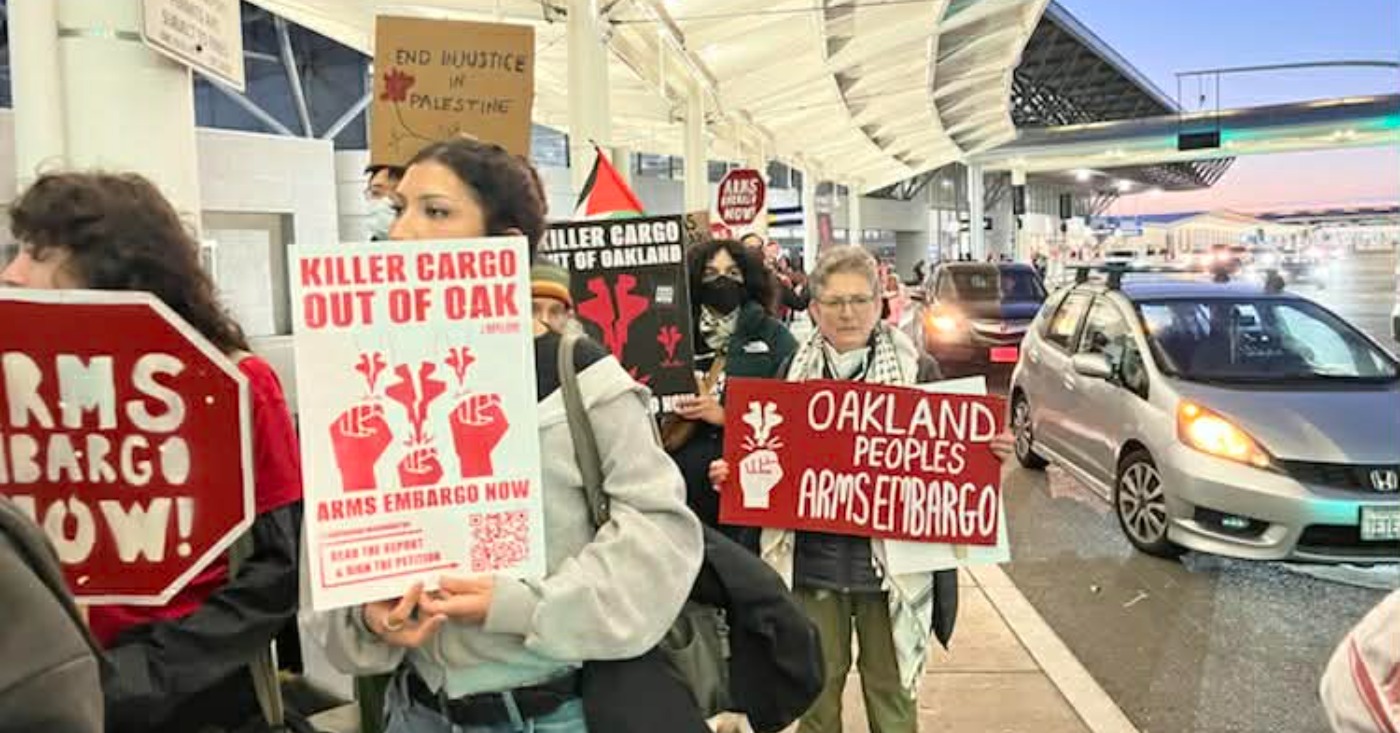
A growing coalition, the Oakland People’s Arms Embargo, has gained broad support in the Bay Area as it organizes to demand to end FedEx shipments of military equipment to Israel through the Oakland International Airport (OAK).
Especially significant, according to the coalition, is the delivery of military hardware to Israel for the U.S. F-35 fighter jet, which has been used to drop 2,000-pound bombs on civilians in Gaza, Lebanon, and Iran.
In an interview with the Oakland Post, Rami Abdelkarim, a spokesperson for the Oakland People’s Arms Embargo and a member of the Bay Area chapter of the Palestinian Youth Movement (PYM), discussed the goals and the organizing work of the coalition, which has expanded rapidly since it began in August 2025.
Besides, PYM, other groups involved in organizing the coalition are the Arab Resource and Organizing Center (AROC), and the U.S. Palestinian Community Network.
Backing the demand for an arms embargo are 150 local businesses and over 300 local organizations, including the faith community as well as more than 20 labor unions and the Alameda Labor Council, which unanimously endorsed the campaign.

Support for the demand has also come from Oakland Mayor Barbara Lee and U.S. Rep. Lateefah Simon, and Alameda County Supervisor Nikki Fortunato Bas.
Abdelkarim said the coalition has been tracking “how our roads, our airports, and our infrastructure are being used to facilitate the Israeli military’s genocidal campaign against the Palestinian people, and not just the Palestinian people, but also in Lebanon and Iran.”
“We were able to uncover what is Oakland’s complicity in this genocide, and what it looks like for our tax dollars to serve the Israeli military,” he said.
The coalition’s findings were published in a 15-page report on the website of the Oakland People’s Arms Embargo (armsembargonow.com), titled “Exposing Oakland Airport’s Military Cargo Shipments to Israel.”
“Since January 2025, at least 280 military cargo shipments to Israel have been identified departing from OAK, with Nevatim Airbase being the primary final destination,” the report said.
The shipments have occurred multiple times per week for nearly the whole year, “including F-35 fighter jet components used to carry and release munitions, guide weapons, power surveillance and targeting systems, and support critical flight operations—all essential to sustaining the combat readiness of Israel’s Air Force,” according to the report.
“The frequency of these shipments, particularly when compared to other U.S. airports, positions OAK as one of the few consistently active logistical nodes in the U.S. military supply chain to Nevatim Airbase (in Israel),” the report said.
According to the report, a sample of 500 shipments to Israel transported through FedEx’s Global Superhub in Memphis, Tennessee, between April and June 2025, OAK was the second-most frequent transit point nationwide, after Fort Worth, Texas.
Among the items that were shipped were “bomb release units, weapons bay adapters, surveillance sensors, and flight-critical electronics … “the mechanisms that enable the F-35 to fly its bombing missions and to identify, target, and strike with lethal accuracy.”
These components were supplied or contracted through Lockheed Martin and “have been used extensively by the Israeli Air Force in bombing campaigns in Gaza, including the airstrike on Al-Mawasi in July 2024, during which Israel dropped three 2,000-pound bombs on a designated humanitarian safe zone—killing at least 90 people.”
In a section of the report on the F‑35 Lightning II fighter jet, the airplane is described as “a highly advanced combat aircraft utilized in Israel’s bombardment of Palestinians in Gaza.”
“The F‑35 can carry up to 18,000 pounds of munitions—including 2,000-pound ‘bunker buster’ bombs—and uses advanced sensor systems to identify targets, guide bombs, and conduct precision attacks,” the report said.
“These shipments typically arrive at OAK’s FedEx cargo facility between Monday and Friday and are consolidated into outbound freight flights routed through hubs in other states. The flights identified in the report “used for these transfers are civilian-operated cargo planes, not military aircraft. While they do not carry passengers, these FedEx Express flights operate out of a commercial airport shared with public air traffic, serving the broader Bay Area.”
“This means that military cargo destined for the Israeli Air Force is routinely shipped through infrastructure embedded in densely populated civilian areas,” with data showing that “shipments departed OAK on multiple days every week.”
FedEx has strongly denied allegations that it transports military supplies.
A FedEx spokesperson stated, “FedEx is committed to complying with applicable laws and regulations. We do not ship weapons or ammunition internationally and have put in place strict screening procedures to prevent such shipments.”
International Amnesty International and European civil society groups have filed a criminal complaint against FedEx Belgium, alleging the unauthorized transit of F-35 fight jet parts without required regional licenses. Further, the Jewish anti-Zionist group France Action has filed a genocide claim against FedEx in France over cargo transporting through Paris.
In a statement released in February, Mayor Lee said, “As you know, for decades, I have been opposed to the use of public property to militarize arms shipments, federal immigration enforcement, and public safety, whether it is in Oakland or anywhere else,” she said. “Thus, I share your concerns about weapons and military cargo being shipped through the Oakland International Airport.”
Congresswoman Simon in September 2025, announced she is supporting a federal bill, the “Block the Bombs Act,” to withhold the transfer of offensive weapons to Israel and demanding Israel’s compliance with U.S. and international law.
“I come to Congress from a lineage of folks who know that war does not make us stronger, from a lineage of Ron Dellums and Barbara Lee, who were very clear that we as a nation cannot kill and slaughter our way to peace, that we cannot fund the machinery of death, and that safety is found in care – and not conquest.”
Uncategorized
NBA All-Star Damian Lillard Returns Home for 15th Annual Backpack Giveaway
OAKLAND POST — “I know what it is to grow up here and be here in Oakland,” shared Lillard. “I do feel like it’s my responsibility to be present and supportive and be a resource and be an example for the kids and right now as somebody from Oakland that’s well positioned, with a big platform, I’m always trying to find ways to use that platform and serve our youth and community.”
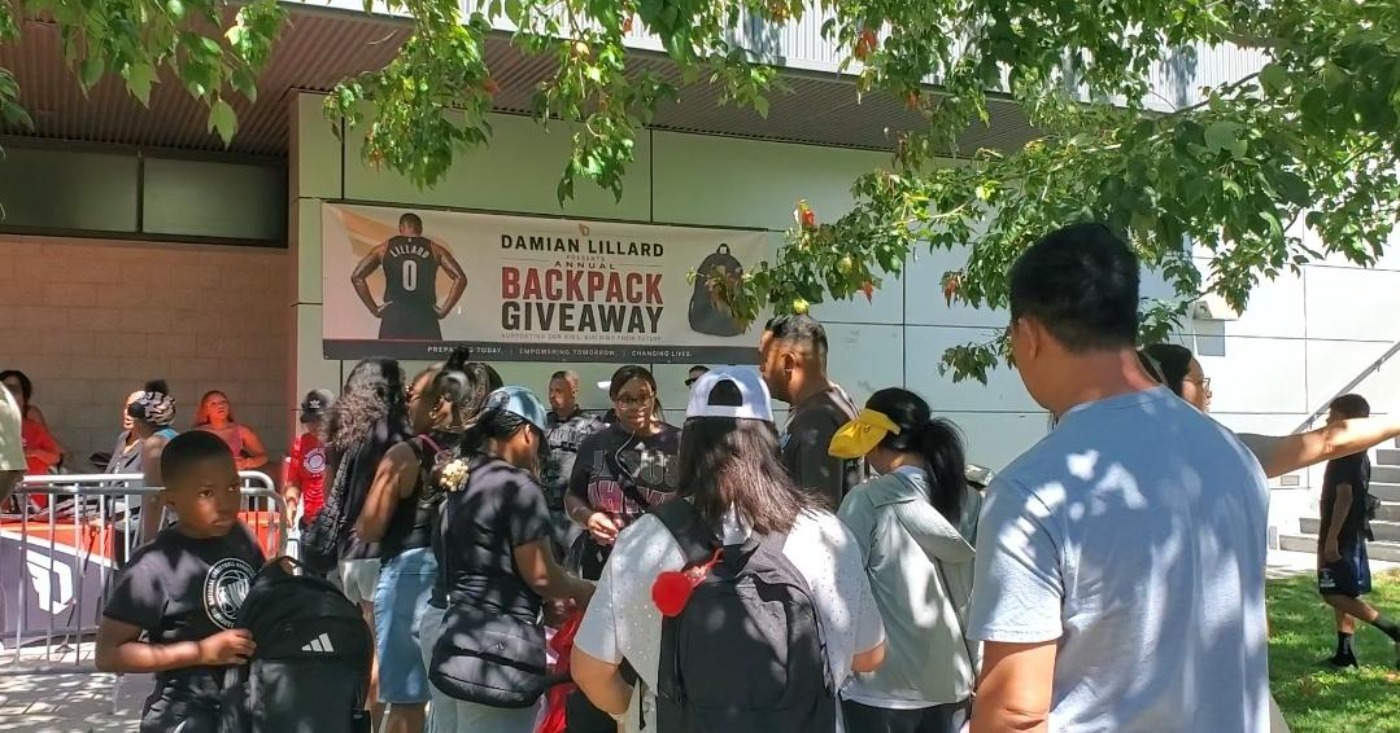
Music, food trucks, bouncers, and rock climbing turned Ira Jinkins Park into a neighborhood block party on Saturday, Sept. 5, as nine-time NBA All-Star Damian Lillard hosted his 15th annual back-to-school backpack giveaway in Deep East Oakland.
The Portland Trail Blazers point guard, an Oakland High School alum, returned to the recreation center where he trained as a kid and distributed backpacks stuffed with school supplies to nearly 400 children. Lillard was joined by family, friends, and former Oakland City Councilmember Desley Brooks in an event that has become a fixture of the neighborhood.
“I know what it is to grow up here and be here in Oakland,” shared Lillard. “I do feel like it’s my responsibility to be present and supportive and be a resource and be an example for the kids and right now as somebody from Oakland that’s well positioned, with a big platform, I’m always trying to find ways to use that platform and serve our youth and community.”

While watching children play inflatable basketball and roll a giant beach ball on the grass, Lillard took in the scene.
“Doing something positive makes me feel great,” said Lillard. “I remember attending cookouts like this as a child and it was always a lot of fun. It feels great to not only show youth a great time, but to be of service to them.”
Beyond the giveaway, Lillard is funding renovations to the Ira Jinkins Recreation Center, including major upgrades to its basketball courts, the same courts he once used daily before heading to play recreation league games across town. Last Christmas, he provided gifts to more than 400 local families.
Sports agent Aaron Goodwin, who has represented Lillard throughout his career, described the tradition as core to who Lillard is: someone who consistently looks for ways to give back, uses his platform to inspire youth, and treats events like this as more than a handout, but a chance to be a genuine resource and example for kids from his hometown.
“That’s who Damian is,” said Goodwin. “He always wants to give back. He does this every summer, and he also has an annual Christmas giveaway. He wants to inspire youth that they too can achieve.”
Lillard grew up traveling to the Ira Jinkins Center to train before playing at Rainbow Recreation Center, and he went on to star at Oakland High before his college and NBA career took off.
Lillard who has built a life legacy hosted the event within a center carrying its own historical weight.
The facility is named for Ira Jinkins, a civil rights organizer who helped lead West Coast marches honoring Martin Luther King Jr. and pushed for the creation of the MLK Regional Shoreline Park.
Its building sits within the William “Bill” Patterson Park complex, beside the East Oakland Sports Center that opened in 2011. Patterson was known for his civic impact and work with EBMUD East Bay Municipal Utility District, Merritt College, and the NAACP, among other organizations. A film on Patterson’s life debuted at the Oakland International Film Festival this week.
Last year, before the NBA All-Star Weekend in the Bay Area, the City of Oakland dedicated a court at the center in Lillard’s honor, and Lillard launched a $25,000-per-year scholarship with Portland State University for high school students across nine East Bay schools. He also sponsors camps and other programming throughout the nation.
Lillard sat out of the 2025-2026 NBA season due to an Achilles tendon injury incurred as a Milwaukee Buck. The year of healing will allow him to return to the Portland Trail Blazers.
“This is a great event,” said Shawn, watching his grandchild enjoying the activities. “I’ve been to every single one of them (backpack giveaways); I’ve been knowing Dame (Damian) since he was 8 years old. You don’t have many people that give back the way Damian does. There’s no better guy to do this. His whole family is awesome from the top down.”
For Lillard, the annual tradition, held in memory of his late grandfather, Albert Johnson, remains a way of reinvesting in the community that shaped him.



Asm. Corey Jackson Announces Launch of 24-Hour Childcare in His District

IN MEMORIAM: The Rev. Leon “Sonny” Clark, Longtime Orange County Pastor and Community Leader, Dies at 72

Poll: Becerra Widens His Lead Over Hilton; Californians Split on Wealth Tax

From Historic Memories to New Possibilities: Oakland Celebrates Coliseum 60

County Office of Education Says OUSD Finances Are Getting Healthier, Materially Stronger

LIVE FREE Sunday Dinner Brings Faith, Fellowship and Civic Conversation to Oakland

Remembering Chauncey Bailey as Student Journalists Face Threats to Truth-Telling

BLACspace Cooperative Invites Bay Area to Experience Oakland’s Black Cultural Ecosystem Through a BLAC Map Tour + Party

In Wake of Death on Doorstep, Williams Chapel Baptist Church Calls for Better Care, Funding for Unhoused

Oakland Centenarian Nuna McKee Honored!

Caribbean Nations Produce Action Plan Calling for UK Reparations Over Slavery

Oakland Post: Week of September 23 – 29, 2026

Doulas Are Helping Black California Moms Navigate Pregnancy–Even as High Mortality Rates Persist

Newsom Signs Addictive Social Media Law to Protect Kids

On Your November Ballot: Prop 38 Would Allocate $8.4 Billion to Immunology and Immunotherapy Funding

Less Affluent School Districts, Including Sacramento City, Face Threat of State Takeover

ESSAY: California Can Close Its Colorectal Cancer Gap

California Hispanic Chambers of Commerce Unveils: ‘Powering the Future’ Theme for 47th Annual Statewide Convention

Four Candidates, Including Incumbent Barbara Lee, Qualify for Oakland Mayor’s Race

Oakland Post: Week of August 12 – 18, 2026

From Blueprint to Breakthrough: Tackling Affordable Housing in Oakland

Oakland Observes Black August with Block Parties, Film Showings, Workshops

COMMENTARY: Why Local School Tax Measure G1 Will Not Be on the November Ballot

Standoff for Justice: Our Homes Are Worth Fighting For

Returning to Its Roots, the Oakland Black-Eyed Pea Festival Partners with the Freedom Farmers Market Sept. 12

Oakland Post: Week of August 26 – September 1, 2026

NPRC Scores First Advocacy Victory: David Shaw Finally Gets His Wish to ‘Go Home’

Frontier Airlines’ Return to Oakland Airport Brings Flights, Jobs and Opportunity

Gubernatorial Candidate Steve Hilton Blasts California New Tire Rules; Newsom Hits Back

Chef Sharon Lee Blends Culinary Excellence, Education and Empowerment

The Conversation With Al McFarlane 6/23/26

Media Monday 6/22/26

LIVE! ASK ALMA! — TUES. 6.23.26 7PM EST

Car Buying Secrets: 4 Hidden Checks Before You Sign!

Is This 550 HP Charger Worth YOUR Money? AutoNetwork Review

Celebrating Juneteenth – Frederick Douglass on education and resistance

LIVE! — ASK ALMA! — TUES. 6.19.26 7PM EST

Hyundai Ioniq 5 Parking, Safety, and 360 View #shorts

2025 Ioniq 5 New Wiper & Powerful Performance! #shorts

Electric SUV Range: Is 259 Miles Enough? #shorts

EV Charging: How Fast Can You Charge an Electric Vehicle? #shorts

Biometric Cooling… Messaging Seats…Come on! 2025 Infiniti QX80 Autograph 4WD

Charged Up: Witness the Magic of a Fully Electric Car! #shorts

Range Rover Sport PHEV Included…: See What’s Inside This Luxury SUV! #shorts

Invisible Hood View: Perfect Parking with X-Ray Vision! #shorts
-
 Commentary4 weeks ago
Standoff for Justice: Our Homes Are Worth Fighting For
-
 Activism4 weeks ago
Oakland Post: Week of August 26 – September 1, 2026
-
 Business4 weeks ago
Frontier Airlines’ Return to Oakland Airport Brings Flights, Jobs and Opportunity
-
 Business4 weeks ago
Gubernatorial Candidate Steve Hilton Blasts California New Tire Rules; Newsom Hits Back
-
 Business4 weeks ago
Chef Sharon Lee Blends Culinary Excellence, Education and Empowerment
-

 Community4 weeks ago
Big City Mayors Ask for “Yes” Vote on Housing Bond Measure; Conservatives Say “No”
-

 Black History4 weeks ago
Jackie Wright Champions Bay Area Stories, Filmmakers and Cultural Institutions
-

 Education4 weeks ago
Gov. Newsom’s Latest Appointees Include Sacramento Advocate for Formerly Incarcerated Students; State’s New Tech Chief
