
#NNPA BlackPress
In the Classroom: How Educators are Teaching Thanksgiving Lessons to the Next Generation
THE AFRO — In real life, the situation was anything but a celebration. According to Holocaust Museum Houston, “when European settlers arrived in the Americas, historians estimate there were over 10 million Native Americans living there. By 1900, their estimated population was under 300,000. Native Americans were subjected to many different forms of violence, all with the intention of destroying the community.”


By DaQuan Lawrence | AFRO International Writer
DLawrence@afro.com
On Nov. 28 the Thanksgiving holiday will arrive, complete with family gatherings, community events and opportunities to give back and be grateful. While conversations about the origin of Thanksgiving and the purpose of the holiday remain suspended between myth and fact-based reality, educators in the state of Maryland grapple each year with how the holiday is addressed in the educational setting.
According to Brittanica, “Thanksgiving is modeled on a 1621 harvest feast shared by the English colonists (Pilgrims) of Plymouth and the Wampanoag people.”
While millions of American citizens use the holiday as the opener to a season of gratitude, for others the holiday is overshadowed by the death and destruction experienced by Native Americans at the hands of Europeans as colonization spread.
According to Dr. Kelli Mosteller, who serves as Citizen Potawatomi Nation’s Cultural Heritage Center director, the holiday “disregards against Native Americans and chooses to take…one tiny snapshot.”
“The world of social media puts pretty filters on it so that it doesn’t look the way it truly did,” she said, in a statement.

In real life, the situation was anything but a celebration. According to Holocaust Museum Houston, “when European settlers arrived in the Americas, historians estimate there were over 10 million Native Americans living there. By 1900, their estimated population was under 300,000. Native Americans were subjected to many different forms of violence, all with the intention of destroying the community.”
Information released by the museum states that “in the late 1800s, blankets from smallpox patients were distributed to Native Americans in order to spread disease. There were several wars, and violence was encouraged; for example, European settlers were paid for each Penobscot person they killed.”
Then came more atrocities.
According to the museum, “In the 19th century, 4,000 Cherokee people died on the Trail of Tears, a forced march from the southern U.S. to Oklahoma.”
The Citizen Potawatomi Nation is the federally recognized government of the Indigenous population and represents over 38,000 tribal members.
Some members of society believe the factual history behind the holiday provides ample reasons for citizens to not celebrate what is billed to the American public as a time to be thankful. To many Native Americans, the holiday ignores over 400 years of mayhem against Indigenous people and maintains the bloody colonialism system responsible for millions of lives lost.
Erica Frank, a social studies teacher specialist in Maryland, expressed concern over the topic of Thanksgiving and highlighted the significance of educational approaches to engage students.
“As a historian and curriculum writer, I struggle with how the narrative of Thanksgiving is relayed,” Frank said. “Like many American historical events, I struggle with the fact that from a young age we condition our students to be compassionate of individuals who created harm towards other cultures that still have reverberating impacts on society today.”
Frank was born and raised in Anne Arundel County, Md. and is currently in her 11th year of education. She remembers learning about the holiday during her own formative years.
“Unfortunately, my experience with Thanksgiving in grade school was more of a teaching in nostalgic American history–rather than accurate American history,” Frank told the AFRO.
“My grade level holiday themed lessons revolved around making turkey and pilgrim crafts to celebrate the coming together of two cultures during one meal. I was not taught about the Wampanoag tribe or the negative impact of Pilgrims– really, colonists– on Native Americans during this time period,” Frank said. “I appreciate that there are a growing number of resources available which discuss the varied perspectives. I have seen growth on the secondary level of both teachers and students asking the right questions about this day and other similar topics.”
Though the origins of the holiday go back to Plymouth, Mass., 1621, President Abraham Lincoln formally established Thanksgiving as a holiday in the U.S. over 200 years later in November 1863 during the Civil War. The holiday was created as a social mechanism to develop improved relations among northern states, southern states and tribal nations.
Unbeknownst to many Americans, is the fact that during the previous year, President Lincoln ordered 38 Dakota tribal members to die from hanging after corrupt federal agents prevented the Dakota-Sioux from receiving food and provisions. Members of the tribe retaliated while enduring starvation, causing the Dakota War of 1862.
Lincoln ultimately believed that Thanksgiving created an opportunity to reduce Indigenous populations’ negative sentiments and to restore their relationship with the federal government.
But the loyalty to the holiday runs deep- especially in the classroom, where Thanksgiving is formally introduced during the elementary school years, amid a student’s formative development period.
“I remember as far back as kindergarten, when teachers had us play the roles of pilgrims and Native Americans,” said Erica Sellman, an English Language Arts department chair at a middle school in Anne Arundel County. “They separated the class, and the Pilgrim group created a ship while the Native American group created beautiful head pieces from feathers. I recall being upset because I wanted to make a head piece, but I was not in that group.”
Voter registration for young Black women in 13 key states is on the rise, with 175 percent more engagement when compared with 2020 — nearly triple the rate. The surge highlights long standing political engagement within this demographic. (Photo courtesy of Word In Black)
The decision of whether to discuss the history of the Thanksgiving holiday in an in-depth manner is largely a matter of an educator’s discretion and dependent upon the educator’s experience and comfortability by addressing the subject with young learners.
“History should be a part of instruction– however, all educators cannot teach sensitive topics without biases,” Sellman said. “It is hard for some educators regardless of ethnicity to discuss some of the context behind historical events, but it can be done, and it should be done.”
Rutgers University’s Graduate School of Education provides resources for educators who are interested in teaching about the Thanksgiving holiday in a culturally responsive manner. Their guide, titled “Teaching Thanksgiving the Culturally Responsive Way,” notes how teachers need to start by deconstructing myths surrounding the holiday.
Experts from Rutgers say myths such as “the arrival of The Mayflower was the introduction between the Pilgrims and Native Americans,” need to be addressed, explored and corrected.
“Europeans had already initiated contact with the Wampanoag tribe through violent slave raiding. When The Mayflower arrived, there were at least two Wampanoag tribe members that spoke English, due to traveling to Europe and back,” states information from Rutgers University’s guide.
The university explains how the myth of “the Wampanoag tribe wanted to help the Pilgrims” is also wrong because “Wampanoag leader Ousamequin chose to welcome the Pilgrims as a strategy. At the time, his tribe was weak and had lower numbers due to coming in contact with disease. He thought an alliance would help strengthen the tribe and protect against rivals.”
Even the Thanksgiving dinner between the Pilgrims and the Native Americans is steeped in incorrect information, according to the university.
“Annual harvests are a tradition in Native American communities, and the Wampanoag’s annual harvest is what the Pilgrims experienced. In reality, a loose version of Thanksgiving was established in 1637 by Massachusetts Bay Governor William Bradford,” report historians from Rutgers. “Instead of commemorating a shared feast, the observance celebrated the Anglo-Pequot War, where armed soldiers surrounded the Pequot village and set it on fire, shooting anyone who tried to escape. During the two-year war, 700 Pequot people were killed or enslaved, with the tribe eventually being eliminated.”
The guide encourages culturally responsive teaching when it comes to the sensitive topic of Thanksgiving in the classroom.
In 2020, the National Education Association took note of Native educators who declared that lessons on the subject and holiday can be both accurate, respectful and interesting to learn about with an element of commemoration.













#NNPA BlackPress
NFL: Week Two Recap | Jalen Hurts did not fold; Caleb Williams exits game with injury
Philadelphia Eagles quarterback Jalen Hurts found Darius Cooper with nine seconds left for the game winning touchdown as his team beat the Tennessee Titans 24-20 in Nashville. Hurts finished the day 26/37 for 264 yards. He threw for two touchdowns and two interceptions. Prior to the final drive, the Eagles ran 25 plays for 45 […]
The post NFL: Week Two Recap | Jalen Hurts did not fold; Caleb Williams exits game with injury appeared first on BlackPressUSA.

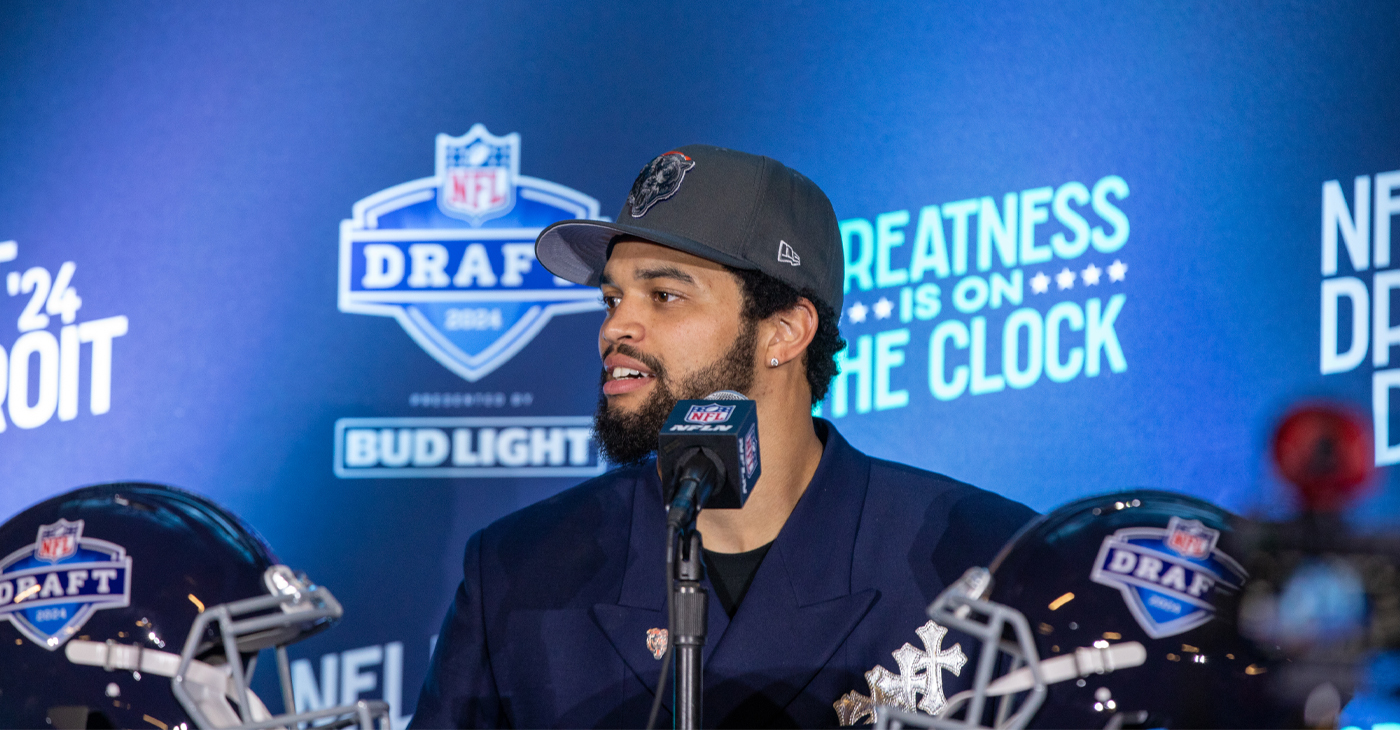
Philadelphia Eagles quarterback Jalen Hurts found Darius Cooper with nine seconds left for the game winning touchdown as his team beat the Tennessee Titans 24-20 in Nashville. Hurts finished the day 26/37 for 264 yards. He threw for two touchdowns and two interceptions.
Prior to the final drive, the Eagles ran 25 plays for 45 yards. During the final drive Hurts went 6-8 with 61 passing yards and the touchdown. Titans defensive tackle — and team captain — Jeffery Simmons said this week that the way to defend Jalen Hurts is to make him “play quarterback.”
Hurts said to Simmons after today’s game: “You started that sh**. I had to finish it.”
Running back Saquon Barkley suffered a stinger in the first half but he ultimately finished the game. He had four carries and nine yards and one catch for eleven yards. He will get an MRI for his injury, but admitted to Cameron Wolfe of the NFL Network he was fine.
Caleb Williams leaves game against Vikings with apparent lower-body injury
Chicago Bears quarterback Caleb Williams was helped off the field with a right leg injury with 7:42 remaining in the fourth quarter. Williams was down, writhing in pain after scrambling to his left. After departing the injury tent, Williams raised his right fist, acknowledging the crowd while expressing his frustration. Testing will commence on Monday to find out more details about his injury.
“We’ll know tomorrow,” Johnson admitted regarding Williams’ injury. “He’s in good spirits. He’s a team player.”
Williams finished the day with 138 passing yards and one interception.
“I’m actually happy it’s nothing with the knee — that was my first inclination,” Johnson said. “But, a hamstring could be pretty damaging as well. So, we’ll see. We’ll see how bad it is tomorrow and we’ll go from there.”
Bryce Young once again dominated the Falcons
Carolina Panthers quarterback Bryce Young is 5-1 against the Atlanta Falcons and is undefeated at Mercedes-Benz Stadium. Today, Young threw for 287 yards and three touchdowns as he led the Panthers to a 34-3 dismembering of the Atlanta Falcons. Georgia Tech alumnus Darren Waller caught two touchdowns and linebacker Devin Lloyd returned one of his two interceptions for a touchdown.
Cooper Rush started his second straight game for the Falcons and it did not go well. The partisan crowd voiced their displeasure after Rush completed 10/17 passes for 86 yards and two interceptions. Jack Strand entered the game for Rush prompting cheers from the Falcons fans. The rookie threw a pick-six on his first career pass attempt. Strand was the first QB to accomplish that feat since Sam Darnold in 2018 and is the first Falcons player to do that since Brett Favre in 1991. Strand finished the day with 59 passing yards and 16 rushing yards.
According to reports, quarterback Michael Penix, Jr. is expected to make his season debut this Thursday at the Green Bay Packers. His return should help the Falcons. They are the first team since the 2008 Rams to not run any plays in the red zone after the first two games to open a season.
The bright spots for the Falcons today were the Spelman College Jaguarettes performing with the Falcons cheerleaders and Florida A&M’s marching band, The Marching 100, also performed during halftime!
Jayden Daniels gets carted off after apparent arm injury
Washington Commanders quarterback Jayden Daniels appeared to injure his left elbow on the final play of the first half in his game against the Dallas Cowboys. During the play, Daniels got stepped on, braced himself for the fall, and his elbow bent the wrong way. Daniels draped a towel over his head as he exited the field on the cart.
He was later ruled out.
Daniels suffered a dislocated elbow to the same arm during week nine of last season against the Washington Commanders, which led to him being shut down for the remainder of the season.
The post NFL: Week Two Recap | Jalen Hurts did not fold; Caleb Williams exits game with injury appeared first on BlackPressUSA.

#NNPA BlackPress
The Complete Negotiation Framework — Every Stage, Every Tactic, Every Win
Master the complete vehicle-purchase negotiation framework with Roosevelt Gist and Roosevelt. Learn every stage, tactic, and win!
The post The Complete Negotiation Framework — Every Stage, Every Tactic, Every Win appeared first on BlackPressUSA.

Roosevelt Gist and Roosevelt deliver the complete vehicle-purchase negotiation framework in Episode 8 of The Color of Our Money Is Green. This episode covers the three foundations of every effective negotiation, the full seven-stage negotiation sequence with exact language for every stage, and five of the most common dealership tactics with the specific response each one requires.
What You Learn in This Episode:
The three foundations that make every negotiation tactic work
The complete seven-stage car-buying negotiation sequence
Exact language for every stage of the dealership conversation
Five common dealership tactics — the turnover, the four-square, the packed payment, spot delivery, and forced add-ons — and how to counter each one
Why signing preliminary paperwork isn’t the same as signing the final contract
___________________________________________________________________
“The Color of Our Money Is Green: A Buyer’s Guide to What Cars Actually Cost” — stan.store/RGist
____________________________________________________________________
AutoNetwork helps serious car shoppers inspect any new vehicle online before walking into a dealership. I’m Roosevelt — I’ve been reviewing cars and shaping digital car buying and credit union auto leasing since before YouTube car reviews existed.
You’ll find detailed walkaround reviews, POV test drives, and buyer-focused breakdowns covering comfort, space, features, and real-world value.
How to use the channel:
Watch the walkaround of the car you’re considering
Visit AutoNetwork.com for the full review
Check CouponsOffersAndDeals.com for current dealer specials
Walk in already knowing what you want — and what it should cost
 AutoNetwork.com
 CouponsOffersAndDeals.com
Affiliate disclosure: some links earn a small commission at no cost to you and help support the channel. Insta360 is one of those partners.
The post The Complete Negotiation Framework — Every Stage, Every Tactic, Every Win appeared first on BlackPressUSA.
#NNPA BlackPress
Mazda CX-90 Luxury: Heated Seats & Premium Comfort! #shorts
Stay toasty in the CX-90! Plush Nappa leather, heated/ventilated seats, and a memory-equipped heated steering wheel deliver ultimate luxury.
The post Mazda CX-90 Luxury: Heated Seats & Premium Comfort! #shorts appeared first on BlackPressUSA.

Experience ultimate comfort in the CX-90. Nappa leather, heated/ventilated seats, 8-way power adjustments, and memory settings for both front passengers. The heated steering wheel with memory tilt/telescope adds premium convenience.
 Watch the full video: https://youtu.be/EH5A4eQ4ipY
#AutoNetwork
The post Mazda CX-90 Luxury: Heated Seats & Premium Comfort! #shorts appeared first on BlackPressUSA.



Doulas Are Helping Black California Moms Navigate Pregnancy–Even as High Mortality Rates Persist

Newsom Signs Addictive Social Media Law to Protect Kids

On Your November Ballot: Prop 38 Would Allocate $8.4 Billion to Immunology and Immunotherapy Funding

Ask California: Golden State Releases New AI Chatbot

Asm. Isaac Bryan’s Bill Banning California Police From ICE Side Jobs Reaches Newsom’s Desk

Assemblymember LaShae Sharp-Collins’s Bill Would Pause Law Enforcement’s Use of Shock Gloves Pending Study

BOOK REVIEW: ‘Laws of Solomon’ Reveals Tender Heart of Former Child Soldier

OPINION: The New American Fear – From 9-11 to AI

Passing for White, Fighting for Black America: The Courage of Walter White

Oakland People’s Arms Embargo Coalition Demands End to Military Shipments Thru Oakland

Barbara Lee Mourns Gloria Steinem, Remembers a Friendship Rooted in Equality

Event Preview: ‘Fashion v. Fascism’ – A Runway Revolution Is Coming to the Bay Area

Two Looming Threats Every Alameda County Elder Should Know About

Oakland Mayor Reads to Children at Bookout Block Party at Marcus Books Store

Tradition Comes to the Streets in 11th Annual Black-Eyed Pea Festival at the Freedom Farmers Market

Less Affluent School Districts, Including Sacramento City, Face Threat of State Takeover

ESSAY: California Can Close Its Colorectal Cancer Gap

California Hispanic Chambers of Commerce Unveils: ‘Powering the Future’ Theme for 47th Annual Statewide Convention

Four Candidates, Including Incumbent Barbara Lee, Qualify for Oakland Mayor’s Race

Oakland Post: Week of August 12 – 18, 2026

From Blueprint to Breakthrough: Tackling Affordable Housing in Oakland

Oakland Observes Black August with Block Parties, Film Showings, Workshops

COMMENTARY: Why Local School Tax Measure G1 Will Not Be on the November Ballot

Standoff for Justice: Our Homes Are Worth Fighting For

Returning to Its Roots, the Oakland Black-Eyed Pea Festival Partners with the Freedom Farmers Market Sept. 12

NPRC Scores First Advocacy Victory: David Shaw Finally Gets His Wish to ‘Go Home’

Oakland Post: Week of August 26 – September 1, 2026

Frontier Airlines’ Return to Oakland Airport Brings Flights, Jobs and Opportunity

Gubernatorial Candidate Steve Hilton Blasts California New Tire Rules; Newsom Hits Back

Chef Sharon Lee Blends Culinary Excellence, Education and Empowerment

The Conversation With Al McFarlane 6/23/26

Media Monday 6/22/26

LIVE! ASK ALMA! — TUES. 6.23.26 7PM EST

Car Buying Secrets: 4 Hidden Checks Before You Sign!

Is This 550 HP Charger Worth YOUR Money? AutoNetwork Review

Celebrating Juneteenth – Frederick Douglass on education and resistance

LIVE! — ASK ALMA! — TUES. 6.19.26 7PM EST

Hyundai Ioniq 5 Parking, Safety, and 360 View #shorts

2025 Ioniq 5 New Wiper & Powerful Performance! #shorts

Electric SUV Range: Is 259 Miles Enough? #shorts

EV Charging: How Fast Can You Charge an Electric Vehicle? #shorts

Biometric Cooling… Messaging Seats…Come on! 2025 Infiniti QX80 Autograph 4WD

Charged Up: Witness the Magic of a Fully Electric Car! #shorts

Range Rover Sport PHEV Included…: See What’s Inside This Luxury SUV! #shorts

Invisible Hood View: Perfect Parking with X-Ray Vision! #shorts
-
 Commentary4 weeks ago
Standoff for Justice: Our Homes Are Worth Fighting For
-
 Activism4 weeks ago
Oakland Post: Week of August 26 – September 1, 2026
-
 Business4 weeks ago
Frontier Airlines’ Return to Oakland Airport Brings Flights, Jobs and Opportunity
-
 Business4 weeks ago
Gubernatorial Candidate Steve Hilton Blasts California New Tire Rules; Newsom Hits Back
-
 Business4 weeks ago
Chef Sharon Lee Blends Culinary Excellence, Education and Empowerment
-

 Education4 weeks ago
Gov. Newsom’s Latest Appointees Include Sacramento Advocate for Formerly Incarcerated Students; State’s New Tech Chief
-

 Community4 weeks ago
Big City Mayors Ask for “Yes” Vote on Housing Bond Measure; Conservatives Say “No”
-

 Business4 weeks ago
Oakland Coliseum Project Opens Door for Small Businesses to Build Bigger
