
Activism
IN MEMORIAM: Celebrating Wenefrett P. Watson
Her greatest contribution was as a parent to James, a father and successful actor, Cynthia, a mother and contributor of many social and political events, Janet, a dedicated daughter who assisted her in the travel agency, Geoffrey, who followed in his father’s footsteps as a father and a dedicated and revered physician and Gary, an entertainment lawyer in Hollywood. As a world traveler, Wene invited and hosted international exchange students in her home to educate them and her children about the world.

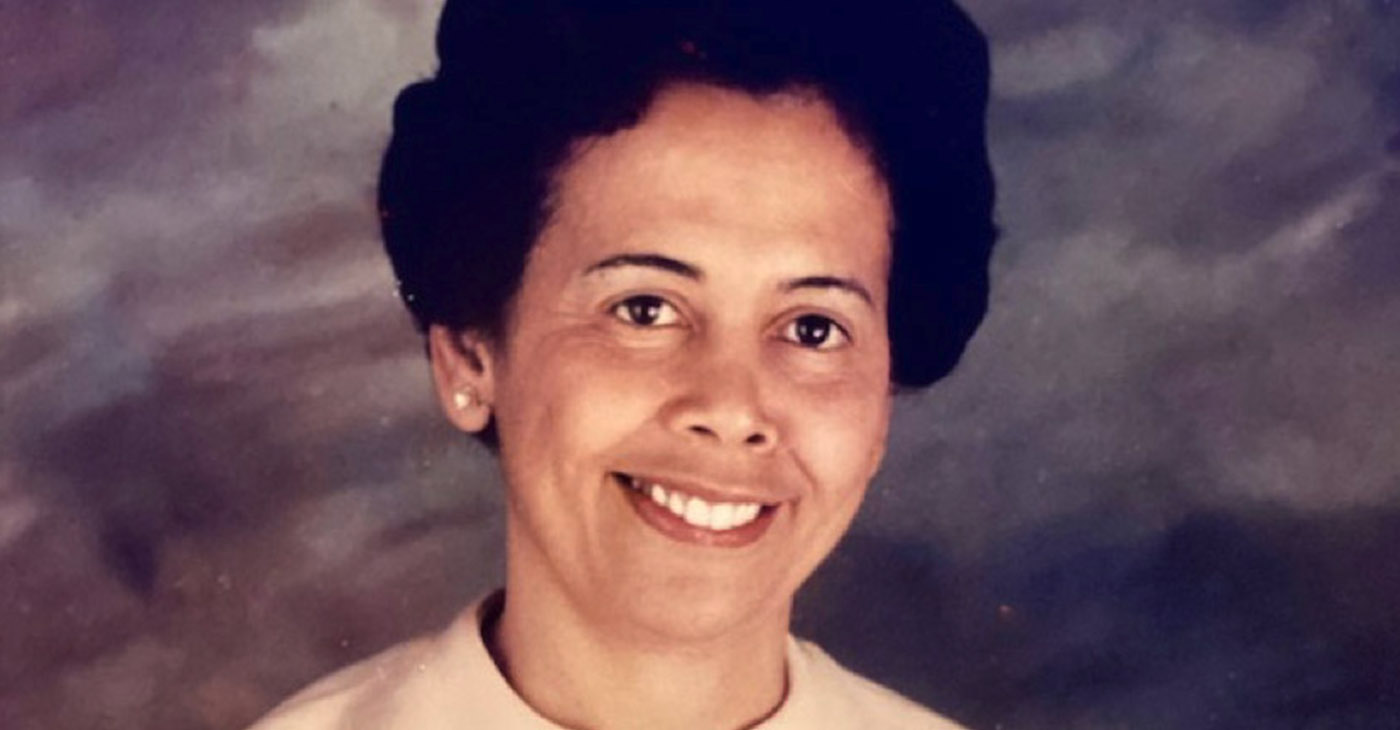
October 29, 1921- November 9, 2021
Wenefrett P. Watson, Wene, born in Marshall Texas, October 29, 1921, graduated from Bishop College where she earned a Bachelor of Arts degree in English Literature. She went on to the University of Southern California in Los Angeles securing a degree in Library Sciences (the same university where her daughter, Cynthia went on to become the first African American “Helen of Troy” at the Rose Bowl Parade). Ambitious and wanting to expand her horizons, Wene applied for and received, sight-unseen, a position with the Department of Agriculture in Washington D.C. Exposed to a bright life in Harlem, New York, she met powerful Black artists. They inspired her. In Los Angeles, on a dare, she sang for Duke Ellington and was shocked when “The Duke” offered her the gig of going on the road with his band.
In Washington D. C., she met Dr. James A. Watson at Howard University. While he expanded his medical practice, they married and started a family. In those early days, with a new husband and three young children, Wene, like most young mothers, was somewhat overwhelmed. Suddenly, her life was much different, compared to the slower and much more sheltered life she had known in Marshall Texas.
Spontaneous and zestful, she enjoyed entertaining friends at home. She liked to play cards, dance and go to the movies. When the good doctor wasn’t available, she would get a babysitter and sneak out to take her six-year-old son, James Jr.), to the movies! She visited with her friend, Jackie and Mrs. Robison, while Jackie was training at Howard University. As a kindness, Jackie taught James Jr. to swim! Jackie, Mrs. Robinson, and Wene had been friends during their shared college years, Wene at USC, while they were at UCLA.
After eight years in Washington D.C., the Watsons traveled to California, where Dr. Watson was a Captain and chief of staff at Edwards Airforce Base hospital. Meeting surgeon Doctor Robert Taylor and Mrs. Estella Taylor, the Watsons moved to Oakland where Dr. Watson helped to build a large medical practice at the Arlington Medical Center with Dr. Taylor and Dr. Benjamin Majors. Dr. Watson’s son, Dr. Henry Geoffrey Watson, now runs the center, serving the Oakland and Berkeley communities.
Most people know Wenefrett for her many notable, social and civic contributions in Oakland. With five children, James, Cynthia, Janet, Geoffrey and Gary, Wenefrett Watson was actively involved with five PTA organizations! Next was her involvement with the Links, Incorporated, an upper-middle class organization that networks their resources to look out for Black families who need support within the commonwealth, highlighting the education and social grace of young girls growing into young women. Eventually she became president of the Oakland Bay Area Chapter of the Links, Incorporated.
During her membership, Wene chaired the Links’ annual grand event which is the debutant ball. This event announces the “coming-out” of these young girls becoming young adults, ready to give back to the community. Simultaneous to these activities, Wene worked with the Oakland Bay Area Chapter of Jack and Jill of America, Inc. organization to make sure her five kids, their friends, and all Black preteen children enjoy socially appropriate activities like dances, hayrides, summer camp, going to the ballet and other fun activities. She was also the founder and president of the San Francisco Chapter of The Smart Set.
In time, she worked with city officials to help Oakland partner with Sekondi-Takoradi, Ghana in 1975 as a sister city. Supporting the direction of the city, she and her husband mentored Mayors Redding and Wilson, helping them to get elected. She was appointed to the Oakland Museum Commission and made serious contributions to its development. Wene supported the arts and organized “The Black Filmmaker’s Hall of Fame Awards” at the Paramount Theater in February 1977.
As a working actor in Hollywood, James Watson, her eldest son, was a co-host with Diahann Carroll. This event propelled the NAACP to begin the Image Awards. In 1984, Wene began and ran WenTravel Agency for eleven years. She worked with many large corporations creating jobs and generating wonderful experiences as well as providing a service. She and her husband traveled the world many times and brought back much enlightenment from their exciting travel. Continuing her many works, Wene served with the NAACP and the YMCA. She continued to support political candidates for the city and state. She met Presidents Lyndon B. Johnson, George Bush, Bill Clinton and Barack Obama, twice!
Her greatest contribution was as a parent to James, a father and successful actor, Cynthia, a mother and contributor of many social and political events, Janet, a dedicated daughter who assisted her in the travel agency, Geoffrey, who followed in his father’s footsteps as a father and a dedicated and revered physician and Gary, an entertainment lawyer in Hollywood. As a world traveler, Wene invited and hosted international exchange students in her home to educate them and her children about the world.
People who knew Wene enjoyed her sparkling humor and joy for life. Friends and strangers alike, also could find themselves on the short end of her very candid rebuke or opinion. She was an honest and direct person when she spoke to you. Wene Watson was a bright and gregarious woman. Everyone who knew here felt better about themselves because of her. She was a devoted wife and mother. In the film “It’s A wonderful Life”, Jimmy Stewart’s character wonders if being born made any difference or gave anyone value. To everyone who knew Wenefrett Watson, imagine that she had not been in your life. Her value is in the love and appreciation you feel when you think of her. Thank God she was here.
Wene is survived by three sons and a daughter, James Watson, Cynthia Arnold (Larkin), Henry Geoffrey Watson (Carolyn), and Gary Watson. She is also survived by five grandchildren, Catherine (Max), Sara, Bryan, Angela, and Richard, and two great grandchildren and a niece and nephew, Jackie Jackson (Warren) and Wendell Phillips, along with a myriad of other family members, loved ones, and many friends. Wene was preceded in her heavenly journey by her husband James A. Watson, M.D., daughter Janet Watson David, her granddaughter Tiffany Washington (Cynthia) and her grandson Henry Geoffrey Watson, II (Geoffrey & Carolyn).
Wenefrett P. Watson will be laid to rest at Mountain View Cemetery on Friday, November 26, 2021, with services held at the Church By the Side Of the Road, 2108 Russell Street, Berkeley, CA at 1:00 P.M. (COVID-19 Protocols Observed). For more details and in-person/Zoom registration go to www.CBSOR.org/announcements.











Activism
Oakland Post: Week of September 23 – 29, 2026
The printed Weekly Edition of the Oakland Post: Week of September 23 – 29, 2026

To enlarge your view of this issue, use the slider, magnifying glass icon or full page icon in the lower right corner of the browser window.
Activism
Oakland Post: Week of September 16 – 22, 2026
The printed Weekly Edition of the Oakland Post: Week of September 16 – 22, 2026

To enlarge your view of this issue, use the slider, magnifying glass icon or full page icon in the lower right corner of the browser window.
Activism
Oakland Post: Week of September 9 – 15, 2026
The printed Weekly Edition of the Oakland Post: Week of September 9 – 15, 2026
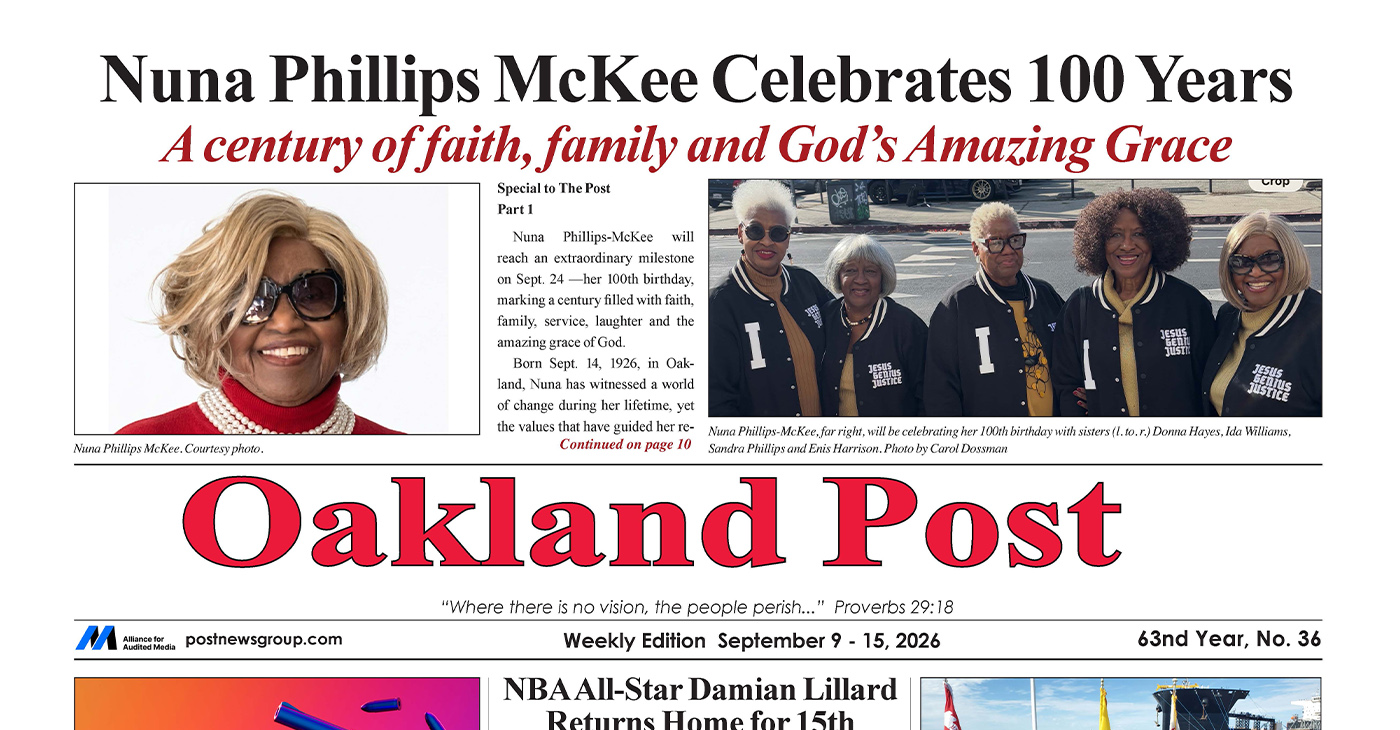
To enlarge your view of this issue, use the slider, magnifying glass icon or full page icon in the lower right corner of the browser window.



Asm. Corey Jackson Announces Launch of 24-Hour Childcare in His District

IN MEMORIAM: The Rev. Leon “Sonny” Clark, Longtime Orange County Pastor and Community Leader, Dies at 72

Poll: Becerra Widens His Lead Over Hilton; Californians Split on Wealth Tax

From Historic Memories to New Possibilities: Oakland Celebrates Coliseum 60

County Office of Education Says OUSD Finances Are Getting Healthier, Materially Stronger

LIVE FREE Sunday Dinner Brings Faith, Fellowship and Civic Conversation to Oakland

Remembering Chauncey Bailey as Student Journalists Face Threats to Truth-Telling

BLACspace Cooperative Invites Bay Area to Experience Oakland’s Black Cultural Ecosystem Through a BLAC Map Tour + Party

In Wake of Death on Doorstep, Williams Chapel Baptist Church Calls for Better Care, Funding for Unhoused

Oakland Centenarian Nuna McKee Honored!

Caribbean Nations Produce Action Plan Calling for UK Reparations Over Slavery

Oakland Post: Week of September 23 – 29, 2026

Doulas Are Helping Black California Moms Navigate Pregnancy–Even as High Mortality Rates Persist

Newsom Signs Addictive Social Media Law to Protect Kids

On Your November Ballot: Prop 38 Would Allocate $8.4 Billion to Immunology and Immunotherapy Funding

Less Affluent School Districts, Including Sacramento City, Face Threat of State Takeover

ESSAY: California Can Close Its Colorectal Cancer Gap

California Hispanic Chambers of Commerce Unveils: ‘Powering the Future’ Theme for 47th Annual Statewide Convention

Four Candidates, Including Incumbent Barbara Lee, Qualify for Oakland Mayor’s Race

Oakland Post: Week of August 12 – 18, 2026

From Blueprint to Breakthrough: Tackling Affordable Housing in Oakland

Oakland Observes Black August with Block Parties, Film Showings, Workshops

COMMENTARY: Why Local School Tax Measure G1 Will Not Be on the November Ballot

Standoff for Justice: Our Homes Are Worth Fighting For

Returning to Its Roots, the Oakland Black-Eyed Pea Festival Partners with the Freedom Farmers Market Sept. 12

Oakland Post: Week of August 26 – September 1, 2026

NPRC Scores First Advocacy Victory: David Shaw Finally Gets His Wish to ‘Go Home’

Frontier Airlines’ Return to Oakland Airport Brings Flights, Jobs and Opportunity

Gubernatorial Candidate Steve Hilton Blasts California New Tire Rules; Newsom Hits Back

Chef Sharon Lee Blends Culinary Excellence, Education and Empowerment

The Conversation With Al McFarlane 6/23/26

Media Monday 6/22/26

LIVE! ASK ALMA! — TUES. 6.23.26 7PM EST

Car Buying Secrets: 4 Hidden Checks Before You Sign!

Is This 550 HP Charger Worth YOUR Money? AutoNetwork Review

Celebrating Juneteenth – Frederick Douglass on education and resistance

LIVE! — ASK ALMA! — TUES. 6.19.26 7PM EST

Hyundai Ioniq 5 Parking, Safety, and 360 View #shorts

2025 Ioniq 5 New Wiper & Powerful Performance! #shorts

Electric SUV Range: Is 259 Miles Enough? #shorts

EV Charging: How Fast Can You Charge an Electric Vehicle? #shorts

Biometric Cooling… Messaging Seats…Come on! 2025 Infiniti QX80 Autograph 4WD

Charged Up: Witness the Magic of a Fully Electric Car! #shorts

Range Rover Sport PHEV Included…: See What’s Inside This Luxury SUV! #shorts

Invisible Hood View: Perfect Parking with X-Ray Vision! #shorts
-
 Commentary4 weeks ago
Standoff for Justice: Our Homes Are Worth Fighting For
-
 Activism4 weeks ago
Oakland Post: Week of August 26 – September 1, 2026
-
 Business4 weeks ago
Frontier Airlines’ Return to Oakland Airport Brings Flights, Jobs and Opportunity
-
 Business4 weeks ago
Gubernatorial Candidate Steve Hilton Blasts California New Tire Rules; Newsom Hits Back
-
 Business4 weeks ago
Chef Sharon Lee Blends Culinary Excellence, Education and Empowerment
-

 Community4 weeks ago
Big City Mayors Ask for “Yes” Vote on Housing Bond Measure; Conservatives Say “No”
-

 Black History4 weeks ago
Jackie Wright Champions Bay Area Stories, Filmmakers and Cultural Institutions
-

 Education4 weeks ago
Gov. Newsom’s Latest Appointees Include Sacramento Advocate for Formerly Incarcerated Students; State’s New Tech Chief
