
#NNPA BlackPress
How One Community is Trying to Break the ‘Vicious Cycle’ of Child Care and Housing Crises
NNPA NEWSWIRE — The district’s commitment to expanding early care and learning opportunities aligned with the values and priorities of the Ocracoke Child Care Board. Owens said it’s about more than aligned values, though. It was about doing what’s best for their neighbors.


Katie Dukes, Director of Early Childhood Policy, EdNC
“If you don’t have the child care in order for people to go to work, they don’t have the income to pay for housing; it’s this vicious cycle,” said Melanie Shaver, superintendent of Hyde County Schools in North Carolina. “So how can we break that cycle at the root cause?” Shaver is leading her district’s attempt to answer that question. Hyde County Schools is now offering universal pre-k to both 3- and 4-year-olds districtwide, at the Ocracoke School on the island and the Mattamuskeet School on the mainland, with the goal of expanding to include early care and learning for children from birth to age 2 in years to come. And the revived Hyde County Education Foundation — chaired by Shaver — is buying two sites to build workforce housing for teachers and other essential workers. It’s a project based on community needs and with community collaboration, and one that became more urgent after the devastation caused by Hurricane Dorian five years ago. While Hyde County sits at the far eastern edge of the state and has its own unique geography, this project could be a model for communities in western North Carolina as they develop long-term recovery plans after the destruction caused by Hurricane Helene.
The housing crisis
When Shaver took on the role of superintendent in 2021, she learned that most of Hyde County’s teachers would be eligible to retire within five years. “When you learn you have 60% ready for retirement, first of all, how am I gonna get these people, and where am I gonna put these people?” Shaver said of recruiting new teachers. On the mainland, Shaver said, affordable housing is hard to come by because a portion of the housing stock is inhabited only part-time, mostly by hunters who come to Lake Mattamuskeet seasonally. And on Ocracoke, many houses serve as second homes, and short-term rentals are inhabited by visitors only during the summer tourism season. The high price of homes and lack of long-term rental properties is a major issue for the island’s workforce, including prospective teachers.
“We are seeing fewer applicants,” said Jeanie Ownes, principal of the Ocracoke School. “One of the questions they always ask is, ‘Where can I live?’ and I do think that is deterring a lot of people from applying here.” Housing pressure increased after Hurricane Dorian destroyed dozens of homes and damaged many others in 2019. Sara Teaster, a member of the Hyde County Education Foundation (HCEF) Board of Directors, shared her struggle to find housing. Teaster had visited Ocracoke and loved it, so when a job opened on the island in 2019, she jumped at the chance to relocate full-time. Someone loaned her a house while she searched for a permanent place to live.
Then Dorian hit, destroying and damaging homes that had offered 12-month leases. Teaster said that some homeowners switched from offering those long-term rentals to weekly vacation rentals so they could recoup the costs of rebuilding. Then COVID-19 hit, bringing remote workers with higher incomes to the island, which Teaster said added pressure to the off-season rental market. Add to that the overall rising costs of homes, interest rates, and insurance over the last five years, and the result is an inaccessible, unaffordable housing market for the year-round residents who make the island so appealing to guests. But Teaster said she got lucky. “Four months after I moved here, I was able to find a yearly rental that was affordable, and I lived there for four years,” Teaster said. “Loved it. Would have continued to live there, but the owner decided that they wanted to come back and live in their home.”
Almost 50 years old, Teaster moved four times in four months after losing that rental. She sent her pet to live with her mother out of state. She’s making it work for now by house-sitting while she continues to search for housing she can afford. And hers is just one story. According to Shaver and Owens, two staff members of the Ocracoke School left their jobs — and the island — because they couldn’t find permanent housing and were no longer willing to live in RVs and campers on lots that can cost up to $1,200 per month to rent.
The childcare crisis
Tekisha Jordan, the district’s pre-k administrator for the last 17 years, said that when Shaver came to Hyde County, licensed childcare was also hard to come by. The mainland has two programs: Head Start, which is licensed to serve up to 40 students aged 3-5, and Linda’s Childcare Home, which is licensed to serve up to eight students from birth to age 12. There’s also unlicensed childcare. “Basically, [parents] have relatives that care for their child, a friend that cares for them,” Jordan said. “And we definitely see a big difference when they reach pre-k since the childcare center closed, socially and emotionally.”
By the time Dorian hit the island, Ocracoke’s only licensed childcare program had already been closed for two years. Ocracoke Child Care was a high-quality nonprofit center that touched the lives of most families on the island. Alice Burruss, who previously taught pre-k and is now the first-grade teacher at Ocracoke School, served as the center’s assistant director starting in the mid-1990s. Both of her children attended the program during her 10 years at Ocracoke Child Care.
“While I was there it was so important for us to have [students] learn and not just be little kids that you’re babysitting,” Burruss said. “It really was a learning facility.” But since the program closed in 2017, young children on Ocracoke haven’t had that learning opportunity. “We live in a space where there are very few places for little kids to socialize, get that interaction with each other,” Burrus said. She pointed out that there’s not even a public playground or park on the island.
“And then you walk into a classroom as a 3- and a 4-year-old with 15 other kids, and imagine how overwhelming that is for you,” Burruss said. Burrus and her colleague Amanda Gaskins Jackson, who teaches kindergarten and attended both Ocracoke Child Care and the Ocracoke School, can tell the difference between students who have and have not experienced early care and learning in a group setting before starting school, especially since the pandemic.
Along with Jordan and Owens, Burruss and Gaskins Jackson provided examples of how those differences show up in young learners:
- Sharing
- Sitting in a circle on the carpet
- Learning to trust adults outside of their families
- Following group directions
- Washing hands
- Standing and walking in a line
- Having independence from adults
Without the childcare center, students were simply less prepared to function in a learning environment with other children. They were missing out on some of the critical brain development that occurs in the first 1,000 days of their lives. “Instead of spending the time in pre-k where we would focus on fine motor skills, getting you ready for writing and letter recognition and all those pre-foundational skills, now it’s we have to learn how to coexist together, and sit for a little bit of time, listen to a story without seeing it on a screen,” Burrus said.
Shaver called early childhood education “critical” and said, “It does make a difference with your kids. It makes a difference not only on their readiness [to learn], but their social ability and their emotional intelligence to be able to then come and transition into a school.” For children who have been affected by trauma like Hurricane Dorian and COVID-19 — or more recently, Hurricane Helene for children in western North Carolina — stability is key to their healthy social and emotional development. “And so I think looking at early childhood is one piece of that root cause, but looking at that housing piece is another,” Shaver said.
Breaking the ‘vicious cycle’
Since Hurricane Dorian hit the island in 2019, the school district has been using the Ocracoke Child Care building as classroom space for their youngest students while the Ocracoke School was being reconstructed. As Shaver began to prepare for the Ocracoke School’s official reopening in 2023, she started thinking about how the childcare building would be sitting empty once again. And she was still wondering how she would hire new teachers when there was nowhere for them to live and no space to build multi-family housing units on the island, even if someone was inclined to do so.
Then she had an idea — maybe the empty Ocracoke Child Care site could be converted to workforce housing. Shaver realized that the HCEF hadn’t been used for 15 years, so she went about reviving it as a nonprofit entity that could address two crises at once by supporting the development of workforce housing and enhancing early care and learning opportunities.
The HCEF by-laws state: “The Foundation recognizes that due to the remote nature of Hyde County, and the housing shortage, the development of housing will provide both the Mattamuskeet and Ocracoke School communities and others the opportunity to partner with the Hyde County Board of Education and others in a common goal of improving public education by ensuring adequate housing.”
HCEF’s Board of Directors is made up of an equal number of mainlanders and islanders because, as stated in the by-laws, “the Board acknowledges that just as mainland Hyde may not know or understand all the nuances for Ocracoke, Ocracoke may not know or understand all the nuances of the mainland. Anytime a decision directly affects an area, an equal or majority number of board members from that area is needed for a vote.”
With the HCEF re-established and a new board in place, Shaver took the first step toward fulfilling its mission — Hyde County introduced universal pre-k for 4-year-olds when the Ocracoke School reopened in 2023. Because Hyde County Schools had already been providing NC Pre-K to eligible 4-year-olds, adding the rest of the county’s 4-year-olds was a logical place to start filling the community’s early care and learning gap.
Top of Form
Bottom of Form
Then Shaver went about finding members of the defunct Ocracoke Child Care Board, so they could start having serious conversations about the property by changing hands. She learned that board members had been holding out hope that the center would be able to reopen one day, and they remained passionate about their commitment to providing early care and learning to Ocracoke’s youngest residents. So, Hyde County Schools extended its universal pre-k program to 3-year-olds, to add programs for birth-to-2 students in coming years. In addition to NC Pre-K funds, the district uses Title I funding and grants to finance the expanded Pre-K program.
Jordan described how parents on the mainland reacted when she announced that all 3-year-olds — not just those with special needs or on the island — would be eligible. “I’m gonna cry, but they was like, ‘Oh my God, thank you Tekisha!’ And I’m like, ‘No, oh my God, thank you Dr. Shaver!’” Jordan said. In its first year, the multi-age pre-k classroom at the Matamuskeet School on the mainland has 18 students, and the one at the Ocracoke School has 13. “The whole school benefits when we get them earlier,” Jordan said. “We take them at 3, they transition to 4, we get them ready for kindergarten. If there are any delays, it’s normally picked up in kindergarten. The kindergarten teacher and the pre-k teacher collaborate, sit in on IEP meetings, and then it just follows from kindergarten to first grade. The whole school benefits.”
The district’s commitment to expanding early care and learning opportunities aligned with the values and priorities of the Ocracoke Child Care Board. Owens said it’s about more than aligned values, though. It was about doing what’s best for their neighbors. “I think us being so small, it truly is about community,” Owens said. “So, while we are talking early childhood education, it’s almost like, ‘Well, yes, they’re part of who we are, and we are going to take care of our littles.’ The Ocracoke Child Care Board sold their building to the district for $10. The Outer Banks Community Foundation and a local Occupancy Tax Board each donated $25,000 to help HCEF get architectural plans and cost estimates drawn up. Shaver identified a similar opportunity to develop workforce housing on the mainland at a shuttered 26-unit public housing development called Hycienda Heights. With 10 units planned for the Ocracoke Child Care site, the total estimated cost of purchasing both properties and converting them to workforce housing is about $4 million.
When asked where HCEF would find the money, Shaver joked, “Fish frys! And we’re gonna do a lot of bake sales!” She knows they’ll likely take out a loan for some of it, but the Board is also seeking philanthropic donations and other funding sources to reduce the size of that loan. “We’re willing to beat any bush, look under any couch cushion, meet with anybody who asks,” Shaver said. When the units are complete, HCEF plans to offer them for yearly rent to teachers first, then other essential workers who need time to secure permanent housing. And they’ll use any profits to make further investments in early care and learning, including opening birth-to-2 classrooms. “One of the reasons I’m excited about this Hycienda Heights property, if we can obtain that as well, is that it has a community center there on site that could be easily formed into that zero-to-2 [space],” Shaver said.
The same goal exists in Ocracoke. “On the island, that’s kind of how we do things; we do take care of each other,” Owens said.













#NNPA BlackPress
Youth-Led Black August Event Brings Past to Present at East Oakland Boxing Association
The mission of Youth Alive! Is to “break the cycle of violence, heal trauma, and uplift a thriving community of leaders, to save lives in Oakland and beyond” by serving “as mentors, youth leaders, counselors, case managers, intervention specialists and violence interrupters,” working “to help violently wounded people heal themselves and their community.”
The post The mission of Youth Alive! Is to “break the cycle of violence, heal trauma, and uplift a thriving community of leaders, to save lives in Oakland and beyond” by serving “as mentors, youth leaders, counselors, case managers, intervention specialists and violence interrupters,” working “to help violently wounded people heal themselves and their community.” appeared first on BlackPressUSA.
Youth-Led Black August Event Brings Past to Present at East Oakland Boxing Association
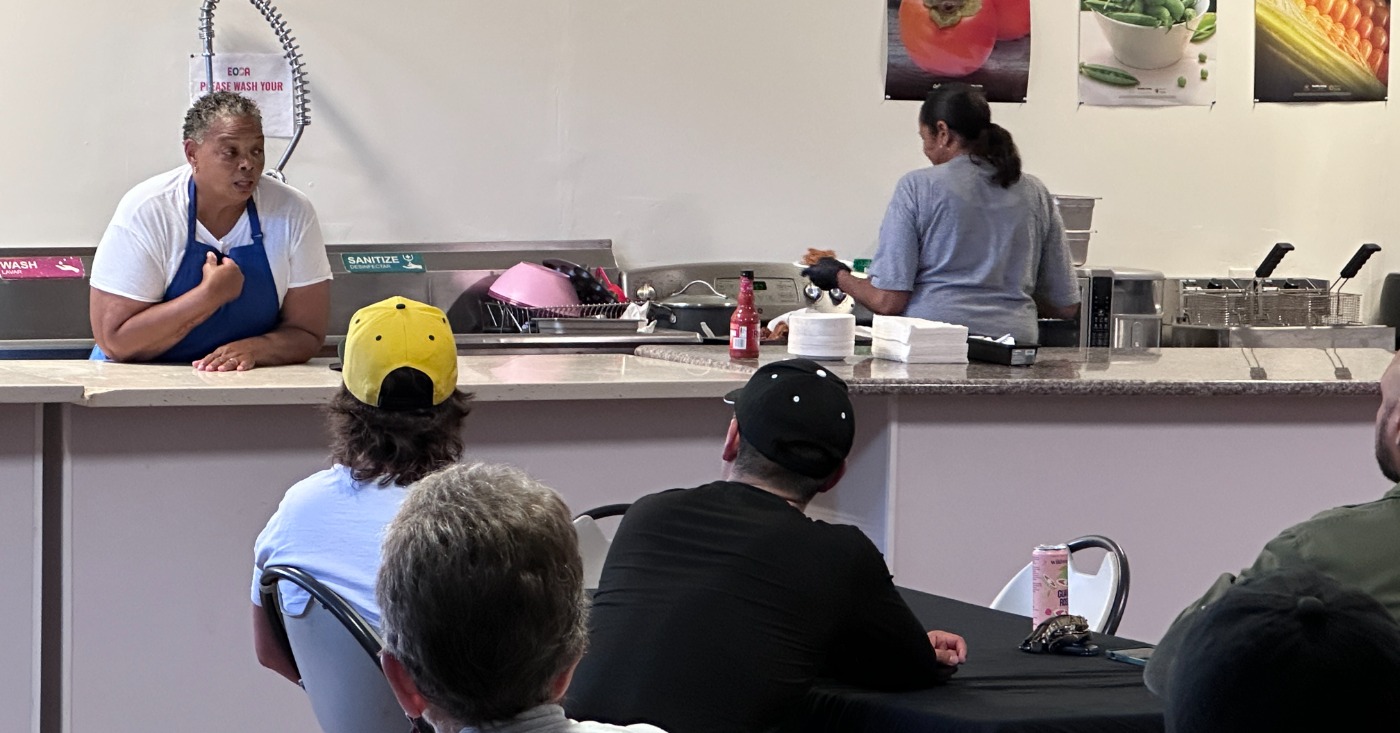
The East Oakland Boxing Association (EOBA) and Youth Alive! came together on Aug. 21 to share with their community all that Black August means to them.
Held on EOBA’s patio at 816 98th Ave. in Deep East Oakland, the two organizations hosted their second annual Black August Experience, featuring a food tasting, financial literacy and mindfulness workshops, and voter registration with the League of Women Voters Oakland (LWV).
Black August is known as a time to uphold the legacy of prisoners who protested their conditions by fasting, fighting, and educating themselves on the economic and political circumstances that contributed to their incarceration.
According to its website, “EOBA is a multi-service youth and community development hub that goes far beyond the ring. While rooted in the discipline of boxing, for nearly 40 years EOBA has also integrated robust programs in workforce development, food justice, afterschool enrichment, financial literacy, mentorship, and wellness.”.
The mission of Youth Alive! Is to “break the cycle of violence, heal trauma, and uplift a thriving community of leaders, to save lives in Oakland and beyond” by serving “as mentors, youth leaders, counselors, case managers, intervention specialists and violence interrupters,” working “to help violently wounded people heal themselves and their community.”
Through Coro California, another leadership organization serving young people across the state for 80 years, they gained a broader understanding of Black August.
EOBA Executive Director Dawna Williams spoke about how much she learned about Black August from the youth who created it. “I let them educate me,” she said. Instead of talking about prison reform and mass incarceration, Williams and youth interns found that Black August meant so much more. “We would have done a disservice if we had just focused on who the people were and what their situation was…We tried to take their message from back in the day and make it relevant to the young people today. What do they need to know?”
Youth interns created and placed posters around the patio to help participants understand how traditional Black foodways, civic engagement, financial literacy, and the power of education are relevant to Black resistance today.
An EOBA member described Black August with Youth ALIVE! as “a whole vibe. “This year we added the Fun Zone for the kids, because you really cannot go wrong with a Fun Zone. I also loved seeing everyone chillin’ in the outdoor lounge, catching some Vitamin D and just enjoying a Friday evening together.”
The food tasting, a popular event from last year, featured traditional Black foods such as black-eyed peas, johnny cakes, and fried chicken. Led by Williams, the tasting included a talk about how these traditional foods were made and why they are forms of Black resilience.
The “‘Plate of History’ was a favorite of the online writers. “Fun, educational, and did I mention delicious? Our Taste of History cook, Angela Southall, served up some good eats while connecting food to history and culture.”
The writer also commended the “League of Women Voters Oakland for their civic leadership and for getting our young people informed, ready, and registered to vote.”
Overall, it was a “good Friday event in East Oakland,” the writer said.
Upcoming Black August events: Building Opportunities for Self-Sufficiency (BOSS), will host “Black August: The Arc of Liberation” at Oakland City Hall on Sat. Aug. 29, from 11 a.m. to 3 p.m.
The websites for East Oakland Boxing Association, Youth Alive! and CORO are sources for this report.
Jana Lang is an Oakland resident, teacher, gardener and poet participating in the Propel News Initiative.
The post The mission of Youth Alive! Is to “break the cycle of violence, heal trauma, and uplift a thriving community of leaders, to save lives in Oakland and beyond” by serving “as mentors, youth leaders, counselors, case managers, intervention specialists and violence interrupters,” working “to help violently wounded people heal themselves and their community.” appeared first on BlackPressUSA.
#NNPA BlackPress
EV Home Charging Warning: What Dealerships Won’t Tell You! #shorts
Is your home EV charging setup ready? Dealerships may not warn you about critical outlet and circuit needs. Find out before you plug in!
The post EV Home Charging Warning: What Dealerships Won’t Tell You! #shorts appeared first on BlackPressUSA.

Dealerships won’t tell you: charging this big battery at home isn’t always simple. Verify your outlet capacity, circuit, and setup before assuming level one or basic outdoor outlets will suffice.
 Watch the full video: https://youtu.be/A9Cd2SspoaQ
#AutoNetwork
The post EV Home Charging Warning: What Dealerships Won’t Tell You! #shorts appeared first on BlackPressUSA.
#NNPA BlackPress
Car Buying Secrets: Dealership Traps & How to Avoid Them #shorts
Don’t get tricked at the dealership! Learn essential car buying secrets to secure the best deal and avoid hidden traps.
The post Car Buying Secrets: Dealership Traps & How to Avoid Them #shorts appeared first on BlackPressUSA.

Before stepping into a dealership, secure bank pre-approval for your financing rate. Then, get the out-the-door price in writing. Never discuss monthly payments until that number is fixed. Test road noise and rear visibility yourself. Decline add-ons with a simple ‘Not today’. Check backseat space with your tallest household member.
Watch the full video: https://youtu.be/maAOBjO1puY
#AutoNetwork
The post Car Buying Secrets: Dealership Traps & How to Avoid Them #shorts appeared first on BlackPressUSA.



Port of Oakland, Army Corps Sign Historic Harbor Design Agreement

Democratic Clubs Interview Candidates for Oakland School Board

Nuna Phillips-McKee Celebrates 100 Years: ‘A Century of Faith, Family and God’s Amazing Grace!’

D.A. Ursula Jones Dickson: Terminix to Pay $3.15 Million Over Illegal Disposal of Pesticides, Customer Records

REPORT: Community Level Policy Is Impacting Homelessness and Drug Abuse in California

OPINION: AI Needs to Know Who Is the Boss
Goldi-Locs and Two (or Three) Bears in the Forest in California Hills

Election Watch 2026: 85% of Eligible Voters in California Are Registered

Don’t Let scammers Crash Your School Year

BOOK REVIEW — Curved Air: A Biography of Sickle Cell Anemia and the Quest to Cure the First Molecular Disease

California’s Legal Cannabis Market Hits $8 Billion as State Touts Progress on Fighting Drugs, Crime

Blacks and Latinos Clash Over LA’s Barrio Run; Mayor Karen Bass Calls for Dialogue Across Racial, Neighborhood Lines

Asm. Smallwood-Cuevas’s Bill Repealing ‘Racist’ CalWORKs ‘Man-in-the-House’ Rule Clears Legislature

Asm. Smallwood-Cuevas’s Bill Repealing ‘Racist’ CalWORKs ‘Man-in-the-House’ Rule Clears Legislature

‘Ready to See These Bills Become Law’: Sen. Weber’s Package of 15 Bills Advance to Gov. Newsom’s Desk

Department of Homeland Security Demands California Secretary of State Shirley N. Weber Scrub Voter Rolls

“The Power to See Threats Sooner”: Gov. Newsom, Safety Officials Showcase California’s Investments in Hi-Tech Wildfire Prevention

California Sen. Padilla Joins Colleagues to Introduce Bill Imposing Term Limits on Supreme Court Justices

Less Affluent School Districts, Including Sacramento City, Face Threat of State Takeover

Car Wash Workers Cope with Lingering Impacts of ICE Raids

ESSAY: California Can Close Its Colorectal Cancer Gap

Oakland Post: Week of August 5 – 11, 2026

As Part of Your Back-to- School Checklist, Vaccinate

Oakland ‘Port Serves as a Powerful Engine for Good Jobs and Economic Development

Gov. Newsom Announces $109.6 Million in Funding for 278 Supportive Homes in Bakersfield, Contra Costa, Sacramento and Fresno

California Hispanic Chambers of Commerce Unveils: ‘Powering the Future’ Theme for 47th Annual Statewide Convention

Closing the Gap: What the Data and Frontline Experiences Reveal About Cancer in Black California

Congresswoman Simon Demands Investigation into Trump’s Abuse of Emergency Powers for Coal Export Terminal in West Oakland

Four Candidates, Including Incumbent Barbara Lee, Qualify for Oakland Mayor’s Race

Oakland Post: Week of August 12 – 18, 2026

The Conversation With Al McFarlane 6/23/26

Media Monday 6/22/26

LIVE! ASK ALMA! — TUES. 6.23.26 7PM EST

Car Buying Secrets: 4 Hidden Checks Before You Sign!

Is This 550 HP Charger Worth YOUR Money? AutoNetwork Review

Celebrating Juneteenth – Frederick Douglass on education and resistance

LIVE! — ASK ALMA! — TUES. 6.19.26 7PM EST

Hyundai Ioniq 5 Parking, Safety, and 360 View #shorts

2025 Ioniq 5 New Wiper & Powerful Performance! #shorts

Electric SUV Range: Is 259 Miles Enough? #shorts

EV Charging: How Fast Can You Charge an Electric Vehicle? #shorts

Biometric Cooling… Messaging Seats…Come on! 2025 Infiniti QX80 Autograph 4WD

Charged Up: Witness the Magic of a Fully Electric Car! #shorts

Range Rover Sport PHEV Included…: See What’s Inside This Luxury SUV! #shorts

Invisible Hood View: Perfect Parking with X-Ray Vision! #shorts
-

 Commentary3 weeks ago
Standoff for Justice: Our Homes Are Worth Fighting For
-

 Business3 weeks ago
Gubernatorial Candidate Steve Hilton Blasts California New Tire Rules; Newsom Hits Back
-

 Activism3 weeks ago
Oakland Post: Week of August 26 – September 1, 2026
-

 Business3 weeks ago
Frontier Airlines’ Return to Oakland Airport Brings Flights, Jobs and Opportunity
-

 Business3 weeks ago
Chef Sharon Lee Blends Culinary Excellence, Education and Empowerment
-

 Education3 weeks ago
Gov. Newsom’s Latest Appointees Include Sacramento Advocate for Formerly Incarcerated Students; State’s New Tech Chief
-

 Business3 weeks ago
Oakland Coliseum Project Opens Door for Small Businesses to Build Bigger
-

 Community3 weeks ago
Big City Mayors Ask for “Yes” Vote on Housing Bond Measure; Conservatives Say “No”
