
Community
Homeless ‘Streets Team’ Starts Trash Clean-up in North Richmond

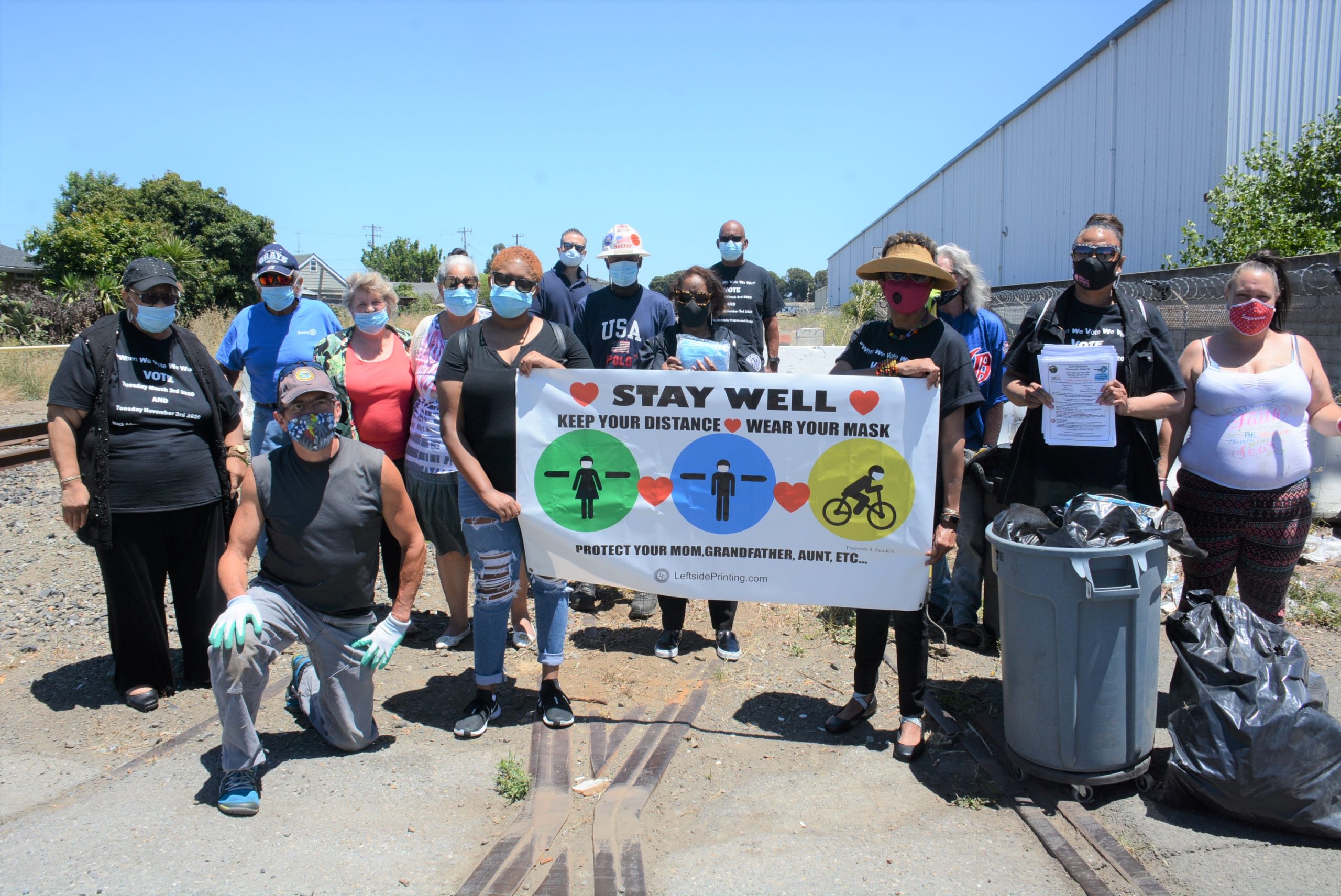
On Tuesday, June 16, the Shields Reid Neighborhood Council, Davis Chapel CME Church and Robert Rogers of Supervisor John Gioia’s office invited a homeless “Streets Team” to begin trash cleanup and organizing of the homeless encampment in North Richmond.
Facilitated by Safe Organized Spaces (SOS!) in Richmond, the SOS! Streets Team employs unsheltered individuals to respond to homelessness at parks, freeways, train tracks, creeks and neighborhood streets impacted by dumping and encampments throughout West Contra Costa County.
The team conducts neighborhood outreach with debris removal, sanitation and hygiene interventions, and community-building processes that lead to improved encampment conditions where unsheltered individuals reside and are supported to shelter-in-place.
The effort started in Central Richmond and now expands across West County.
Each worker is paid a decent wage of $15 per hour for 12 hours or more per week. As the Streets Team builds its personnel – now eight unsheltered individuals – they rely on the support of community members to help meet the challenge of reaching all key encampments where people struggle to shelter themselves and find basic amenities.
While neighborhood beautification is an immediate benefit, the goals of the team’s work are to improve relationships between housed and unsheltered neighbors and to help everyone to recognize how solutions are possible to improve the problems associated with homelessness in our neighborhoods.

The Streets Team is facilitated by SOS!, a community-driven network. The projects of SOS! are fiscally sponsored by TentMakers and Richmond Friends of Recreation. Concerned Richmond community members and agencies continue to join the SOS! network so that housed and unsheltered neighbors may come together and bring about personal, neighborhood and institutional changes. Through the process of integrating encampments and their residents with public agencies, civic groups, neighbors and businesses, SOS! plans to make substantive changes in our responses to homelessness.
The Streets Team has partnered with City and County agencies to place toilet and handwashing portables in key encampment locations. Encampment residents will secure the portable stations and determine responsibilities for sanitation and hygiene. In partnership with Collaborising, a nonprofit that is dedicated to improving race equity and building cross-cultural relationships, the project works with unsheltered leaders in a train-the-trainer process to establish equitable ways to govern the encampments and support safe living conditions.
The Streets Team also distributes food, PPE, hand sanitizer, trash bags and basic amenities to support health hygiene, self-screening and sanitation. It works with Davis Chapel CME Church to provide face masks, gloves, food and water at these encampments. Some 175 lunches are delivered each weekday to encampments through Ephesians of Richmond Church of God in Christ and West Contra County Unified School District.
Richmond is at a critical moment regarding homelessness. Shelters and Warming Centers are closed for adults. The most vulnerable to COVID-19 have been temporarily sheltered in hotels.
Homelessness in Richmond is expected to increase substantially in the coming months as many renters will be unable to pay overdue rents. Temporary hotel stays will end later this year, releasing people back to the streets. Key to increasing Richmond’s capacity to provide interim sheltering before winter includes finding locations to host temporary, managed transitional villages.
Before the pandemic and economic recession, homelessness in Contra Costa County had increased by 43% in two years with more than 1,000 people living outdoors. County Health Services is seeing an alarming increase in the number of homeless seniors in their 70s and 80s. The need is urgent for safe spaces for homeless individuals who are unsheltered and without the resources to pay for housing.
Contributions to the SOS! Streets Team can be made at Venmo: SOS_Richmond. To join the SOS! network to make changes in response to homelessness, call Daniel Barth at 510-990-2686.
Join the Streets Team by showing up with gloves and wearing a mask to contribute to the North Richmond Community Cleanup on Saturday, June 27, 2020 from 8:30 a.m.-12:30 p.m. Meet the team at the end of Castro Street near Fred Jackson Way.



Activism
Oakland Post: Week of April 8 – 14, 2026
The printed Weekly Edition of the Oakland Post: Week of April 8 – 14, 2026


To enlarge your view of this issue, use the slider, magnifying glass icon or full page icon in the lower right corner of the browser window.

Activism
Oakland Post: Week of April 1 – 7, 2026
The printed Weekly Edition of the Oakland Post: Week of April 1 – 7, 2026

To enlarge your view of this issue, use the slider, magnifying glass icon or full page icon in the lower right corner of the browser window.
#NNPA BlackPress
Black Artists in America, Installation Three Wraps at the Dixon Gallery and Gardens
TRI-STATE DEFENDER — With 50+ paintings, sculptures and assemblages, the exhibit features artists like Varnette Honeywood from Los Angeles, whose pieces appeared in Bill Coby’s private collection (before they were auctioned off) and on “The Cosby Show.” Also included are works by Alonzo Davis, another Los Angeles artist who opened one of the first galleries there where Black Artists could exhibit.

By Candace A. Gray | Tri-State Defender
The tulips gleefully greet those who enter the gates at the Dixon Gallery & Gardens on an almost spring day. More than 650,000 bulbs of various hues are currently on display. And they are truly breathtaking.
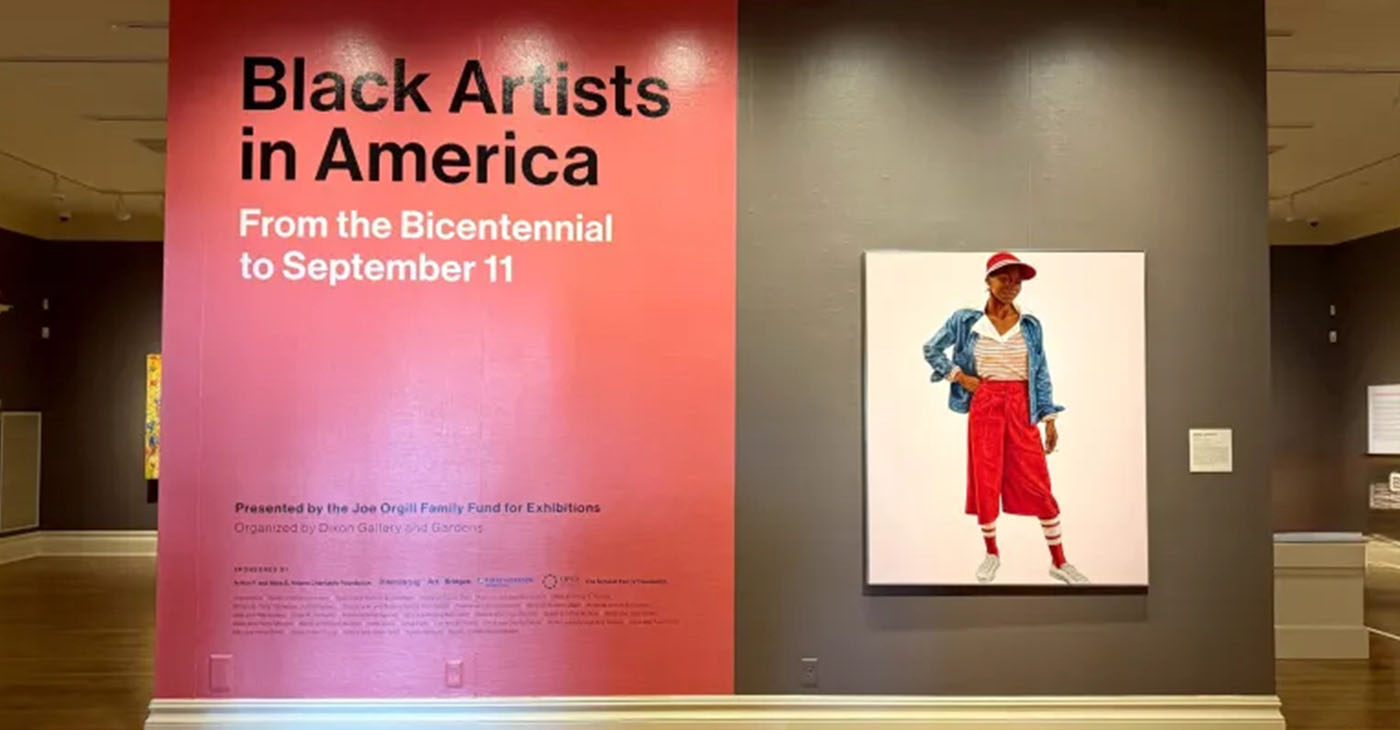
Inside the gallery, and equally as breathtaking, is the “Black Artists in America, From the Bicentennial to September 11” exhibit, which runs through Sunday, March 29. This is the third installment of a three-part series that started years ago and illustrates part of the Black experience through visual arts in the 20th century.
“This story picks up where part two left off,’’ said Kevin Sharp, the Linda W. and S. Herbert Rhea director for the Dixon. “This era is when we really start to see the emergence of these important Black artists’ agency and freedom shine through. They start to say and express what they want to, and it was a really beautiful time.”
With 50+ paintings, sculptures and assemblages, the exhibit features artists like Varnette Honeywood from Los Angeles, whose pieces appeared in Bill Coby’s private collection (before they were auctioned off) and on “The Cosby Show.” Also included are works by Alonzo Davis, another Los Angeles artist who opened one of the first galleries there where Black Artists could exhibit.
“Though [Davis] was from LA, he actually lived in Memphis for a decade,” said Sharp. “He was a dean at Memphis College of Art, and later opened the first gallery in New York owned and operated by black curators.”
Another featured artist is former NFL player, Ernie Barnes. His work is distinctive. Where have you seen one of his most popular paintings, Sugar Shack? On the end scene and credits of the hit show “Good Times.” His piece Saturday Night, Durham, North Carolina, 1974 is in this collection.
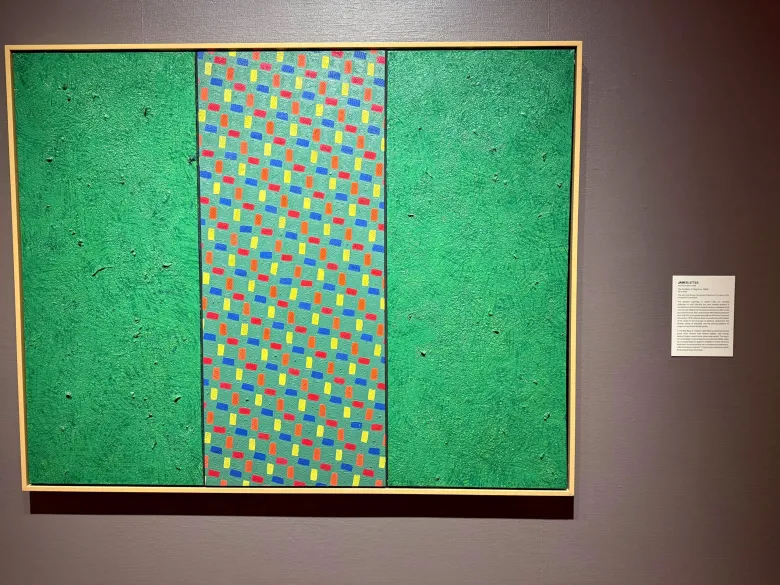
Memphis native James Little’s “The War Baby: The Triptych” is among more than 50 works featured in “Black Artists in America, From the Bicentennial to September 11” at the Dixon Gallery & Gardens, the final installment of a three-part series highlighting the impact and evolution of Black artists through 2011.
The exhibit features other artists with Memphis ties, including abstract painter James Little, who was raised in a segregated Memphis and attended Memphis Academy of Art (before it was Memphis College of Art). He later moved to New York, became a teacher and an internationally acclaimed fixture in the art world in 2022 when he was named a Whitney Biennial selected artist at the Whitney Museum of American Art in New York.
Other artists like Romare Bearden, who had a Southern experience but lived up North, were featured in all three installments.
“During this period of time, he was a major figure,” said Sharp. “He wrote one of the first books on the history of African American art during a time when there were more Black academics, art teachers, more Black everything!”
Speaking of Black educators, Sharp said the head curator behind this tri-part series and Dixon’s partner in the arts is Earnestine Jenkins, Ph.D., an art history professor at the University of Memphis, who also earned a Master of Arts degree from Memphis State University (now UofM). “We began working with Dr. Jenkins in 2018,” he said.
Sharp explained that it takes a team of curators, registrars, counterparts at other museums, and more, about three years to assemble an exhibit like this. It came together quite seamlessly, he added. Each room conjured up more jaw-dropping “wows” than the one before it. Each piece worked with the others to tell the story of Black people and their collective experience during this time period.
One of the last artists about whom Sharp shared information was Bettye Saar, who will turn 100 years old this year. She’s been working in Los Angeles for 80 years and is finally getting her due. Her medium is collages or assemblages, and an incredible work of hers is on display. She’s married to an artist and has two daughters, also artists.
The exhibit catalogue bears some of these artists’ stories, among other scholarly information.
The exhibit, presented by the Joe Orgill Family Fund for Exhibitions, is culturally and colorfully rich. It is a must see and admission to the Dixon is free.
Visit https://www.dixon.org/ to learn more.
Fun Facts: An original James Little design lives in the flooring of the basketball court at Tom Lee Park, and he makes and mixes his own paint colors.


WORK FROM HOME
Home-based business with potential monthly income of $10K+ per month. A proven training system and website provided to maximize business effectiveness. Perfect job to earn side and primary income. Contact Lynne for more details: Lynne4npusa@gmail.com 800-334-0540


Oakland Post: Week of April 8 – 14, 2026

Oakland Post: Week of April 1 – 7, 2026

Black Artists in America, Installation Three Wraps at the Dixon Gallery and Gardens

Grief, Advocacy, and Education: A Counselor Reflects on Black Maternal Health

Future of Florida’s Black History Museum in Limbo

New Research Shows the Many Benefits of Early Learning

South Hampton K-8 Students Among Top 10 Finalists for Samsung’s ‘Solve for Tomorrow’ Competition

Cuba: No Negotiation with US on the President or Political System

Brooklyn Academy of Music Names Jamaican-Born Tamara McCaw as President

Trinidad & Tobego – U.S. Launches WhatsApp Channel for American Citizens in the Country

Oakland Post: Week of March 18 – 24, 2026

AI Innovation vs. Ethics and Environmental Impact

AI, Web3, and Digital Reparations

What If You Owned Your AI Agent?

Season 7, Episode 3 – January Reporter’s Roundtable 📱

Reflecting on Black History Milestones in Birmingham AL

Oakland Post: Week of February 25 – March 3, 2026

Oakland Post: Week of March 4 – 10, 2026

PRESS ROOM: NBA Hall of Fame Nominee Terry Cummings Joins 100 Black Men of DeKalb County to Launch Victory & Values Initiative

Trump’s MAGA Allies are Creating Executive Order Plan to Steal the 2026 Midterms

U.S. manufacturing rebounds – how foundry services are adapting to rising demand

Poll Shows Support for Policies That Help Families Afford Child Care

Oakland Post: Week of March 11 -17, 2026
Oakland Post: Week of March 18 – 24, 2026

OP-ED: One Hundred Years of Black Workers Telling the Truth

Advancements in solar technology that are changing the way we power the world

Financial Wellness and Mental Health: Managing Money Stress in College

Woman’s Search for Family’s Roots Leads to Ancestor John T. Ward – A Successful Entrepreneur and Conductor on the Underground Railroad

COMMENTARY: Women of Color Shape Our Past and Future

PRESS ROOM: Civil Rights TV Launches in Selma as the World’s First 24/7 Civil Rights Television Network

Hyundai Ioniq 5 Parking, Safety, and 360 View #shorts

2025 Ioniq 5 New Wiper & Powerful Performance! #shorts

Electric SUV Range: Is 259 Miles Enough? #shorts

EV Charging: How Fast Can You Charge an Electric Vehicle? #shorts

Biometric Cooling… Messaging Seats…Come on! 2025 Infiniti QX80 Autograph 4WD

Charged Up: Witness the Magic of a Fully Electric Car! #shorts

Range Rover Sport PHEV Included…: See What’s Inside This Luxury SUV! #shorts

Invisible Hood View: Perfect Parking with X-Ray Vision! #shorts

AI Is Reshaping Black Healthcare: Promise, Peril, and the Push for Improved Results in California

ESSAY: Technology and Medicine, a Primary Care Point of View

Sanctuary Cities

The RESISTANCE – FREEDOM NOW

STATE OF THE PEOPLE: Freddie

ECONOMIC BOYCOTT DAY!!!!!

I told You So
-
 Activism3 weeks ago
Oakland Post: Week of March 11 -17, 2026
-
 Activism3 weeks ago
Oakland Post: Week of March 18 – 24, 2026
-
 Advice3 weeks ago
Financial Wellness and Mental Health: Managing Money Stress in College
-
 #NNPA BlackPress3 weeks ago
Brooklyn Academy of Music Names Jamaican-Born Tamara McCaw as President
-
 #NNPA BlackPress2 weeks ago
Grief, Advocacy, and Education: A Counselor Reflects on Black Maternal Health
-
 #NNPA BlackPress2 weeks ago
New Research Shows the Many Benefits of Early Learning
-
 #NNPA BlackPress2 weeks ago
Black Artists in America, Installation Three Wraps at the Dixon Gallery and Gardens
-

 Advice4 weeks ago
Women & Wealth: Tips for Navigating Your Lifelong Financial Journey
