
Crime
Historic Settlement Ends CA Indefinite Solitary Confinement

Federal Judge Claudia Wilken this week approved the final agreement to end indefinite solitary confinement in California calling the settlement humane, innovative and fair.
Prisoners celebrated Tuesday’s settlement agreement, whose terms were agreed on last September, claiming it as a victory that bolstered their struggle for human rights.
<p>
Oakland civil rights attorney Anne Weills, one of the attorneys representing the prisoners, said, “What was missing from the courtroom were all the prisoners who risked their lives in the hunger strikes of 2011 and 2013.”

Attorney Anne Weills speaks at a press conference in Oakland.
“Yes, our litigation team did the best we could to bring our clients out of indefinite solitary confinement and into the light of day – but there is no doubt that we could not have gotten where we have with this settlement without the leadership of the brilliant, courageous, fearless and enlightened men in the Short Corridor at Pelican Bay who in 2011 set this all in motion,” she said.
The Center for Constitutional Rights released data showing the agreement has already led to the transfer of hundreds of prisoners from segregated housing units back to the state’s general prison population.

Between preliminary approval of the California settlement in October and Jan. 22, 686 out of a total of 1,813 prisoners entitled to reviews under the settlement have been reviewed for release into the general prisoner population; 546 of the prisoners reviewed, nearly 80 percent, have been cleared for release into general population; and 437 have actually been released from solitary confinement.
The vast majority of prisoners who have been reviewed but not cleared are awaiting a higher-level prison review; most are expected to be released into general population as well.
The settlement requires all first-level reviews to be complete within one year.
Jules Lobel, the attorney representing the Center for Constitutional Rights said “we look forward to the full implementation of all its terms.”
One of the longtime prisoner organizers, Mutope Duguma, cautions, “The power of the legal support and the family/community support is what literally humanized us prisoners to the rest of the world. The countless families and friends did a remarkable job in representing us from an emotional and human perspective and our legal support represented our civil and human rights, and together they re-humanized us as men and women.”
“This is what made it possible for us to be able to demand such a settlement. It is with this family, community, and legal support that we demand accountable implementation of the settlement. We know what works so let’s stay the course,” he said.
A recently released letter written by one of the main representatives of the prisoners asks that prisoners “Monitor and report on the functional implementation of prison conditions and California Department of Corrections and Rehabilitation (CDCR) employees, holding their feet to the ground and letting CDCR employees know that they are not above the Ashker v. Brown Settlement Agreement.”
The settlement transforms California’s use of solitary confinement from a status-based system, in which prisoners were isolated indefinitely based on vague and unsubstantiated allegations of gang affiliation, to a behavior-based system, in which solitary confinement is used only as punishment for serious rule infractions and only for determinate periods of time. It also limits the total amount of time a prisoner can spend in the Security Housing Unit (SHU) at Pelican Bay State Prison.
The settlement includes a two-year monitoring period, which may be extended if the CDCR is found to be violating prisoners’ constitutional rights or the settlement terms.
When the case was filed in 2012 on behalf of prisoners in Pelican Bay, more than 500 of them had been isolated in the SHU for over 10 years, and 78 had been there for more than 20 years. They spent 22-and-a-half to 24-hours every day in a cramped, concrete, windowless cell, and were denied telephone calls, physical contact with visitors, and vocational, recreational, and educational programming.
Hundreds of other prisoners throughout California have been held in similar SHU conditions, and the settlement applies to all of them.







Activism
Oakland Post: Week of March 18 – 24, 2026
The printed Weekly Edition of the Oakland Post: Week of March 18 – 24, 2026

To enlarge your view of this issue, use the slider, magnifying glass icon or full page icon in the lower right corner of the browser window.
Activism
Oakland Post: Week of March 11 -17, 2026
The printed Weekly Edition of the Oakland Post: Week of March 11 – 17, 2026
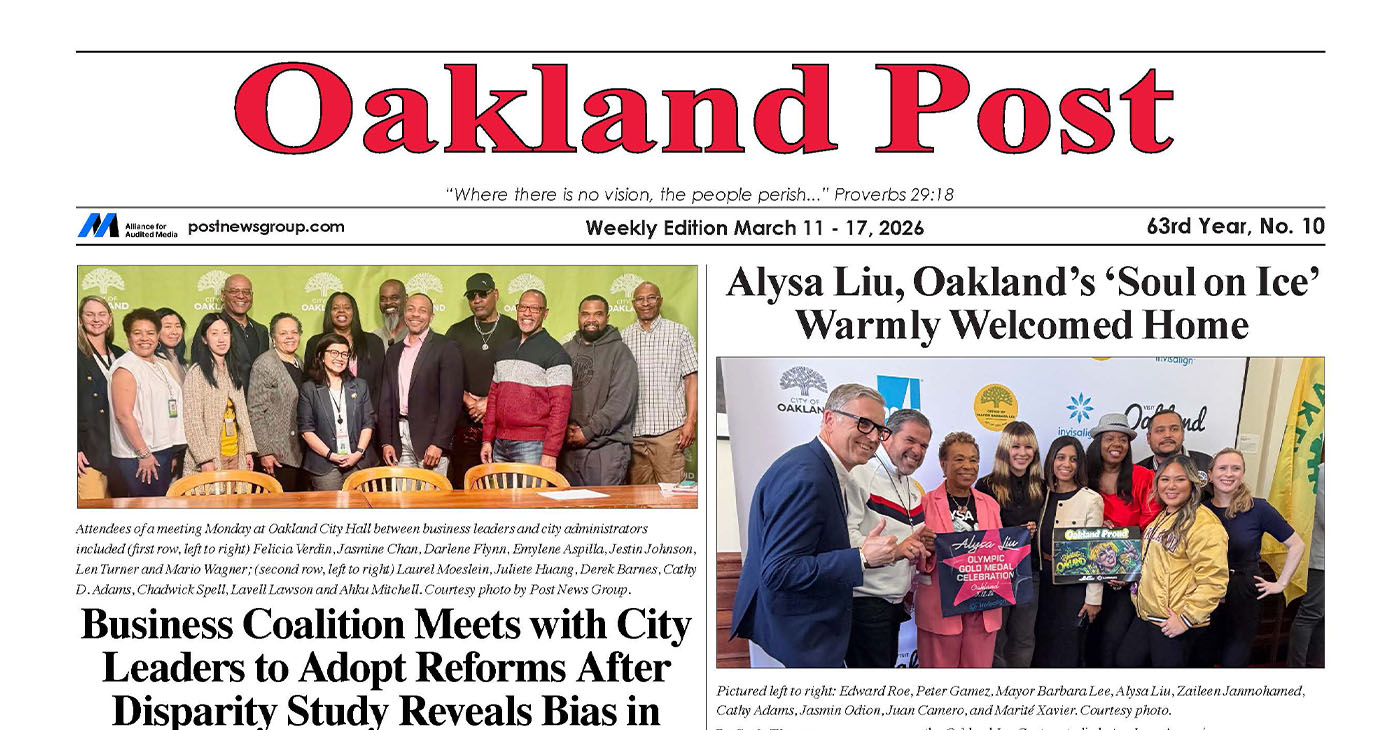
To enlarge your view of this issue, use the slider, magnifying glass icon or full page icon in the lower right corner of the browser window.
Activism
Oakland Post: Week of March 4 – 10, 2026
The printed Weekly Edition of the Oakland Post: Week of March 4 – 10, 2026

To enlarge your view of this issue, use the slider, magnifying glass icon or full page icon in the lower right corner of the browser window.


WORK FROM HOME
Home-based business with potential monthly income of $10K+ per month. A proven training system and website provided to maximize business effectiveness. Perfect job to earn side and primary income. Contact Lynne for more details: Lynne4npusa@gmail.com 800-334-0540


Black Artists in America, Installation Three Wraps at the Dixon Gallery and Gardens

Grief, Advocacy, and Education: A Counselor Reflects on Black Maternal Health

Future of Florida’s Black History Museum in Limbo

New Research Shows the Many Benefits of Early Learning

South Hampton K-8 Students Among Top 10 Finalists for Samsung’s ‘Solve for Tomorrow’ Competition

Cuba: No Negotiation with US on the President or Political System

Brooklyn Academy of Music Names Jamaican-Born Tamara McCaw as President

Trinidad & Tobego – U.S. Launches WhatsApp Channel for American Citizens in the Country

Oakland Post: Week of March 18 – 24, 2026

AI Innovation vs. Ethics and Environmental Impact

AI, Web3, and Digital Reparations

What If You Owned Your AI Agent?

Season 7, Episode 3 – January Reporter’s Roundtable 📱

Season 7, Episode 3 – January Reporter’s Roundtable

AI, Media, and Power | Part 2, Real-World Impacts and Tradeoffs

Reflecting on Black History Milestones in Birmingham AL

CITY OF SAN LEANDRO STATE OF CALIFORNIA PUBLIC WORKS DEPARTMENT ENGINEERING DIVISION NOTICE TO BIDDERS FOR ANNUAL STREET OVERLAY/REHABILITATION 2019-21 – PHASE III

Oakland Post: Week of February 18 – 24, 2026

Oakland Post: Week of February 25 – March 3, 2026

PRESS ROOM: NBA Hall of Fame Nominee Terry Cummings Joins 100 Black Men of DeKalb County to Launch Victory & Values Initiative

Trump’s MAGA Allies are Creating Executive Order Plan to Steal the 2026 Midterms

U.S. manufacturing rebounds – how foundry services are adapting to rising demand

Oakland Post: Week of March 4 – 10, 2026

Chase Oakland Community Center Hosts Alley-Oop Accelerator Building Community and Opportunity for Bay Area Entrepreneurs

Poll Shows Support for Policies That Help Families Afford Child Care

OP-ED: One Hundred Years of Black Workers Telling the Truth

Advancements in solar technology that are changing the way we power the world

Woman’s Search for Family’s Roots Leads to Ancestor John T. Ward – A Successful Entrepreneur and Conductor on the Underground Railroad

PRESS ROOM: Civil Rights TV Launches in Selma as the World’s First 24/7 Civil Rights Television Network

COMMENTARY: Women of Color Shape Our Past and Future

Hyundai Ioniq 5 Parking, Safety, and 360 View #shorts

2025 Ioniq 5 New Wiper & Powerful Performance! #shorts

Electric SUV Range: Is 259 Miles Enough? #shorts

EV Charging: How Fast Can You Charge an Electric Vehicle? #shorts

Biometric Cooling… Messaging Seats…Come on! 2025 Infiniti QX80 Autograph 4WD

Charged Up: Witness the Magic of a Fully Electric Car! #shorts

Range Rover Sport PHEV Included…: See What’s Inside This Luxury SUV! #shorts

Invisible Hood View: Perfect Parking with X-Ray Vision! #shorts

AI Is Reshaping Black Healthcare: Promise, Peril, and the Push for Improved Results in California

ESSAY: Technology and Medicine, a Primary Care Point of View

Sanctuary Cities

The RESISTANCE – FREEDOM NOW

STATE OF THE PEOPLE: Freddie

ECONOMIC BOYCOTT DAY!!!!!

I told You So
-
 Activism4 weeks ago
Oakland Post: Week of March 4 – 10, 2026
-
 #NNPA BlackPress4 weeks ago
Woman’s Search for Family’s Roots Leads to Ancestor John T. Ward – A Successful Entrepreneur and Conductor on the Underground Railroad
-
 #NNPA BlackPress4 weeks ago
COMMENTARY: Women of Color Shape Our Past and Future
-

 #NNPA BlackPress4 weeks ago
OP-ED: NNPA Launches 2026 “Leadership Matters” Video Series
-

 Activism2 weeks ago
Oakland Post: Week of March 11 -17, 2026
-

 #NNPA BlackPress4 weeks ago
Advocates Raise Alarm Over ICE Operation, MOU and Detention Risks in Baltimore County
-

 #NNPA BlackPress4 weeks ago
Pete Buttigieg to Join Mayor Randall Woodfin for Community Town Hall in Birmingham
-

 Advice2 weeks ago
Financial Wellness and Mental Health: Managing Money Stress in College
