
Crime
Hillary Clinton Pledges Commitment to Reforming Criminal Justice

At Columbia University today, Hillary Clinton called for the end of the “era of mass incarceration.” During remarks at the 18th Annual David N. Dinkins Leadership and Public Policy Forum, Clinton outlined the criminal justice challenges we face today, including in Baltimore, and the first ideas on solutions to meet them.
Hillary called for innovative solutions by changing the way we approach punishment and prison saying, “It’s time to end the era of mass incarceration.” She also addressed the need for innovative strategies to fight crime and rebuild trust between law enforcement and the communities they represent, including body cameras for every police department in the country.
Full text of the remarks as delivered are available below:
Thank you so much. I am absolutely delighted to be back here at Columbia. I want to thank President Bollinger, Dean Janow, and everyone at the School of International and Public Affairs. It is a special treat to be here with and on behalf of a great leader of this city and our country, David Dinkins. He has made such an indelible impact on New York, and I had the great privilege of working with him as First Lady and then, of course, as a new senator.
When I was just starting out as a senator, David’s door was always open. He and his wonderful wife Joyce were great friends and supporters and good sounding boards about ideas that we wanted to consider to enhance the quality of life and the opportunities for the people of this city. I was pleased to address the Dinkins Leadership and Public Policy Forum in my first year as a senator, and I so appreciated then as I have in the years since David’s generosity with his time and most of all his wisdom. So 14 years later, I’m honored to have this chance, once again, to help celebrate the legacy of one of New York’s greatest public servants.
I’m pleased too that you will have the opportunity after my remarks to hear from such a distinguished panel, to go into more detail about some of the issues that we face. I also know that Manhattan Borough President Gail Brewer is here, along with other local and community leaders.
Because surely this is a time when our collective efforts to devise approaches to the problems that still afflict us is more important than ever. Indeed, it is a time for wisdom.
For yet again, the family of a young black man is grieving a life cut short. Yet again, the streets of an American city are marred by violence. By shattered glass and shouts of anger and shows of force.
Yet again a community is reeling, its fault lines laid bare and its bonds of trust and respect frayed.
Yet again, brave police officers have been attacked in the line of duty. What we’ve seen in Baltimore should, indeed does, tear at our soul.
And, from Ferguson to Staten Island to Baltimore, the patterns have become unmistakable and undeniable.
Walter Scott shot in the back in Charleston, South Carolina. Unarmed. In debt. And terrified of spending more time in jail for child support payments he couldn’t afford.
Tamir Rice shot in a park in Cleveland, Ohio. Unarmed and just 12 years old.
Eric Garner choked to death after being stopped for selling cigarettes on the streets of this city. And now Freddie Gray. His spine nearly severed while in police custody.
Not only as a mother and a grandmother but as a citizen, a human being, my heart breaks for these young men and their families.
We have to come to terms with some hard truths about race and justice in America.
There is something profoundly wrong when African American men are still far more likely to be stopped and searched by police, charged with crimes, and sentenced to longer prison terms than are meted out to their white counterparts.
There is something wrong when a third of all black men face the prospect of prison during their lifetimes. And an estimated 1.5 million black men are “missing” from their families and communities because of incarceration and premature death.
There is something wrong when more than one out of every three young black men in Baltimore can’t find a job.
There is something wrong when trust between law enforcement and the communities they serve breaks down as far as it has in many of our communities.
We have allowed our criminal justice system to get out of balance. And these recent tragedies should galvanize us to come together as a nation to find our balance again.
We should begin by heeding the pleas of Freddie Gray’s family for peace and unity, echoing the families of Michael Brown, Trayvon Martin, and others in the past years.
Those who are instigating further violence in Baltimore are disrespecting the Gray family and the entire community. They are compounding the tragedy of Freddie Gray’s death and setting back the cause of justice. So the violence has to stop.
But more broadly, let’s remember that everyone in every community benefits when there is respect for the law and when everyone in every community is respected by the law. That is what we have to work towards in Baltimore and across our country.
We must urgently begin to rebuild the bonds of trust and respect among Americans. Between police and citizens, yes, but also across society.
Restoring trust in our politics, our press, our markets. Between and among neighbors and even people with whom we disagree politically.
This is so fundamental to who we are as a nation and everything we want to achieve together. It truly is about how we treat each other and what we value. Making it possible for every American to reach his or her God-given potential—regardless of who you are, where you were born, or who you love.
The inequities that persist in our justice system undermine this shared vision of what America can be and should be.
I learned this firsthand as a young attorney just out of law school—at one of those law schools that will remain nameless here at Columbia. One of my earliest jobs for the Children’s Defense Fund, which David had mentioned—I was so fortunate to work with Marian Wright Edelman as a young lawyer and then serving on the board of the Children’s Defense Fund—was studying the problem then of youth, teenagers, sometimes preteens, incarcerated in adult jails. Then, as director of the University of Arkansas School of Law’s legal aid clinic, I advocated on behalf of prison inmates and poor families.
I saw repeatedly how our legal system can be and all too often is stacked against those who have the least power, who are the most vulnerable. I saw how families could be and were torn apart by excessive incarceration. I saw the toll on children growing up in homes shattered by poverty and prison.
So, unfortunately, I know these are not new challenges by any means. In fact they have become even more complex and urgent over time. And today they demand fresh thinking and bold action from all of us.
Today there seems to be a growing bipartisan movement for commonsense reforms in our criminal justice systems. Senators as disparate on the political spectrum as Cory Booker and Rand Paul and Dick Durbin and Mike Lee are reaching across the aisle to find ways to work together. It is rare to see Democrats and Republicans agree on anything today. But we’re beginning to agreeing on this: We need to restore balance to our criminal justice system. Now of course it is not enough just to agree and give speeches about it—we actually have to work together to get the job done.
We need to deliver real reforms that can be felt on our streets, in our courthouses, and our jails and prisons, in communities too long neglected.
Let me touch on two areas in particular where I believe we need to push for more progress. First, we need smart strategies to fight crime that help restore trust between law enforcement and our communities, especially communities of color.
There’s a lot of good work to build on. Across the country, there are so many police officers out there every day inspiring trust and confidence, honorably doing their duty, putting themselves on the line to save lives. There are police departments already deploying creative and effective strategies, demonstrating how we can protect the public without resorting to unnecessary force. We need to learn from those examples, build on what works.
We can start by making sure that federal funds for state and local law enforcement are used to bolster best practices, rather than to buy weapons of war that have no place on our streets. President Obama’s task force on policing gives us a good place to start. Its recommendations offer a roadmap for reform, from training to technology, guided by more and better data. We should make sure every police department in the country has body cameras to record interactions between officers on patrol and suspects.
That will improve transparency and accountability; it will help protect good people on both sides of the lens. For every tragedy caught on tape, there surely have been many more that remained invisible. Not every problem can be or will be prevented with cameras, but this is a commonsense step we should take.
The President has provided the idea of matching funds to state and local governments investing in body cameras. We should go even further and make this the norm everywhere. And we should listen to law enforcement leaders who are calling for a renewed focus on working with communities to prevent crime, rather than measuring success just by the number of arrests or convictions.
As your Senator from New York, I supported a greater emphasis on community policing, along with putting more officers on the street to get to know those communities.
David Dinkins was an early pioneer of this policy. His leadership helped lay the foundation for dramatic drops in crime in the years that followed.
And today smart policing in communities that builds relationships, partnerships, and trust makes more sense than ever. And it shouldn’t be limited just to officers on the beat. It’s an ethic that should extend throughout our criminal justice system. To prosecutors and parole officers. To judges and lawmakers. We all share a responsibility to help re-stitch the fabric of our neighborhoods and communities. We also have to be honest about the gaps that exist across our country, the inequality that stalks our streets. Because you cannot talk about smart policing and reforming the criminal justice system if you also don’t talk about what’s needed to provide economic opportunity, better educational chances for young people, more support to families so they can do the best jobs they are capable of doing to help support their own children.
Today I saw an article on the front page of USA Today that really struck me, written by a journalist who lives in Baltimore. And here’s what I read three times to make sure I was reading correctly: “At a conference in 2013 at Johns Hopkins University, Vice Provost Jonathan Bagger pointed out that only six miles separate the Baltimore neighborhoods of Roland Park and Hollins Market.
But there is a 20-year difference in the average life expectancy.” We have learned in the last few years that life expectancy, which is a measure of the quality of life in communities and countries, manifests the same inequality that we see in so many other parts of our society.
Women—white women without high school education—are losing life expectancy. Black men and black women are seeing their life expectancy goes down in so many parts of our country. This may not grab headlines, although I was glad to see it on the front page of USA Today. But it tells us more than I think we can bear about what we are up against.
We need to start understanding how important it is to care for every single child as though that child were our own.
David and I started our conversation this morning talking about our grandchildren; now his are considerably older than mine. But it was not just two longtime friends catching up with each other. It was so clearly sharing what is most important to us, as it is to families everywhere in our country.
So I don’t want the discussion about criminal justice, smart policing, to be siloed and to permit discussions and arguments and debates about it to only talk about that. The conversation needs to be much broader. Because that is a symptom, not a cause, of what ails us today. The second area where we need to chart a new course is how we approach punishment and prison.
It’s a stark fact that the United States has less than 5 percent of the world’s population, yet we have almost 25 percent of the world’s total prison population. The numbers today are much higher than they were 30, 40 years ago, despite the fact that crime is at historic lows. Of the more than 2 million Americans incarcerated today, a significant percentage are low-level offenders: people held for violating parole or minor drug crimes, or who are simply awaiting trial in backlogged courts.
Keeping them behind bars does little to reduce crime. But it is does a lot to tear apart families and communities.
One in every 28 children now has a parent in prison. Think about what that means for those children.
When we talk about one and a half million missing African American men, we’re talking about missing husbands, missing fathers, missing brothers. They’re not there to look after their children or bring home a paycheck. And the consequences are profound.
Without the mass incarceration that we currently practice, millions fewer people would be living in poverty.
And it’s not just families trying to stay afloat with one parent behind bars. Of the 600,000 prisoners who reenter society each year, roughly 60 percent face long-term unemployment. And for all this, taxpayers are paying about $80 billion a year to keep so many people in prison. The price of incarcerating a single inmate is often more than $30,000 per year—and up to$60,000 in some states. That’s the salary of a teacher or police officer.
One year in a New Jersey state prison costs $44,000—more than the annual tuition at Princeton. If the United States brought our correctional expenditures back in line with where they were several decades ago, we’d save an estimated $28 billion a year. And I believe we would not be less safe. You can pay a lot of police officers and nurses and others with $28 billion to help us deal with the pipeline issues.
It’s time to change our approach. It’s time to end the era of mass incarceration. We need a true national debate about how to reduce our prison population while keeping our communities safe. I don’t know all the answers. That’s why I’m here—to ask all the smart people in Columbia and New York to start thinking this through with me. I know we should work together to pursue together to pursue alternative punishments for low-level offenders. They do have to be in someway registered in the criminal justice system, but we don’t want that to be a fast track to long-term criminal activity, we don’t want to create another “incarceration generation.”
I’ve been encouraged to see changes that I supported as Senator to reduce the unjust federal sentencing disparity between crack and powder cocaine crimes finally become law.
And last year, the Sentencing Commission reduced recommended prison terms for some drug crimes. President Obama and former Attorney General Holder have led the way with important additional steps. And I am looking forward to our new Attorney General, Loretta Lynch, carrying this work forward.
There are other measures that I and so many others have championed to reform arbitrary mandatory minimum sentences are long overdue.
We also need probation and drug diversion programs to deal swiftly with violations, while allowing low-level offenders who stay clean and stay out of trouble to stay out of prison. I’ve seen the positive effects of specialized drug courts and juvenile programs work to the betterment of individuals and communities. And please, please, let us put mental health back at the top of our national agenda.
You and I know that the promise of de-institutionalizing those in mental health facilities was supposed to be followed by the creation of community-based treatment centers. Well, we got half of that equation—but not the other half. Our prisons and our jails are now our mental health institutions.
I have to tell you I was somewhat surprised in both Iowa and New Hampshire to be asked so many questions about mental health. “What are we going to do with people who need help for substance abuse or mental illness?” “What are we going to do when the remaining facilities are being shut down for budget reasons?” “What are we going to do when hospitals don’t really get reimbursed for providing the kind of emergency care that is needed for mental health patients?” It’s not just a problem in our cities. There’s a quiet epidemic of substance abuse sweeping small-town and rural America as well. We have to do more and finally get serious about treatment. I’ll be talking about all of this in the months to come, offering new solutions to protect and strengthen our families and communities.
I know in a time when we’re afflicted by short-termism, we’re not looking over the horizon for the investments that we need to make in our fellow citizens, in our children. So I’m well aware that progress will not be easy, despite the emerging bipartisan consensus for certain reforms. And that we will have to overcome deep divisions and try to begin to replenish our depleted reservoirs of trust.
But I am convinced, as the congenital optimist I must be to live my life, that we can rise to this challenge. We can heal our wounds. We can restore balance to our justice system and respect in our communities. And we can make sure that we take actions that are going to make a difference in the lives of those who for too long have been marginalized and forgotten. Let’s protect the rights of all our people. Let’s take on the broader inequities in our society. You can’t separate out the unrest we see in the streets from the cycles of poverty and despair that hollow out those neighborhoods.
Despite all the progress we’ve made in this country lifting people up—and it has been extraordinary—too many of our fellow citizens are still left out. Twenty-five years ago, in his inaugural address as Mayor, David Dinkins warned of leaving “too many lost amidst the wealth and grandeur that surrounds us.”
Today, his words and the emotion behind them ring truer than ever. You don’t have to look too far from this magnificent hall to find children still living in poverty or trapped in failing schools. Families who work hard but can’t afford the rising prices in their neighborhood.
Mothers and fathers who fear for their sons’ safety when they go off to school—or just to go buy a pack of Skittles. These challenges are all woven together. And they all must be tackled together.
Our goal must truly be inclusive and lasting prosperity that’s measured by how many families get ahead and stay ahead…
How many children climb out of poverty and stay out of prison…
How many young people can go to college without breaking the bank…
How many new immigrants can start small businesses…
How many parents can get good jobs that allow them to balance the demands of work and family.
That’s how we should measure prosperity. With all due respect, that is a far better measurement than the size of the bonuses handed out in downtown office buildings.
Now even in the most painful times like those we are seeing in Baltimore…
When parents fear for their children…
When smoke fills the skies above our cities…
When police officers are assaulted…
Even then—especially then—let’s remember the aspirations and values that unite us all: That every person should have the opportunity to succeed. That no one is disposable. That every life matters.
So yes, Mayor Dinkins. This is a time for wisdom. A time for honesty about race and justice in America.
And, yes, a time for reform. David Dinkins is a leader we can look to. We know what he stood for. Let us take the challenge and example he presents and think about what we must do to make sure that this country we love—this city we live in—are both good and great.
And please join me in saying a prayer for the family of Freddie Gray, and all the men whose names we know and those we don’t who have lost their lives unnecessarily and tragically. And in particular today, include in that prayer the people of Baltimore and our beloved country.
Thank you all very much.
Courtesy of FoxNews.com










Activism
Oakland Post: Week of March 18 – 24, 2026
The printed Weekly Edition of the Oakland Post: Week of March 18 – 24, 2026
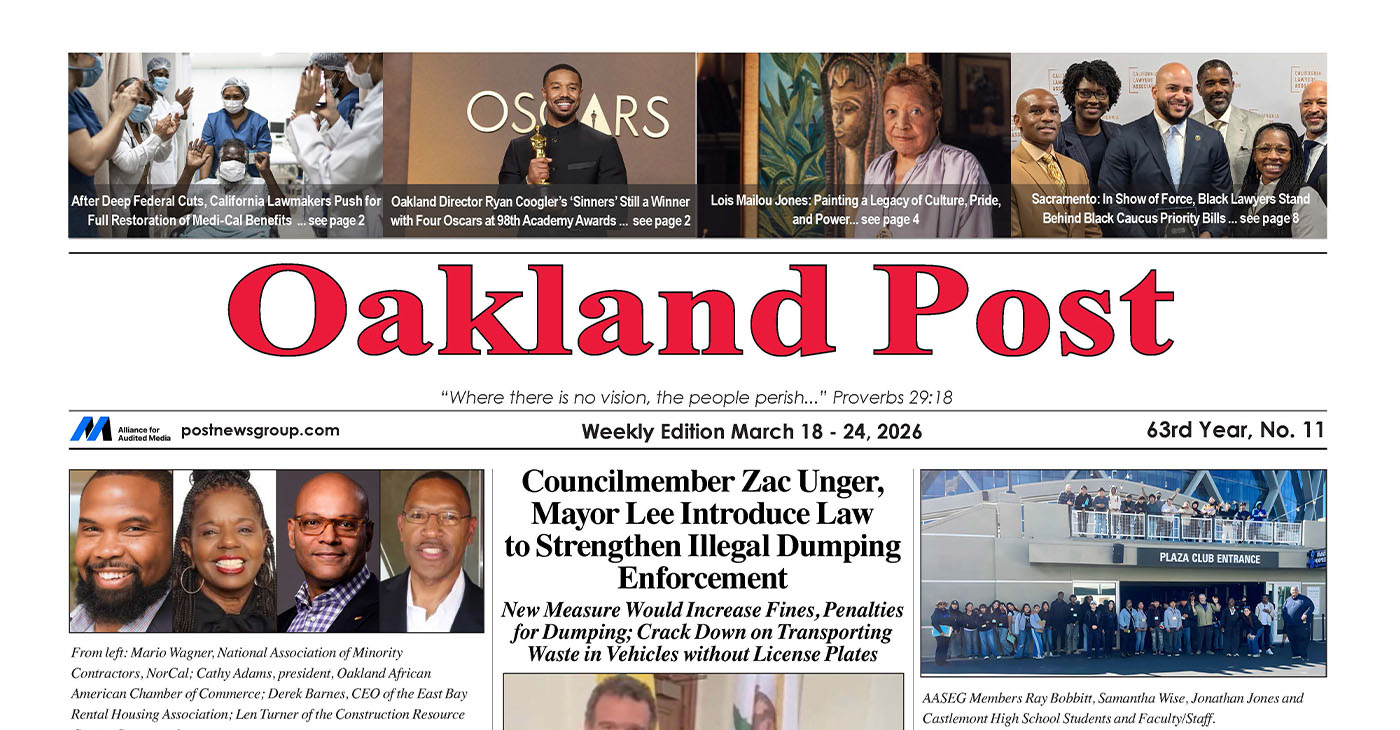
To enlarge your view of this issue, use the slider, magnifying glass icon or full page icon in the lower right corner of the browser window.
Activism
Oakland Post: Week of March 11 -17, 2026
The printed Weekly Edition of the Oakland Post: Week of March 11 – 17, 2026
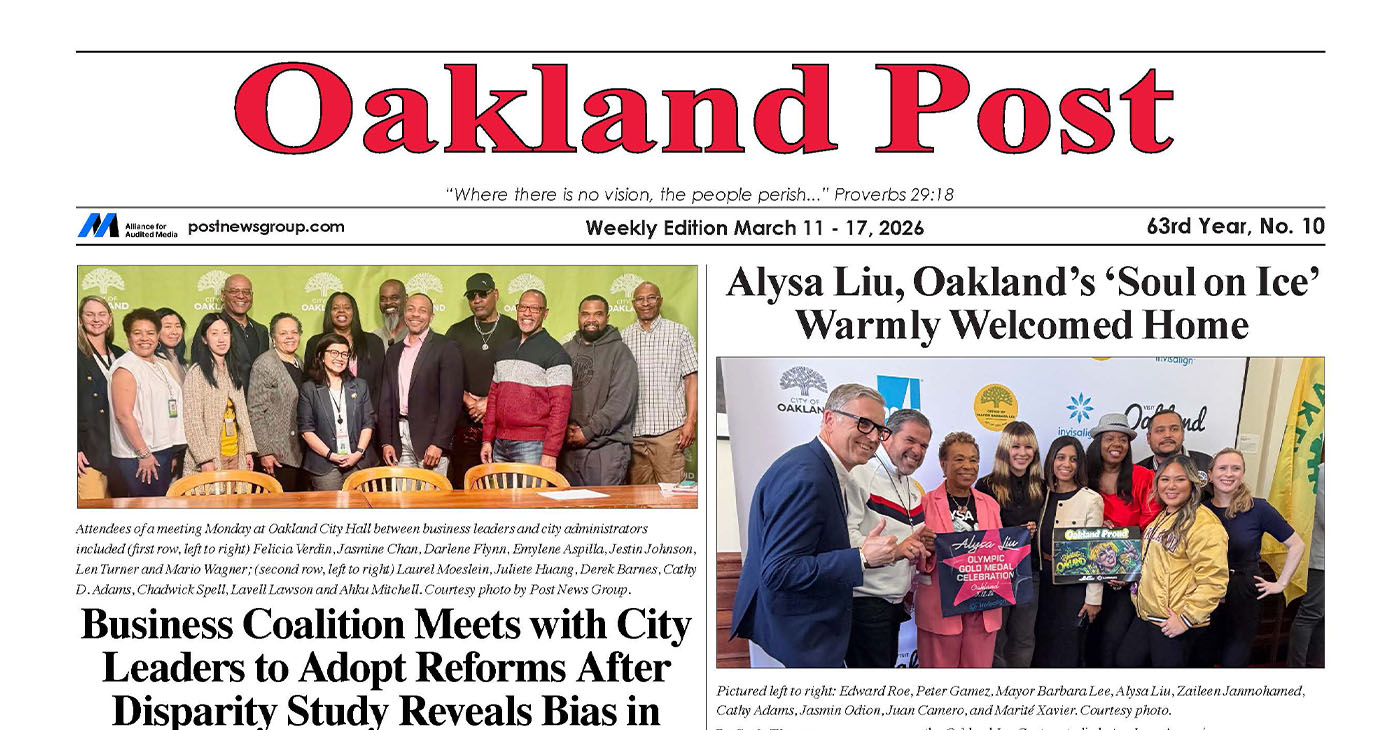
To enlarge your view of this issue, use the slider, magnifying glass icon or full page icon in the lower right corner of the browser window.
Activism
Oakland Post: Week of March 4 – 10, 2026
The printed Weekly Edition of the Oakland Post: Week of March 4 – 10, 2026
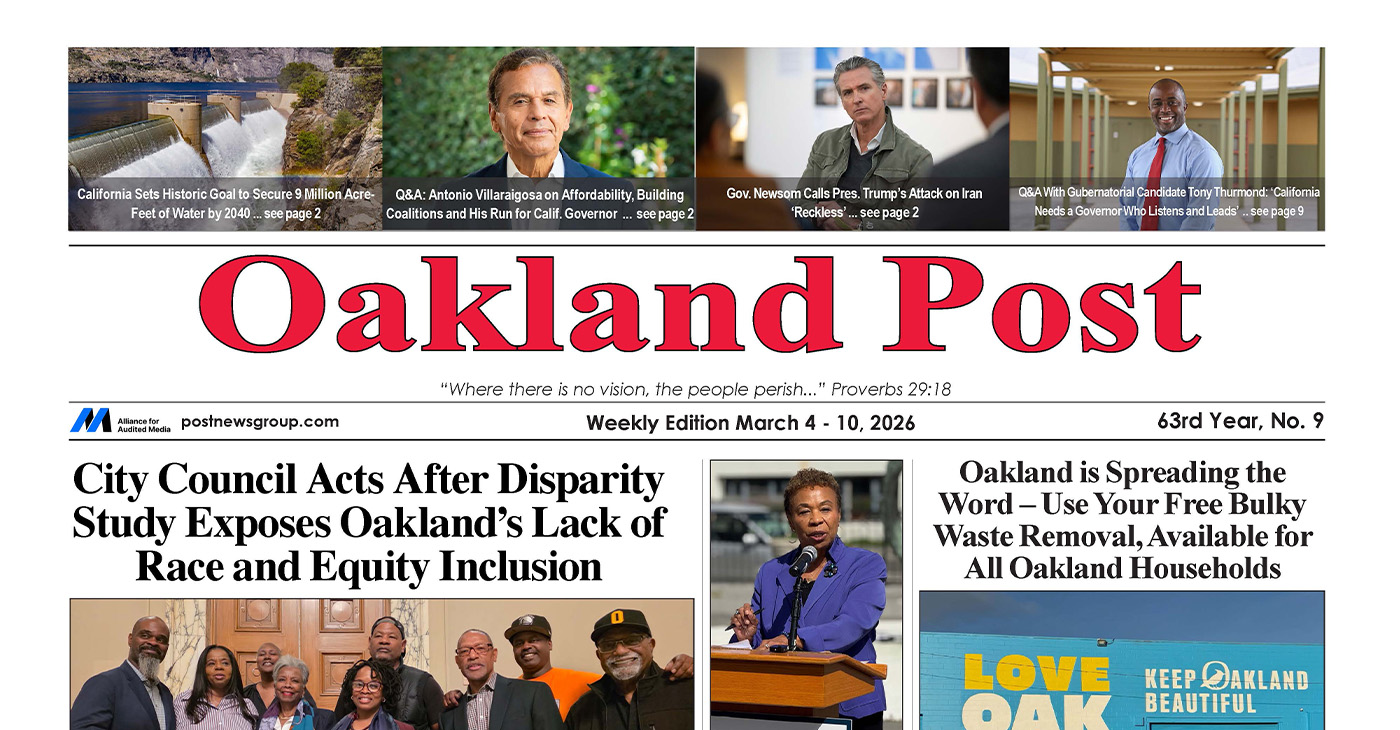
To enlarge your view of this issue, use the slider, magnifying glass icon or full page icon in the lower right corner of the browser window.


WORK FROM HOME
Home-based business with potential monthly income of $10K+ per month. A proven training system and website provided to maximize business effectiveness. Perfect job to earn side and primary income. Contact Lynne for more details: Lynne4npusa@gmail.com 800-334-0540


Black Artists in America, Installation Three Wraps at the Dixon Gallery and Gardens

Grief, Advocacy, and Education: A Counselor Reflects on Black Maternal Health

Future of Florida’s Black History Museum in Limbo

New Research Shows the Many Benefits of Early Learning

South Hampton K-8 Students Among Top 10 Finalists for Samsung’s ‘Solve for Tomorrow’ Competition

Cuba: No Negotiation with US on the President or Political System

Brooklyn Academy of Music Names Jamaican-Born Tamara McCaw as President

Trinidad & Tobego – U.S. Launches WhatsApp Channel for American Citizens in the Country

Oakland Post: Week of March 18 – 24, 2026

AI Innovation vs. Ethics and Environmental Impact

AI, Web3, and Digital Reparations

What If You Owned Your AI Agent?

Season 7, Episode 3 – January Reporter’s Roundtable 📱

Season 7, Episode 3 – January Reporter’s Roundtable

AI, Media, and Power | Part 2, Real-World Impacts and Tradeoffs

Discrimination in City Contracts

Oakland Post: Week of February 11 – 17, 2026

Reflecting on Black History Milestones in Birmingham AL

Rising Optimism Among Small And Middle Market Business Leaders Suggests Growth for California

CITY OF SAN LEANDRO STATE OF CALIFORNIA PUBLIC WORKS DEPARTMENT ENGINEERING DIVISION NOTICE TO BIDDERS FOR ANNUAL STREET OVERLAY/REHABILITATION 2019-21 – PHASE III

Oakland Post: Week of February 18 – 24, 2026

PRESS ROOM: NBA Hall of Fame Nominee Terry Cummings Joins 100 Black Men of DeKalb County to Launch Victory & Values Initiative

Oakland Post: Week of February 25 – March 3, 2026

U.S. manufacturing rebounds – how foundry services are adapting to rising demand

Trump’s MAGA Allies are Creating Executive Order Plan to Steal the 2026 Midterms

OP-ED: One Hundred Years of Black Workers Telling the Truth

Advancements in solar technology that are changing the way we power the world

Chase Oakland Community Center Hosts Alley-Oop Accelerator Building Community and Opportunity for Bay Area Entrepreneurs

Poll Shows Support for Policies That Help Families Afford Child Care

PRESS ROOM: Civil Rights TV Launches in Selma as the World’s First 24/7 Civil Rights Television Network

Hyundai Ioniq 5 Parking, Safety, and 360 View #shorts

2025 Ioniq 5 New Wiper & Powerful Performance! #shorts

Electric SUV Range: Is 259 Miles Enough? #shorts

EV Charging: How Fast Can You Charge an Electric Vehicle? #shorts

Biometric Cooling… Messaging Seats…Come on! 2025 Infiniti QX80 Autograph 4WD

Charged Up: Witness the Magic of a Fully Electric Car! #shorts

Range Rover Sport PHEV Included…: See What’s Inside This Luxury SUV! #shorts

Invisible Hood View: Perfect Parking with X-Ray Vision! #shorts

AI Is Reshaping Black Healthcare: Promise, Peril, and the Push for Improved Results in California

ESSAY: Technology and Medicine, a Primary Care Point of View

Sanctuary Cities

The RESISTANCE – FREEDOM NOW

STATE OF THE PEOPLE: Freddie

ECONOMIC BOYCOTT DAY!!!!!

I told You So
-
 #NNPA BlackPress4 weeks ago
Reflecting on Black History Milestones in Birmingham AL
-
 #NNPA BlackPress4 weeks ago
PRESS ROOM: NBA Hall of Fame Nominee Terry Cummings Joins 100 Black Men of DeKalb County to Launch Victory & Values Initiative
-
 Activism4 weeks ago
Oakland Post: Week of February 25 – March 3, 2026
-
 #NNPA BlackPress4 weeks ago
Trump’s MAGA Allies are Creating Executive Order Plan to Steal the 2026 Midterms
-
 #NNPA BlackPress4 weeks ago
Poll Shows Support for Policies That Help Families Afford Child Care
-
 Activism3 weeks ago
Oakland Post: Week of March 4 – 10, 2026
-

 #NNPA BlackPress3 weeks ago
Woman’s Search for Family’s Roots Leads to Ancestor John T. Ward – A Successful Entrepreneur and Conductor on the Underground Railroad
-

 #NNPA BlackPress3 weeks ago
OP-ED: NNPA Launches 2026 “Leadership Matters” Video Series
