
Bay Area
Gov. Newsom’s “Water Supply Strategy”
Employing more efficient water conservation the state will free up 500,000 acre-feet of water to make up for water lost because of climate change. Additionally, new water captured by stormwater and desalinating ocean water and salty water in groundwater basins will be available for use.

Geared to Battle Drought, Climate Change
By McKenzie Jackson, California Black Media
The Golden State is doing more than just praying for rain amid the historic drought that is battering the California and the Western United States.
Gov. Gavin Newsom unveiled a plan that would increase California’s water supply and combat the extreme weather patterns caused by climate change. The initiative, its scope captured in the 19-page document called “California’s Water Supply Strategy, Adapting to a Hotter, Drier Future,” will invest $8 billion in water recycling, storage, and desalination.
The plan, Newsom said, is in response to a deeper understanding of how dire California’s water crisis is.
“The hydrology in the state has begun to change pretty significantly,” he said. “The aridification that we are experiencing leads us now, the science and data leads us now, to understand we will lose 10% of our water supply by 2040.”
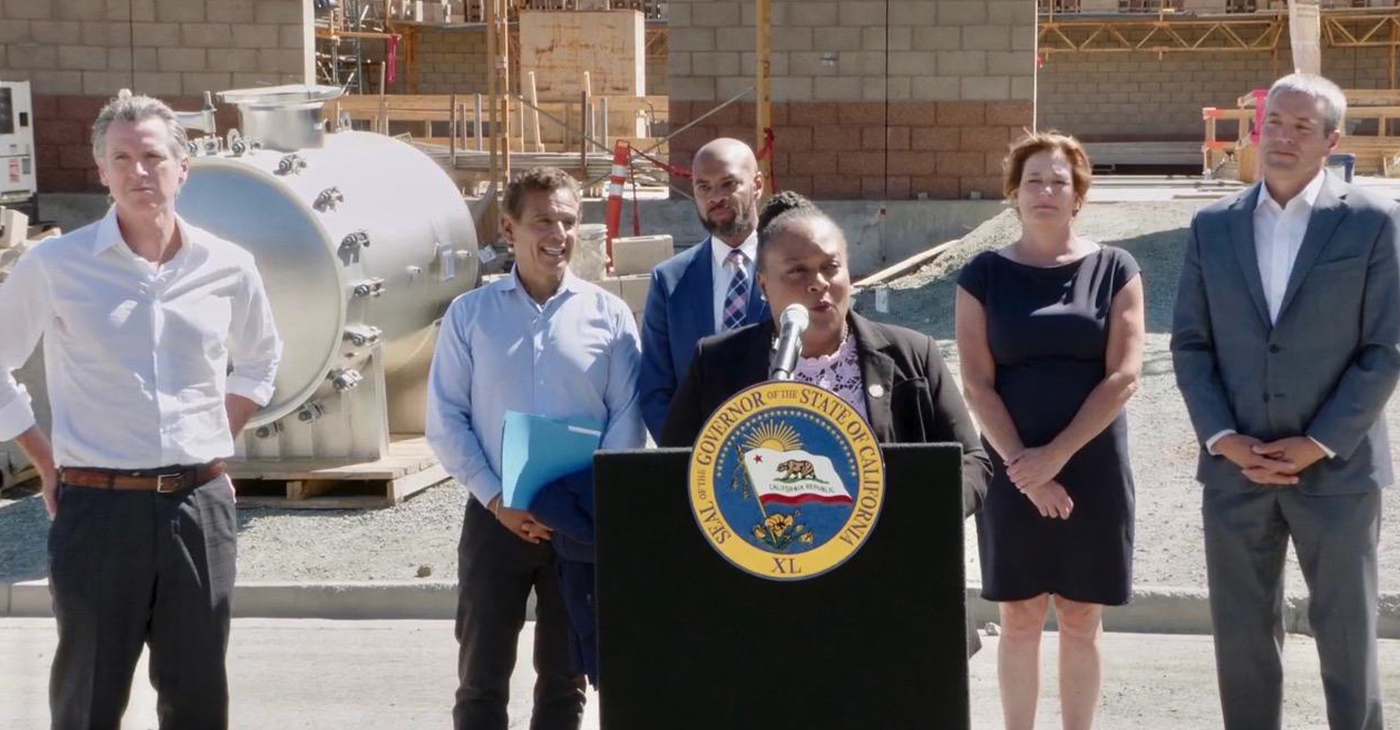
The governor made his remarks at an August 11 press conference held in front of the $110 million Antioch Brackish Desalination Project facility, currently under construction at the city of Antioch’s wastewater treatment plant.
When completed within the next two years, the first surface-water desalination plant in the Bay Area will use large reverse-osmosis filters to create 6 million gallons of fresh water per day.
Antioch Mayor Lamar Thorpe said the facility is one of the innovative solutions Californians need to embrace in response to climate change and the current drought, which began in 2020.
Assemblymember Lori Wison (D-Suisun) said, “We are experiencing the worst drought the Western United States has seen in 1,200 years. We must find innovative solutions to climate challenges like this if we are to move forward successfully… Under the Governor’s leadership, California is investing in technology, solutions, and people, even as California leads the charge to combat climate change.”
Newsom said constructions like the Antioch project are part of the plan.
“We are focused on creating more supply. We are focused on creating more water,” he said. “We need to be more creative and more aggressive in not just promoting this technology but delivering on its promise and more over its potential.”
The “Water Supply Strategy” includes creating storage space for up to 4 million acre-feet of water, so that rain water from big storms can be captured and stored for dry periods and recycling and reusing a minimum of 800,000 acre-feet of water per year by 2030, reducing wastewater discharged to the ocean.
Employing more efficient water conservation the state will free up 500,000 acre-feet of water to make up for water lost because of climate change. Additionally, new water captured by stormwater and desalinating ocean water and salty water in groundwater basins will be available for use.
Officials across the state applauded plan.
San Diego County Water Authority General Manager Sandra L. Kerl said the “Water Supply Strategy” is an important step to protect California’s economy and quality of life.
“The governor’s approach aligns closely with the Water Authority’s 30-year strategy that combines new supplies, infrastructure upgrades, and conservation,” she said.
There were some who disagreed with some of Newsom’s plan.
Kate Poole, senior director of the Natural Resources Defense Council’s nature program, told the L.A. Times that some of the initiative was good.
Poole said, “It’s really the things that aren’t in there that are most concerning,” she said. “Agriculture obviously uses 80% of our developed water supply in California. So, you can’t really deal effectively with water use without dealing with Big Ag. And Newsom does not seem very willing to do that.”
California is experiencing its second drought in the last decade. The sense of urgency is real, said Newsom.
“The hots are getting a lot hotter and the dries are getting a lot drier,” he said. “We have to adapt.”











Activism
Oakland Post: Week of September 23 – 29, 2026
The printed Weekly Edition of the Oakland Post: Week of September 23 – 29, 2026

To enlarge your view of this issue, use the slider, magnifying glass icon or full page icon in the lower right corner of the browser window.
Activism
Oakland Post: Week of September 16 – 22, 2026
The printed Weekly Edition of the Oakland Post: Week of September 16 – 22, 2026

To enlarge your view of this issue, use the slider, magnifying glass icon or full page icon in the lower right corner of the browser window.
Activism
Oakland Post: Week of September 9 – 15, 2026
The printed Weekly Edition of the Oakland Post: Week of September 9 – 15, 2026

To enlarge your view of this issue, use the slider, magnifying glass icon or full page icon in the lower right corner of the browser window.



Asm. Corey Jackson Announces Launch of 24-Hour Childcare in His District

IN MEMORIAM: The Rev. Leon “Sonny” Clark, Longtime Orange County Pastor and Community Leader, Dies at 72

Poll: Becerra Widens His Lead Over Hilton; Californians Split on Wealth Tax

From Historic Memories to New Possibilities: Oakland Celebrates Coliseum 60

County Office of Education Says OUSD Finances Are Getting Healthier, Materially Stronger

LIVE FREE Sunday Dinner Brings Faith, Fellowship and Civic Conversation to Oakland

Remembering Chauncey Bailey as Student Journalists Face Threats to Truth-Telling

BLACspace Cooperative Invites Bay Area to Experience Oakland’s Black Cultural Ecosystem Through a BLAC Map Tour + Party

In Wake of Death on Doorstep, Williams Chapel Baptist Church Calls for Better Care, Funding for Unhoused

Oakland Centenarian Nuna McKee Honored!

Caribbean Nations Produce Action Plan Calling for UK Reparations Over Slavery

Oakland Post: Week of September 23 – 29, 2026

Doulas Are Helping Black California Moms Navigate Pregnancy–Even as High Mortality Rates Persist

Newsom Signs Addictive Social Media Law to Protect Kids

On Your November Ballot: Prop 38 Would Allocate $8.4 Billion to Immunology and Immunotherapy Funding

Standoff for Justice: Our Homes Are Worth Fighting For

Oakland Post: Week of August 26 – September 1, 2026

Frontier Airlines’ Return to Oakland Airport Brings Flights, Jobs and Opportunity

Gubernatorial Candidate Steve Hilton Blasts California New Tire Rules; Newsom Hits Back

Chef Sharon Lee Blends Culinary Excellence, Education and Empowerment

Jackie Wright Champions Bay Area Stories, Filmmakers and Cultural Institutions

Big City Mayors Ask for “Yes” Vote on Housing Bond Measure; Conservatives Say “No”

Oakland Coliseum Project Opens Door for Small Businesses to Build Bigger

Gov. Newsom’s Latest Appointees Include Sacramento Advocate for Formerly Incarcerated Students; State’s New Tech Chief

Misnamed ‘Parent’ PAC Seeks to Influence Oakland School Board Elections

Longtime BWOPA Member Brendalyn Goodall Appointed to California Workforce Development Board

Gov. Newsom Signs Law Shielding Immigration Aid Workers From Doxing Threats

Secretary of State Shirley N. Weber Urges Californians to Vote Early as Voter ID Battle Intensifies

From Palestine to Oakland: Seeds for Liberation Examines Shared Struggles for Freedom

IN MEMORIAM: Dolly Parton Dead at 80 — How She Built a Legacy of Love and Earned Her Place in Black Culture

The Conversation With Al McFarlane 6/23/26

Media Monday 6/22/26

LIVE! ASK ALMA! — TUES. 6.23.26 7PM EST

Car Buying Secrets: 4 Hidden Checks Before You Sign!

Is This 550 HP Charger Worth YOUR Money? AutoNetwork Review

Celebrating Juneteenth – Frederick Douglass on education and resistance

LIVE! — ASK ALMA! — TUES. 6.19.26 7PM EST

Hyundai Ioniq 5 Parking, Safety, and 360 View #shorts

2025 Ioniq 5 New Wiper & Powerful Performance! #shorts

Electric SUV Range: Is 259 Miles Enough? #shorts

EV Charging: How Fast Can You Charge an Electric Vehicle? #shorts

Biometric Cooling… Messaging Seats…Come on! 2025 Infiniti QX80 Autograph 4WD

Charged Up: Witness the Magic of a Fully Electric Car! #shorts

Range Rover Sport PHEV Included…: See What’s Inside This Luxury SUV! #shorts

Invisible Hood View: Perfect Parking with X-Ray Vision! #shorts
-
 Community2 weeks ago
Misnamed ‘Parent’ PAC Seeks to Influence Oakland School Board Elections
-

 Activism3 weeks ago
Oakland Post: Week of September 2 – 8, 2026
-

 Community2 weeks ago
Richmond Tiny House Village Farm & Garden Set to Open Gates on Sept. 26
-

 Black History2 weeks ago
Latest Massacre in Haiti Reveals Cruelty U.S. Deportations
-

 Black History2 weeks ago
OPINION: Nolan Wells’ Death One of Several Signifying Racial Terror Lives on in U.S. South
-

 Activism2 weeks ago
Oakland Post: Week of September 9 – 15, 2026
-

 Community2 weeks ago
Democratic Clubs Interview Candidates for Oakland School Board
-
 Featured2 weeks ago
‘Ready to See These Bills Become Law’: Sen. Weber’s Package of 15 Bills Advance to Gov. Newsom’s Desk
