
Politics
Giuliani Supporting Loretta Lynch Nomination


U.S. Attorney Loretta Lynch is seen in the Roosevelt Room of the White House in Washington, Saturday, Nov. 8, 2014, after President Barack Obama nominated her to be the next Attorney General succeeding Eric Holder. (AP Photo/Susan Walsh)
By Freddie Allen
NNPA Senior Washington Correspondent
WASHINGTON (NNPA) – In recent weeks, Rudy Giuliani, the former mayor of New York City, claimed that President Barack Obama didn’t love America, blamed the president for creating the atmosphere that led to the shootings of two police officers being shot in Ferguson, Mo., and said that he should speak more like the beleaguered Bill Cosby on issues of race.
There is one issue, however, that he is in total agreement with President Obama — Loretta Lynch’s qualification to become the next attorney general.
“Loretta Lynch is more than qualified. She’s over-qualified to be the attorney general,” said Giuliani. “She is as well-qualified as some of the bests attorney generals that we’ve had.”
During a call with reporters last Friday, Giuliani admitted that he didn’t often agree with President Obama, but whether the president is a Republican or a Democrat he is entitled to his choice.
The former mayor and presidential candidate said that the confirmation process has become distorted over time.
“Republicans torture Democrats and Democrats torture Republicans. Who started it? Only God knows and it has now become the Hatfields and McCoys,” said the former New York City mayor.
Giuliani said that he was impressed by the way that Lynch, as a United States attorney in New York, prosecuted cases to protect New York City and, on the few occasions that she had to investigate the city, she was fair.
“She makes decisions on the merit,” said Giuliani. “She’s not a political operative in any sense.”
Lynch, who was first confirmed as a United States attorney during the Clinton administration in 1999 and again during the Obama administration in 2010, has also undergone three FBI background investigations.
Giuliani joined a chorus of lawmakers, law enforcement officials and civil rights leaders urging Senate Republicans to confirm Lynch.
Rep. G.K. Butterfield (D-N.C.), the chair of the Congressional Black Caucus (CBC), called the delay in confirming Loretta Lynch political.
“The politics that Republicans have played with her nomination are deplorable and opposition to her nomination is nothing more than a political ploy to once again use any means necessary to show their disdain for President Obama,” said Butterfield. “This is a travesty. We should not deny the president of the United States his choice of a qualified candidate.”
Wade Henderson, president and CEO of the Leadership Conference on Civil and Human Rights, a coalition of 200 civil and human rights groups, said that the Senate Republican majority is using every excuse it can find to delay or obstruct Lynch’s confirmation.
“And the one thing these excuses all have in common is that none of them have anything to do with the nominee herself,” said Henderson. “We know that senators can walk and chew gum at the same time and that this is just the latest turn in what has been the most mishandled and manipulated confirmation process in memory.”
Even Eric Holder, the current attorney general who was held in contempt of Congress on a Republican-majority vote in 2012 over a gun trade investigation, recently quipped that the Republican Congress has delayed the Lynch confirmation because they discovered a new fondness for him.
Senator Dick Durbin (D-Ill.) said that when it comes to the Senate calendar, Loretta Lynch was being asked “to sit in the back of the bus,” and that the delay was, “beneath the decorum and dignity of the United States Senate.”
Louis Freeh, a partner of Pepper Hamilton, LLP and a former Director of the Federal Bureau of Investigation (FBI), agreed that politics is driving opposition to Lynch’s nomination.
“The nomination is being held up for political reasons. Some of the senators didn’t like her answers on immigration,” said Freeh. “The fact of the matter is that she supports the immigration policies of the president. What nominee would come before the Senate for the attorney generalship who did not support the policies of the president? Nobody has made any credible arguments about her competency her independence or her integrity.”
Freeh continued: “You don’t want any attorney general to start his or her tenure there otherwise qualified with that sort of a cloud.”
Giuliani said that the president is entitled to appointments that agree with his point of view and that playing partisan politics over nominations not only impedes the ability of any president to get his job done, but also discourages people from going through this process.
“It is a golden opportunity for my political party to show that we’re going back to the original intent of the framers of the Constitution in the way that the confirmation process should work,” said Giuliani. “Maybe, just maybe, if we have a Republican president two years from now we can appeal to the Democrats to do the same thing.”
###




Activism
Oakland Post: Week of March 18 – 24, 2026
The printed Weekly Edition of the Oakland Post: Week of March 18 – 24, 2026

To enlarge your view of this issue, use the slider, magnifying glass icon or full page icon in the lower right corner of the browser window.
Activism
Oakland Post: Week of March 11 -17, 2026
The printed Weekly Edition of the Oakland Post: Week of March 11 – 17, 2026
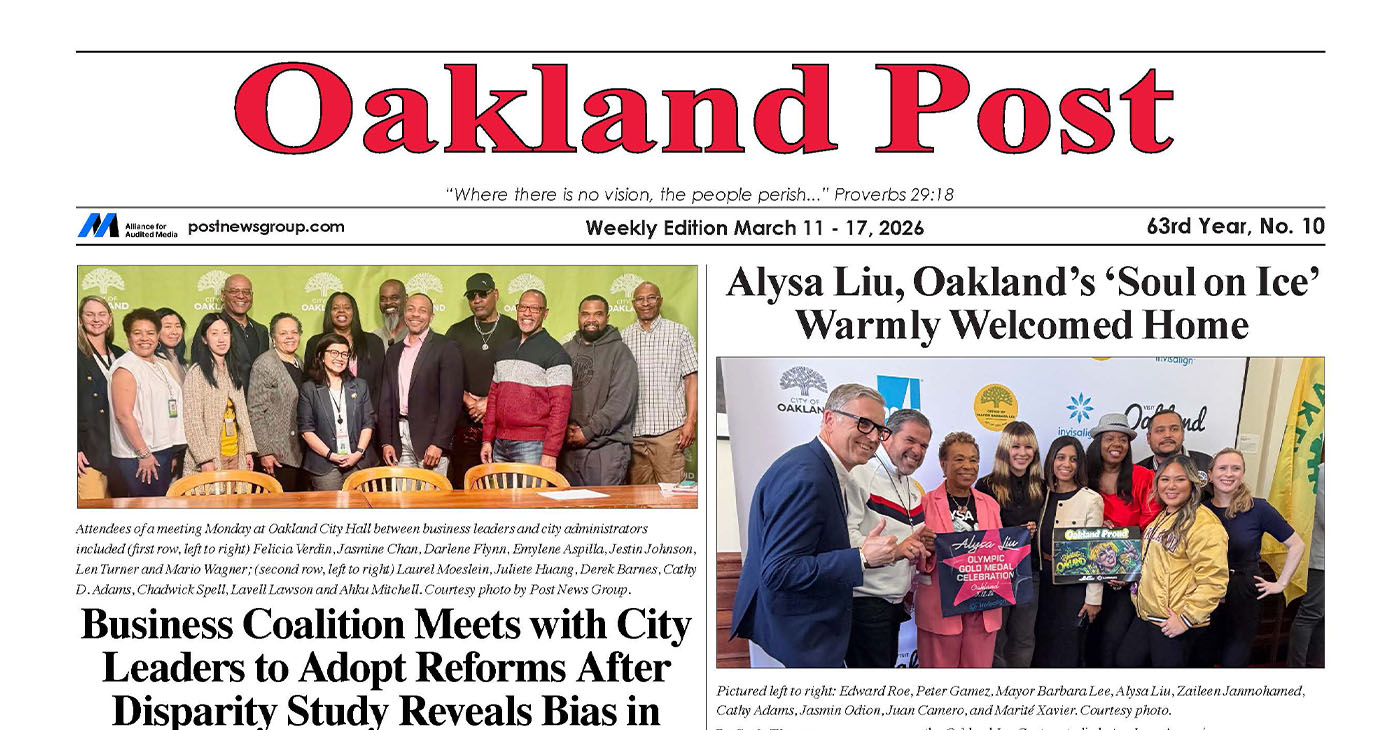
To enlarge your view of this issue, use the slider, magnifying glass icon or full page icon in the lower right corner of the browser window.
Activism
Oakland Post: Week of March 4 – 10, 2026
The printed Weekly Edition of the Oakland Post: Week of March 4 – 10, 2026

To enlarge your view of this issue, use the slider, magnifying glass icon or full page icon in the lower right corner of the browser window.


WORK FROM HOME
Home-based business with potential monthly income of $10K+ per month. A proven training system and website provided to maximize business effectiveness. Perfect job to earn side and primary income. Contact Lynne for more details: Lynne4npusa@gmail.com 800-334-0540


Black Artists in America, Installation Three Wraps at the Dixon Gallery and Gardens

Grief, Advocacy, and Education: A Counselor Reflects on Black Maternal Health

Future of Florida’s Black History Museum in Limbo

New Research Shows the Many Benefits of Early Learning

South Hampton K-8 Students Among Top 10 Finalists for Samsung’s ‘Solve for Tomorrow’ Competition

Cuba: No Negotiation with US on the President or Political System

Brooklyn Academy of Music Names Jamaican-Born Tamara McCaw as President

Trinidad & Tobego – U.S. Launches WhatsApp Channel for American Citizens in the Country

Oakland Post: Week of March 18 – 24, 2026

AI Innovation vs. Ethics and Environmental Impact

AI, Web3, and Digital Reparations

What If You Owned Your AI Agent?

Season 7, Episode 3 – January Reporter’s Roundtable 📱

Season 7, Episode 3 – January Reporter’s Roundtable

AI, Media, and Power | Part 2, Real-World Impacts and Tradeoffs

Oakland Post: Week of February 11 – 17, 2026

Reflecting on Black History Milestones in Birmingham AL

Rising Optimism Among Small And Middle Market Business Leaders Suggests Growth for California

CITY OF SAN LEANDRO STATE OF CALIFORNIA PUBLIC WORKS DEPARTMENT ENGINEERING DIVISION NOTICE TO BIDDERS FOR ANNUAL STREET OVERLAY/REHABILITATION 2019-21 – PHASE III

Oakland Post: Week of February 18 – 24, 2026

PRESS ROOM: NBA Hall of Fame Nominee Terry Cummings Joins 100 Black Men of DeKalb County to Launch Victory & Values Initiative

Oakland Post: Week of February 25 – March 3, 2026

Trump’s MAGA Allies are Creating Executive Order Plan to Steal the 2026 Midterms

U.S. manufacturing rebounds – how foundry services are adapting to rising demand

OP-ED: One Hundred Years of Black Workers Telling the Truth

Advancements in solar technology that are changing the way we power the world

Chase Oakland Community Center Hosts Alley-Oop Accelerator Building Community and Opportunity for Bay Area Entrepreneurs

Poll Shows Support for Policies That Help Families Afford Child Care

PRESS ROOM: Civil Rights TV Launches in Selma as the World’s First 24/7 Civil Rights Television Network

Oakland Post: Week of March 4 – 10, 2026

Hyundai Ioniq 5 Parking, Safety, and 360 View #shorts

2025 Ioniq 5 New Wiper & Powerful Performance! #shorts

Electric SUV Range: Is 259 Miles Enough? #shorts

EV Charging: How Fast Can You Charge an Electric Vehicle? #shorts

Biometric Cooling… Messaging Seats…Come on! 2025 Infiniti QX80 Autograph 4WD

Charged Up: Witness the Magic of a Fully Electric Car! #shorts

Range Rover Sport PHEV Included…: See What’s Inside This Luxury SUV! #shorts

Invisible Hood View: Perfect Parking with X-Ray Vision! #shorts

AI Is Reshaping Black Healthcare: Promise, Peril, and the Push for Improved Results in California

ESSAY: Technology and Medicine, a Primary Care Point of View

Sanctuary Cities

The RESISTANCE – FREEDOM NOW

STATE OF THE PEOPLE: Freddie

ECONOMIC BOYCOTT DAY!!!!!

I told You So
-
 Activism4 weeks ago
Oakland Post: Week of February 25 – March 3, 2026
-
 #NNPA BlackPress4 weeks ago
Poll Shows Support for Policies That Help Families Afford Child Care
-
 Activism3 weeks ago
Oakland Post: Week of March 4 – 10, 2026
-

 #NNPA BlackPress3 weeks ago
Woman’s Search for Family’s Roots Leads to Ancestor John T. Ward – A Successful Entrepreneur and Conductor on the Underground Railroad
-

 #NNPA BlackPress3 weeks ago
OP-ED: NNPA Launches 2026 “Leadership Matters” Video Series
-

 #NNPA BlackPress3 weeks ago
Advocates Raise Alarm Over ICE Operation, MOU and Detention Risks in Baltimore County
-

 #NNPA BlackPress3 weeks ago
COMMENTARY: Women of Color Shape Our Past and Future
-

 #NNPA BlackPress3 weeks ago
Pete Buttigieg to Join Mayor Randall Woodfin for Community Town Hall in Birmingham
