Connect with us

Bay Area

GETTING TO YES 

BAYSIDE BALL PARK OR WATERFRONT DEVELOPMENT

Published

on

Howard Terminal Courtesy Port of Oakland website

Arguably, development of Howard’s Terminal has been in the making for long time.  According to Councilmember Gallo, Oakland’s previous city officials Robert Bobb and Jerry Brown entertained development of Howard’s Terminal, for the Fishers and A’s, during their tenure as city manager and mayor respectively. 

Let’s be clear, the A’s initially pitched its development project at Howard’s Terminal as a Bayside Baseball Stadium, when in essence its project goal has always been a major condominium-housing and business development, along Oakland’s waterfront … the stadium was then and is now just the shinny thing.  Many argue the Coliseum site is more suited for a new stadium development, if that’s really what the A’s want. 

On Tuesday, July 20, 2021, Oakland City Council held a special meeting to consider the Oakland A’s proposal submitted in April 2021; the A’s pressed Council for this special meeting so as to give the A’s an up or down vote on their proposal.  Council voted 6-1, with one abstention, not to support the A’s proposal as submitted.  Council did agree, however, to support the A’s project proposal with certain City amendments.   

Oakland City Council considered their vote to be a big win for Oakland.  On the other hand, A’s President, Dave Kaval, called the City Council’s vote “a swing and a miss.” Based upon the complexity of the pending issues, it appears more time – extended ending – will be necessary for both sides to get to a mutually beneficial yes. 

According to the A’s Kaval, progress has been made in negotiations but, the plan Council voted for on Tuesday “is not a business partnership that works for [A’s] us.”   Moreover, Kaval claims the A’s had not seen some of the amendments Oakland city staff presented to the City Council Tuesday morning before the council’s vote. 

Council-member Rebecca Kaplan said the City Council’s amendments addressed the A’s biggest concern, having to pay for offsite transportation, and infrastructure improvements. However, the A’s still could not agree with the city’s overall offer.   

 Also, the A’s waterfront development project proposal includes some 3000 units of condominium-housing, but the A’s proposal ignored adequate provisions for affordable housing.  The A’s wants the City to waive the A’s legal requirement to provide for affordable housing.  Oakland’s City Council determined that fact to a major sticking point. 

Council President Nikki Fortunato Bas, who worked on the amendments with Vice Mayor Kaplan, said, “It’s (now) at the beginning of the eighth inning.”  As a matter of fact, Council advised the A’s to use Council’s just approved amended Term-Sheet as a road map for further negotiations. 

Following the City Council meeting, Oakland Mayor Libby Schaaf said the City and A’s are very close to an agreement, but Kaval said “in some ways it’s too early to say how close the two sides are.”  

Kaval expressed hope that the A’s can get the City Council vote on some terms his team could agree on before Council’s summer recess.  Council President Bas’, office said no council meetings are scheduled before the recess to further negotiate the A’s new waterfront proposal.  

 Negotiation between Oakland’s City Council and the Oakland A’s appears to be headed for extra innings.  The complexity of the issues and public reactions, after Tuesday’s Council vote, gives many citizens cause to pause and wonder if we are at the end of the seventh inning stretch or the bottom of the ninth; either way, getting to a mutually beneficial yes will require a walk-off hit. 

Activism

From Disparity Study to Solutions: Oakland Coalition and Mayor Barbara Lee Renew Commitment to Reform City Contracting

She committed to ensuring the coalition has direct access to City leadership by designating Assistant Deputy City Administrator Chuck Baker the primary liaison. Working alongside Deputy City Administrator Sofia Navarro, DWES Director Emylene Aspilla, Race and Equity Director Darlene Flynn, and other City departments, the coalition will continue advancing these priorities while maintaining regular communication with City leadership.

Published

on

Present at the recent meeting on implementing recommendations on Oakland’s Disparity Study on city work contracts were (first row, l. to r.):  Chuck Baker, Oakland Mayor Barbara Lee and Darlene Flynn. Second row, l. to r.) Samuel Adams, Erica Astrella, Chadwick Spell, Cathy Adams, Stanley Cooper, Maria Wagner, Len Turner, Derek Barnes, Paul Cobb. Photo courtesy of Oakland Mayor’s Office.

Special to The Post

On June 30, a coalition of minority business leaders, contractors and others met with Oakland Mayor Barbara Lee to discuss the City’s commitment to implement recommendations outlined in Oakland’s Disparity Study and eliminate barriers that have historically prevented Black and minority-owned businesses from fully participating in public contracting opportunities.

Representatives of the Oakland African American Chamber of Commerce (OAACC), National Association of Minority Contractors Northern California (NAMC NorCal), Construction Resource Center (CRC), and the East Bay Rental Housing Association (EBRHA) said the meeting represented an important milestone in a process that has been underway for several months.

On April 21, the Oakland City Council’s Life Enrichment Committee received a progress report from the Department of Workplace and Employment Standards (DWES), where Director Emylene Aspilla presented the coalition’s working document and outlined a collaborative implementation plan between the coalition and the City. That report established 30-, 60-, and 90-day objectives focused on five key priorities:

  • Reforming Local and Small Local Business Enterprise (L/SLBE) waiver practices
  • Strengthening prompt payment compliance
  • Improving procurement forecasting and transparency
  • Expanding contractor capacity building and business development
  • Increasing oversight, accountability, and public reporting

A series of working sessions was scheduled between coalition representatives, DWES, and the City Administrator’s Office to begin implementing those priorities but were temporarily delayed by the resignation of former City Administrator Jestin Johnson.

Rather than allowing that momentum to stall, OAACC President and CEO Cathy Adams requested a meeting with Lee to gain clarity on the City’s direction and reaffirm its commitment to implementing the recommendations contained within the Disparity Study.

Coalition leaders described the meeting as productive, candid, collaborative, and encouraging.

During the meeting, Lee spoke not only from her role as mayor but also from her experience as an 8(a) contractor and business owner, sharing that she understands firsthand what it takes to build and grow a successful company, employ a substantial workforce, compete for public work, and navigate the complexities of municipal contracting.

She committed to ensuring the coalition has direct access to City leadership by designating Assistant Deputy City Administrator Chuck Baker the primary liaison. Working alongside Deputy City Administrator Sofia Navarro, DWES Director Emylene Aspilla, Race and Equity Director Darlene Flynn, and other City departments, the coalition will continue advancing these priorities while maintaining regular communication with City leadership.

Mayor Lee also expressed her commitment to personally participate in future working meetings with the coalition.

“This meeting represents a renewed commitment to partnership,” said Adams. “Mayor Lee listened, engaged, and demonstrated that she wants to move beyond conversation and into implementation.”

CRC’s Len Turner said the roadmap is already in place. ““The City already has the evidence. What’s been missing is execution. …Now it’s time to deliver results.”

Mario Wagner, president of NAMC NorCal agreed that the next phase must focus on implementation, funding, and accountability.

“The coalition is ready to get to work. …The next step is ensuring these initiatives receive meaningful funding in the upcoming fiscal budget cycle. Just as important, the City must establish transparent reporting mechanisms that keep the public informed through regular progress reports, measurable benchmarks, and accountability.”

Coalition leaders also acknowledged that while City leadership has indicated it is reviewing Local and Small Local Business Enterprise waiver practices, the community continues to seek a formal response regarding existing long-term waivers, including waivers extending 10 and 25 years. The coalition believes those waivers should be comprehensively reviewed and, where appropriate, rolled back as part of the City’s broader contracting reforms.

The coalition is also calling on the City to include meaningful funding in the upcoming fiscal budget cycle to support implementation of the Disparity Study recommendations and establish better methods and mechanisms to keep the public informed through regular progress reports, measurable benchmarks, and transparent accountability.

The coalition’s immediate next step is to schedule a working meeting with Baker, Aspilla, Lee, and the appropriate City staff to review what has already been accomplished under the implementation framework.

Continue Reading

Activism

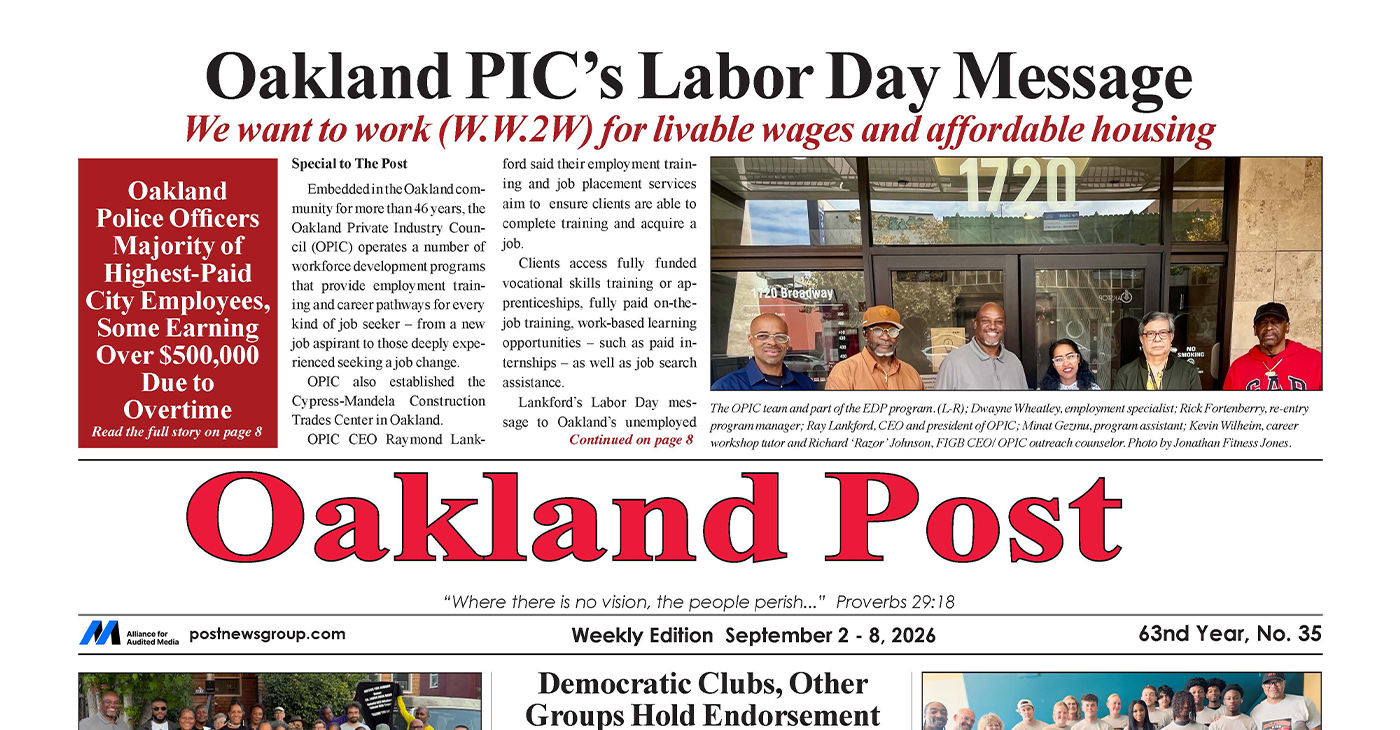
Oakland Post: Week of July 8 – 14, 2026

The printed Weekly Edition of the Oakland Post: Week of July 8 – 14, 2026

Published

on

To enlarge your view of this issue, use the slider, magnifying glass icon or full page icon in the lower right corner of the browser window.

Continue Reading

Activism

Diabetes in Black California: Turning the Tide from Crisis to Control

According to the Centers for Disease Control and Prevention (CDC) Behavioral Risk Factor Surveillance System data, nearly 17.9% of Black adults in California have been diagnosed with diabetes — above the national Black adult average of 16.8%, and nearly five points higher than California’s overall adult rate of 12.6% across all races. California ranks 24th out of 39 states with available data for Black adult diabetes rates.

Published

on

Dr. Khadijah Lang is a family physician with a clinic in Los Angeles who specializes in several family medical practices, including prenatal care. Lang believes in family medicine. She says it is important to treat all members of a family. Thursday, June 5, 2026. Photo by Solomon O. Smith/California Black Media.

By Charlene Muhammad, California Black Media

Crystal Lambert knew something was terribly wrong with her three-year-old granddaughter as she sped down the street trying to get her to the hospital.

“I thought she got a hold of some poison,” Lambert recalled.

Doctors found Lambert’s granddaughter had a blood sugar level over 800, diagnosing her with Diabetic Ketoacidosis(DKA), a state in which the body, starved of insulin, begins to shut down.

Lambert said she was born with a pancreas that was not fully functioning — it lacked the specialized cells required to produce insulin.

Her granddaughter survived and is five years old today.  Now, she gives herself insulin shots, asks endless questions about her condition, and runs like the spirited child she is. But the terror of that night transformed Lambert — and ultimately inspired her to launch the We Fight Back Organization, a mobile health and food access initiative serving underserved communities across California. Lambert is the executive director.

The Crisis by the Numbers

According to the Centers for Disease Control and Prevention (CDC) Behavioral Risk Factor Surveillance System data, nearly 17.9% of Black adults in California have been diagnosed with diabetes — above the national Black adult average of 16.8%, and nearly five points higher than California’s overall adult rate of 12.6% across all races. California ranks 24th out of 39 states with available data for Black adult diabetes rates.

Nationally, according to the U.S. Department of Health and Human Services, Black Americans were 24% more likely than the overall U.S. population to have diabetes in 2024. They also died from diabetes 78% more often than the general population in 2022. Black Americans are also more than twice as likely as the overall population to develop kidney failure caused by diabetes.

According to the California Health Care Foundation’s 2024 Health Disparities Almanac, Black Californians have the shortest life expectancy in the state at just 74.6 years — due in part to chronic conditions like diabetes and its devastating complications.

Leon Rock, co-founder of the African American Diabetes Association, believes statistics, though revealing, only tell part of the story.

“There are a whole bunch of Black folks that don’t tell you that they have diabetes — or don’t know,” he said.

And the disease itself, Rock is careful to note, is not what kills. “They die from the complications. That’s heart attack, that’s stroke, that’s amputations of legs, of feet. Going blind. All those complications are inherent in a system that has impacted Black folks with diabetes in California and across America.”

Crystal Lambert, creator and executive director of We Fight Back. She started the organization out of a need to learn more about diabetes on behalf of her granddaughter. Now she is looking to spread the impact of her organization to the valley. Friday, June 6, 2026. Photo by Solomon O. Smith/California Black Media.

Crystal Lambert, creator and executive director of the We Fight Back Organization, started out of a need to learn more about diabetes on behalf of her granddaughter. Now she is looking to spread her organization to the valley, on Friday, June 6, 2026 Photo by Solomon O. Smith/ California Black Media

An Information Gap Fuels the Crisis

For Rock, part of the solution is diagnosis. He says the medical and public health systems are failing Black Californians by the absence of information designed for them.

“That is the bottom line. We need good information. Information that is culturally specific,” said Rock.

Telling people to eat healthy or exercise, he added, falls short when culturally specific alternatives are not provided, and when many residents of urban communities do not feel safe exercising in some neighborhoods – or outside at night.

Dr. Khadijah Lang, a family medicine physician and president of the Golden State Medical Association, agrees that the roots of the crisis run deeper than individual behavior — and blaming patients misses the point.

“We are not genetically predisposed to diabetes,” Lang said. “But the system under which we live increases the likelihood that we will develop it.” 

What the Body Needs — What Communities Are Denied

Type 2 diabetes, which accounts for 90 to 95% of all diabetes cases, according to the CDC, develops when the body can no longer use insulin effectively to regulate blood sugar. Left unmanaged, it damages nerves, kidneys, eyes, and the cardiovascular system. The hemoglobin A1C test is a blood draw that reveals how the body has processed sugar over the previous three months — not just at the moment of the test. It is the standard tool for both diagnosis and ongoing monitoring.

That distinction matters, Lang emphasized, because patients cannot manipulate three months of blood sugar history the way they might fast for a day before a single blood draw.

“The pill is not meant to undo or control a sugar level that’s being constantly stressed,” Lang said. “It’s meant to work in conjunction with a low-carbohydrate diet and exercise.” She recommended at minimum 30 minutes of physical activity five days a week — breakable into 10-minute sessions for those who need it.

Lang stressed that education must be delivered in language people recognize and can relate to. The goal is to inform them of the choices that serve their health best, she said.

But for many Black Californians, even those informed choices remain out of reach, Lambert said.

“They need access to healthy foods and medication, too” she said.

California has made some critical policy advances. The state has expanded access to the Continuous Glucose Monitor (CGM), which has transformed diabetes care for state residents. Assembly Bill 365, introduced in 2024, proposed requiring Medi-Cal to cover the costs of CGM and other related medical equipment but it failed in the State Senate. Since then, the California Department of Health Care Services (DHCS) reports that the core Medi-Cal CGM benefit now available to eligible patients was solidified through previous budget actions and pharmacy policy updates.

These measures, while meaningful, have not closed the gap for the communities most at risk, according to advocates.

Control Through Community

Health care advocates conclude that the solution must be communal, culturally grounded, and sustained — not a fad, not a celebrity moment, not a single clinic visit. For example, observed Lang, lifestyle shaped by shared values and collective accountability can move the needle where individual prescriptions have not.

Rock is building infrastructure to match the urgency, establishing local chapters of the African American Diabetes Association across the country, with California next.

“We have to do for self, period,” he said. “Health is wealth. We have to eat to live.”

And Lambert, whose granddaughter unknowingly started all of this for her, keeps showing up.

“Diabetes advocacy is about dignity, education, prevention, and hope,” she said.

Video: Diabetes Disparity Exposed in California

This article is supported by the California Health Care Foundation 

(CHCF). Visit www.chcf.org 

Continue Reading

Subscribe to receive news and updates from the Oakland Post

* indicates required

CHECK OUT THE LATEST ISSUE OF THE OAKLAND POST

ADVERTISEMENT

WORK FROM HOME

Home-based business with potential monthly income of $10K+ per month. A proven training system and website provided to maximize business effectiveness. Perfect job to earn side and primary income. Contact Lynne for more details: Lynne4npusa@gmail.com 800-334-0540

Facebook

Trending

Copyright ©2021 Post News Group, Inc. All Rights Reserved.