
Bay Area
Former Prisoners, Advocates Hold Solitary Confinement Symposium at CSU Fullerton
On July 7 and 8, the California Families Against Solitary Confinement (CFASC) held a symposium at California State University at Fullerton to celebrate the 10th anniversary of the historic agreement to end hostilities among inmates and to mark the three hunger strikes that occurred at the Pelican Bay State Prison from 2011-2012.

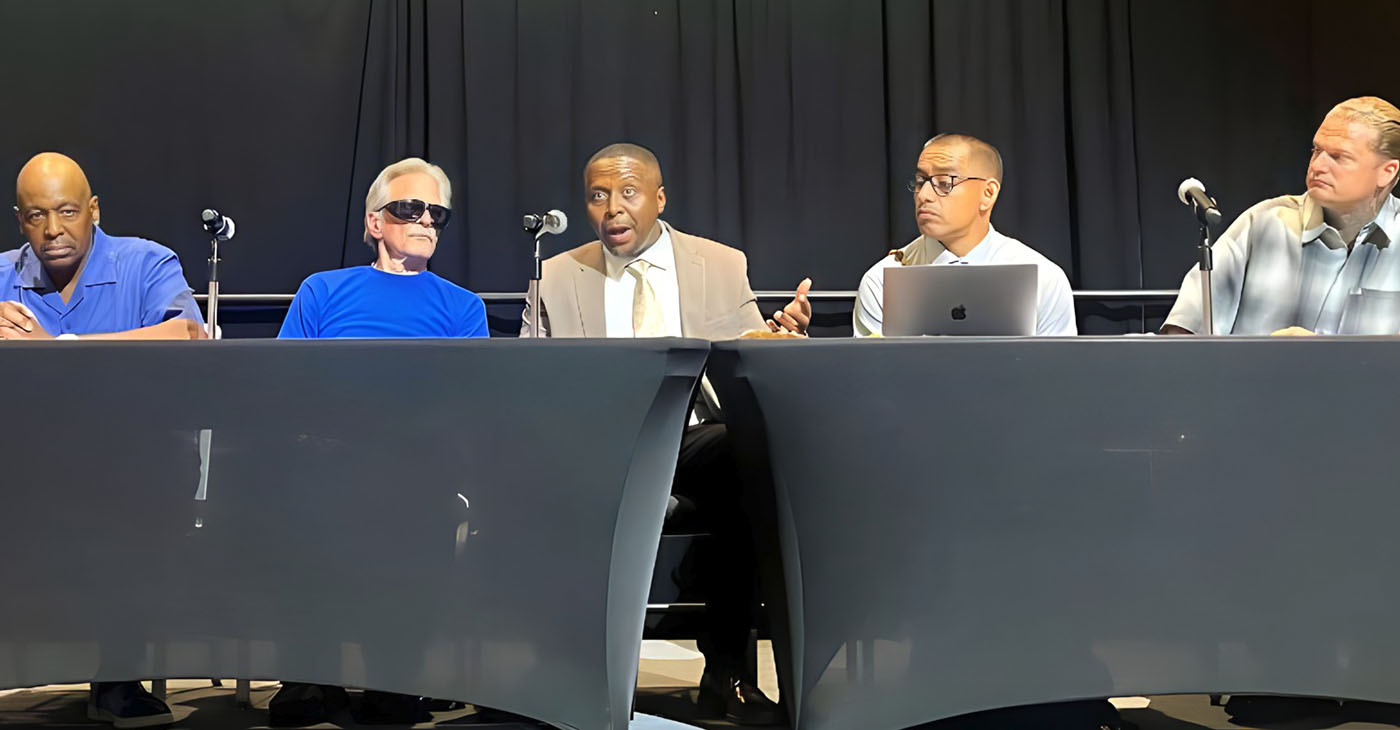
How the Mexican Mafia, Nuestra Familia, Black Guerrilla Family (BGF), and Aryan Brotherhood’s agreement to end hostilities against each other in prison could also be applied on the streets with gangs.

By Richard Johnson
On July 7 and 8, the California Families Against Solitary Confinement (CFASC) held a symposium at California State University at Fullerton to celebrate the 10th anniversary of the historic agreement to end hostilities among inmates and to mark the three hunger strikes that occurred at the Pelican Bay State Prison from 2011-2012.
This symposium provided the opportunity for the families, victims, supporters, and for all those who made the hunger strike and agreement to cease hostilities a success. Former inmates recounted experiences of solitary confinement. The lawyers, therapists, psychologists, and support personnel spoke about how the strike and the agreement to end hostilities helped to make a positive paradigm change for the inmates and their families.
As a panelist, I spoke of how I was victimized by being held in solitary confinement for nearly 20 years because I was labeled a “gang member,” and referred to as “the worst of the worst.”
But I emphatically pointed out that many of those who had suffered and endured, as I did, are now out in society, making a change for the betterment of society and their families. They are proving that, when given a chance, they can make positive contributions.
I was even impressed by the magnitude of success that so many of my formerly incarcerated colleagues have achieved. There are so many with advanced college degrees and PhDs while others are attending universities such as Columbia, UC Berkeley, UC Fullerton, University of Southern California, and many others. If given the chance, both women and men can ascend out of hopelessness and despair to become better versions of themselves.
Jules Lobel, a professor of law at the University of Pittsburgh, was the main speaker at the symposium. He was given the honor to give the keynote address because he was the lead attorney for the hunger strikers as well as the main litigator before the federal courts. Lobel has written several books and numerous legal articles for Harvard, Cornell, Oxford and many other institutions of higher learning. (https://ccrjustice.org/node/4464)
I am grateful to all participants and especially to Dolores Canalis who organized this event with her husband Jack Morris. I want to thank unsung heroes and sheroes that we owe a debt of gratitude for their support, volunteerism and prayers.
They include; Danny Murillo, Azadeh Zohrabi of the Berkeley underground scholars; Angelica Camacho, Ph.D.; professor at San Francisco State University and a member of the California Families Against Solitary Confinement and coordinator for the Mandela Campaign; Jamala Taylor of the Inside Garden Program; Penny Schoner of Prison Activist Resource Center; panelist Marie Levin representing her brother Ronnie Dewberry (Sitawa Nantambu Jamaa) who was one of the four main people who negotiated the hunger strike as well as the litigations; my former attorney Dan Siegel and his wife Ann Weills; Post News Group and Jonathan ‘Fitness’ Jones an ambassador from the African American Sports and Entertainment Group (AASEG).
What must be mentioned is that at the onset of the hunger strike in 2011 the various formations weren’t exactly getting along, thus the first hurdle to overcome in petitioning the court for isolation relief was to open a dialogue between the formations, such as Mexican Mafia, Nuestra Familia, Black Guerrilla Family (BGF), and Aryan Brotherhood.
This took time and energy because of all the previously held positions of discord between them. As I sat there on that stage among old rivals, it gave me great pleasure to see the fruits of our labor manifested at that symposium. Who in the past could conceive such a step forward out of the rigors of prison politics?
I must mention one guy who was my next-door neighbor and a member of the Aryan Brotherhood at one time in Pelican Bay Security Housing Unit (SHU); his name was Eddie Burnett. We sat on that stage, side-by-side, participating in panel discussions, this in itself demonstrates the beauty of respect, cooperation, remarkable reconciliation, and of course persistence and understanding. Nothing is perfect yet everything is “solutionable.” The symposium clearly highlighted that fact. Where do we go from here now that a leap forward has been taken? Life can be made simple, either you win, or you don’t lose.
This symposium opens the door for us to bring an end to hostilities on the streets. If it can work in prison, it can work on the streets too.
We as a society have an obligation to at least try to make this world a better place. I feel the responsibility rests on our shoulders to do all that is necessary to make a change for the better.
Our non-profit organization, Formerly Incarcerated Giving Back (FIGB) is currently engaged in Transitional Reentry Housing Services with the Diplomat’s Center Inc. and providing mentorship, gang intervention, community safety, trauma-informed care, voter registration, and providing housing for the unhoused in collaboration with Dr. Maritony’s Life Impact for Humanity (LIFH).
FIGB, in partnership with Partners in Careers (PIC), will be advocating for and developing living-wage jobs and recreational spaces for development and technology training.
Special thanks to POST Newsgroup Publisher Paul Cobb and owner Gay Plair Cobb for being one of the first to give a substantial donation to the Formerly Incarcerated Giving Back (FIGB). And if you have been touched and/or moved to also contribute your time, resources, and/or donations to our great community efforts feel free to contact us at 1-888-711-8351 ext.1 or email us at formerlyinc.gb@gmail.com





Activism
Oakland Post: Week of September 30 – October 6, 2026
The printed Weekly Edition of the Oakland Post: Week of September 30 – October 6, 2026
To enlarge your view of this issue, use the slider, magnifying glass icon or full page icon in the lower right corner of the browser window.
Activism
Oakland Post: Week of September 23 – 29, 2026
The printed Weekly Edition of the Oakland Post: Week of September 23 – 29, 2026

To enlarge your view of this issue, use the slider, magnifying glass icon or full page icon in the lower right corner of the browser window.
Activism
Oakland Post: Week of September 16 – 22, 2026
The printed Weekly Edition of the Oakland Post: Week of September 16 – 22, 2026

To enlarge your view of this issue, use the slider, magnifying glass icon or full page icon in the lower right corner of the browser window.


Listening as a Lifeline: A Doula’s Witness to Black Maternal Health

New Protections for Ticket Buyers: Gov. Newsom Signs Assemblymember Isaac Bryan’s Bill

‘We Don’t Talk Trash — We Pick Up Trash!’

Zakiya Jendayi Arrested, Locked Out of Home by Sheriff’s Deputies

Oakland Post: Week of September 30 – October 6, 2026

Asm. Corey Jackson Announces Launch of 24-Hour Childcare in His District

IN MEMORIAM: The Rev. Leon “Sonny” Clark, Longtime Orange County Pastor and Community Leader, Dies at 72

Poll: Becerra Widens His Lead Over Hilton; Californians Split on Wealth Tax

From Historic Memories to New Possibilities: Oakland Celebrates Coliseum 60

County Office of Education Says OUSD Finances Are Getting Healthier, Materially Stronger

LIVE FREE Sunday Dinner Brings Faith, Fellowship and Civic Conversation to Oakland

Remembering Chauncey Bailey as Student Journalists Face Threats to Truth-Telling

BLACspace Cooperative Invites Bay Area to Experience Oakland’s Black Cultural Ecosystem Through a BLAC Map Tour + Party

In Wake of Death on Doorstep, Williams Chapel Baptist Church Calls for Better Care, Funding for Unhoused

Oakland Centenarian Nuna McKee Honored!

Standoff for Justice: Our Homes Are Worth Fighting For

Oakland Post: Week of August 26 – September 1, 2026

Frontier Airlines’ Return to Oakland Airport Brings Flights, Jobs and Opportunity

Gubernatorial Candidate Steve Hilton Blasts California New Tire Rules; Newsom Hits Back

Chef Sharon Lee Blends Culinary Excellence, Education and Empowerment

Jackie Wright Champions Bay Area Stories, Filmmakers and Cultural Institutions

Misnamed ‘Parent’ PAC Seeks to Influence Oakland School Board Elections

Oakland Coliseum Project Opens Door for Small Businesses to Build Bigger

Big City Mayors Ask for “Yes” Vote on Housing Bond Measure; Conservatives Say “No”

Gov. Newsom’s Latest Appointees Include Sacramento Advocate for Formerly Incarcerated Students; State’s New Tech Chief

Longtime BWOPA Member Brendalyn Goodall Appointed to California Workforce Development Board

Gov. Newsom Signs Law Shielding Immigration Aid Workers From Doxing Threats

Secretary of State Shirley N. Weber Urges Californians to Vote Early as Voter ID Battle Intensifies

Oakland Post: Week of September 2 – 8, 2026

IN MEMORIAM: Dolly Parton Dead at 80 — How She Built a Legacy of Love and Earned Her Place in Black Culture

The Conversation With Al McFarlane 6/23/26

Media Monday 6/22/26

LIVE! ASK ALMA! — TUES. 6.23.26 7PM EST

Car Buying Secrets: 4 Hidden Checks Before You Sign!

Is This 550 HP Charger Worth YOUR Money? AutoNetwork Review

Celebrating Juneteenth – Frederick Douglass on education and resistance

LIVE! — ASK ALMA! — TUES. 6.19.26 7PM EST

Hyundai Ioniq 5 Parking, Safety, and 360 View #shorts

2025 Ioniq 5 New Wiper & Powerful Performance! #shorts

Electric SUV Range: Is 259 Miles Enough? #shorts

EV Charging: How Fast Can You Charge an Electric Vehicle? #shorts

Biometric Cooling… Messaging Seats…Come on! 2025 Infiniti QX80 Autograph 4WD

Charged Up: Witness the Magic of a Fully Electric Car! #shorts

Range Rover Sport PHEV Included…: See What’s Inside This Luxury SUV! #shorts

Invisible Hood View: Perfect Parking with X-Ray Vision! #shorts
-
 Community3 weeks ago
Misnamed ‘Parent’ PAC Seeks to Influence Oakland School Board Elections
-
 Activism4 weeks ago
Oakland Post: Week of September 2 – 8, 2026
-

 Activism3 weeks ago
Oakland Post: Week of September 9 – 15, 2026
-

 Community3 weeks ago
Richmond Tiny House Village Farm & Garden Set to Open Gates on Sept. 26
-

 Black History3 weeks ago
Latest Massacre in Haiti Reveals Cruelty U.S. Deportations
-

 Black History3 weeks ago
OPINION: Nolan Wells’ Death One of Several Signifying Racial Terror Lives on in U.S. South
-

 Business2 weeks ago
Mayor Lee Announces $1 Million Kaiser Permanente Grant for Pilot Program to Address Homelessness, Clean Up Public Spaces throughout Oakland
-

 Community3 weeks ago
Democratic Clubs Interview Candidates for Oakland School Board
