
Bay Area
Former Holy Names University Education Students Struggle to Complete Credentials, Call on HNU Trustees to Honor Commitment to Pay Teacher Training Scholarships
A group of former Holy Names University (HNU) education students are seeking support from local leaders and members of the public to push the HNU Board of Trustees to honor its commitment to use a still existing $55 million endowment to pay tuition for its education students who are now at other teacher training institutions after the university closed and abandoned them.


By Ken Epstein
A group of former Holy Names University (HNU) education students are seeking support from local leaders and members of the public to push the HNU Board of Trustees to honor its commitment to use a still existing $55 million endowment to pay tuition for its education students who are now at other teacher training institutions after the university closed and abandoned them.
HNU trustees still administer the affairs of the university, though they closed the school in Spring 2023 and sold the campus to private real estate developers. Many of HNU’s former education students currently teach in public, charter, and private school classrooms around the Bay Area while struggling to pay the high expenses of finishing their teaching credentials, often at the cost of over $1,300 a unit.
About 90 former HNU education students signed a letter to Attorney General Rob Bonta, asking the institution’s trustees to use the $55 million endowment for its intended purpose, which was left to the university as part of an estate to support training for new East Bay teachers.
The HNU Board responded in an email to the issues raised in this article, saying that they were operating within the court-ordered requirements, which leave them with no discretion.

Though $50 million of the endowment is still tied up in probate court, approximately $5 million has been disbursed to provide scholarships to help students who need financial support. Some students have received a little money, but while the HNU trustees had pledged in probate court to reach out to all former students about the availability of scholarships, that has not happened, and the scholarship amounts have been arbitrary and partial, according to students.
“We’ve been reaching out to let people know how to apply,” said members of the student group. “The Attorney General informed us that they (the HNU trustees) said they were going to contact everyone, but that never happened. No one from the School of Education, who this money was intended for, has heard from them.”
When students originally enrolled in HNU, the university had promised that the Logan endowment would pay 50% of their tuition. Yet the HNU Board, led by chair Steven Borg, now is distributing varying amounts, generally not over $3,000, which does not pay for a single three-unit class.
Some students are taking three units per semester, while others are taking 12 units and received the same amount of money. Those who have received scholarships, report that the money was not issued in a timely way. Many students are graduating this semester after having paid out of pocket, and no retroactive funds are being distributed.
Scholarships must be issued promptly because students cannot graduate if they have an outstanding overdue balance, and much of the money students received was “not based on anything solid, not based on units they were taking,” said another student.
In interviews with the Oakland Post, some former HNU students, all of whom take classes at the University of San Francisco while teaching in K-12 classrooms, discussed some obstacles they have faced since HNU closed.
Adrianna Castaing, who teaches first grade at a private school in the East Bay, said she attended HNU since 2017, completing her undergraduate degree and then entered the teacher training graduate program.
Though she received no money for fall semester, she said she did receive a small amount after “little to no communication from HNU,” but the amount was not in any way equal to the amount she had to pay for her coursework, which she expects to complete this semester,
Donna McClinto, who teaches elementary school in Oakland, said she was denied any money because HNU said she still owed HNU, though she had never heard that before, and because she was not enrolled in classes at HNU toward the end, when the school stopped offering classes that she needed. One of her classmates in the same situation did receive funding. There is no clear formula for distribution and students feel that the amounts are arbitrary.
Alice Thiuri, who teaches high school at a private school in Oakland, said she received $3,000 which did not cover her tuition. “I requested a little more, but they said no, though I gave them receipts for five classes I took.” They said the scholarship amount was not based on her expenses, but when she expected to graduate. She said she was told that the amount she received was determined by the Attorney General.
Kassandra Solano, an elementary teacher in Oakland who started at HNU in 2018, had completed all the classes for her masters’ degree except for one or two. “I reached out for counseling, advising, but heard nothing. They kept changing advisors. I never found out what other class I needed to take,” she said.
“I reached out for a scholarship but was told I didn’t qualify because I wasn’t registered for classes,” she said. “HNU changed advisors three times, and there was never an answer from any of those advisors,” she continued. “I was very upset.”
HNU failed to create a Memorandum of Understanding (MOU) with any school of education, so that students could transfer, though the trustees had promised to do so.
“Every student was left to fend for themselves,” said Dr. Nirali Jani, a former education professor at HNU who is currently teaching at the University of San Francisco.
Many of the students emphasized that the closing of HNU and failure to maintain the scholarships only exacerbates the teacher shortage that is hitting Oakland and other districts across the state and country.
In response to this article, Bernard D. Bollinger of HBU wrote:
“The terms for the distribution of Logan Fund Scholarships for transfer students are delineated in … (an) order of the Superior Court (a public record). Paragraph 1 … permits scholarships to be provided to ‘students who were enrolled at Holy Names University during the 2022-2023,’ (if) they continue to meet academic performance requirements of the Logan Fund gift instrument.
“It does not require that the scholarship recipients attend a school of education. Distributions from the Logan Scholarship are specifically limited to the provisions delineated in court orders and the terms of the gift agreement, so neither HNU (nor any other party) has discretion on how to award those funds.
“As a result, HNU did not focus on getting MOUs with ‘schools of education’ but with schools that HNU believed to be attracting large numbers of transferred students from HNU in order to assist as many students as possible.
“The list of 11 schools that HNU has entered into an MOU with (including USF) can be found on HNU’s website (at) https://hnu.edu/resources/formerhnustudents/#tinstitutions
“That section of the HNU website has a list of several resources for former students including under Financial FAQs. At the question ‘Is my HNU scholarship still available?’ students can provide information and get in contact with HNU representatives via that link that is provided there in addition to readily available information on the HNU website.
“Student outreach was significant, with multiple emails and paper letters to former students.”
The student group will hold an information session for former HNU education students on how to apply for scholarships and to complete their teacher training programs Saturday, April 27, 3 -5:30 p.m. at Wild Child Schoolhouse, 160 41st St. in Oakland.
A happy hour will follow at Cato’s Ale House, 3891 Piedmont Ave. in Oakland.
For more information, email reclaimlogan@gmail.com.







Activism
Oakland Post: Week of August 12 – 18, 2026
The printed Weekly Edition of the Oakland Post: Week of August 12 – 18, 2026

To enlarge your view of this issue, use the slider, magnifying glass icon or full page icon in the lower right corner of the browser window.
Activism
Oakland Post: Week of August 5 – 11, 2026
The printed Weekly Edition of the Oakland Post: Week of August 5 – 11, 2026
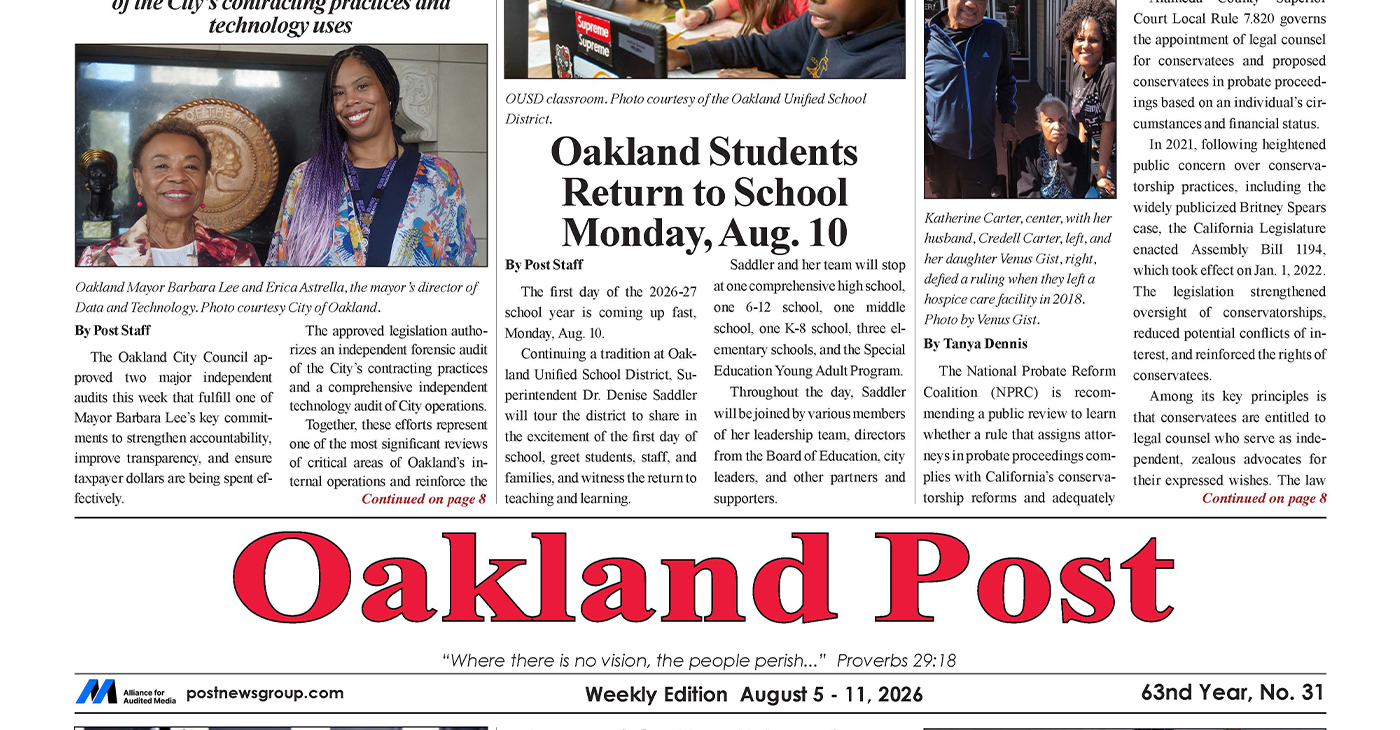
To enlarge your view of this issue, use the slider, magnifying glass icon or full page icon in the lower right corner of the browser window.
Activism
Oakland Post: Week of July 29 – August 4, 2026
The printed Weekly Edition of the Oakland Post: Week of July 29 – August 4, 2026
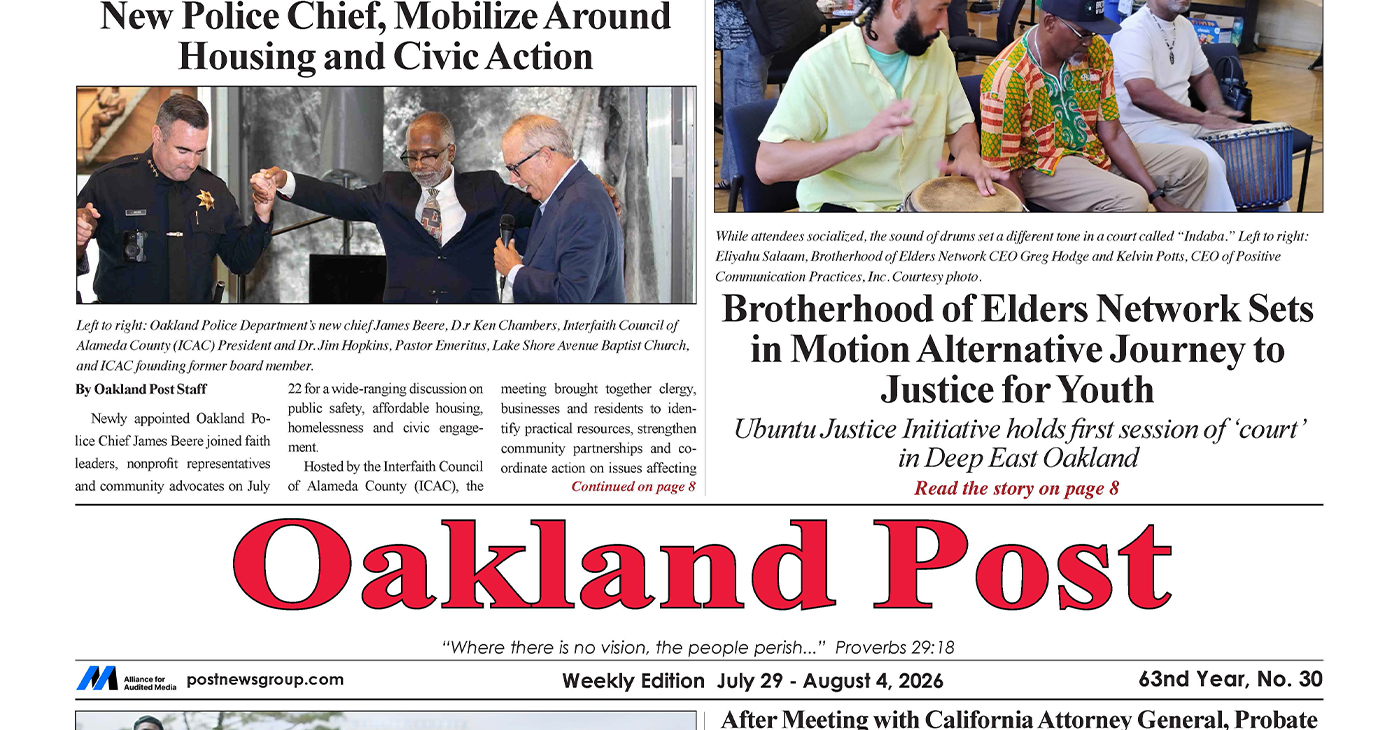
To enlarge your view of this issue, use the slider, magnifying glass icon or full page icon in the lower right corner of the browser window.

WORK FROM HOME
Home-based business with potential monthly income of $10K+ per month. A proven training system and website provided to maximize business effectiveness. Perfect job to earn side and primary income. Contact Lynne for more details: Lynne4npusa@gmail.com 800-334-0540


Four Candidates, Including Incumbent Barbara Lee, Qualify for Oakland Mayor’s Race

Oakland Observes Black August with Block Parties, Film Showings, Workshops

Oakland Post: Week of August 12 – 18, 2026

COMMENTARY: Why Local School Tax Measure G1 Will Not Be on the November Ballot

California Hispanic Chambers of Commerce Unveils: ‘Powering the Future’ Theme for 47th Annual Statewide Convention

Returning to Its Roots, the Oakland Black-Eyed Pea Festival Partners with the Freedom Farmers Market Sept. 12

Less Affluent School Districts, Including Sacramento City, Face Threat of State Takeover

From Blueprint to Breakthrough: Tackling Affordable Housing in Oakland

NPRC Scores First Advocacy Victory: David Shaw Finally Gets His Wish to ‘Go Home’

ESSAY: California Can Close Its Colorectal Cancer Gap

Car Wash Workers Cope with Lingering Impacts of ICE Raids

Misty Copeland Shapes Ballet’s Tomorrow

As Part of Your Back-to- School Checklist, Vaccinate

As Part of Your Back-to- School Checklist, Vaccinate

Congresswoman Simon Demands Investigation into Trump’s Abuse of Emergency Powers for Coal Export Terminal in West Oakland

Department of Homeland Security Demands California Secretary of State Shirley N. Weber Scrub Voter Rolls

Oakland Children’s Hospital Workers and Patients Rally for Pediatric Medical Care

New Judge Could Decide if Karmelo Anthony Gets a New Trial

“The Power to See Threats Sooner”: Gov. Newsom, Safety Officials Showcase California’s Investments in Hi-Tech Wildfire Prevention

Alpha Kappa Alpha Sorority, Inc. Celebrates New North Atlantic Regional Director

Surveillance Pricing Fight: State Senate Debates Bill Banning Retailers from Using AI to Set Prices Based on a Buyer’s Profile

Mount Zion MBC, Church of Jesus Christ of Latter-day Saints Partner to Bring 29,000 Meals to Alameda County

California Sen. Padilla Joins Colleagues to Introduce Bill Imposing Term Limits on Supreme Court Justices

Starting This Summer, California Car Buyers Can Get an Instant $3500 Off the Cost of Electric Vehicles

COMMENTARY: You Are Already Paying for the AI Boom
Less Affluent School Districts, Including Sacramento City, Face Threat of State Takeover

California Bill Would Let Abuse Victims Use Trauma as Legal Defense for Violent Crime
Car Wash Workers Cope with Lingering Impacts of ICE Raids

Fed Court to Decide Landmark First Amendment Case

Gov. Gavin Newsom Signs Law Streamlining Affordable Housing Rules

The Conversation With Al McFarlane 6/23/26

Media Monday 6/22/26

LIVE! ASK ALMA! — TUES. 6.23.26 7PM EST

Car Buying Secrets: 4 Hidden Checks Before You Sign!

Is This 550 HP Charger Worth YOUR Money? AutoNetwork Review

Celebrating Juneteenth – Frederick Douglass on education and resistance

LIVE! — ASK ALMA! — TUES. 6.19.26 7PM EST

Hyundai Ioniq 5 Parking, Safety, and 360 View #shorts

2025 Ioniq 5 New Wiper & Powerful Performance! #shorts

Electric SUV Range: Is 259 Miles Enough? #shorts

EV Charging: How Fast Can You Charge an Electric Vehicle? #shorts

Biometric Cooling… Messaging Seats…Come on! 2025 Infiniti QX80 Autograph 4WD

Charged Up: Witness the Magic of a Fully Electric Car! #shorts

Range Rover Sport PHEV Included…: See What’s Inside This Luxury SUV! #shorts

Invisible Hood View: Perfect Parking with X-Ray Vision! #shorts
-
 Featured1 week ago
Department of Homeland Security Demands California Secretary of State Shirley N. Weber Scrub Voter Rolls
-
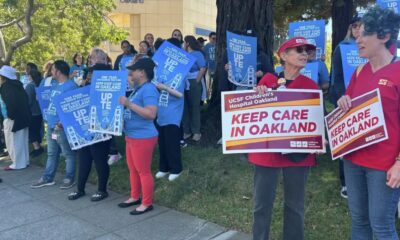 Business3 weeks ago
Oakland Children’s Hospital Workers and Patients Rally for Pediatric Medical Care
-
 #NNPA BlackPress2 weeks ago
New Judge Could Decide if Karmelo Anthony Gets a New Trial
-
 Environment1 week ago
“The Power to See Threats Sooner”: Gov. Newsom, Safety Officials Showcase California’s Investments in Hi-Tech Wildfire Prevention
-
 Black History2 weeks ago
Alpha Kappa Alpha Sorority, Inc. Celebrates New North Atlantic Regional Director
-
 Business3 weeks ago
Surveillance Pricing Fight: State Senate Debates Bill Banning Retailers from Using AI to Set Prices Based on a Buyer’s Profile
-
 Business3 weeks ago
Mount Zion MBC, Church of Jesus Christ of Latter-day Saints Partner to Bring 29,000 Meals to Alameda County
-
 Featured1 week ago
California Sen. Padilla Joins Colleagues to Introduce Bill Imposing Term Limits on Supreme Court Justices
