
Activism
For New UC Berkeley Chief Yogananda Pittman, Building Trust Is Key to Modern Police Work
Now, after helping to guide the force through a time of crisis and rapid change, Pittman will become chief of the UC Berkeley Police Department. Starting Feb. 1, she will lead an ambitious initiative, begun under retiring Chief Margo Bennett, to broadly modernize campus police operations and strengthen sometimes strained community relations.


In the hours after the Jan. 6 mob attack on the Capitol, veteran police leader Yogananda Pittman faced a profoundly difficult choice: She was offered the position of interim chief of the U.S. Capitol Police, a post for which she’d been preparing for nearly two decades, but it would mean taking charge of a department that was reeling and certain to face intense scrutiny and pressure to reform.
Some, sensing a no-win assignment, would have declined it. Pittman, however, said yes, not so much out of ambition as out of a belief that leaders must lead — and seize the opportunity for reform — even in chaotic conditions. Two days after the insurrection, she became the first Black woman to lead the Capitol Police.
Now, after helping to guide the force through a time of crisis and rapid change, Pittman will become chief of the UC Berkeley Police Department. Starting Feb. 1, she will lead an ambitious initiative, begun under retiring Chief Margo Bennett, to broadly modernize campus police operations and strengthen sometimes strained community relations.
“Nothing is more important than the safety and well-being of our community, and I am confident that Yogananda Pittman has all of the skills, qualities, and experience necessary to excel as our next police chief at UC Berkeley,” said Chancellor Carol Christ. “Chief Pittman’s remarkable record of achievement and her steadfast commitment to reform and social justice make her perfectly suited for this essential leadership role on the Berkeley campus.”
Pittman will direct a police force of about 140 officers, community safety officers and staff, with an annual budget of $15 million. In recent years, the campus police department has struggled with reduced budgets, depleted ranks, and rising crime.
Like other urban police agencies nationwide, Berkeley’s at times seems caught between competing pressures from advocates — including students and parents — who want a stronger police presence on campus, and those who would abolish the department and use the funds for social welfare programs.
For Pittman, that’s a new landscape. But in an interview, she said that her experience in policing, leadership, and diplomacy have prepared her to build essential bridges. Respect for diversity and inclusion will be crucial, she said. So will be listening.
“In the first 100 days after I arrive,” Pittman said, “I want to have a campaign of meetings with all of the entities that have a vested interest in safety and security on campus. Once I understand what everyone’s concerns are, then we’ll be able to come up with ways to address those concerns.
“To achieve change, it helps to have leaders who have deep professional experience, but who also know the perspective of people who have been on the receiving end of unfortunate encounters with law enforcement.”
A commitment to social justice leads to a career in police work
Pittman’s path to law enforcement and her rise to its highest ranks have been shaped by unexpected choices and extraordinary challenges.
She grew up in Cambridge, Maryland, a Chesapeake Bay community not far from Washington, D.C. In the 18th century, the town was a center of the slave trade; two centuries later, in the 1960s, it was a national flashpoint for the modern civil rights movement.
Her adoptive parents died when they were young, and she was raised by her aunt, the Rev. Enez Stafford-Grubb, a minister at Bethel African Methodist Episcopal Church in Cambridge and a prominent civil rights organizer.
Education, service, justice — these were core values in Pittman’s family. She earned a bachelor’s degree in psychology in 1999 from Morgan State University, a historically Black research university in Baltimore.
But then came the decision that, from the outside, might seem surprising: To be an agent for social change, Pittman reasoned, she could be more effective working within an institution, rather than challenging it from the outside.
As a police officer for 20 years, she maintained that approach through a series of historic crises that have reordered the American political and social landscape.
She was sworn in to active duty on the Capitol Police force just a few hours after the Sept. 11, 2001, terror attacks on New York City and Wash., D.C. In the ensuing years came the presidential inaugurations of Barack Obama and then Donald Trump, a seeming epidemic of police violence against Black people, and the insurrection against U.S. democracy on Jan. 6, 2021.
A quiet, persistent struggle against the forces of racism and sexism
As Pittman rose through the ranks, taking promotions with more responsibility and more influence, it seemed that race and gender were constant themes — not just in the national landscape, but in her own career, and in her family.
“When I came onto the Capitol Police force,” she recalled, “there were zero persons of color in leadership and definitely not any women — zero, none.”
“It was not easy. As I continued to get promoted, I was oftentimes the only woman and always the only person of color in the room. And more often than not, people let me know that I wasn’t welcome, that I wasn’t part of the team. They questioned my capabilities.”
“But coming from my hometown, from my parents, and from Morgan State University, your mind is trained to believe just the opposite: ‘I am just as good, if not better, than anybody in this room.’”
At the same time, she experienced the crisis in American policing through her two sons, young Black men who today are ages 22 and 17.
“Even in 2022,” she said, “I’ve had to have the talk with them about what not to do when you engage with police. I’m a police chief, and I have all this knowledge about law enforcement tactics, and I’m still fearful of what happens if they get pulled over. I can only imagine what the average mother feels when her son goes out the door.”
And so, even as she pursued her day-to-day work, she had a parallel goal: to help lead the way toward a more diverse, more inclusive Capitol Police culture.
“This was not just some statement, or to check a box,” Pittman explained. “We really worked to make the culture different, because the men and women of the organization deserve it.”
The terror of Jan. 6: Capitol Police ‘saved democracy that day’
So many of these deep social conflicts were present — but dangerously unresolved — in the days leading up to Jan. 6, 2021. That was the date that Congress had set for certifying Joe Biden’s election as president, and it was to be a crucial test for American democracy.
Pittman said the Capitol Police had substantial evidence that extremists could pose a violent threat to the certification, and to the safety of lawmakers. Then-Chief Steven Sund repeatedly asked the sergeants-at-arms for the House and the Senate to use their power to declare an emergency and to put the National Guard on standby, but they refused.
And then, on Jan. 6, an estimated 30,000 protesters marched to the Capitol, where the Capitol Police had 1,200 officers on duty. Some 2,500 rioters breached the building. Vastly outnumbered, the officers, along with reinforcements from other departments, engaged in hand-to-hand combat with extremists for over five hours.
In retrospect, Pittman sees their efforts as heroic.
“I could not be more proud of the men and women of U.S. Capitol Police,” she said. “The votes to certify the election were counted. We achieved the transfer of power. It was not pretty, but because our officers stood, our democracy didn’t fall.”
“They saved democracy that day.”
After the insurrection, a reckoning
In the immediate aftermath, there was a brutal accounting: Within hours after the battle, two officers were dead. Over 100 others were injured. The Capitol building sustained damage approaching $3 million.
Sund resigned the next day. The sergeants-at-arms of the House and Senate soon followed.
On Jan. 8, Pittman became the first Black person and the first woman to lead the Capitol Police — and while that might have been a cause for celebration, she quickly became the focus of blame and recrimination.
At first, that seemed a distraction. There was work to be done: consoling the families of deceased colleagues, connecting with the injured cops, and restoring order and morale in the department. Biden’s inauguration was just days away, and the police had to be ready.
But as time passed, she came to understand what was driving the criticism. Not that she agreed — she saw the insurrection and the Capitol Police response as the confluence of many forces, across many institutions, converging over time toward a systemic breakdown. No single person or department was to blame.
But as the department’s former head of intelligence, and now its chief, she had to take responsibility.
“As a leader,” she said, “the more you can embrace your mistakes, own them, take full accountability for them, that’s the only way you’re going to get past them. You open yourself up to learn better ways. And that’s what we did.”
In the ensuing months, the deeper toll of Jan. 6 became clear. Four officers who defended the Capitol on Jan. 6 took their own lives. Others suffered post-riot psychological trauma.
During her time as acting chief, Pittman guided an intensive reform campaign. New tactics, training and equipment were put in place to make sure that department personnel were prepared for future crises, while new programs and services aimed to support a traumatized workforce.
In July 2021, a new permanent chief was named, and Pittman returned to the rank of assistant chief. Last week, after 21 years on the job, she announced her retirement from the Capitol Police, effective early in 2023.
“D.C. has changed,” she said. “Our democracy is being challenged in ways that we never expected or never imagined…I don’t ever run from a challenge, but I know I’ve left the department I served in a much better space than we were prior to Jan. 6.”
At Berkeley, ‘we can … really show the world what’s possible’
Last summer in downtown Cambridge, an artist completed a brightly colored outdoor mural featuring 12 pioneering women from surrounding Dorchester County. Among them are Harriet Tubman, the iconic antislavery activist; Donna Wolf Mother Abbott, the first woman chief of the Nause Waiwash tribe; and Bea Arthur, an actor on stage and screen. And in the lower left corner? Yogananda Pittman, smiling in her blue watch cap and uniform.
Her place in the mural reflects the place of honor she holds in her hometown and in much of the Wash., D.C., area. She hadn’t foreseen the day that she would leave, but when Berkeley reached out to discuss the coming vacancy on its police force, she was intrigued.
Through her sons, Pittman has an affinity for young adults. She’s drawn to academic culture. She has a master’s degree in public administration, and she’s working on the final chapters of her Ph.D. thesis in that field, focused on gender diversity in law enforcement. She’s inspired to see that at UC Berkeley, racism is seen as a public health issue.
Of course, in ways both superficial and profound, the U.S. Capitol in Washington is a long way from the Berkeley campus. One features the nation’s highest-ranking elected officials and visiting dignitaries; the other, extraordinary scholars and young people who are just beginning to find their way in life.
But Pittman and university officials are focused on the points these geographies hold in common. Both are sprawling campuses with diverse communities numbering in the tens of thousands. While the Berkeley police department is far smaller than the Capitol’s, both must manage a range of threats to safety and security.
“The environment for policing on large, urban campuses is challenging,” said Marc Fisher, Berkeley’s vice chancellor for administration. “This is a nationwide phenomenon, and Berkeley is not immune. But in Chief Pittman, we have a leader of incredible personal and professional experience. She has confronted extraordinary challenges and achieved results, both in policing and community-building.
“We are very fortunate to have her join the UC Berkeley Police Department.”
Pittman will arrive as a leader in managing a multi-year campus security reform program, initiated in 2020, to improve emergency management, mental health crisis response and security technology, and to strengthen relations with diverse communities.
She has experience in all of those areas. She’s already met with campus officers during a recent visit to their headquarters in the basement of Sproul Hall. She said she “connected with them immediately.”
Beyond that, though, she’s not offering specific plans or bold pronouncements. Instead, she said, her early days in office will be for listening, learning, understanding — and building trust and legitimacy. It’s a topic that she’s spoken about recently to groups in Canada and Germany.
To those debating the need for protection from crime versus a greater commitment to social services, Pittman answers that both are needed. The goal is building consensus for a balanced approach.
“There does not have to be an either-or in terms of policing and much-needed mental health services, services for the unhoused or drug and rehabilitation services,” she said.
“I’m confident that when we work together, we will find that balance to accommodate the needs of everyone.”
“I hope we can take the lessons we’ve learned and really show the world what’s possible.”













Activism
Oakland Post: Week of September 9 – 15, 2026
The printed Weekly Edition of the Oakland Post: Week of September 9 – 15, 2026

To enlarge your view of this issue, use the slider, magnifying glass icon or full page icon in the lower right corner of the browser window.
Activism
Oakland Post: Week of September 2 – 8, 2026
The printed Weekly Edition of the Oakland Post: Week of September 2 – 8, 2026

To enlarge your view of this issue, use the slider, magnifying glass icon or full page icon in the lower right corner of the browser window.
Activism
Youth-Led Black August Event Brings Past to Present at East Oakland Boxing Association
The mission of Youth Alive! Is to “break the cycle of violence, heal trauma, and uplift a thriving community of leaders, to save lives in Oakland and beyond” by serving “as mentors, youth leaders, counselors, case managers, intervention specialists and violence interrupters,” working “to help violently wounded people heal themselves and their community.”

Youth-Led Black August Event Brings Past to Present at East Oakland Boxing Association
The East Oakland Boxing Association (EOBA) and Youth Alive! came together on Aug. 21 to share with their community all that Black August means to them.
Held on EOBA’s patio at 816 98th Ave. in Deep East Oakland, the two organizations hosted their second annual Black August Experience, featuring a food tasting, financial literacy and mindfulness workshops, and voter registration with the League of Women Voters Oakland (LWV).
Black August is known as a time to uphold the legacy of prisoners who protested their conditions by fasting, fighting, and educating themselves on the economic and political circumstances that contributed to their incarceration.
According to its website, “EOBA is a multi-service youth and community development hub that goes far beyond the ring. While rooted in the discipline of boxing, for nearly 40 years EOBA has also integrated robust programs in workforce development, food justice, afterschool enrichment, financial literacy, mentorship, and wellness.”.
The mission of Youth Alive! Is to “break the cycle of violence, heal trauma, and uplift a thriving community of leaders, to save lives in Oakland and beyond” by serving “as mentors, youth leaders, counselors, case managers, intervention specialists and violence interrupters,” working “to help violently wounded people heal themselves and their community.”
Through Coro California, another leadership organization serving young people across the state for 80 years, they gained a broader understanding of Black August.
EOBA Executive Director Dawna Williams spoke about how much she learned about Black August from the youth who created it. “I let them educate me,” she said. Instead of talking about prison reform and mass incarceration, Williams and youth interns found that Black August meant so much more. “We would have done a disservice if we had just focused on who the people were and what their situation was…We tried to take their message from back in the day and make it relevant to the young people today. What do they need to know?”
Youth interns created and placed posters around the patio to help participants understand how traditional Black foodways, civic engagement, financial literacy, and the power of education are relevant to Black resistance today.
An EOBA member described Black August with Youth ALIVE! as “a whole vibe. “This year we added the Fun Zone for the kids, because you really cannot go wrong with a Fun Zone. I also loved seeing everyone chillin’ in the outdoor lounge, catching some Vitamin D and just enjoying a Friday evening together.”
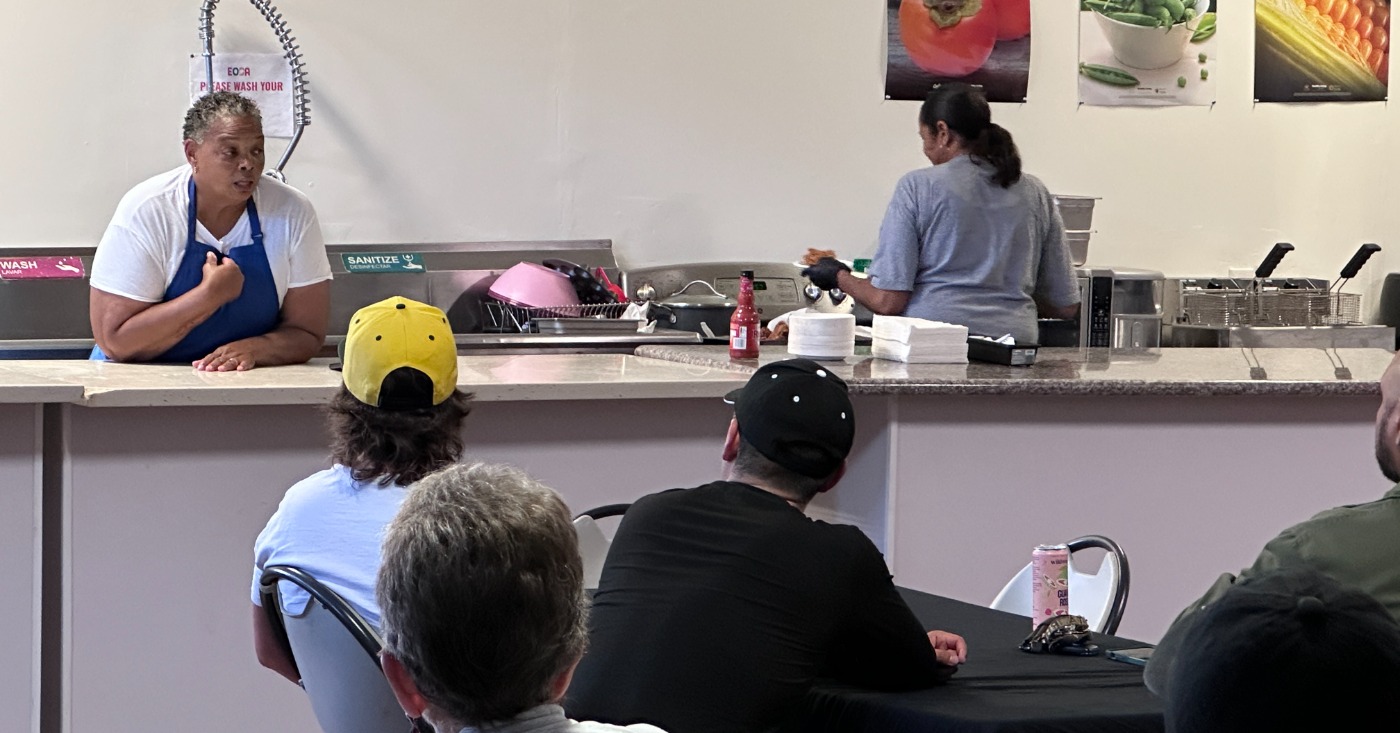
The food tasting, a popular event from last year, featured traditional Black foods such as black-eyed peas, johnny cakes, and fried chicken. Led by Williams, the tasting included a talk about how these traditional foods were made and why they are forms of Black resilience.
The “‘Plate of History’ was a favorite of the online writers. “Fun, educational, and did I mention delicious? Our Taste of History cook, Angela Southall, served up some good eats while connecting food to history and culture.”
The writer also commended the “League of Women Voters Oakland for their civic leadership and for getting our young people informed, ready, and registered to vote.”
Overall, it was a “good Friday event in East Oakland,” the writer said.
Upcoming Black August events: Building Opportunities for Self-Sufficiency (BOSS), will host “Black August: The Arc of Liberation” at Oakland City Hall on Sat. Aug. 29, from 11 a.m. to 3 p.m.
The websites for East Oakland Boxing Association, Youth Alive! and CORO are sources for this report.
Jana Lang is an Oakland resident, teacher, gardener and poet participating in the Propel News Initiative.




Event Preview: ‘Fashion v. Fascism’ – A Runway Revolution Is Coming to the Bay Area

Port of Oakland, Army Corps Sign Historic Harbor Design Agreement

Democratic Clubs Interview Candidates for Oakland School Board

Nuna Phillips-McKee Celebrates 100 Years: ‘A Century of Faith, Family and God’s Amazing Grace!’

D.A. Ursula Jones Dickson: Terminix to Pay $3.15 Million Over Illegal Disposal of Pesticides, Customer Records

REPORT: Community Level Policy Is Impacting Homelessness and Drug Abuse in California

OPINION: AI Needs to Know Who Is the Boss
Goldi-Locs and Two (or Three) Bears in the Forest in California Hills

Election Watch 2026: 85% of Eligible Voters in California Are Registered

Don’t Let scammers Crash Your School Year

BOOK REVIEW — Curved Air: A Biography of Sickle Cell Anemia and the Quest to Cure the First Molecular Disease

California’s Legal Cannabis Market Hits $8 Billion as State Touts Progress on Fighting Drugs, Crime

Blacks and Latinos Clash Over LA’s Barrio Run; Mayor Karen Bass Calls for Dialogue Across Racial, Neighborhood Lines

Asm. Smallwood-Cuevas’s Bill Repealing ‘Racist’ CalWORKs ‘Man-in-the-House’ Rule Clears Legislature

Asm. Smallwood-Cuevas’s Bill Repealing ‘Racist’ CalWORKs ‘Man-in-the-House’ Rule Clears Legislature

Department of Homeland Security Demands California Secretary of State Shirley N. Weber Scrub Voter Rolls

“The Power to See Threats Sooner”: Gov. Newsom, Safety Officials Showcase California’s Investments in Hi-Tech Wildfire Prevention

California Sen. Padilla Joins Colleagues to Introduce Bill Imposing Term Limits on Supreme Court Justices

Less Affluent School Districts, Including Sacramento City, Face Threat of State Takeover

Car Wash Workers Cope with Lingering Impacts of ICE Raids

ESSAY: California Can Close Its Colorectal Cancer Gap

As Part of Your Back-to- School Checklist, Vaccinate

Oakland ‘Port Serves as a Powerful Engine for Good Jobs and Economic Development

Gov. Newsom Announces $109.6 Million in Funding for 278 Supportive Homes in Bakersfield, Contra Costa, Sacramento and Fresno

California Hispanic Chambers of Commerce Unveils: ‘Powering the Future’ Theme for 47th Annual Statewide Convention

Congresswoman Simon Demands Investigation into Trump’s Abuse of Emergency Powers for Coal Export Terminal in West Oakland

Four Candidates, Including Incumbent Barbara Lee, Qualify for Oakland Mayor’s Race

Oakland Post: Week of August 12 – 18, 2026

From Blueprint to Breakthrough: Tackling Affordable Housing in Oakland

Oakland Observes Black August with Block Parties, Film Showings, Workshops

The Conversation With Al McFarlane 6/23/26

Media Monday 6/22/26

LIVE! ASK ALMA! — TUES. 6.23.26 7PM EST

Car Buying Secrets: 4 Hidden Checks Before You Sign!

Is This 550 HP Charger Worth YOUR Money? AutoNetwork Review

Celebrating Juneteenth – Frederick Douglass on education and resistance

LIVE! — ASK ALMA! — TUES. 6.19.26 7PM EST

Hyundai Ioniq 5 Parking, Safety, and 360 View #shorts

2025 Ioniq 5 New Wiper & Powerful Performance! #shorts

Electric SUV Range: Is 259 Miles Enough? #shorts

EV Charging: How Fast Can You Charge an Electric Vehicle? #shorts

Biometric Cooling… Messaging Seats…Come on! 2025 Infiniti QX80 Autograph 4WD

Charged Up: Witness the Magic of a Fully Electric Car! #shorts

Range Rover Sport PHEV Included…: See What’s Inside This Luxury SUV! #shorts

Invisible Hood View: Perfect Parking with X-Ray Vision! #shorts
-

 Commentary3 weeks ago
Standoff for Justice: Our Homes Are Worth Fighting For
-

 Activism3 weeks ago
Oakland Post: Week of August 26 – September 1, 2026
-

 Business3 weeks ago
Gubernatorial Candidate Steve Hilton Blasts California New Tire Rules; Newsom Hits Back
-

 Business3 weeks ago
Frontier Airlines’ Return to Oakland Airport Brings Flights, Jobs and Opportunity
-

 Business3 weeks ago
Chef Sharon Lee Blends Culinary Excellence, Education and Empowerment
-

 Education3 weeks ago
Gov. Newsom’s Latest Appointees Include Sacramento Advocate for Formerly Incarcerated Students; State’s New Tech Chief
-

 Business3 weeks ago
Oakland Coliseum Project Opens Door for Small Businesses to Build Bigger
-

 Community3 weeks ago
Big City Mayors Ask for “Yes” Vote on Housing Bond Measure; Conservatives Say “No”
